Poland's TV landscape shifts as Polsat overtakes rivals and screens dominate
Nielsen's 2026 report shows Polsat capturing 18.12% share in Poland as Warner Bros. Discovery slips to second. Digital platforms increasingly favor television screens.


Nielsen's 2026 report shows Polsat capturing 18.12% share in Poland as Warner Bros. Discovery slips to second. Digital platforms increasingly favor television screens.
Nielsen today published its first All Screens Video Landscape report of 2026, revealing significant shifts in Poland's television market as Polsat claimed the top position from Warner Bros. Discovery and viewing patterns demonstrated increasingly concentrated engagement despite declining reach.
The report tracked household viewership across Poland between 2024 and 2025 through Nielsen's measurement framework combining total reach with time spent viewing across four screen types: televisions, personal computers and laptops, smartphones, and tablets.
Polsat secured first place in 2025 with 18.12% audience share, according to Nielsen's data released January 19, 2026. Warner Bros. Discovery dropped from first place in 2024 (19.51%) to second position with 17.97% share, while TVP declined from second place (18.41% in 2024) to third with 17.56% in 2025.
The rankings compared the top 10 content distributors in Poland based on their audience share while analyzing whether viewing occurred on television screens versus other screen types. Traditional broadcasters maintained dominance over digital-first platforms throughout both measurement periods.
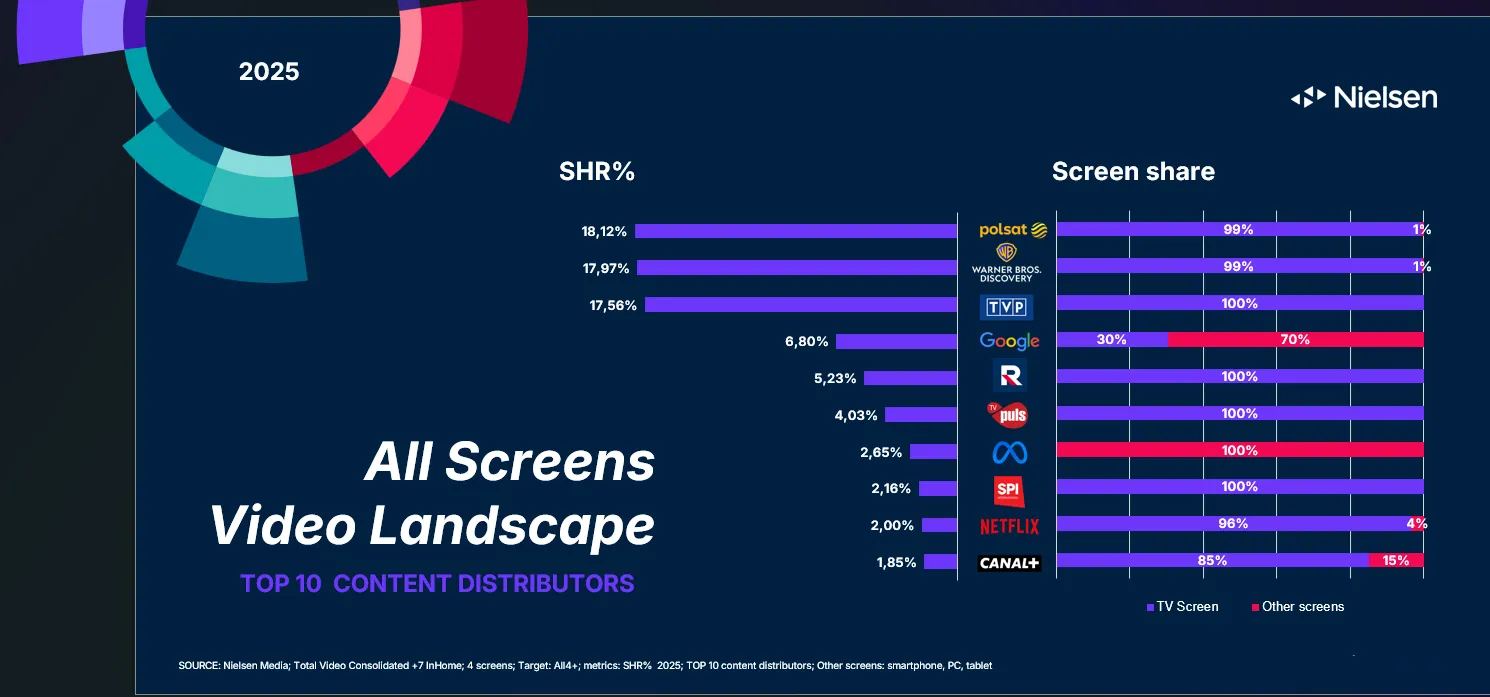
The measurement data demonstrated substantial increases in television screen viewing for digital platforms. Google saw household viewership on television screens increase from 27% to 29% year-over-year, according to Nielsen's findings.
Netflix recorded even more pronounced growth in television screen concentration, with viewership on TV screens rising from 80% to 84%. This shift indicates that digital platforms originally designed for multi-device consumption increasingly derive their viewing from traditional television sets in Polish households.
"The TV screen is becoming an increasingly important destination for digital-first platforms," stated Lucyna Koba, Market Leader at Nielsen Poland. "The growth in TV screen share for digital platforms such as Google and Netflix suggests that even as viewing options expand across mobile devices, the living room remains a central hub for household consumption in Poland."
The concentration of viewing on television screens contradicts assumptions about mobile-first consumption patterns. While streaming platforms provide flexibility across multiple devices, Polish audiences demonstrated preference for larger screens when accessing digital content.
Telewizja Republika emerged as a significant gainer in Nielsen's annual comparison. The broadcaster held sixth place in 2024 with 3.24% audience share but climbed to fifth position in 2025 while increasing its share to 5.23%.
The 1.99 percentage point gain represented the largest year-over-year increase among the top 10 distributors. Canal+ entered the top 10 rankings in 2025 as a new entry, while Byte Dance dropped out of the top 10 entirely.
The distributor rankings reflect both programming decisions and broader market dynamics affecting Polish television consumption. Political content played an outsized role during 2025, with numerous debates surrounding the Polish presidential election helping create deeper engagement with news and analysis programming.
Total reach across all video consumption declined 4.42% year-over-year, according to Nielsen's measurement data. However, average time spent viewing increased by 1.04%, demonstrating that audiences spending time with video content consumed more programming per viewing session.
The pattern intensified for streaming specifically. When examining streaming content while excluding linear television viewing, average viewing time increased 4.19% despite reach declining 4.32%. Linear television viewing remained essentially stable with minimal 0.19% growth in average viewing time despite experiencing a 4.5% decline in reach.
"The 2025 data indicates a clear pivot from broad audience reach towards deeper, more concentrated engagement within Polish households," Koba stated. "While the reach saw a slight contraction, those who watched became more dedicated consumers, spending more time with content overall."
The decline in reach occurred partly due to the absence of major sporting events in 2025. The 2024 calendar included the Olympic Games and UEFA European Championships, which drove substantial viewership across both traditional television and streaming platforms. The 2025 measurement period lacked comparable global sporting competitions.
The data underscores that linear television continues holding a highly loyal and consistent core audience despite declining reach. Traditional broadcasting infrastructure maintained stable viewing time even as fewer households tuned in during 2025 compared to 2024.
"For distributors and advertisers alike, success is increasingly defined not just by how many people they reach, but by how effectively they can retain that audience's attention," Koba explained. "The fact that linear TV viewing time remained stable despite a drop in reach further underscores that traditional television continues to hold a highly loyal and consistent core audience."
For marketing professionals operating in Poland's television advertising market, these patterns create specific strategic considerations. Advertisers must evaluate whether campaign objectives prioritize broad reach across many viewers or deeper engagement with dedicated audiences. The measurement data suggests these two goals increasingly diverge within Poland's media landscape.
The concentration of viewing among dedicated audiences presents both opportunities and challenges. Advertisers reaching these engaged viewers benefit from longer exposure to programming and advertising. However, the declining reach means campaigns must work harder to achieve coverage across the total potential audience.
Nielsen's methodology categorized distributors based on their channel portfolios and streaming platforms. Polsat operated the most extensive network with 37 properties including 25 television channels plus digital platforms Polsat Box Go, Polsat Go, Polsatnews.pl, and Interia.pl.
Warner Bros. Discovery maintained 27 channels alongside the Max streaming service, Player portal, and TVN24.pl website. TVP operated 15 channels focused on public broadcasting across news, culture, sports, and specialized programming.
Google's presence in the rankings came entirely through YouTube viewership on television screens and other devices. Meta's inclusion covered video viewing across Facebook and Instagram on television screens, demonstrating that social platforms compete directly with traditional broadcasters for living room viewing time.
SPI International operated eight specialty channels focused on film and gaming content including Stopklatka, Kino Polska, and FILMBOX Premium. Canal+ Group maintained the second-largest channel lineup with 18 television networks plus its Canal+ streaming platform.
Nielsen's All Screens Video Landscape report compiled data from 3,500 Polish households comprising nearly 9,700 panelists. The measurement framework tracked viewing behavior across cable, satellite, and terrestrial television systems while capturing streaming consumption and time-shifted viewing up to seven days after original broadcast.
The single-source panel methodology enabled Nielsen to track individual household viewing behavior consistently across multiple platforms and delivery systems simultaneously. This approach eliminates discrepancies that could arise from measuring different platforms through separate data collection systems.
Nielsen classifies live streaming viewership of television stations accessed through over-the-top platforms within the streaming category rather than traditional television. This methodology reflects the technical delivery method rather than content origin, providing clarity about how audiences access programming.
The "Other" category within Nielsen's classification system captures views of unrecognized content, potentially including user-generated content, gaming, or emerging digital services falling outside traditional broadcasting and established streaming platforms.
The viewing patterns documented in Nielsen's report hold significant implications for advertising professionals developing media strategies for the Polish market. The sustained dominance of traditional television infrastructure - with cable, satellite, and terrestrial platforms commanding the vast majority of viewing time - indicates that television advertising remains essential for achieving broad reach.
However, the increasing concentration of digital platform viewing on television screens creates opportunities for targeting strategies that leverage both traditional and digital capabilities. Advertisers can reach audiences through streaming platforms while benefiting from the engaged viewing environment that television screens provide.
The year-over-year comparison reveals that Poland's television market continues maturing from a broad reach model toward deeper engagement patterns. Broadcasters and streaming platforms competing for audience attention must increasingly focus on retaining viewers rather than simply attracting them initially.
Political content emerged as a significant driver of engagement during 2025. The numerous debates surrounding the Polish presidential election helped create concentrated viewing periods where audiences devoted sustained attention to news and analysis programming. This dynamic demonstrates how major events can counterbalance the absence of sporting competitions in driving viewership patterns.
Nielsen's measurement infrastructure positions the company to track viewing behavior across international markets, enabling media industry stakeholders to benchmark Polish performance against global patterns. The increasing television screen concentration for digital platforms observed in Poland mirrors trends identified in other European markets where streaming services have achieved higher penetration rates.
The 2025 viewing year demonstrated that non-sporting content can generate substantial audience engagement when it addresses topics of immediate public interest. Debates surrounding the Polish presidential election created programming that held audience attention despite the absence of Olympic Games or European Championships.
This pattern suggests that content quality and topical relevance drive engagement more effectively than assumptions about specific content categories. While sporting events traditionally deliver large audiences, political programming during election periods can generate comparable engagement levels through sustained news coverage and analysis.
The measurement data provides broadcasters with evidence that diverse programming strategies can maintain audience engagement across different calendar periods. Rather than depending exclusively on major sporting events to drive viewership, content distributors can develop programming aligned with political, cultural, or social developments affecting Polish audiences.
For advertisers, this dynamic creates opportunities to reach engaged audiences outside traditional high-profile sporting windows. Campaign planning can leverage political content during election periods while recognizing that engagement levels may rival those achieved during major sporting competitions.
Nielsen's All Screens Video Landscape report provides comprehensive visibility into how Polish households consume video content across multiple platforms and devices. The methodology's breadth enables tracking of both traditional broadcasting and emerging digital platforms through a unified measurement framework.
The report establishes baseline metrics against which future viewing pattern shifts can be evaluated. As streaming platforms continue expanding their presence in Poland and traditional broadcasters adapt their strategies, Nielsen's ongoing measurement will document how these competitive dynamics reshape the media landscape.
The concentration of viewing on television screens for digital platforms represents a particularly significant finding. This pattern contradicts expectations that mobile devices would dominate digital platform consumption, instead demonstrating that traditional living room viewing environments remain central to how Polish households experience video content.
Nielsen operates as a global leader in audience measurement, data, and analytics. The company provides understanding of people and behaviors across all channels and platforms, empowering clients with independent and actionable intelligence for connecting and engaging with audiences.
Who: Nielsen, the global audience measurement company, released its first All Screens Video Landscape report of 2026 tracking Polish television viewership. Lucyna Koba, Market Leader at Nielsen Poland, provided analysis of the findings.
What: The report documented significant shifts in Poland's television market between 2024 and 2025. Polsat captured first place with 18.12% audience share, overtaking Warner Bros. Discovery (17.97%) and TVP (17.56%). Telewizja Republika demonstrated substantial growth, rising from sixth place (3.24% in 2024) to fifth place (5.23% in 2025). Television screen viewing increased for digital platforms, with Google rising from 27% to 29% and Netflix climbing from 80% to 84%. Total viewership reach declined 4.42% year-over-year while average viewing time increased 1.04%, indicating deeper engagement among remaining viewers.
When: Nielsen released the report on January 19, 2026, analyzing viewing data from 2024 and 2025. The measurement period captured the absence of major sporting events in 2025 compared to 2024's Olympic Games and UEFA European Championships, while documenting increased engagement driven by Polish presidential election debates.
Where: The report covered Poland's television market through data collected from Nielsen's single-source panel of 3,500 households comprising nearly 9,700 panelists. Viewing occurred across four screen types: televisions, personal computers and laptops, smartphones, and tablets. Cable television retained the largest distribution share at 33.4%, followed by satellite (26.2%) and terrestrial (23.2%).
Why: The report matters for marketing professionals because it documents fundamental shifts in how Polish audiences consume video content. The declining reach coupled with increased viewing time indicates that advertising strategies must increasingly prioritize engagement over simple reach metrics. The concentration of digital platform viewing on television screens demonstrates that traditional living room environments remain central to video consumption despite proliferating device options. For advertisers, these patterns suggest that television advertising - both traditional and streaming - maintains effectiveness for reaching engaged audiences in Poland's maturing media market.