


Publicis Groupe today entered into a definitive agreement to acquire LiveRamp, the San Francisco-based data collaboration platform listed on the New York Stock Exchange under the ticker RAMP, in an all-cash transaction valuing the target at an equity value of $2.5 billion. The acquisition price of $38.50 per share represents a 30% premium to LiveRamp's closing share price of roughly $29.66 on May 15, 2026, the last trading day before the announcement. Publicis put the total enterprise value at $2.167 billion after deducting $379 million in acquired net cash. Both companies' Boards of Directors unanimously approved the transaction.
The deal lands on the same day that LiveRamp reported its fourth-quarter and full-year fiscal 2026 results, and it effectively replaces the company's scheduled earnings call. LiveRamp will not host its previously scheduled investor call or provide forward guidance, citing the pending transaction. Closing is expected before year-end 2026, subject to regulatory approvals and a LiveRamp shareholder vote. A joint conference call to discuss the transaction is scheduled for Monday, May 18, 2026, at 8:00 AM CET.
-Arthur Sadoun (CEO of Publicis) and Carla Serrano (Chief Strategy Officer) explain rationale of the Liveramp acquisition
Sadoun and Serrano detail the agentic playbook
Publicis posted a video announcement on its YouTube channel on the day of the deal, in which Arthur Sadoun, Chairman and CEO of Publicis Groupe, and Carla Serrano, Chief Strategy Officer of Publicis Groupe, walked through the strategic reasoning in unusual detail for a same-day acquisition communication. The video extends well beyond the press release, putting on the record the business case Publicis intends to make to clients, employees, and investors.
Sadoun opened the announcement by framing the timing as deliberate. "At a time where our industry is being challenged by AI and a difficult micro environment, we are making a bold move to continue to invest in new talent and innovation," Sadoun said. "In fact, Publicis has entered into an agreement to acquire LiveRamp. With the addition of LiveRamp to Publicis capabilities, we will become a leader in data co-creation to fuel more intelligent agents for our clients to thrive in this world."
Sadoun then described LiveRamp's technical positioning in terms that closely tracked the press release. "LiveRamp is a collaboration platform that allows companies to connect, unify and activate data across the entire digital ecosystem. It is interoperable by essence," Sadoun said. "This interoperable technology connects data across all major cloud environments and is safe and secure by design, protecting the exposure to sensitive data. It enables data activation at scale through plug-and-play connections across a collaboration network that is made of 25,000 publishers and more than 500 data and technology partners across 14 markets."
The customer scale figures Sadoun cited in the video are slightly more specific than those in the written press release. "As a standalone operation, LiveRamp has delivered double-digit growth year after year thanks to the trust of over 800 clients including more than 25% of the Fortune 500 and across nearly every segment and verticals including advertisers, retailers, publishers, platforms and holding companies," Sadoun said. The 800-client figure aligns with LiveRamp's reported 846 direct subscription customers as of March 31, 2026.
Serrano then delivered the conceptual core of the announcement: a defense of data co-creation as the bottleneck constraining enterprise AI returns. "Data co-creation is the process by which companies connect multiple high-value data sources across partners in a secure environment," Serrano said. "It generates new data assets that companies could not generate alone and sets the foundation for building more intelligent agents for clients."
Serrano then introduced what she described as the AI paradox, citing aggregate industry investment figures that frame the business case Publicis is making to clients.
"As AI adoption accelerates, the AI paradox is becoming impossible to ignore. Companies are investing millions and getting thousands in return. Only thousands," Serrano said. "When you roll those investments up across industries, that disconnect becomes even more staggering. Of $1 trillion in expected AI investment, only 5% will deliver meaningful value. That's $1 trillion of spend without material returns."
Serrano was direct about where Publicis believes the problem actually sits. "But let's be clear, the problem with agentic development isn't the AI itself. It's the data foundation," she said. "The fundamental issue is that the agents that companies are building today do not have the data required to compete and grow their business. In fact, 93% of companies don't have the right data to support effective agentic builds."
Serrano then identified three specific failure modes for agents trained on conventional enterprise data. "First, most companies are running agents on legacy enterprise data built to report the past, not make decisions for the future," she said. "Second, everyone has access to the same data for the same agents, killing their competitive advantage. Third, all of this incomplete and disconnected data increases AI hallucinations, moves agents further away from their set objectives, and means companies can't identify where an agent went wrong or how to fix it."
This three-part diagnosis is the most explicit articulation Publicis has offered of why it believes LiveRamp's clean rooms, marketplace, partner network, and combination with Epsilon's identity layer create what executives describe as a defensible position rather than a commodity capability. "That is why we've decided to invest in LiveRamp," Serrano said. "Thanks to their data connectivity and marketplace, collaborative clean rooms, and partner and agent network combined with Epsilon's identity, we're going to accelerate on data co-creation to help clients build more intelligent agents for real business outcomes."
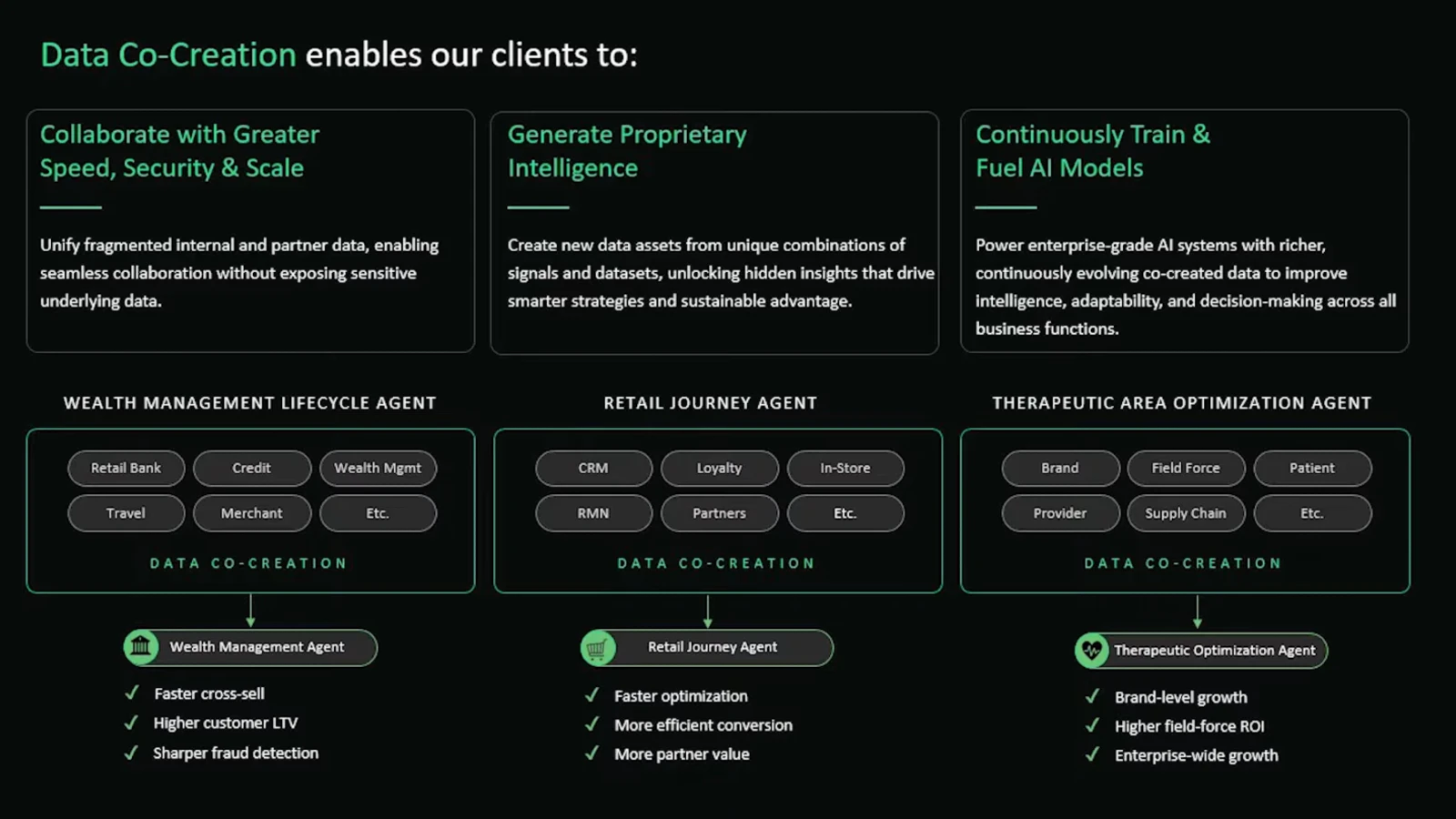
Serrano walked through three sectoral examples that match the verticals described in the written press release but with operational detail the press release left out. On financial services: "A bank could build a powerful wealth management lifecycle agent. The agent could use unified customer data from its retail banking, credit card, and wealth management and securely connect it with partner data from merchants, payment networks, and travel providers without exposing sensitive customer records." The business outcome, in Serrano's framing, is "transformed from narrow task completion into a tangible competitive advantage in customer lifetime value, customer experience and retention and risk mitigation."
On retail: "A retailer could build a comprehensive retail journey agent. That agent could connect data from CRM, loyalty, to in-store, to retail media network inventory, to partners in order to measure the incrementality of each touchpoint and to build new proprietary journeys for shoppers."
On pharmaceuticals: "A global pharmaceutical company can build a therapeutic area optimization agent. This agent can compliantly use clinical, commercial, and operational signals with patient, prescriber, payer, and supply chain data across their brands and at a therapeutic area level."
Serrano closed her section by referencing Scott Howe directly. "As Scott Howe, the CEO of LiveRamp, would say, they show how together we can democratize innovation and data for the entire ecosystem," Serrano said.
Sadoun then returned to address the financial implications and Publicis's wider M&A history. "Agent built on co-created data learn and improve with every signal, separating them from competitors that train their agents on stagnant generic data," Sadoun said. "Building smarter agents by leading in data co-creation opens up a new addressable market for Publicis that allows us to raise our '27 and '28 financial objectives."
Sadoun then placed the LiveRamp deal in the lineage of Publicis's prior bet on Epsilon. "This is not the first time that we have made a bold move in an uncertain environment for the benefit of our clients. In 2019, we acquired Epsilon to lead personalization at scale and enable them to take back control of their data from the walled garden by shifting from cookies to identity," he said. "Since then, we have been outperforming the industry and become the most valuable company in our sector. Now with LiveRamp, we are looking ahead to what is next by accelerating data co-creation to fuel more intelligent agents."
The new addressable market framing was explicit. "It's how we will enable clients to generate new exclusive and proprietary data to build the smartest and most differentiated AI agents on the top of all the world-leading LLMs. It will be of course very valuable for our clients and a new addressable market for us," Sadoun said. "Thanks to the Power of One, we will be able to quickly unite and deploy LiveRamp capabilities for all of our clients globally."
Sadoun also positioned LiveRamp within the existing Publicis technology stack. "With LiveRamp added to our ecosystem of Publicis Sapient, Epsilon and Marcel, as you have seen in the presentation, we will go even further and faster in delivering agentic business transformation for our clients, safely, transparently, and very important, in their environment," he said.
For LiveRamp's existing customer base, the most consequential commitment in the video came near the end, where Sadoun directly addressed the neutrality question that competing holding companies, publishers, and independent brands will be watching closely. "LiveRamp will maintain the total neutrality that has defined its operation so far," Sadoun said.
That single sentence is the public commitment against which Publicis's operational decisions in the integration period will be measured. The video also acknowledged the procedural hurdle still ahead. "Of course the deal still has to go through the full regulatory process," Sadoun said.
The closing remarks turned to the human dimension. "We have been speaking about data and technology for roughly the last nine minutes, but at Publicis we continue to believe that our people are a key differentiator," Sadoun said. "We have absolutely no doubt that LiveRamp culture and highly talented team will have a great impact on our organization after the acquisition."
The strategic rationale
For Publicis, the acquisition is positioned as the next step in a sequence that began with its 2019 purchase of Epsilon for $4.4 billion and continued with the March 2025 acquisition of Lotame, through which the French holding company added Lotame's identity graph to Epsilon's existing 2.3 billion global profiles. With LiveRamp, Publicis layers data collaboration and clean room infrastructure on top of that identity stack.
According to Publicis, the rationale centers on a concept the company calls data co-creation - the process by which companies connect multiple high-value data sources across partners in a secure environment to generate new data assets they could not build alone. Publicis frames this as the data layer underneath autonomous AI agents, which the holding company sees as the next addressable market.
"LiveRamp joining Publicis Groupe is the latest demonstration of our commitment to investing in new talent and innovation, ahead of market shifts," said Arthur Sadoun, Chairman and CEO of Publicis Groupe, in a statement. "After acquiring Epsilon in 2019 in the name of personalization at scale and enabling our clients to take back control of their data from the walled gardens, by shifting from cookies to identity, once again we are looking ahead to what's next."
Scott Howe, CEO of LiveRamp, framed the deal in financial terms for shareholders. "This transaction also represents the best path forward for our shareholders, delivering significant and certain cash value at a compelling premium," Howe said.
Howe will continue to lead LiveRamp after the close and will report directly to Sadoun. LiveRamp's numbers will be reported inside Publicis's Technology segment, alongside Publicis Sapient.
LiveRamp ends FY26 with $813 million in revenue
The pricing of the deal becomes more readable against the backdrop of LiveRamp's just-reported numbers. For the fiscal year ended March 31, 2026, LiveRamp posted total revenue of $813 million, up 9% year over year. Subscription revenue was $614 million, up 8%, while Marketplace and Other revenue reached $199 million, up 12%. Annualized recurring revenue stood at $545 million, up 8%, with subscription net retention improving to 107%.
GAAP operating income was $83 million for fiscal 2026, compared to $5 million the prior year. Non-GAAP operating income reached $182 million, up 34%, with non-GAAP operating margin expanding by 4 percentage points to 22%. The company generated $168 million in operating cash flow, a record, and returned $194 million to shareholders through repurchases of approximately 7.1 million shares.
The fourth quarter alone produced $206 million in revenue, also up 9%, with subscription revenue of $158 million and Marketplace and Other revenue of $49 million. Q4 GAAP diluted earnings per share came in at $1.12, benefiting from the release of deferred tax valuation allowances. Non-GAAP diluted EPS was $0.52. Operating cash flow for the quarter was $59 million.
LiveRamp ended fiscal 2026 with 133 customers whose annualized subscription revenue exceeds $1 million, up from 128 the prior year, and 846 direct subscription customers, compared to 840 the year before. Current remaining performance obligations - contracted revenue expected to be recognized over the next 12 months - was $518 million, up 10%.
Howe described the year's operating context in the earnings release. "We finished FY26 on a strong note, with Q4 revenue and operating income ahead of consensus and ARR growth accelerating sequentially," Howe said.
According to Publicis's filing, LiveRamp has delivered a trailing five-year compound annual growth rate of 13%, employs 1,300 people, and connects more than 25,000 publisher domains and 500-plus technology and data partners across 14 markets. The figure of 25,000 publisher domains in the acquirer's communication is higher than the 900-partner figure cited in LiveRamp's October 2025 agentic AI launch coverage and reflects a broader counting of distinct domains within the platform's reach.
An accretive deal, raised mid-term guidance
Publicis said the acquisition is expected to be accretive to its headline earnings per share from the first year of consolidation, excluding transaction-related costs. The Groupe will fund the purchase price with cash on hand and debt while maintaining a financial profile aligned with current BBB+ / Baa1 ratings, with full deleveraging expected two years after completion. Net financial leverage is forecast to remain capped at 1.2x in 2027.
Crucially for investors, Publicis raised its 2027 and 2028 constant currency growth objectives on the back of the deal. Net revenue growth targets move to a range of +7% to +8%, up from the previous +6% to +7%. Headline EPS growth targets move to +8% to +10%, up from +7% to +9%. Transaction costs are estimated at approximately €30 million. Publicis also confirmed its 2026 guidance of 4% to 5% net revenue organic growth and free cash flow before working capital change of approximately €2.1 billion.
Advisors on the transaction were Wachtell, Lipton, Rosen and Katz as legal counsel and BofA Securities as financial advisor to Publicis Groupe. Sullivan and Cromwell LLP served as legal advisor to LiveRamp, with Evercore as financial advisor.
Data co-creation as the next layer
The product architecture Publicis is describing centers on combining Epsilon's identity assets with LiveRamp's clean rooms, data connectivity, marketplace and partner network, and on activating those combined capabilities through Marcel, the holding company's internal agentic platform.
According to the announcement, the integrated stack is designed to allow client companies to perform three distinct functions: secure collaboration across partner data without exposing underlying records, generation of proprietary data assets from unique combinations of signals and datasets, and continuous training of enterprise-grade AI agents with anonymized co-created data. Publicis used three sectoral examples in the release: a bank building a wealth management lifecycle agent that draws on tokenized retail banking, credit card, and partner data; a retailer building a retail journey agent across CRM, loyalty, in-store, and retail media inventory; and a global pharmaceutical company building a therapeutic area optimization agent across clinical, commercial, supply chain, and de-identified patient and prescriber data.
Publicis cited Harvard Business Review Analytics Services research stating that 93% of companies lack the right data for AI success. The argument the holding company is making to clients is that ownership of proprietary, co-created data is what separates AI agents that work in a demo from agents that produce measurable business outcomes - a positioning that aligns with Publicis Sapient research published in late 2025 documenting a confidence-capability gap in enterprise AI deployment.
LiveRamp's recent product trajectory
The pricing premium also reflects the AI-related infrastructure LiveRamp has assembled over the past 18 months. The company launched agentic orchestration on October 1, 2025, introducing autonomous AI agents that could access identity resolution, segmentation, activation, measurement, clean rooms, and the company's partner network. That release positioned LiveRamp as the first data collaboration platform to offer AI agents governed access to its complete marketing toolset.
In November 2025, LiveRamp donated the User Context Protocol to the IAB Tech Lab, establishing an open standard for how AI agents exchange identity, contextual, and reinforcement signals across advertising systems. The donation moved the technology from proprietary control to industry-wide governance.
The Data Marketplace expanded on January 6, 2026 to include licensing infrastructure for AI training datasets, pre-built AI models, and AI-powered applications. This transformed what had been principally an audience marketplace into broader AI infrastructure.
In March 2026, LiveRamp deployed live agentic AI capabilities through Newton Research and SemantIQ, enabling autonomous agents to build audiences, query cross-media performance data, and optimize spend directly within the platform. Newton Research was founded by entrepreneurs who previously sold Data Plus Math to LiveRamp.
On April 16, 2026, DIRECTV Advertising became the first MVPD to integrate with LiveRamp's Conversions API Hub, enabling real-time conversion signals across its premium connected television inventory ahead of the 2026-27 Upfront season.
In the earnings release, LiveRamp also disclosed two more recent product milestones that the Publicis communication touches on in passing. The company announced native support for NVIDIA AI infrastructure inside its clean rooms - a move detailed in PPC Land's coverage of the GPU integration - allowing AI partners to train and deploy models inside the governed environment at up to 15 times the speed of CPU-based architectures. The company also disclosed an expanded partnership with the game engine Unity, which will make RampID available across Unity Exchange and expose the identifier to Unity's mobile ecosystem of 2.9 billion monthly active devices.
LiveRamp's partnership with Akkio in April 2026 brought conversational AI into the measurement layer, allowing agency and brand teams to query campaign data in natural language. The February 2026 deal with Scowtt integrated CRM-based predictive models into LiveRamp's data collaboration platform.
Other recent partnerships include Uber Intelligence, launched on December 8, 2025, through which Uber Advertising began using LiveRamp's clean room infrastructure to enable brands to combine their customer data with Uber's consented mobility and delivery signals. The October 2025 release that allowed retail media networks to measure Meta campaign performance through the LiveRamp Clean Room remains relevant to the retail media use case Publicis described in its acquisition rationale.
Governance under Publicis ownership
One of the more sensitive questions in any agency holding company acquisition of a neutral data platform is whether the platform will remain genuinely neutral for non-Publicis clients. Publicis addressed the question directly in the release.
According to the announcement, LiveRamp will continue to operate as a neutral, interoperable platform with open access across the ecosystem. No current or prospective customer will be prohibited from accessing or restricted in using its services. The release also stated that LiveRamp will continue to protect client, partner, and publisher data in accordance with existing contractual commitments and will not use that data beyond what is expressly permitted under those agreements. Standard commercial practices will remain in place, with no pricing changes outside normal course of business.
These commitments matter because LiveRamp's clean room and identity infrastructure underpin parts of the advertising operations of holding companies that compete with Publicis, including WPP and Omnicom-Interpublic.
Board appointment and capital returns
LiveRamp also disclosed two additional governance and capital actions in the earnings release. On February 11, 2026, the company appointed Kristi Argyilan to its Board of Directors. Argyilan currently serves as Global Head of Advertising at Uber, and previously led the Albertsons Media Collective. PPC Land has covered Argyilan's role in Uber Advertising's Journey Takeover partnership with The Coca-Cola Company and the JourneyTV Presents launch with publisher partnersin 2025.
On February 12, 2026, LiveRamp increased its share repurchase authorization by $200 million and extended the expiration by one year to December 31, 2027. As of March 31, 2026, $262 million remained available under that authorization. With the announcement of the Publicis transaction, the company's capacity to deploy that authorization is effectively suspended pending closing.
Why the deal matters for marketing
The acquisition compresses two industry trends into a single transaction. The first is the consolidation of identity, clean room, and data collaboration infrastructure inside agency holding companies. Publicis's acquisition of Epsilon in 2019 set the template, and the March 2025 Lotame deal extended it. The LiveRamp transaction adds clean room infrastructure and a multi-cloud collaboration layer, alongside RampID, the deterministic identifier that operates across the open web.
The second trend is the race to provide the data substrate for autonomous AI agents in advertising. The IAB Tech Lab released the Agentic RTB Framework v1.0 for public comment in November 2025. Amazon launched its Ads Agent for automated campaign management in November 2025. PubMatic launched AgenticOS with live campaigns in partnership with WPP Media, Butler/Till, and MiQ in early January 2026. Yahoo DSP rolled out agentic AI capabilities on the same day. Publicis is positioning the LiveRamp acquisition as the supply-side counterpart to these agentic execution layers: the data co-creation infrastructure that gives AI agents something differentiated to act on.
For marketers, the practical effect is that one of the industry's largest neutral data collaboration platforms will become part of a major advertising holding company by year-end 2026, subject to regulatory clearance and shareholder approval. Whether LiveRamp's neutrality commitments hold under that ownership structure, particularly in relation to clients of competing holding companies, will be a defining question for the integration period.
The deal also closes a chapter in LiveRamp's history as a public company. The stock has traded on the New York Stock Exchange under the ticker RAMP since 2018, when Acxiom sold its Marketing Solutions business to Interpublic Group for $2.3 billion and renamed the remaining company LiveRamp. Eight years later, the company is being acquired in a transaction valued at approximately the same headline figure.
LiveRamp's customer base and the competitive response
The economics of the deal rest on the breadth of LiveRamp's customer relationships. According to LiveRamp's own published positioning materials, the platform serves over 400 brand customers, including 20 of the 25 largest US advertisers and roughly 30% of the Fortune 500. Its destination network includes Disney, Hulu, Pinterest, Snap, Spotify, Perplexity, Netflix, and TikTok, alongside 10 of the 11 largest streaming platforms and more than 21,000 publisher domains. The platform integrates with more than 200 ad tech platforms - including DSPs, SSPs, marketing clouds, and customer data platforms - and 30-plus retail and commerce media networks, including 14 of the 15 largest.
In the marketing intelligence software category, third-party tracker Enlyft estimates LiveRamp's market share at roughly 40%.
The most consequential dimension of the customer base, in light of the Publicis acquisition, is the agency relationship layer. LiveRamp lists more than 70 agencies in its partner ecosystem, including all six of what were until late 2025 considered the largest global agency holding companies. That set now includes WPP, Omnicom (which absorbed Interpublic Group on November 26, 2025), Dentsu, Havas, Stagwell, and Publicis itself.
LiveRamp also published its largest customer and partner names in connection with its RampUp 2026 conference in March 2026. According to the company's earnings release, the event included presentations and panels featuring General Motors, JPMorgan Chase, Netflix, and Meta. The investor recap on LiveRamp's investor relations site additionally listed Uber, Publicis, and Google among speakers. Disney has been a public LiveRamp partner since at least 2023, when Disney Advertising integrated RampID with its Audience Graph for addressable CTV buys. LiveRamp's October 2025 Meta measurement release cited Albertsons Media Collective by name as an early adopter, and the company's REMAX commerce media partnership and casino media work with Mohegan are documented elsewhere.
The presence of WPP, Omnicom-IPG, Dentsu, Havas, and Stagwell on the LiveRamp customer roster is precisely what makes Publicis's commitment to platform neutrality the focal question for competitors. Each of those holding companies books campaigns that depend on RampID matching, LiveRamp's clean room infrastructure, or both. As of today, every one of them is effectively buying critical advertising infrastructure from a soon-to-be Publicis subsidiary.
The competitive response is unlikely to be uniform.
Omnicom, the largest of the post-2025 holding companies by revenue after closing its $13.25 billion all-stock acquisition of IPG on November 26, 2025, is the best-positioned competitor. Omnicom inherited Acxiom through that transaction. Acxiom's RealID identity graph has been positioned as the centerpiece of the new combined Omni platform, which Omnicom showcased at CES 2026 in January. According to Omnicom's CES messaging, the company described identity leadership powered by Acxiom RealID and commerce data as the differentiator for Omni. The implication is that Omnicom may accelerate its substitution of LiveRamp's RampID with Acxiom RealID inside its own media operations, while continuing to use LiveRamp where client-specific contracts demand it. Acxiom, notably, was the parent company that originally created LiveRamp before spinning it off in 2018 and renaming the remaining entity. The competitive history runs deep.
WPP took a different route. In April 2025, WPP acquired InfoSum, the privacy-first data clean room provider, and folded it into GroupM. According to industry reporting at the time, the acquisition put InfoSum's data collaboration technology inside what WPP brands as its AmeriLink US identity stack and the broader WPP Open AI operating system. InfoSum's customer base includes Channel 4, DIRECTV, ITV, Netflix, News Corp, Samsung Ads, Experian, TransUnion, Circana, Dynata, and NCSolutions. That gives WPP an in-house alternative to LiveRamp for clean room collaboration, although InfoSum's reach is smaller than LiveRamp's network of 500-plus partners and 21,000-plus publisher domains. WPP is likely to lean harder on InfoSum, but the practical reality is that InfoSum and LiveRamp serve overlapping use cases - including for some shared clients - which limits how cleanly WPP can disengage.
Dentsu, Havas, and Stagwell do not own comparable identity or clean room platforms. Each will likely continue to use LiveRamp under existing commercial terms while monitoring how Publicis treats neutrality commitments in practice. For Havas in particular, which has partnered with Akkio on AI-driven capabilities and was identified by Teads as one of its agency revenue contributors in the Q1 2026 earnings cycle, the practical question is whether Publicis ownership of LiveRamp creates information-sharing risks that justify investment in alternatives.
Outside the holding company landscape, three categories of competitors are likely to press for market share.
The first is the tech giant clean room category. Snowflake, Google Ads Data Hub, Amazon Marketing Cloud, AWS Clean Rooms, Adobe, and Databricks all operate clean room or data collaboration infrastructure that overlaps with parts of LiveRamp's offering. Snowflake and Acxiom announced a joint marketing AI initiative with Interpublic Group in June 2025, positioning Snowflake's AI Data Cloud as direct infrastructure for brand-side marketing operations. The combined Publicis-LiveRamp entity gives Snowflake and AWS a clearer pitch to neutrality-sensitive clients: stay on the cloud platform rather than embed inside a holding company's stack.
The second is the smaller independent data collaboration and identity vendor category. With Habu now inside LiveRamp (and therefore Publicis) and InfoSum now inside WPP, the universe of unaligned clean room vendors has narrowed materially. Decentriq, Optable, AppsFlyer's clean room, and Liveintent's identity infrastructure occupy that residual space. Companies positioning themselves as neutral alternatives stand to benefit from any shift in client sentiment away from holding-company-owned infrastructure.
The third is The Trade Desk and its OpenPath, UID2, and EUID identity initiatives. The Trade Desk has long competed with LiveRamp at the identity layer, and the company has built UID2 as an alternative deterministic identifier supported by publishers and advertisers. With LiveRamp now positioned inside an agency holding company, The Trade Desk's pitch to brands and publishers seeking a buy-side identifier that is not controlled by an agency holding company strengthens. The Trade Desk reported nearly $3 billion in 2025 revenue, although its Q4 2025 results and Q1 2026 guidance disappointed investors.
A separate question concerns LiveRamp's publisher-side relationships. Disney, NBCUniversal, Paramount, Warner Bros. Discovery, Roku, Netflix, Amazon Prime, Fox, and TikTok have all integrated RampID into their addressable inventory. For these publishers, LiveRamp inside Publicis raises a structural concern: Publicis is also one of their largest advertising customers. Publishers may pursue parallel integrations with InfoSum, Snowflake clean rooms, or direct UID2 adoption to avoid concentration risk.
The retail media segment, which according to PPC Land's tracking reached $52.44 billion in the United States in 2024and is projected to grow toward $129.93 billion by 2028, is particularly exposed. LiveRamp's clean room sits at the center of measurement workflows for Albertsons, Kroger, REMAX, Mohegan, and many other commerce media networks. These networks negotiate directly with brand advertisers whose media budgets are often controlled by holding companies, including Publicis competitors. Whether retail media networks adopt secondary clean room partners as a hedge is a near-term variable to watch.
The collective effect is that the acquisition both consolidates and fragments the market simultaneously. It consolidates infrastructure inside the largest agency holding companies. It fragments the market for clients and publishers that prefer to stand outside any holding company's ecosystem. The neutrality commitments Publicis put in writing - no restrictions on current or prospective customers, no pricing changes outside normal business, no use of client data beyond contractual permissions - will be tested in operational practice over the 12 to 18 months following close.
Timeline
- April 14, 2019: Alliance Data agrees to sell Epsilon to Publicis Groupe for $4.4 billion in cash
- January 14, 2025: LiveRamp partners with Mohegan to launch the first casino media network
- March 6, 2025: Publicis announces the agreement to acquire Lotame, reinforcing the Epsilon identity graph
- May 15, 2025: LiveRamp and REMAX announce partnership to power the REMAX Media Network through clean room integration
- July 17, 2025: Publicis CEO Arthur Sadoun dismisses Meta AI as a threat during the H1 2025 earnings call
- August 6, 2025: LiveRamp reports Q1 FY26 revenue of $194.8 million, up 10.7%
- October 1, 2025: LiveRamp launches agentic orchestration, AI-powered segmentation, and AI-powered marketplace search
- October 23, 2025: LiveRamp enables retail media networks to measure Meta campaign performance through its Clean Room
- November 23, 2025: Publicis Sapient research documents the AI confidence gap across industries
- December 8, 2025: Uber launches Uber Intelligence on LiveRamp's clean room infrastructure
- January 6, 2026: LiveRamp expands its Data Marketplace to include AI training data and pre-built models
- February 11, 2026: LiveRamp appoints Kristi Argyilan to its Board of Directors
- February 12, 2026: LiveRamp increases its share repurchase authorization by $200 million
- February 20, 2026: LiveRamp partners with Scowtt to integrate CRM-driven predictive models into its platform
- March 3, 2026: LiveRamp deploys live AI agents for audience building and cross-media measurement through Newton Research and SemantIQ
- April 7, 2026: LiveRamp and Akkio announce strategic partnership integrating conversational AI into measurement reports
- April 16, 2026: DIRECTV Advertising becomes the first MVPD to integrate with LiveRamp's CAPI Hub
- April 28, 2026: LiveRamp adds NVIDIA GPU infrastructure inside its clean rooms, enabling AI workloads at up to 15x CPU speeds
- May 15, 2026: LiveRamp's closing share price of roughly $29.66 sets the reference point for the acquisition premium
- May 17, 2026: Publicis Groupe and LiveRamp announce the definitive agreement; LiveRamp simultaneously reports Q4 and FY26 results
- May 18, 2026: Joint investor conference call scheduled for 8:00 AM CET
- Expected before year-end 2026: Transaction close, subject to regulatory approvals and LiveRamp shareholder vote
Summary
Who: Publicis Groupe, the Paris-based holding company listed on Euronext Paris and a constituent of the CAC 40 index, led by Chairman and CEO Arthur Sadoun, agreed to acquire LiveRamp Holdings Inc., the San Francisco-based data collaboration platform listed on the New York Stock Exchange under the ticker RAMP and led by CEO Scott Howe.
What: An all-cash acquisition of all outstanding LiveRamp shares at $38.50 per share, for a total equity value of $2.5 billion and an enterprise value of $2.167 billion after deducting acquired net cash of $379 million. The price represents a 29.8% premium to LiveRamp's closing share price on May 15, 2026. Publicis simultaneously raised its 2027 and 2028 constant currency growth objectives to +7% to +8% for net revenue and +8% to +10% for headline EPS. LiveRamp will sit inside Publicis's Technology segment alongside Publicis Sapient, with Scott Howe continuing as CEO and reporting to Arthur Sadoun.
When: Announced on May 17, 2026, the same day LiveRamp reported its fourth-quarter and fiscal year 2026 results. A joint investor conference call is scheduled for May 18, 2026, at 8:00 AM CET. The transaction is expected to close before year-end 2026, subject to regulatory approvals and a LiveRamp shareholder vote.
Where: LiveRamp is headquartered in San Francisco, California, with offices worldwide. Publicis Groupe is headquartered in Paris, with operations in over 100 countries and approximately 114,000 employees. The combined entity will operate LiveRamp's network across the 14 markets where it currently has presence, alongside Publicis's global footprint.
Why: Publicis is positioning data co-creation - secure collaboration between high-value data sources across partners - as the foundational layer for enterprise AI agents. The acquisition combines LiveRamp's clean rooms, marketplace, and partner network with Epsilon's identity graph and Publicis Sapient's transformation services, all activated through Marcel, the Groupe's agentic platform. The transaction is expected to be accretive to Publicis's headline EPS from the first year of consolidation and is intended to expand the holding company's addressable market beyond traditional advertising services into AI infrastructure and data services. For LiveRamp shareholders, the deal delivers a 29.8% premium and certain cash value at a moment when the company's product roadmap had become increasingly tied to autonomous agent infrastructure, a market characterized by uncertain monetization timelines.


Discussion