Spend-based carbon measurements overstate ad emissions by 450%
Cedara and momox case study reveals how spend-based carbon calculations inflate digital advertising emissions compared to GMSF activity-based methodology.


Cedara and momox case study reveals how spend-based carbon calculations inflate digital advertising emissions compared to GMSF activity-based methodology.
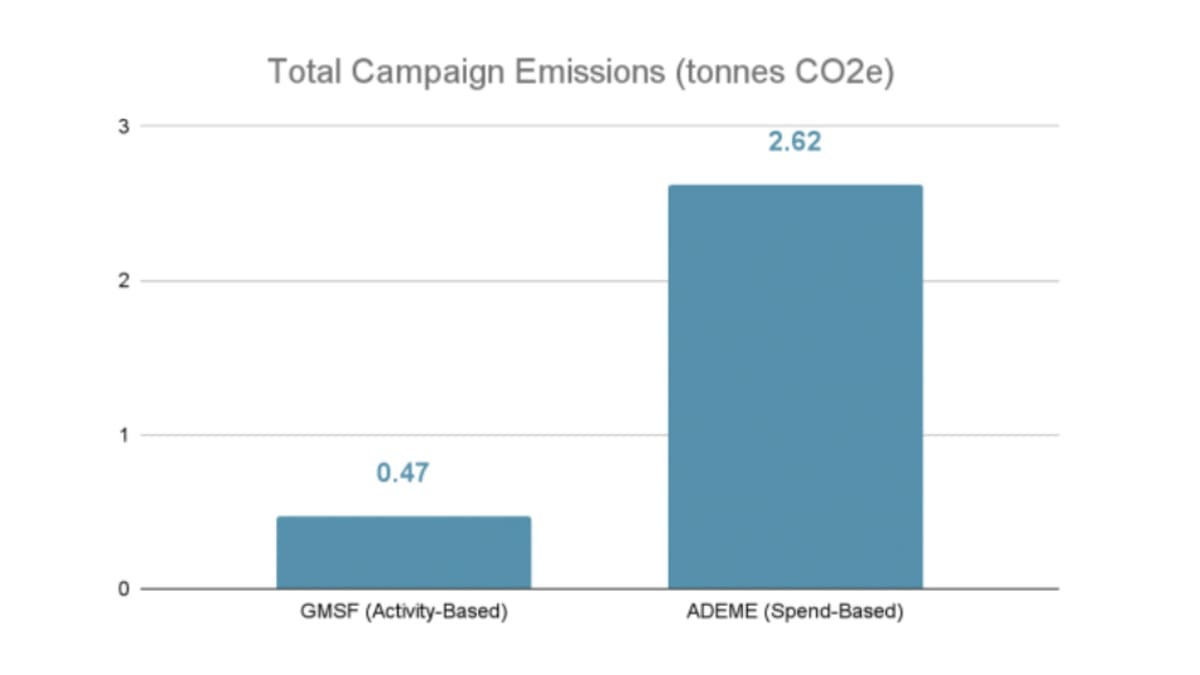
Traditional spend-based approaches to measuring digital advertising carbon footprints can overstate emissions by more than five times compared to activity-based methodologies, according to a case study released January 8, 2026, by Cedara and European recommerce platform momox.
The analysis examined three digital marketing campaigns across Google Performance Max, Google Search, and Programmatic Display & Video channels. Researchers compared activity-based measurement aligned with the Global Media Sustainability Framework version 1.2 against a spend-based estimation approach using the ADEME Base Carbone emission factor of 170 kg CO₂e per thousand euros. The spend-based calculation produced 2.62 tonnes CO₂e for the campaigns, while GMSF activity-based measurement showed actual emissions of 0.47 tonnes CO₂e—a discrepancy of 450%.
"Financial proxy methods were never designed to reflect how digital media actually operates," said Eric Shih, Chief Operating Officer at Cedara. "Activity-based measurement aligned with the GMSF provides a far more accurate and credible view of emissions and, critically, gives brands practical levers to reduce impact without compromising performance."
Subscribe PPC Land newsletter ✉️ for similar stories like this one
The case study highlights fundamental methodological differences between the two measurement approaches. Activity-based GMSF measurement tracks real operational activity across the digital advertising lifecycle, including ad serving, network delivery, data centers, user-device rendering, and creative characteristics such as file size and duration. Spend-based methods apply flat emission factors to advertising expenditures regardless of actual energy consumption or technical execution.
momox operates as Europe's leading recommerce company, buying and reselling pre-owned books, media items, and clothing to support circular economy principles. The company has facilitated transactions for over 400 million items since its 2004 founding. For an organization focused on sustainability through business model design, accurate carbon measurement across marketing operations carries strategic importance.
"For us, accuracy matters," said Lenia Karallus, Chief Commercial Officer Fashion at momox. "Using an industry-standard, activity-based approach allows us to measure our media footprint credibly, benchmark fairly, and make informed decisions that align sustainability goals with performance-driven marketing."
The discrepancy between measurement methodologies creates practical consequences for marketing teams attempting to meet environmental targets. Spend-based approaches provide no operational insights beyond reducing advertising budgets—an impractical solution for performance-driven businesses. Activity-based measurement identifies specific reduction opportunities including creative file size optimization, video length adjustments, supply-path efficiency improvements, and device targeting refinements.
The Global Media Sustainability Framework represents the advertising industry's collective effort to establish consistent measurement standards. Ad Net Zero developed the framework through collaborative working groups comprising over 120 advertising and media companies operating in more than 40 markets. The standard aims to move the industry beyond observation stages toward systematic carbon reduction optimization and unified reporting.
The framework has gained substantial adoption across the advertising technology ecosystem. Scope3 aligned its emissions model with GMSF version 1.2 on October 1, 2025, with formal compliance processes expected in early 2026. Major platforms including TikTok partnered with Scope3 in June 2025 to enable transparent emissions tracking for advertisers.
Cedara's measurement process for the momox campaigns incorporated log-level bidstream data to accurately estimate emissions from programmatic delivery. The methodology accounts for factors including server usage, network consumption, and screen operation across the advertising supply chain. This granular approach enables identification of specific emission sources and optimization opportunities that aggregate spend-based calculations cannot provide.
Marketing professionals face increasing pressure to demonstrate environmental responsibility across their advertising activities. Digital advertising represents approximately 4% of global greenhouse gas emissions from digital services, making carbon efficiency a material consideration for brands with substantial media budgets. The availability of standardized measurement frameworks enables advertisers to incorporate environmental impact alongside traditional performance metrics when evaluating channel selection.
The case study emphasizes benchmarking capabilities as a critical advantage of standardized activity-based measurement. Spend-based approaches provide no comparative context, making it impossible to assess whether a campaign's emissions represent good, average, or poor performance relative to industry standards. GMSF-aligned measurement enables comparison against recognized benchmarks for open web and walled garden environments.
Platform-specific emission characteristics create significant variation in carbon efficiency. Programmatic display advertising typically generates 0.84g CO2e per impression, while programmatic video produces 1.24g CO2e per impression, according to industry benchmarking data. These differences matter when marketing teams evaluate channel mix decisions and budget allocation strategies.
Buy ads on PPC Land. PPC Land has standard and native ad formats via major DSPs and ad platforms like Google Ads. Via an auction CPM, you can reach industry professionals.
The Google Performance Max campaigns analyzed in the momox study operate across Search, YouTube, Display, Discover, and Gmail channels simultaneously. Performance Max received more than 90 quality improvements during the past year, according to September 2025 announcements from Google. The automated campaign type relies on AI-driven optimization to distribute budget across channels based on predicted conversion probability.
Google Search campaigns represent a different technical environment with distinct emission profiles. Search advertising involves query processing, ad auction mechanics, and text-based creative delivery rather than video encoding or image rendering. The variation in technical operations between Search and Programmatic Display & Video explains why aggregate spend-based calculations fail to capture actual environmental impact.
Programmatic advertising introduces additional complexity through supply chain intermediaries, real-time bidding processes, and data transfer requirements. The Association of National Advertisers found that 42% of each programmatic dollar goes to tech or agency fees rather than media, highlighting the technical infrastructure consuming energy beyond final ad delivery.

Cedara analyzed multiple data sets during the measurement process, examining business operations, media delivery activity, data centers, and media owner infrastructure. The comprehensive approach provides visibility into emissions generated at each stage of the advertising supply chain—from initial campaign setup through final impression delivery to end users.
The ADEME Base Carbone emission factor used in the spend-based comparison represents a French government database of carbon emissions factors. The 170 kg CO₂e per thousand euros metric applies broadly across economic activities without accounting for specific technical characteristics of digital media delivery. This generalized approach contrasts sharply with GMSF methodology that measures actual energy consumption patterns in advertising infrastructure.
Growing regulatory attention on corporate environmental disclosure requirements makes standardized carbon measurement increasingly valuable for large advertisers. The European Union's Corporate Sustainability Reporting Directive and similar regulations in other markets require detailed environmental impact reporting across business operations. Digital advertising represents a measurable component of corporate carbon footprints, making accurate tracking essential for compliance reporting.
IAB Italia released a digital sustainability white paper in September 2025 addressing carbon emissions, noting that internet activity alone consumes 10% of global electricity and pollutes six times more than a decade ago. The document provided Italian advertisers with strategies to measure and reduce carbon footprints of digital advertising campaigns.
The measurement infrastructure for sustainable advertising continues developing across the advertising technology ecosystem. DoubleVerify launched carbon tracking capabilities in June 2025 through partnership with Impact Plus, providing brands with detailed carbon impact data across their entire digital advertising supply chain. The competitive landscape includes both specialized environmental measurement firms and established ad tech companies adding carbon tracking to existing product suites.
Adform introduced a measurement-only option powered by Scope3 in March 2024 for its Carbon Reduction feature. This enhancement allowed advertisers to assess carbon emissions associated with campaigns without initially implementing carbon reduction strategies, addressing industry concerns about measurement accuracy before optimization implementation.
The momox case study identifies four specific benefits motivating the company's adoption of GMSF activity-based measurement. Precision and credibility provide a standardized, industry-accepted methodology for measuring actual energy use behind media delivery. This approach gives momox a reliable view of emissions across each step of the supply chain rather than aggregate financial estimates.
Benchmarking against industry standards enables comparison of media efficiency against recognized performance indicators for open web and walled garden environments. Spend-based estimation cannot support meaningful benchmarking because it lacks contextual reference points for campaign assessment. Activity-based data enables objective evaluation of whether specific campaigns achieve carbon efficiency comparable to or better than industry averages.
Actionable optimization insights represent the operational advantage of granular measurement. The case study identifies creative file size, video length, supply-path optimization, and device and network targeting refinements as specific reduction levers accessible through activity-based data. Spend-based methods offer no operational insights beyond budget reduction—an impractical approach for businesses maintaining performance objectives.
Support for sustainability strategy provides the strategic rationale. Since marketing constitutes a meaningful contributor to momox's overall carbon footprint, activity-based transparency becomes essential to meeting long-term sustainability goals while maintaining media performance. The company can now incorporate environmental impact metrics into campaign planning and optimization workflows alongside traditional performance indicators.
Cedara provides specialized carbon intelligence solutions designed specifically for the media industry. Founded in 2021 and headquartered in New York City, the company operates offices across the United States, United Kingdom, France, Germany, and Australia. The platform enables media companies to measure and optimize environmental impact across both operations and advertising campaigns through enterprise-grade solutions.
Previous Cedara measurement work with VIOOH demonstrated the programmatic digital out-of-home platform achieved 0.35g CO2e per impression in 2023—more than 90% more efficient than programmatic display advertising's typical 3.6g CO2e per impression. The measurements aligned with the Ad Net Zero Global Media Sustainability Framework using industry default values from the SRI & Alliance Digitale framework.
momox SE employs more than 2,100 people across three locations in Germany. The company operates multiple consumer-facing brands including medimops for books and media in Germany, momox shop in France, and momoxfashion for quality-checked second-hand clothing, shoes, and accessories. International operations extend through online marketplaces worldwide.
The business model centers on buying pre-owned items at fixed prices, conducting thorough quality checks, and reselling at up to 70% off original retail prices. This approach directly addresses resource consumption by extending product lifecycles and reducing demand for new manufacturing. For such an organization, accurate measurement of marketing emissions aligns with broader environmental commitments embedded in core business operations.
The case study notes that sustainability reporting expectations are increasing across the advertising ecosystem. Brands face pressure from investors, regulators, and consumers to demonstrate environmental responsibility in business operations. Marketing teams require measurement systems that provide credible data for disclosure while enabling optimization toward reduction targets.
Digital ad tech firms showcased carbon reduction wins during a March 2025 webinar organized by IAB Europe, demonstrating that performance and sustainability can coexist in digital advertising. Presentations revealed specific technical approaches and measurable outcomes from companies implementing sustainability frameworks. The urgency to take action both individually and collectively as an industry continues growing as data transfer expands 40% annually.
The GMSF framework underwent updates in June 2025 with version 1.2 introducing improvements to the digital framework, updated emissions factors, and enhanced guidance on data accuracy levels. These refinements address feedback from initial framework applications, incorporating advancements in data availability and measurement techniques. The standardization addresses previous inconsistencies in measurement methodologies that hindered industry-wide progress.
Marketing professionals incorporating sustainability considerations into media strategies can utilize emissions intensity data alongside traditional performance metrics. Campaign planning processes that evaluate cost per thousand impressions, viewability rates, and engagement metrics can integrate carbon cost per thousand impressions for comprehensive assessment. This approach balances business objectives with environmental responsibility.
The momox case study concludes that moving beyond generic financial proxies provides precise understanding of digital emissions, the ability to benchmark fairly across the industry, a roadmap for meaningful optimization and reduction, and more accurate representation of overall footprint. These benefits support both sustainability reporting requirements and operational campaign management.
The shift from spend-based to activity-based measurement represents a fundamental change in how marketing organizations approach environmental accountability. Rather than treating carbon emissions as an inevitable cost proportional to advertising expenditure, activity-based methodologies enable identification of specific technical and operational factors driving emissions. This granularity transforms carbon measurement from compliance reporting into operational optimization opportunity.
The 450% overstatement identified in the momox campaigns demonstrates the magnitude of inaccuracy possible with spend-based approaches. For organizations reporting environmental performance to stakeholders, such discrepancies undermine credibility and prevent meaningful progress tracking. The case study provides empirical evidence supporting industry movement toward standardized activity-based frameworks like GMSF.
Subscribe PPC Land newsletter ✉️ for similar stories like this one
Subscribe PPC Land newsletter ✉️ for similar stories like this one
Who: Cedara, an AI-powered sustainable media measurement company, partnered with momox, Europe's leading recommerce platform with over 2,100 employees, to conduct carbon footprint analysis of digital advertising campaigns. Eric Shih, Chief Operating Officer at Cedara, and Lenia Karallus, Chief Commercial Officer Fashion at momox, provided commentary on the findings.
What: A case study comparing two carbon measurement methodologies for digital advertising campaigns showed spend-based calculations using ADEME Base Carbone emission factors overstated emissions by more than five times (450%) compared to activity-based measurement aligned with Global Media Sustainability Framework version 1.2. The analysis examined three campaigns across Google Performance Max, Google Search, and Programmatic Display & Video, finding spend-based methodology produced 2.62 tonnes CO₂e while GMSF activity-based measurement showed actual emissions of 0.47 tonnes CO₂e.
When: Cedara released the case study on January 8, 2026, analyzing momox campaign data from an unspecified recent period. The study utilized GMSF version 1.2, which Ad Net Zero introduced in June 2025, and compared results against the ADEME Base Carbone spend-based methodology using a 170 kg CO₂e per thousand euros emission factor.
Where: The study examined digital advertising campaigns operating across Google's advertising platforms and programmatic display and video environments serving European markets where momox operates. The research was conducted by Cedara's team operating across offices in the United States, United Kingdom, France, Germany, and Australia, with momox headquartered in Berlin, Germany.
Why: The case study demonstrates that traditional spend-based carbon measurement significantly overstates digital advertising emissions while providing no actionable optimization insights. Activity-based GMSF-aligned measurement provides accurate emission quantification, enables industry benchmarking, identifies specific reduction opportunities including creative optimization and supply-path efficiency, and supports sustainability reporting requirements. Marketing constitutes a meaningful contributor to momox's overall carbon footprint, making accurate measurement essential for meeting long-term sustainability goals while maintaining performance-driven marketing operations.