Stack Overflow traffic collapses as AI tools reshape how developers code
Monthly question volume plummets from 200,000 to below 50,000 since ChatGPT launch, threatening the platform's survival as programmers abandon community forums.


Monthly question volume plummets from 200,000 to below 50,000 since ChatGPT launch, threatening the platform's survival as programmers abandon community forums.
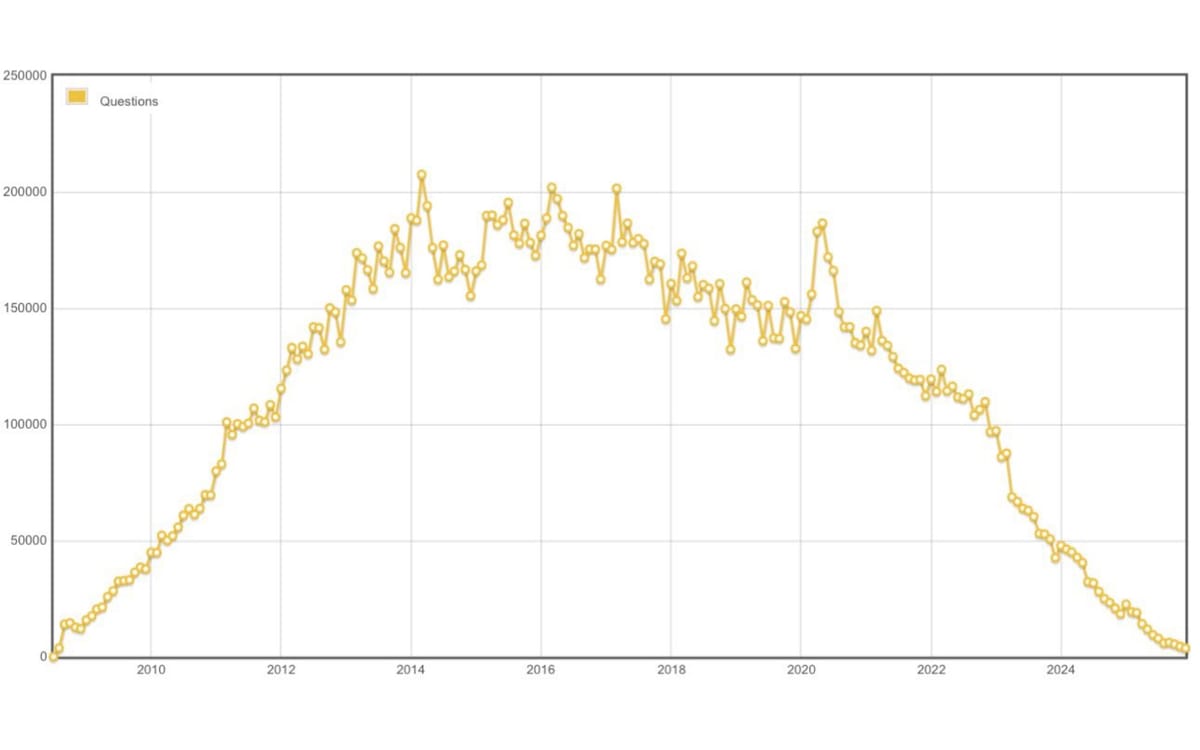
Stack Overflow faces an existential crisis. Monthly question volume has collapsed from peaks exceeding 200,000 in 2014 to under 50,000 by late 2025, marking a decline steeper than most industry observers anticipated.
Data visualization shared on X by developer Sam Rose on January 4, 2026, revealed the stark trajectory of Stack Overflow's question volume using the platform's own query system. The graph shows monthly question submissions climbing steadily from the site's 2008 launch, reaching maximum levels between 2014 and 2020, before entering terminal decline. By late 2025, question volumes had retreated to 2008 levels—a complete erasure of 15 years of growth.
The platform was sold to Netherlands-based Prosus for $1.8 billion on June 2, 2021, just before the steepest portion of the decline began. Stack Overflow's new ownership structure placed it within Prosus's portfolio of internet properties, which includes major stakes in Tencent, food delivery platforms, and educational technology companies. According to Wikipedia, Prosus acquired Stack Overflow as part of a broader investment strategy focused on long-term growth potential across technology sectors.
ChatGPT's November 2022 launch accelerated trends already underway. The platform had experienced declining activity after 2014, following changes in moderation policies that made the community less welcoming to beginners. However, the introduction of conversational AI tools capable of generating code and explaining programming concepts appears to have permanently altered developer behavior patterns.
Stack Overflow's 2025 Developer Survey, released in 2025, documented this transformation in stark detail. The survey received responses from over 49,000 developers across 177 countries, covering 314 different technologies. OpenAI's GPT models dominated usage statistics, with 81.4% of developers indicating they worked with these tools in the past year. Claude Sonnet achieved 42.8% adoption, while Gemini Flash reached 35.3%. The data reveals that 84% of respondents now use AI tools in their development process, up from 76% the previous year.
Professional developers demonstrate particularly high AI adoption rates. The survey found that 51% of professional developers use AI tools daily, compared to lower percentages among those learning to code. This pattern suggests AI has become standard infrastructure for experienced programmers rather than a novelty for beginners experimenting with technology. The frequency of daily usage indicates fundamental workflow integration rather than occasional consultation.
Platform preference data shows Claude Sonnet earning the highest admiration rating at 67.5%, surpassing OpenAI GPT's 61.2% despite lower overall usage numbers. Anthropic's model appeals particularly strongly to professional developers, with 45% adoption among this group compared to just 30% among those learning to code. The discrepancy suggests experienced developers value Claude's specific capabilities for complex programming tasks.
YouTube emerged as a more popular community resource for developers learning to code than for professionals. While 60.5% of all respondents use YouTube for development community engagement, the percentage rises to 70% among those learning to code while remaining at 60% for professional developers. Stack Overflow maintained its position as the dominant community platform overall, with 84.2% usage, though this represents a significant shift from the platform's historical monopoly on programming questions.
Sentiment toward AI tools has decreased despite rising adoption. Positive sentiment dropped from over 70% in 2023 and 2024 to just 60% in 2025. Professional developers show higher overall favorable sentiment at 61% compared to 53% among those learning to code, though this still represents a decline from previous years. The data suggests growing familiarity with AI limitations even as usage expands.
Trust in AI accuracy remains low across all experience levels. Only 3.1% of respondents report highly trusting AI output, while 19.6% highly distrust it. More developers actively distrust AI accuracy—46% total—than trust it, which stands at 33%. Experienced developers demonstrate the most caution, with the lowest "highly trust" rate at 2.6% and the highest "highly distrust" rate at 20%. This skepticism indicates persistent verification needs despite widespread AI adoption.
The biggest frustration with AI tools, cited by 66% of developers, involves "AI solutions that are almost right, but not quite." This near-accuracy problem leads directly to the second-largest frustration: debugging AI-generated code proves more time-consuming than writing original code, according to 45.2% of respondents. These findings suggest AI serves as a productivity tool only when developers possess sufficient expertise to identify and correct errors.
Stack Overflow's decline reflects broader traffic disruption documented across the web. Microsoft Clarity reveals how AI assistants are reshaping website traffic patterns, with analytics showing distinct consumption behaviors when users arrive via AI referral versus traditional search. AI-referred visitors demonstrate different engagement patterns, potentially reading more content because AI systems prime them with context before referral.

The measurement challenges extend beyond behavioral analysis. Traditional analytics registers zero activity when AI tools consume content without directing users to source websites. Content creators receive no credit or compensation when AI platforms extract information and present it directly to users without generating clickthroughs. This dynamic threatens business models dependent on traffic-driven advertising or subscription conversions.
Research from Ahrefs demonstrates the paradox of AI traffic quality versus volume. AI search visitors worth 4.4x more than traditional organic traffic, according to comprehensive analysis published June 9, 2025. Despite representing minimal traffic share, AI search visitors convert at rates 23 times higher than conventional search engine visits when they do arrive at destination websites.
Traffic patterns show combined volumes decreasing temporarily before reaching equilibrium and expanding slowly over time. Analysis of ChatGPT search citations reveals that when ChatGPT search references webpages, those pages rank in traditional organic search positions 21 or lower for related queries approximately 90% of the time. This finding contradicts traditional SEO assumptions about visibility correlating with ranking position.
The transition reflects fundamental changes in user behavior patterns. AI search compresses marketing funnels by delivering comprehensive information upfront, often eliminating the need for users to visit multiple websites. Additionally, AI search systems deprioritize links compared to traditional search, with included links appearing less prominently than standard search results.
Buy ads on PPC Land. PPC Land has standard and native ad formats via major DSPs and ad platforms like Google Ads. Via an auction CPM, you can reach industry professionals.
Google executives contradict research on AI search traffic impact, with Liz Reid, VP and Head of Google Search, announcing on August 6, 2025, that AI features in search produce more queries and higher quality clicks to websites. According to Reid, total organic click volume from Google Search remains relatively stable year-over-year. However, third-party research documented substantial click-through rate decreases, with studies showing reductions ranging from 34.5% to 54.6% when AI summaries appear in search results.
Publishers observe impression increases alongside traffic declines in Google Search Console data. Martin Splitt, Google's Developer Advocate, acknowledged this pattern during a Warsaw event on June 17, 2025. The phenomenon represents what has been termed "The Great Decoupling," where websites receive significantly more impressions while experiencing substantial click decreases.
Google Discover dominates news traffic as search declines, accounting for two-thirds of Google referrals according to research analyzing 2,000 global news and media websites published August 7, 2025. The study demonstrates that this proportion continues growing as AI Overviews and AI Mode prevent readers from clicking through to original sources. This shift away from search-driven discovery affects information sites across categories, not just news publishers.
Independent website owners face crisis conditions as Google's AI features drastically reduce visits. Google's AI search overhaul decimates website traffic, with many publishers reporting declines of 70% or more according to Bloomberg reporting from April 7, 2025. Website creators who followed Google's quality guidelines now face existential threats to their businesses and livelihoods.
Mike Hardaker, founder of Mountain Weekly News which reviews outdoor gear, told Google's chief search scientist Pandu Nayak that most attendees at an October meeting had struggled with little to no web traffic for more than a year. Hardaker, who made $250,000 in gross revenue in 2023, reported relying on a food bank by the time of the October meeting. Google employees stated they could not guarantee any recovery for these websites because "the search product had fundamentally changed in the AI era."
Stack Overflow's particular vulnerability stems from its role as a reference resource rather than a destination for ongoing engagement. Developers historically visited the platform when encountering specific problems requiring solutions. AI tools now provide those solutions directly within development environments, eliminating the need to navigate to external websites. The 2025 Developer Survey data shows this pattern clearly, with Visual Studio Code and Visual Studio maintaining dominance as development environments while incorporating AI extensions as optional paid services.
The platform attempted to adapt through its own AI initiatives. In June 2023, Stack Exchange made several changes regarding policies around content generated by artificial intelligence, resulting in a strike by a portion of volunteer moderators. The protest centered around a policy stating that AI-detection tools were not permitted for use in moderation. This led to 11% of moderators ceasing content moderation, growing to more than 23% of all moderators across the network by June 22, including more than 70% of all Stack Overflow moderators.
Negotiations between Stack Exchange and moderators resulted in new policies allowing moderators to remove AI content when strong indicators of GPT usage exist, along with commitments to continue providing data and API access. The strike ended August 2, 2023, but the underlying tensions between AI-generated content and community standards persist.
Stack Overflow's culture faced criticism in research papers for being unfriendly, especially regarding gender differences in participation and beginners learning computer science. A 2023 study concluded that the website's new users met with significant difficulties obtaining help from other users. Analysis from a sample of 968 posts showed that 49% experienced hurdles such as their questions being closed, receiving no response, or receiving no explanation for negative scoring.
The moderation approach, while well-intentioned and aimed at improving overall question and answer quality, appeared to swing too far. Even reasonable questions and answers sometimes faced downvotes or closures. This created barriers for precisely the users who might have sustained platform activity as experienced developers shifted to AI tools.
A 2013 study found that 75% of users only ask one question, 65% only answer one question, and only 8% of users answer more than 5 questions. These participation patterns suggest the platform always relied on a relatively small core of active contributors. As that core moves to AI tools, the community loses critical mass necessary for rapid, high-quality responses that historically made Stack Overflow valuable.
Developer workflow changes compound the problem. Ahrefs study finds AI search visitors convert 23x higher than organic traffic, published June 16, 2025, revealed that despite representing 0.5% of total traffic, AI search visitors generated 12.1% of all signups. This conversion efficiency demonstrates substantial commercial value for websites optimized for AI discovery channels, but Stack Overflow operates primarily as a community resource rather than a conversion-focused platform.
The platform serves as a training data source for AI models, creating an uncomfortable dynamic where its content enables the tools displacing its traffic. Stack Overflow content is licensed under Creative Commons Attribution-ShareAlike license, allowing AI companies to use it for model training. The platform receives no compensation when AI tools trained on Stack Overflow content answer questions that would have previously driven traffic to the site.
Similarweb launches dual tracking platform for AI search optimization, announced July 28, 2025, enables organizations to measure traffic to their properties while benchmarking against competitor performance across AI-powered discovery tools. The platform combines visibility tracking with traffic measurement, addressing the challenge of understanding which prompts generate AI responses containing brand references or driving traffic to websites.
Understanding successful prompts enables content optimization strategies targeting the language patterns that trigger favorable AI responses. For Stack Overflow, this would require fundamentally rethinking content structure to serve both human visitors and AI consumption. However, the platform faces the challenge that optimal AI content may differ substantially from optimal community discussion formats.
Python adoption grew significantly in 2025 according to the Developer Survey, seeing a 7-percentage-point increase from 2024 to reach 57.9% usage. This growth speaks to Python's position as the go-to language for AI, data science, and back-end development. The acceleration coincides with AI tool adoption, suggesting developers increasingly choose languages with strong AI library ecosystems and extensive training data available to AI assistants.
Remote work patterns stabilized with 32.4% of developers working remotely according to the 2025 survey. The United States has the highest percentage of remote developers at 45% among top-reporting countries. This distributed workforce relies heavily on digital communication and problem-solving tools, making AI assistants particularly valuable for developers working without immediate access to colleague expertise.
Job satisfaction increased slightly, with 24.5% of developers reporting happiness at work compared to 20% the previous year. This improvement likely relates to pay increases documented in the data for certain roles. The correlation between compensation and satisfaction suggests developers evaluate workplace quality partly through economic measures, which could influence tool adoption decisions favoring AI that demonstrably increases productivity.
The broader context reveals AI agents not yet achieving mainstream adoption. A majority of developers—52%—either don't use agents or stick to simpler AI tools, while 38% have no plans to adopt them. However, among the 30.9% who do use AI agents, 69% agree that agents have increased productivity, and 70% agree they have reduced time spent on specific development tasks.
The most recognized impacts are personal efficiency gains rather than team-wide effects. Approximately 70% of agent users agree that agents have reduced time spent on specific tasks and increased productivity. Only 17% agree that agents have improved collaboration within their team, making it the lowest-rated impact by a wide margin. This pattern suggests AI tools currently serve individual developers more effectively than they facilitate team coordination.
Stack Overflow faces mounting pressure to demonstrate continued relevance. The platform still receives substantial traffic—visitors access it at least a few times per month according to 82% of survey respondents, with 25% visiting daily or more often. However, this represents a shift from the platform's historical position as the primary destination for programming questions.
Approximately 35% of developers report that visits to Stack Overflow result from AI-related issues at least some of the time. This creates an ironic dynamic where AI tools both displace Stack Overflow traffic and generate new traffic when they fail to provide adequate solutions. The platform becomes a fallback option rather than a first resource, fundamentally altering its position in developer workflows.
Content preferences among younger developers show significantly higher interest in social and interactive formats compared to older developers. While all age groups want lists and articles, 37% of 18-24 year olds want "Chat (people)" compared to only 20% of 55-64 year olds. Similarly, 39% of the youngest cohort want "Coding challenges," aligning with a motivation to skill up through active practice rather than passive consumption.
These preferences suggest Stack Overflow's traditional question-and-answer format may seem outdated to newer developers who expect more interactive, conversational interfaces. The platform's strength—comprehensive, searchable archives of programming solutions—serves AI training more effectively than it serves human discovery in an era of conversational interfaces.
AI traffic converts at 3x higher rates than traditional channels, according to Microsoft Clarity research released November 6, 2025, analyzing over 1,200 publisher and news websites. Traffic from AI platforms grew 155.6% over eight months while converting to sign-ups at 1.66% compared to 0.15% from search. This conversion advantage emerges despite AI referrals accounting for less than 1% of overall traffic.
Stack Overflow could potentially benefit from superior conversion quality if it can capture AI-referred traffic, but the fundamental challenge remains that AI tools reduce total traffic volume dramatically. Higher conversion rates on minuscule traffic provides limited consolation when overall engagement collapses.
The technology stack underlying Stack Overflow—written in C# using ASP.NET MVC framework with Microsoft SQL Server—remains robust. Unregistered users access most site functionality, while registered users gain privileges like asking questions, establishing profiles, and earning reputation through community participation. The gamification elements that made Stack Overflow distinctive—reputation points, badges, and unlocking privileges—lose appeal when developers obtain answers through AI tools without community participation.
Security considerations affect platform viability. A security breach in early May 2019 potentially exposed IP addresses, names, or emails for approximately 184 public network users. While relatively limited in scope, such incidents erode trust in platforms already facing existential questions about continued relevance.
Python package manager uv earned the highest admiration rating at 74.2% among Stack Overflow tag technologies in the 2025 survey. Built in Rust, uv exemplifies the kind of developer tooling that garners enthusiasm in the current environment. Developers increasingly value tools that reduce friction and increase productivity—precisely the value proposition AI assistants offer when they work correctly.
The fundamental question confronting Stack Overflow involves whether the platform can evolve from a question-and-answer site into something AI-compatible without losing its essential character. The platform's value derived from community expertise, peer review, and comprehensive coverage of programming topics. AI tools trained on that expertise now provide answers without requiring community participation, creating a tragedy-of-the-commons dynamic where the resource that enabled AI training faces extinction from the tools it made possible.
Jorge A, a tech tinkerer, commented on Sam Rose's post: "Stack Overflow was sold just before the decline," to which Rose responded, "I saw! Incredible timing." The observation highlights the fortunate exit timing for the platform's original owners, who received $1.8 billion for an asset whose traffic would collapse within four years.
The platform announced partnerships and initiatives attempting to maintain relevance. However, these efforts face the challenge that AI fundamentally changes why developers seek information. Rather than searching for specific solutions to encountered problems, developers increasingly prompt AI assistants to generate solutions directly within their development environments.
Prosus's broader portfolio context matters for understanding Stack Overflow's future. The company invests across social networking, gaming, classifieds, payments, financial technology, educational technology, food delivery, real estate listings, and ecommerce. Stack Overflow represents a relatively small piece of a diversified portfolio, reducing pressure for immediate profitability but potentially limiting resources dedicated to reversing its decline.
The developer community's shift toward AI tools appears irreversible at current technology capability levels. Unless AI tools experience significant capability deterioration—an unlikely scenario given ongoing investment and research—developers have limited incentive to return to community question-and-answer platforms for information readily available through conversational interfaces.
Stack Overflow's historical importance to software development remains undisputed. The platform served as essential infrastructure for millions of developers over nearly two decades. Its comprehensive archive of programming knowledge continues providing value, particularly to AI models trained on its content. Whether the platform can transition from primary resource to archival reference while maintaining financial viability represents the central question facing its current ownership.
The data shared by Sam Rose crystallizes a transformation most developers recognize intuitively. AI has fundamentally altered how programmers work, and platforms built for the pre-AI era face extinction unless they can identify sustainable new roles. Stack Overflow's question volume collapse from 200,000+ monthly to under 50,000 quantifies a shift felt throughout the developer community—the end of one era and the uncertain beginning of another.
Subscribe PPC Land newsletter ✉️ for similar stories like this one
Subscribe PPC Land newsletter ✉️ for similar stories like this one
Who: Stack Overflow, the question-and-answer platform for programmers founded by Jeff Atwood and Joel Spolsky, now owned by Netherlands-based Prosus. The platform's 29 million registered users, volunteer moderators, and developer community face fundamental changes in how programming knowledge is discovered and shared.
What: Monthly question submissions to Stack Overflow collapsed from peaks exceeding 200,000 in 2014 to under 50,000 by late 2025, erasing 15 years of growth. The decline coincides with widespread AI tool adoption, with 84% of developers now using AI in their development process and 81.4% specifically using OpenAI GPT models. The platform's traditional role as the primary destination for programming questions has been displaced by conversational AI assistants that provide answers directly within development environments.
When: The decline began gradually after 2014 following moderation policy changes, but accelerated dramatically after ChatGPT's November 2022 launch. Data visualization published January 4, 2026, revealed the full extent of traffic collapse. Stack Overflow was sold to Prosus on June 2, 2021, just before the steepest portion of the decline, demonstrating fortunate timing for original owners who received $1.8 billion for the platform.
Where: The traffic collapse affects Stack Overflow globally, impacting its 177-country user base documented in the 2025 Developer Survey. The platform's data infrastructure runs on C# using ASP.NET MVC framework with Microsoft SQL Server. Broader context shows similar traffic disruption across web properties as AI tools reduce direct website visits while occasionally generating higher-quality conversions when users do arrive.
Why: AI tools fundamentally changed developer workflows by providing code generation and programming explanations directly within development environments, eliminating the need to navigate to external question-and-answer platforms. Developers obtain solutions from AI assistants trained partly on Stack Overflow's own content, creating a dynamic where the platform's historical value enabled the tools now displacing its traffic. The shift represents permanent structural changes rather than temporary adjustment, with 51% of professional developers using AI tools daily and showing little indication of returning to community-based problem-solving.