TikTok Shop forces sellers into logistics ultimatum that could destroy 3PL businesses
TikTok Shop discontinues seller shipping on February 25, requiring merchants to use approved fulfillment partners or face exclusion from the platform.


TikTok Shop discontinues seller shipping on February 25, requiring merchants to use approved fulfillment partners or face exclusion from the platform.
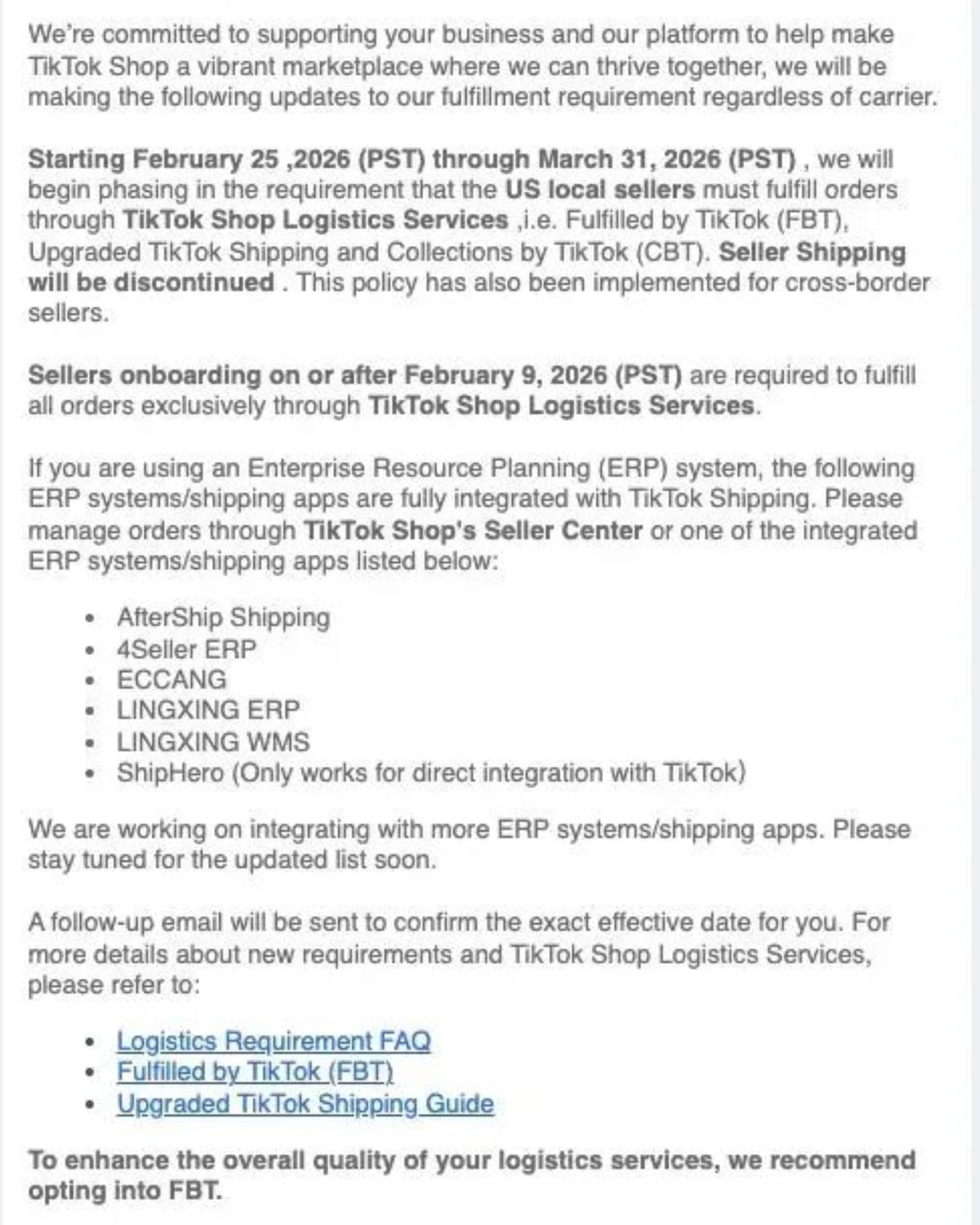
TikTok Shop this month eliminated merchant choice in fulfillment operations, announcing that Seller Shipping will be discontinued on February 25, 2026, forcing US local sellers onto TikTok Shop Logistics Services or a restricted list of approved providers. The change fundamentally alters the competitive landscape for third-party logistics providers and creates operational uncertainty for merchants who have built businesses around independent fulfillment infrastructure.
According to the announcement distributed to TikTok Shop sellers, the company will require orders to be fulfilled through one of three designated services: Fulfilled by TikTok (FBT), Upgraded TikTok Shipping, or Collections by TikTok (CBT). The notification states explicitly that "Seller Shipping will be discontinued for your shop on the same date."
The policy mirrors Amazon's fulfillment model, where third-party sellers operate within a controlled logistics ecosystem rather than managing shipping through independent providers. TikTok Shop launched in the United States in 2023, offering sellers the flexibility to handle fulfillment through their own shipping accounts and warehouse partners. That autonomy ends in approximately one month.
The logistics requirement extends beyond mere warehouse location decisions. According to Matthew Hertz, CEO of Third Person, who discussed the policy on LinkedIn after receiving confirmation, third-party logistics providers and shippers can no longer use their own shipping accounts to ship TikTok orders. The restriction eliminates what has been a fundamental operational model for thousands of e-commerce fulfillment partnerships.
"It's not just about where the inventory sits," Hertz explained in his post. The change means 3PLs operating traditional fulfillment services for TikTok Shop merchants face a binary choice: integrate with TikTok's approved Enterprise Resource Planning systems and shipping applications, or exit the TikTok Shop fulfillment business entirely.
TikTok Shop provided documentation identifying which ERP systems and shipping apps maintain full integration with TikTok Shipping. The approved systems include AfterShip Shipping, 4Seller ERP, ECCANG, LINGXING ERP, and LINGXING WMS. According to the notification, ShipHero remains "only for direct integration with TikTok" rather than standard ERP connectivity.
The platform directed sellers to manage orders through TikTok Shop's Seller Center or integrated ERP systems listed in the company's Eligible ERP directory. According to the documentation, sellers can explore the complete list through resources provided in the notification. TikTok stated it is "working on integrating with more ERP systems/shipping apps," though no timeline appeared in the announcement for additional partnerships.
The operational impact cascades through established fulfillment relationships. Brands working with 3PLs that lack approved integrations must either migrate to new warehouse partners within the next month or invest in completely different warehouse management systems - a transition that typically requires months rather than weeks for properly implemented operations.
Mo Afshar, whose company Pipe17 handles e-commerce integration, noted in response to Hertz's post that his platform is "in beta with this and so will have it live on time." He added that "3PLs that run pipe17 need not worry," suggesting some integration partners are racing to meet the February 25 deadline.
The financial implications extend beyond integration costs. According to industry discussions on LinkedIn, established sellers are consulting their 3PL partners about compliance readiness, and many providers have not yet determined their response strategy. Mark D., commenting on Hertz's post, acknowledged being "overly biased but ShipHero is the best e-comm WMS solution on the market by a mile."
Retailers operating at scale face particularly acute challenges. Hertz referenced discussions with a top seller on the platform who described the confusion as "palpable." The seller's question - "What is the plan?" - remains unanswered for many merchants whose 3PL partners have not yet invested in TikTok-approved integrations.
For such operations, the available paths forward include moving inventory to FBT (surrendering control over fulfillment operations), attempting manual fulfillment (which becomes unscalable beyond small volumes), or hoping for direct integrations from warehouse management systems like ShipStation or ShipHero. That last option introduces what Hertz described as a "Shopify as Source of Truth nightmare regarding inventory sync," where inventory management systems must maintain accuracy across multiple platforms simultaneously.
The policy positions TikTok Shop alongside Amazon's FBA model rather than maintaining the open fulfillment approach that characterized early marketplace operations. Amazon's fulfillment infrastructure has established strict inventory deadlines and capacity constraints that force sellers into early planning cycles, and TikTok Shop's new requirements create similar operational constraints for a different platform.
Victoria Scott, Senior IT Business Analyst at MaryRuth's, commented on the development with a single word: "Interesting." The understated response reflects the complexity of implementing such significant operational changes on compressed timelines for businesses already managing multi-platform fulfillment operations.
The competitive dynamics between platforms continue evolving. Walmart allowed Amazon fulfillment for cross-platform sales starting May 16, 2025, permitting sellers to use Amazon Multi-Channel Fulfillment for Walmart orders under specific conditions. That policy loosening contrasts sharply with TikTok Shop's tightening restrictions, suggesting different strategic priorities between established marketplaces and emerging social commerce platforms.
TikTok Shop's infrastructure requirements arrive as social commerce adoption accelerates across multiple platforms. TikTok ads now support Buy with Prime checkout integration, enabling users to complete purchases through Amazon's system while discovering products through TikTok's content platform. That partnership allows brands to bypass TikTok Shop's fulfillment requirements entirely by routing transactions through Amazon's established logistics network.
The Buy with Prime integration represents an alternative approach where customers discover products on TikTok but complete purchases using their Prime membership benefits without requiring inventory in TikTok's fulfillment centers. However, that option only works for brands running advertising campaigns rather than operating TikTok Shop storefronts, creating a bifurcated strategy where advertising and marketplace operations require different fulfillment approaches.
Jon Elder, who helps brand owners scale on Amazon and Walmart marketplaces, noted the development with apparent approval, stating simply "Like · 2" in response to Hertz's LinkedIn post about the policy change. His reaction suggests some industry professionals view the logistics consolidation as inevitable platform maturation rather than problematic restriction.
The timing of TikTok Shop's policy change coincides with broader questions about the platform's search quality and user experience. TikTok users are complaining about search functionality, with users reporting that commercial content dominates their feeds. According to discussions in the r/AskIreland community from one month ago, users stated that "every second vid now is some wannabe influencer trying to flog some knock off projector or game console, the app is become unusable."
The financial impact of mandatory fulfillment service adoption remains unclear for most sellers. TikTok Shop's documentation does not publish pricing for FBT services, and comparative cost analysis between approved providers and independent 3PL arrangements will determine whether the policy change primarily affects operational flexibility or also imposes significant cost increases.
One LinkedIn commenter who met with a major TikTok agency reported that the agency's "biggest client which is a well-known shoe brand got a quote from TikTok on FBT and it was more expensive than them using their own warehouse." The anecdote suggests that for some sellers, particularly those operating established fulfillment infrastructure, the policy change may force cost increases alongside operational disruption.
Mark D. responded to concerns about fulfillment costs by noting that while some might view the changes negatively, time constraints for implementation create the most pressing issue. He stated that "I do think given the time frame of the TikTok change many won't be able to move in time, as such Voila can fill this gap but where there is time I would agree it's a strong solution challenging traditional WMS solutions."
The compressed implementation timeline - approximately one month from announcement to enforcement - prevents careful evaluation and methodical migration for many sellers. Businesses that spent months or years optimizing fulfillment operations with specific 3PL partners now face rushed decisions about warehouse migrations, system integrations, or business model changes.
Matthew Dunne, Founder of The Despatch Company, reacted to the announcement with apparent understanding of broader implications, responding with engagement to the LinkedIn discussion. His company's focus on fulfillment operations positions him to observe how platform requirements reshape the third-party logistics industry.
The policy reflects TikTok Shop's strategic decision to prioritize platform control over merchant flexibility. By mandating approved fulfillment systems, TikTok gains visibility into inventory levels, shipping performance, and delivery timelines across its entire seller base. This data enables better customer experience management but reduces merchant autonomy in areas like packaging, carrier selection, and fulfillment speed.
Peng Lin, Owner and CEO of DKK Brands, which operates ESPRO, Liiton, and VIVA, noted the development alongside other industry observers tracking how platforms consolidate control over commerce operations. The concentration of fulfillment decision-making with platforms rather than merchants represents a structural shift in e-commerce power dynamics.
Michael S., who identifies himself as an "Entrepreneur, rabbit hole addict" with experience in "ORC and Triangulation Fraud Victims," offered a characteristically blunt assessment: "And guess who benefits? Chinaaaaaaaa. If this move surprises anyone, shame on you." His comment reflects suspicions among some market participants about the strategic motivations behind platform policy changes.
The technical requirements for compliance extend beyond simple carrier selection. Warehouse management systems must communicate directly with TikTok Shop's Seller Center, transmitting order data, inventory levels, and tracking information through approved APIs. According to the seller notification, orders must be managed through "TikTok Shop's Seller Center or one of the integrated ERP systems/shipping apps" from the approved list.
Natalie C., who describes herself as "Asking the Whys in the Business World," responded to the announcement with engagement, suggesting industry professionals are analyzing the strategic rationale behind TikTok Shop's policy shift. The question of why TikTok would risk alienating established sellers by eliminating fulfillment flexibility points to competing priorities between rapid platform growth and operational control.
The mandatory integration requirement means merchants cannot simply contract with any competent 3PL provider and expect seamless TikTok Shop operations. Instead, sellers must verify that potential fulfillment partners have invested in TikTok-specific integration development - a requirement that favors larger, well-capitalized logistics companies over smaller regional providers.
According to Hertz's analysis, brands at scale face particular uncertainty about the optimal path forward. Moving to FBT means "loss of control" over fulfillment operations, while manual fulfillment becomes "unscalable" beyond certain order volumes. The hope for direct integrations from shipping platforms like ShipStation or ShipHero introduces inventory synchronization challenges across multiple sales channels.
Industry response to the announcement reflects divided perspectives on whether the policy change represents necessary platform maturation or overreach that could damage TikTok Shop's competitive position. Some observers note that Amazon's FBA program, despite similar restrictions, enabled explosive marketplace growth by ensuring consistent customer experiences through standardized fulfillment.
One commenter suggested the change could represent positive development: "This is a game changer. Depends on their partner (or inhouse) operations execution, they might finally be competing again FBA like experience." The implication is that TikTok Shop's previous flexibility in fulfillment options may have created inconsistent customer experiences that damaged the platform's reputation compared to Amazon's reliable delivery performance.
However, other responses expressed skepticism about whether the policy serves sellers' interests. The comment "So how does this effect the small time seller?" highlights concerns that the new requirements disproportionately impact smaller merchants who lack resources to quickly migrate fulfillment operations or absorb cost increases from mandatory service providers.
Another LinkedIn user suggested marketplace saturation might drive sellers to alternative platforms: "I bet eBay is sounding better right now or Facebook marketplace." The comment reflects a perception that TikTok Shop's increasing operational demands may push merchants toward platforms with lower barriers to entry, even if those platforms offer less discovery potential.
The systems integration requirements create immediate pressure for software vendors serving e-commerce sellers. Muhammad Farhan, who helps e-commerce brands scale on Amazon and TikTok Shop with expertise in PPC and DSA, engaged with the announcement, indicating that advertising and fulfillment strategies must align as platform requirements change.
Mo Afshar's comment about Pipe17 entering beta testing with TikTok's new requirements suggests some integration providers anticipated the policy change and began development work before the public announcement. His statement that the platform "will have it live on time" indicates confidence in meeting the February 25 deadline for customers running Pipe17 integration software.
The race to achieve compliance before the enforcement date creates competitive advantage for early movers among software vendors. Companies that secure TikTok approval and complete integration testing before February 25 can market themselves as certified solutions to desperate merchants facing platform exclusion.
Mark D.'s acknowledgment that many sellers won't be able to complete system migrations in time underscores the practical challenges of compressed implementation schedules. Enterprise software deployments typically involve months of configuration, testing, and training. Condensing that timeline to approximately four weeks increases the risk of errors, data loss, and operational disruptions.
The policy change reflects broader trends in social commerce platform development. Facebook Marketplace introduces AI features and collaborative shopping tools as of November 13, 2025, showing how platforms continuously add features to improve customer experience while potentially constraining seller operations.
Similarly, Shopify launches cross-merchant product network blurring store boundaries as of December 10, 2025, demonstrates how e-commerce infrastructure providers are reshaping traditional merchant relationships through technology-enabled networks. TikTok Shop's fulfillment requirements represent a parallel approach to platform consolidation through logistics control rather than merchant networking.
The competitive pressure from Amazon's mature fulfillment infrastructure appears to influence TikTok Shop's strategic decisions. Amazon's critical inventory deadlines for 2025 holiday season established patterns of strict inventory management that set customer expectations for e-commerce fulfillment. TikTok Shop may conclude that matching those standards requires similar control over logistics operations.
Industry observers note that Amazon's fulfillment dominance extends beyond its own marketplace. Walmart allows Amazon fulfillment for cross-platform sales as of May 16, 2025, acknowledging that Amazon's Multi-Channel Fulfillment service has become infrastructure that even competitors sometimes rely upon. TikTok Shop's decision to build proprietary fulfillment requirements rather than allowing Amazon MCF integration suggests strategic priorities favor platform independence over operational flexibility.
Sellers facing the February 25 deadline have limited options for achieving compliance. The first path involves migrating inventory to TikTok's Fulfilled by TikTok program, which handles storage, picking, packing, and shipping but requires surrendering control over fulfillment operations and accepting TikTok's fee structure.
The second option requires working with existing 3PL partners to implement approved ERP systems or shipping applications from TikTok's integration list. According to the seller notification, partners using AfterShip Shipping, 4Seller ERP, ECCANG, LINGXING ERP, or LINGXING WMS should have technical compatibility, though actual implementation timelines depend on each provider's readiness.
The third approach involves switching to 3PL providers that have already completed TikTok integrations. Hertz noted that Third Person is "seeing a lot of brands looking for a 3PL and/or full compliance with these new requirements," suggesting demand is concentrating among fulfillment providers that moved early to achieve TikTok certification.
Large brands with established fulfillment operations face particularly complex decisions. Moving inventory to FBT represents the simplest compliance path but may conflict with existing contracts, operational procedures, and quality standards that brands have developed through years of logistics optimization.
Smaller sellers operating through general-purpose fulfillment providers may find themselves caught between 3PLs that haven't prioritized TikTok integration and the compressed timeline for finding alternative arrangements. The February 25 deadline leaves little room for careful evaluation of cost, service quality, and technical capabilities across competing fulfillment providers.
Mid-sized merchants that have invested in custom fulfillment infrastructure face the most challenging decisions. These businesses typically operate through 3PLs selected for specific capabilities - specialized packaging, quality control procedures, or vertical-specific expertise. Mandating migration to TikTok-approved systems within one month may force compromises on operational priorities that took years to optimize.
The policy creates immediate opportunity for fulfillment service providers that achieved early TikTok integration. These companies can market their compliance status as a competitive differentiator and potentially command premium pricing from desperate merchants facing platform exclusion. The concentration of seller demand among a limited number of approved providers may strain capacity and service quality across the industry.
TikTok Shop's notification specified that sellers must begin using approved fulfillment services by February 25, 2026 (PST). The four-week implementation window from announcement to enforcement provides minimal time for operational transitions that typically require months of planning, testing, and training.
The platform's decision to announce major operational changes with compressed implementation timelines reflects confidence in its market position. Sellers who built businesses around TikTok Shop must scramble to achieve compliance or risk losing access to a significant sales channel during what has been TikTok Shop's rapid growth phase.
According to discussions among sellers and industry observers, the lack of detailed cost information about TikTok's fulfillment services complicates decision-making. Merchants cannot evaluate whether FBT represents a cost-neutral option compared to existing arrangements without receiving quotes, yet quotes require time that the February 25 deadline does not provide.
The policy also raises questions about how TikTok Shop will handle sellers who fail to achieve compliance by the deadline. The notification stated that "Seller Shipping will be discontinued for your shop on the same date," suggesting that non-compliant sellers may lose the ability to fulfill orders through TikTok Shop entirely. Whether the platform will suspend seller accounts or simply reject orders remains unclear from available documentation.
Amazon's transformation from an open marketplace to a fulfillment-controlled ecosystem provides a template for understanding TikTok Shop's strategic direction. When Amazon introduced FBA in 2006, the service was optional. Over time, the company increased incentives for FBA adoption through Prime eligibility, Buy Box advantages, and advertising benefits until most successful sellers concluded that FBA was effectively mandatory for competitive operations.
Amazon introduces star-only seller feedback system as of August 4, 2025, demonstrating how platforms continuously adjust policies in ways that shift power dynamics between marketplace operators and third-party sellers. The removal of written feedback requirements gave Amazon greater control over seller reputation management while reducing seller ability to address customer concerns through contextual responses.
Similarly, Amazon forces all sellers to use prepaid returns, ending high-value exemption as of February 8, 2026, shows the platform's pattern of eliminating seller flexibility in operational decisions. That policy mandated that all US sellers use Amazon Prepaid Return Labels for customer returns, removing the previous exemption for high-value items despite seller objections about cost impacts.
TikTok Shop's fulfillment mandate follows similar logic: centralizing operational control enables consistent customer experiences and provides the platform with comprehensive data about seller performance, inventory availability, and delivery capabilities. However, the speed of implementation distinguishes TikTok's approach from Amazon's gradual evolution, compressing years of marketplace development into a four-week transition.
The policy creates winners and losers across the e-commerce ecosystem. Software vendors with approved TikTok integrations gain immediate competitive advantage and potential pricing power. Traditional 3PLs without TikTok partnerships face urgent decisions about whether to invest in integration development or cede the TikTok fulfillment market to competitors.
Sellers with inventory already in FBT or relationships with approved 3PLs gain relative advantage over competitors who must scramble for compliance. Brands operating through non-integrated fulfillment providers face immediate operational disruption and potential sales interruption if they cannot achieve compliance by February 25.
The concentration of power with platform-approved service providers raises questions about long-term cost trends. When sellers have limited fulfillment options, competitive pressure on pricing decreases. TikTok Shop's decision to control fulfillment through approved partners creates oligopolistic conditions where a small number of providers serve a captive customer base.
The fulfillment mandate represents TikTok Shop's evolution from a flexible marketplace into a controlled ecosystem where the platform dictates operational standards. This transformation mirrors Amazon's development but occurs at compressed speed, forcing sellers to adapt within weeks rather than years.
For the 3PL industry, the policy creates a new category of partnerships where platform integration capabilities become as important as warehouse operations, shipping rates, and service quality. Fulfillment providers must now invest in maintaining technical relationships with multiple sales channels, each with unique requirements and approval processes.
The change may accelerate consolidation in the 3PL industry as smaller providers lack resources to develop and maintain integrations across TikTok Shop, Amazon, Walmart, Shopify, and other platforms. Larger logistics companies with engineering teams can spread integration development costs across thousands of customers, while regional providers face decision points about which platforms to support.
For sellers, the policy creates new operational complexity in multi-channel commerce. Businesses selling across Amazon, TikTok Shop, their own websites, and other marketplaces must now manage different fulfillment requirements for each channel. The dream of unified inventory serving all sales channels through a single 3PL relationship becomes increasingly difficult as platforms impose conflicting operational mandates.
TikTok Shop has not provided comprehensive cost information about FBT services, leaving sellers unable to evaluate the financial impact of different compliance options. The platform also has not clarified enforcement mechanisms for the February 25 deadline or described how it will handle partial compliance attempts.
The approved ERP list remains incomplete according to the seller notification, which stated TikTok is "working on integrating with more ERP systems/shipping apps." Sellers whose preferred systems are not yet approved face uncertainty about whether those integrations will arrive before the enforcement deadline.
The policy's impact on small sellers - who may lack resources for rapid system migrations or relationships with enterprise-focused fulfillment providers - remains unclear. TikTok Shop's early growth included many individual entrepreneurs and small businesses attracted by low barriers to entry. The new fulfillment requirements raise those barriers significantly.
Industry observers are also questioning whether the policy will prompt sellers to reduce their TikTok Shop presence in favor of platforms with more flexible fulfillment options. While TikTok Shop has driven significant sales for some merchants, the platform's youth compared to Amazon or Walmart means many sellers maintain larger businesses elsewhere. If fulfillment complexity on TikTok Shop exceeds the channel's revenue contribution, rational economic decisions might lead to de-prioritization.
Who: TikTok Shop announced the policy affecting US local sellers, third-party logistics providers, and enterprise resource planning system vendors. Matthew Hertz, CEO of Third Person, provided analysis of operational implications. Mo Afshar confirmed Pipe17 integration development, while Mark D. discussed fulfillment solutions. Industry professionals including Victoria Scott, Peng Lin, Jon Elder, and others responded to the announcement across LinkedIn.
What: TikTok Shop will discontinue Seller Shipping on February 25, 2026, requiring all merchants to fulfill orders through TikTok Shop Logistics Services - specifically Fulfilled by TikTok (FBT), Upgraded TikTok Shipping, or Collections by TikTok (CBT). The policy eliminates the ability for 3PLs and shippers to use their own shipping accounts for TikTok orders. Approved ERP systems include AfterShip Shipping, 4Seller ERP, ECCANG, LINGXING ERP, LINGXING WMS, and ShipHero (for direct TikTok integration only).
When: TikTok Shop distributed the announcement to sellers on January 26, 2026, with enforcement beginning February 25, 2026 (PST). The four-week implementation window requires rapid operational transitions that typically take months to execute properly.
Where: The policy applies to US local sellers operating on TikTok Shop. International markets were not addressed in the announcement. Orders must be managed through TikTok Shop's Seller Center or integrated ERP systems from the approved list.
Why: TikTok Shop aims to create consistent customer experiences through controlled fulfillment operations, mirroring Amazon's FBA model. The policy enables platform visibility into inventory levels, shipping performance, and delivery timelines while standardizing seller operations. However, the change eliminates merchant autonomy in fulfillment decisions and creates operational disruption for sellers built around independent 3PL relationships.