Uber debuts Journey Takeover with Coca-Cola at your destination
Uber Advertising launches Journey Takeover format January 6, 2026, pairing branded maps with destination-linked ads as Coca-Cola campaigns debut across 12 markets.


Uber Advertising launches Journey Takeover format January 6, 2026, pairing branded maps with destination-linked ads as Coca-Cola campaigns debut across 12 markets.
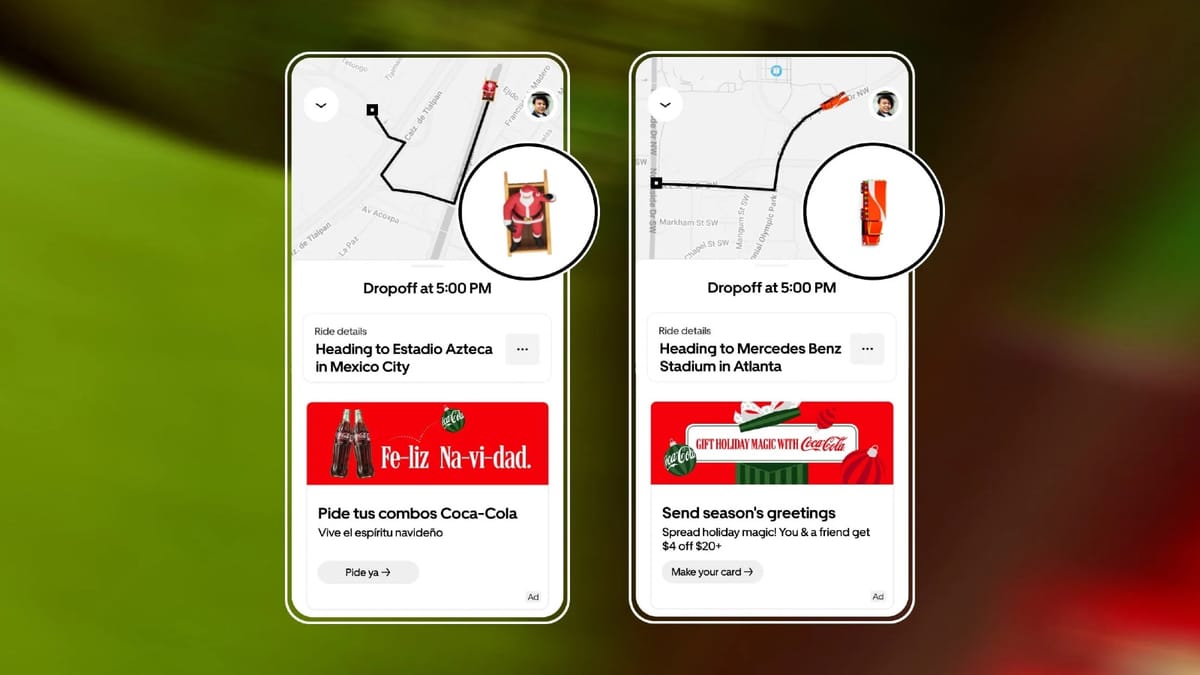
Uber Advertising announced Journey Takeover on January 6, 2026, a premium advertising format that combines branded map displays with destination-specific creative executions deployed across entire ride experiences. The product emerged from Uber Advertising's Creative Studio and launched with The Coca-Cola Company as its initial partner, according to materials shared with media outlets at the Consumer Electronics Show.
Journey Takeover operates differently from standard Journey Ads inventory. The format integrates three distinct components: customized map interfaces displaying brand imagery across Uber's navigation interface, animated brand icons that move along route paths during transit, and Journey Ads video units that appear at specific trip stages. These elements work together to create what Uber describes as cohesive brand narratives aligned with rider destinations.
The Coca-Cola campaign illustrates the contextual targeting approach. According to the announcement, riders traveling to restaurants, sporting events, and grocery stores—locations where Coca-Cola beverages are available for purchase—encountered the branded experience during their December holiday season trips. The creative execution varied by market. United States riders saw Christmas Caravan imagery. Spanish and Portuguese markets received similar holiday truck creative. Australia and New Zealand displayed branded Kombi vans, while Mexican riders encountered Santa's sleigh iconography navigating their routes.
"People open Uber when they're already headed somewhere that matters," said Kristi Argyilan, Global Head of Uber Advertising, in the announcement. "Journey Ads features an average global view time of over 100 seconds, and the moving icon on the map is one of the most attention-grabbing spaces in the app."
The attention metrics Argyilan referenced position Journey Takeover within broader engagement patterns Uber has documented across its advertising inventory. Journey Video Ads on mobile devices achieved scores 41% higher than mobile video benchmarks in testing conducted with Adelaide and Kantar, as reported in October 2025. These performance differentials reflect what Uber characterizes as the captive nature of in-ride advertising environments compared to competing digital channels.
Journey Takeover availability differs substantially from standard advertising inventory. Uber structures the format as limited campaigns restricted by market and time period. The company positions this scarcity approach as maintaining premium quality for both riders and participating brands. Initial market deployment spans the United States, Canada, United Kingdom, Ireland, France, Spain, Portugal, Australia, New Zealand, Japan, Taiwan, Mexico, and Brazil.
The Creative Studio component represents Uber Advertising's internal production capability rather than external agency partnerships. This approach enables the company to develop market-specific creative variations while maintaining creative control over how brands integrate with the core Uber interface. The Coca-Cola campaign required distinct iconography across at least seven different regional executions, each calibrated to local cultural contexts and seasonal expectations.
Destination alignment forms the targeting foundation. Unlike demographic or behavioral targeting common in programmatic advertising, Journey Takeover uses real-time trip data to match brand messages with rider destinations. This location-based approach creates what Uber describes as intentional brand presence during journeys where subsequent purchase opportunities exist. The methodology resembles proximity-based advertising strategies used in retail media networks, though applied to transit moments rather than shopping environments.
The timing coincides with broader expansions across Uber's advertising infrastructure. The company launched Uber Intelligence on December 8, 2025, a data collaboration platform that enables brands to analyze consumer behavior patterns derived from mobility and delivery services. That platform operates through LiveRamp's clean room infrastructure, processing aggregated insights about how users move, dine, and order across metropolitan areas.
Journey Ads opened to programmatic buying in June 2024 through partnerships with Google's Display & Video 360, The Trade Desk, and Yahoo DSP. The shift from direct-only sales enabled advertisers to purchase inventory through preferred demand-side platforms using Programmatic Guaranteed deals. European expansion followed in June 2025, covering 10 markets including the United Kingdom, Spain, France, Germany, Netherlands, Ireland, Sweden, Poland, Switzerland, and Portugal.
Journey Takeover operates separately from programmatic channels. The format requires direct Creative Studio partnerships rather than automated buying processes, reflecting the custom creative development necessary for market-specific executions and destination targeting logic. This positions Journey Takeover as a premium tier above standard Journey Ads inventory, which has delivered average click-through rates exceeding 3% and average global view times surpassing 100 seconds since launching in late 2022.
The engagement environment differs substantially from traditional display advertising contexts. Riders interact with Uber's interface during periods when competing distractions remain limited compared to social media feeds or web browsing. This captive audience dynamic has attracted advertiser interest across Uber's advertising products, though it also creates user experience considerations around ad load and intrusiveness during functional app usage.
In-app advertising effectiveness data from AppLovin research released in September 2024 demonstrated that customers acquired through in-app advertisements show significantly higher engagement rates compared to social media channels. In fintech applications, customers acquired via in-app ads opened applications an average of 9 times per month, compared to 5.8 times for social media acquisitions. These engagement differentials reflect attention patterns similar to those Uber leverages during ride experiences.
The map takeover component represents the most distinctive element. Uber's navigation interface functions as the primary rider touchpoint during trips, with users regularly checking progress, estimated arrival times, and driver locations. Integrating brand imagery directly into this functional interface transforms utility interactions into advertising exposures without requiring separate content consumption. The animated brand icon moving along routes creates repeated visual engagement as riders monitor trip progress.
Journey Ads video units complete the experience. These placements appear at specific trip stages—when riders open the app, during the journey, and approaching destinations. The timing creates narrative progression opportunities where brand messages can build across multiple touchpoints rather than relying on single impression impact. This sequential exposure approach resembles episodic storytelling techniques used in premium video advertising environments.
The contextual targeting methodology addresses privacy considerations increasingly relevant across digital advertising. Using destination data for ad targeting avoids reliance on cross-site tracking or third-party cookies facing regulatory scrutiny. The ride-hailing context provides natural audience segmentation based on travel patterns without requiring external data integrations or identifier matching beyond Uber's first-party information.
Buy ads on PPC Land. PPC Land has standard and native ad formats via major DSPs and ad platforms like Google Ads. Via an auction CPM, you can reach industry professionals.
Uber's broader advertising strategy targets $1 billion in annual advertising revenue, as noted in reporting on the European programmatic expansion. The company competes with Lyft in mobility advertising, where Lyft opened programmatic access via Microsoft Monetize in October 2025. Uber's programmatic integration and premium format development reflect dual strategies addressing both scaled media buying and premium brand partnerships.
The Creative Studio model provides competitive differentiation. Rather than offering self-service advertising tools or relying on agency creative, Uber maintains direct involvement in campaign development. This approach enables quality control over how brands integrate with the core product experience while generating custom creative assets tailored to specific markets and cultural contexts. The Coca-Cola campaign's varied iconography across seven markets demonstrates execution complexity requiring dedicated creative resources.
Journey Takeover joins JourneyTV Presents as a premium content initiative. JourneyTV Presents launched in September 2025, bringing editorial content from publishers including Time Out, Matador Network, and The Weather Channel to riders through tablet systems in select markets. That platform achieves 98% completion rates with average view times approaching 120 seconds per ride, according to company data. The tablet-based system targets different inventory from Journey Takeover's mobile app placement, though both reflect Uber's strategy of monetizing attention during transit periods.
The announcement timing at the Consumer Electronics Show positions Journey Takeover within broader industry conversations about advertising innovation and technology integration. CES traditionally serves as a platform for major consumer technology announcements, though advertising format launches remain less common than product hardware or platform features. The venue selection signals Uber's positioning of advertising capabilities as technology products rather than pure media inventory.
For marketing professionals, Journey Takeover represents another entry point in the expanding universe of contextual advertising environments. Mobile app marketing reached $109 billion globally in 2025, according to AppsFlyer data released in December, with user acquisition accounting for $78 billion. Journey Takeover competes for budget allocations alongside other in-app advertising formats, programmatic display, social media, and emerging channels including generative AI applications.
The destination-specific targeting creates natural category affinities. Consumer packaged goods brands targeting grocery shoppers, restaurants promoting delivery or dine-in occasions, entertainment venues reaching attendees, and retail locations attracting nearby consumers all benefit from riders already traveling toward relevant purchase environments. This pre-purchase proximity differs from awareness-focused advertising or retargeting approaches, creating what Uber positions as high-intent advertising moments.
Measurement approaches for Journey Takeover campaigns remain unspecified in the announcement materials. Standard Journey Ads inventory provides campaign performance measurement tools including viewability metrics, engagement rates, and attention scoring through the Adelaide partnership. Whether Journey Takeover receives similar measurement infrastructure or operates through custom reporting frameworks for premium campaigns remains unclear from available documentation.
The limited availability model creates access questions for advertisers. Unlike programmatic inventory accessible through self-service platforms or managed service with flexible entry points, Journey Takeover appears to require direct partnerships facilitated through Uber Advertising's sales organization. This structure favors major brands with substantial budgets and established advertiser relationships rather than performance marketers or mid-market companies seeking scaled reach.
Coca-Cola's selection as launch partner reflects the brand's global scale and multi-market presence necessary for initial deployment across 12 countries. The beverage category also creates natural destination alignment with restaurants, grocery stores, and entertainment venues where product availability enables immediate post-exposure purchase opportunities. This contextual fit demonstrates ideal use cases for the format while potentially limiting applicability for categories without similar destination-based purchase patterns.
The holiday timing for the initial Coca-Cola campaign positioned Journey Takeover within seasonal advertising periods when major consumer brands increase spending and seek distinctive placements. Whether the format maintains year-round availability or operates primarily during peak advertising periods remains unaddressed in the announcement. The limited campaign structure suggests intermittent availability rather than continuous inventory, though specific scheduling details were not disclosed.
Market selection for initial deployment spans both developed and emerging advertising markets. The inclusion of Japan, Taiwan, Mexico, and Brazil alongside North American and European markets indicates global ambitions rather than focus on premium markets exclusively. This geographic breadth creates scale opportunities while requiring localized creative development and cultural adaptation for effective execution across diverse contexts.
The announcement positions Journey Takeover within competitive dynamics across mobility platforms, social media giants, and emerging advertising channels. Meta enhanced value optimization capabilities in November 2025, delivering 29% higher return on ad spend improvements. Google announced enhanced measurement tools for iOS app campaigns in May 2025. These platform developments reflect intensifying competition for advertiser budgets amid changing privacy regulations and measurement standards.
For Uber's business model, advertising revenue provides margin expansion opportunities complementing core mobility transaction fees. The company coordinates 9 million rides daily for Lyft according to available data, creating substantial impression inventory without requiring new user acquisition or marketplace expansion. Monetizing existing traffic through advertising generates incremental revenue with limited marginal costs compared to driver incentives or rider promotions.
The Creative Studio's role merits examination within broader advertising industry structures. Traditional agency holding companies including WPP, Publicis, Omnicom, and IPG typically handle creative development for major brand campaigns. Uber's in-house studio competes with these established creative services while maintaining platform-specific expertise and direct integration with advertising placement systems. This verticalization reflects broader trends toward platform-owned creative capabilities seen across major advertising channels.
Journey Takeover's success metrics remain undefined in public materials. Whether Uber evaluates the format based on advertiser demand, rider satisfaction scores, revenue generation, or competitive positioning against alternative advertising products will influence future development and availability. The limited campaign structure enables experimentation and iteration without committing to permanent product offerings if market response disappoints.
The regulatory environment for location-based advertising continues developing across global markets. European privacy regulations including GDPR establish consent requirements for data processing. California's privacy frameworks create disclosure obligations. Journey Takeover's reliance on destination information as a targeting mechanism operates within first-party data contexts less affected by third-party tracking restrictions, though user consent frameworks still apply to data collection and usage.
Subscribe PPC Land newsletter ✉️ for similar stories like this one
Subscribe PPC Land newsletter ✉️ for similar stories like this one
Who: Uber Advertising Creative Studio developed Journey Takeover as a premium advertising format, launching with The Coca-Cola Company as the initial brand partner. Kristi Argyilan, Global Head of Uber Advertising, provided commentary on the announcement. The format targets select brands willing to co-create custom campaigns through direct Creative Studio partnerships.
What: Journey Takeover combines three integrated components—branded map interfaces displaying custom imagery across Uber's navigation, animated brand icons moving along route paths during trips, and Journey Ads video units appearing at specific journey stages. The format creates cohesive brand narratives aligned with rider destinations through contextual targeting based on where riders travel. Initial campaigns feature market-specific creative executions, with Coca-Cola deploying seven distinct variations including Christmas Caravans in the United States, Kombi vans in Australia, and Santa's sleigh in Mexico.
When: Uber announced Journey Takeover on January 6, 2026, at the Consumer Electronics Show. The Coca-Cola holiday campaign ran during December 2025 as the format's debut execution. Journey Takeover operates as limited campaigns by market and time period rather than continuously available inventory, though specific scheduling details beyond the initial launch remain undisclosed.
Where: Initial deployment spans 12 markets including the United States, Canada, United Kingdom, Ireland, France, Spain, Portugal, Australia, New Zealand, Japan, Taiwan, Mexico, and Brazil. The format appears within Uber's mobile application during ride experiences, integrating with the core navigation interface riders use to monitor trip progress and estimated arrival times.
Why: Journey Takeover addresses advertiser demand for premium, contextually relevant placements that leverage the captive attention environment during rides. The destination-based targeting methodology creates what Uber positions as high-intent advertising moments when riders already travel toward locations where advertised products are available for purchase. The format provides differentiation from standard Journey Ads inventory while supporting Uber's broader strategy of monetizing existing ride traffic through advertising revenue that complements transaction fees. Journey Ads features average global view times exceeding 100 seconds, positioning the in-ride environment as a distinctive attention-capture opportunity compared to competing digital channels.