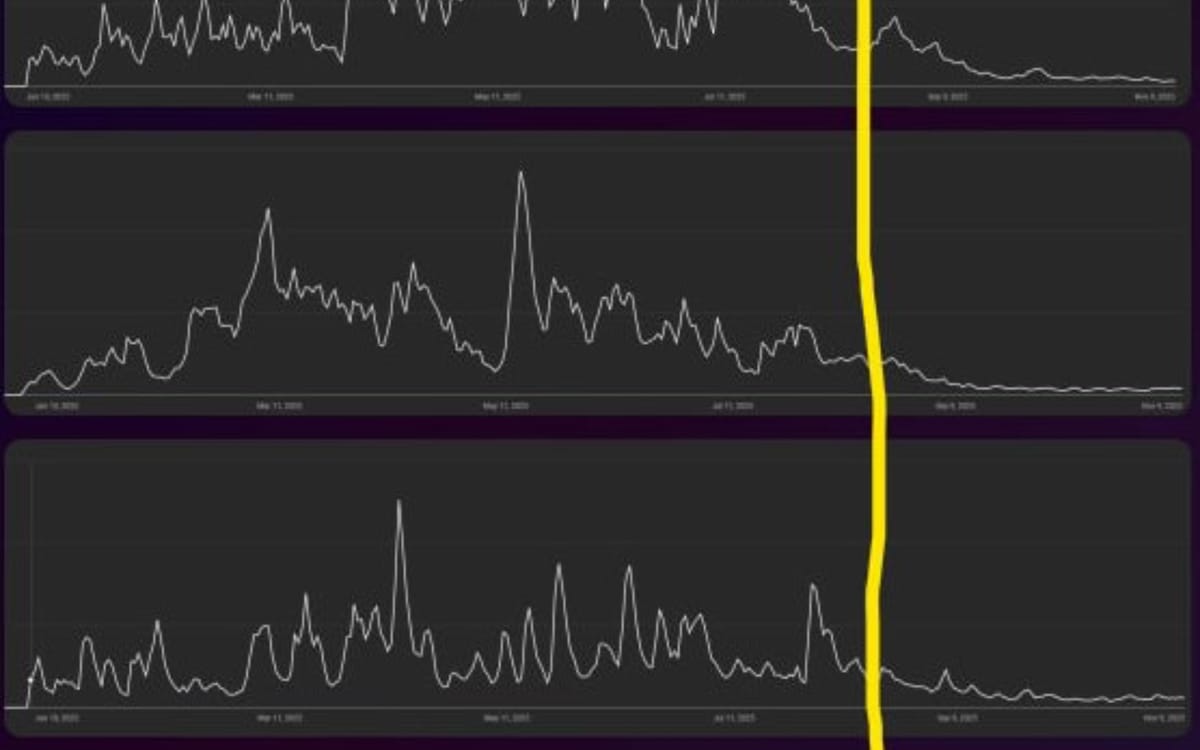
YouTube creators report drops in Shorts viewership after September algorithm change
Data from major channels shows engagement metrics declined sharply starting September 7, with performance remaining suppressed through November 2025.

YouTube Shorts creators experienced substantial viewership declines beginning in early September 2025, with multiple channels documenting synchronized drops that align with undisclosed platform modifications. Mario Joos, a retention director who works with channels exceeding 100 million subscribers including MrBeast, presented data on November 30, 2025, showing significant algorithm changes affecting Shorts distribution across the platform.
The timing proved particularly notable. Joos documented that seven major Shorts channels saw viewership metrics fall off dramatically starting September 7, 2025. These channels, which represent some of YouTube's largest Shorts producers, experienced sustained performance degradation that persisted through late November. The data revealed a clear dividing line in performance metrics, with engagement patterns shifting abruptly rather than gradually declining over time.
Subscribe PPC Land newsletter ✉️ for similar stories like this one
YouTube's recommendation system underwent what industry observers describe as a fundamental restructuring. The platform previously operated on an "expected watch time per impression" model that prioritized content based on predicted viewing duration and audience retention capabilities. Joos explained that YouTube's initial formula considered three primary factors: the prediction-based recommendation system, the ability to retain audience attention, and the method of recommendation delivery.
The September changes introduced additional complexity to this framework. "Expected watch time per impression" expanded to become "expected satisfied watch time per click from impressions," according to Joos's analysis. This modified formula now incorporates five distinct elements: the prediction-based recommendation system, the ability to create a satisfying watch experience, watch time, per-click performance from impressions, and the method of recommendation.
When we think about YouTube's simplified algorithm formula, we think about “expected watch time per impression”. However, this way of thinking isn't complete. Let’s talk about this.
— Mario Joos (@MarioJoos) November 29, 2025
Let’s begin with some context.
Eight years ago, some software engineers at Google published a… pic.twitter.com/mT55y7ykX4
This shift fundamentally altered how YouTube evaluates content performance. The platform now assesses not just whether viewers watch content, but whether they demonstrate satisfaction through continued engagement. The "satisfied" metric represents a qualitative judgment about viewer experience that extends beyond simple watch time calculations.
Joos emphasized that YouTube's algorithm does not test content against initial audiences before broader distribution. "Unlike what most people will tell you and what the common belief is, the YouTube algorithm doesn't really test your content against an initial audience to see how it would perform before sending it to a wider audience," Joos stated. Instead, the system collects data on both videos and viewers, attempting to understand content topics and identify interested audiences. When users access YouTube, the platform pulls videos from its database into a large pool of potential recommendations based on user information and predicted interest levels.
The ranking process then examines each candidate video, assigning performance predictions based on potential user engagement. This ranking determines which content populates feeds through the recommendation system. Throughout this process, YouTube's algorithm learns and improves its recommendation accuracy.
The implications for creators proved significant. Content that previously performed well through established audience relationships now faced additional hurdles. "What this means for you is that it could be that if the algorithm doesn't think your video will be a good interest match for the viewer, it'll never serve your video to this viewer, even if they're a subscriber," Joos explained.
Multiple creators across different content categories reported similar experiences. The synchronized timing of viewership declines suggested platform-level changes rather than isolated performance issues. Channels that previously maintained consistent engagement metrics found their content receiving substantially reduced distribution despite unchanged production quality or audience behavior.
The September algorithm modification followed previous platform adjustments documented in August, when creators reported approximately 30% viewership drops and dramatic shifts from desktop to mobile traffic consumption. Those earlier changes demonstrated YouTube's willingness to implement significant algorithmic adjustments without comprehensive creator communication.
Buy ads on PPC Land. PPC Land has standard and native ad formats via major DSPs and ad platforms like Google Ads. Via an auction CPM, you can reach industry professionals.
YouTube's Shorts format has undergone extensive technical development throughout 2024 and 2025. The platform extended maximum video length from 60 seconds to three minutes in October 2024, while introducing AI-powered editing tools that transform raw footage into polished content. These duration changes affected videos uploaded after October 15, 2024, with gradual rollout spanning several weeks.
The monetization landscape for Shorts has improved substantially. YouTube achieved revenue parity between Shorts and traditional long-form content in the United States during Q3 2025, with Shorts generating equivalent advertising revenue per watch hour. Sundar Pichai, CEO of Alphabet and Google, stated during the October 29, 2025 earnings call that "in the U.S., Shorts now earn more revenue per watch hour than traditional in-stream on YouTube."
The platform also modified how it counts Shorts views starting March 31, 2025, removing minimum watch time requirements and counting views from the moment a video starts to play or replay. This change resulted in higher reported view counts but did not directly impact creator earnings or YouTube Partner Program eligibility criteria.
Content discovery mechanisms received continuous refinement through AI integration. Philipp Schindler, Senior Vice President and Chief Business Officer at Google, noted during the Q3 2025 earnings call that "our recommendation systems are driving robust watch time growth in our key monetization areas like Shorts and Living Room. As we leverage Gemini models, we are seeing further discovery improvement."
Subscribe PPC Land newsletter ✉️ for similar stories like this one
The September algorithm change coincided with YouTube's broader push toward AI-powered content creation tools. The platform introduced Edit with AI in October 2025, converting raw camera roll footage into edited Shorts with automated editing, music, and voiceover capabilities. These tools launched in 15 markets including the United States, Canada, Australia, and several Asian countries.
YouTube also expanded its generative AI capabilities through Photo to Video powered by Veo 2, which transforms static photographs into 6-second video clips based on text prompts. The platform upgraded from Veo 2 to Veo 3 in late November 2025, enabling videos up to eight seconds in length compared to the previous six-second maximum.
Despite these feature enhancements, creators expressed frustration with algorithmic opacity and limited platform communication about changes affecting content distribution. The synchronized viewership declines across multiple large channels suggested systematic rather than isolated impacts, yet YouTube provided no official explanation for the performance shifts.
The algorithmic changes particularly affected evergreen content that previously generated consistent views over extended periods. One creator noted that shorts maintaining steady performance for years suddenly stopped receiving significant distribution after the September update. This shift toward emphasizing recent content over historical material altered fundamental content strategy assumptions for creators who invested in building libraries of timeless material.
YouTube's viewer analytics system, which categorizes audiences into new, casual, and regular viewers, provides creators with engagement depth metrics. However, the September algorithm change appeared to deemphasize regular viewer relationships in favor of satisfying immediate interest matching predictions, potentially reducing the distribution advantage that established creator-audience relationships previously provided.
The platform's collaboration features launched in August 2025 enable multiple creators to receive formal credit and audience exposure on individual videos. These features modify recommendation algorithms to include all tagged creators' audiences in content distribution calculations, creating pathways for audience crossover between collaborating channels.
Marketing professionals relying on YouTube for content distribution must adapt strategies to account for increased algorithmic unpredictability. The September changes demonstrate that established content performance patterns can shift rapidly based on platform modifications that may not receive advance notice or comprehensive explanation.
Recent platform developments suggest YouTube prioritizes immediate viewer satisfaction metrics over accumulated audience relationships or historical content performance. This represents a fundamental shift from previous algorithmic approaches that weighted subscriber relationships and consistent creator-viewer engagement patterns more heavily in distribution decisions.
The timing of these changes aligns with YouTube's competitive positioning against TikTok and Instagram Reels in the short-form video market. Research released November 18, 2025 found YouTube Shorts at 56% consumer preference, narrowly leading TikTok and Facebook at 50% each. Maintaining this competitive advantage likely influences algorithmic optimization priorities.
YouTube's trending page closure in July 2025 marked another significant shift in content discovery mechanisms, with the platform moving toward category-specific charts rather than centralized trending lists. This transition supports algorithmic personalization while reducing centralized content promotion pathways.
For creators dependent on YouTube Shorts for audience development or revenue generation, the September algorithm change introduces substantial uncertainty. Content strategies based on building evergreen libraries or leveraging established subscriber relationships face challenges when algorithmic distribution patterns shift toward immediate interest matching without consideration of accumulated audience relationships.
The situation illustrates ongoing tensions between platform optimization objectives and creator sustainability. While YouTube emphasizes its commitment to creator success through the YouTube Partner Program, which includes 3 million channels earning revenue and has paid $70 billion to creators over three years according to July 2025 disclosures, algorithmic changes that dramatically reduce viewership for established channels undermine these partnership claims.
Technical documentation of the algorithm changes remains limited to creator analysis rather than official platform communication. This lack of transparency complicates strategic planning for marketing professionals utilizing YouTube as a distribution channel, as performance prediction models must account for potential algorithmic shifts that occur without advance notice.
Subscribe PPC Land newsletter ✉️ for similar stories like this one
Subscribe PPC Land newsletter ✉️ for similar stories like this one
Who: Mario Joos, retention director for channels exceeding 100 million subscribers including MrBeast, documented algorithm changes affecting YouTube Shorts creators. Seven major Shorts channels provided data showing synchronized performance declines.
What: YouTube implemented algorithm changes that modified content recommendation formulas from "expected watch time per impression" to "expected satisfied watch time per click from impressions," introducing qualitative viewer satisfaction assessments and reducing emphasis on established creator-audience relationships.
When: Viewership declines began September 7, 2025, with sustained performance degradation persisting through late November 2025. Mario Joos publicly disclosed the analysis on November 30, 2025.
Where: Algorithm changes affected YouTube Shorts globally across all markets, impacting both large-scale creators with established audiences and smaller channels dependent on consistent distribution patterns.
Why: YouTube's algorithmic modifications prioritize immediate viewer satisfaction metrics and interest matching predictions over historical content performance or subscriber relationships, potentially supporting competitive positioning against TikTok and Instagram Reels while optimizing for platform-defined engagement quality standards.