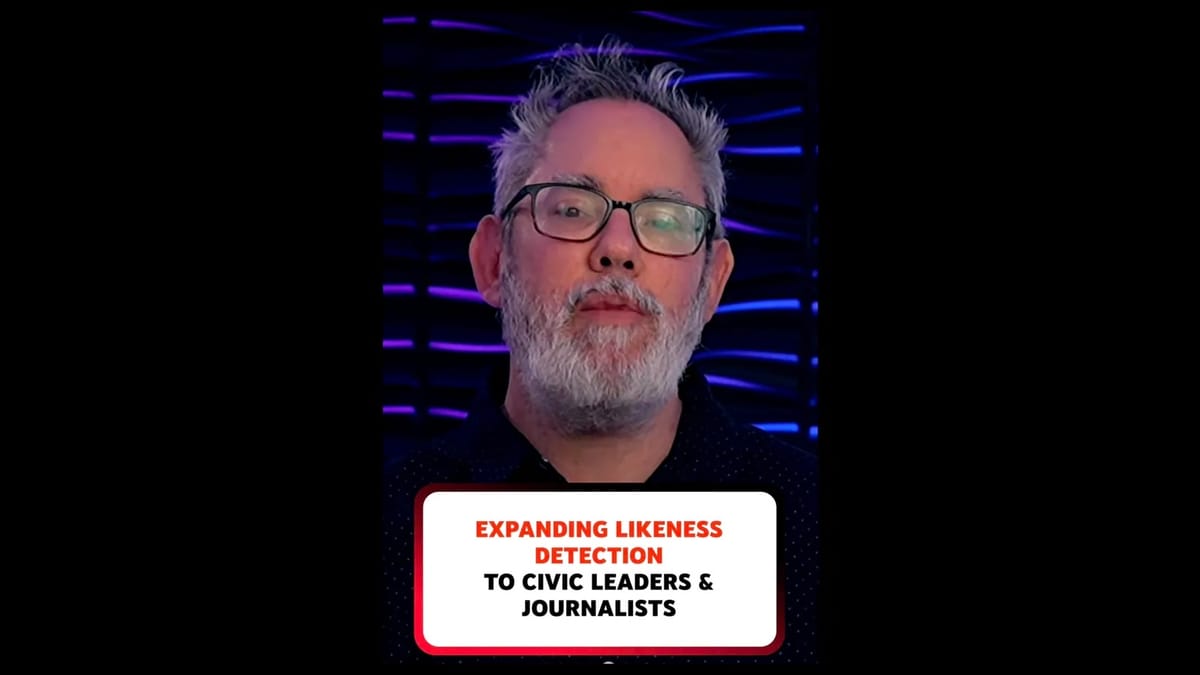
YouTube expands likeness detection to politicians and journalists - will it hold?
YouTube expanded its AI likeness detection tool to government officials, journalists, and political candidates on March 10, 2026, targeting deepfake impersonation of civic figures.
YouTube expands AI likeness detection to civic leaders and journalists to fight deepfakes.
YouTube expands AI likeness detection to civic leaders and journalists to fight deepfakes.
YouTube this week extended its likeness detection tool - previously limited to creators in the YouTube Partner Program - to a pilot group of government officials, journalists, and political candidates, the company announced on March 10, 2026. The expansion was authored by Amjad Hanif, Vice President of Creator Products at YouTube, and Leslie Miller, VP of Government Affairs and Public Policy at YouTube, in a post on the YouTube Official Blog.
The announcement marks a notable escalation in how the platform is tackling AI-generated impersonation, moving beyond the creator economy and into the politically sensitive territory of civic information.
What likeness detection actually does
According to YouTube's documentation, the tool works similarly to Content ID - the platform's long-standing copyright enforcement system - except that it scans for a person's face rather than copyrighted content. When newly uploaded videos are processed, the system performs a one-time automated search to identify whether an enrolled individual's likeness appears. If a match is detected, the enrolled participant receives a notification and can review the content, then decide whether to submit a privacy complaint for removal.
The mechanism relies on biometric data. According to the platform's Help Center documentation, creators and participants must provide a government-issued ID and a brief selfie video to complete verification before enrollment. That selfie video also serves as the reference sample that enables the detection system to search for likeness in uploaded content. Verification can take up to five days to complete.
Data storage is governed by specific retention parameters. According to the platform's documentation, the unique identifier assigned to a participant's verification video, full legal name, and likeness template will be stored on YouTube's internal database for up to three years from the last time the user signed into YouTube - unless the participant withdraws consent or deletes their account. Data from individuals who appear incidentally in scanned videos is discarded immediately and is never stored or used to identify those individuals.
A critical distinction shapes what the tool can and cannot do. According to YouTube, the system "can only identify likeness for enrolled creators who have consented to using the feature and have submitted a reference of their face." It does not constitute general facial recognition across the platform. Non-enrolled individuals whose faces appear in scanned videos are detected as part of the scanning process, but their data is immediately discarded after the enrolled creator's likeness is either found or ruled out.
From creators to civic figures
The tool was first launched to creators in the YouTube Partner Program in 2024. That initial rollout was described by the company at the time as an industry-first capability for managing AI-generated content. The March 10, 2026 expansion to government officials, political candidates, and journalists represents the second major phase of the deployment.
According to Hanif and Miller's blog post, YouTube is "starting with this cohort to ensure the tool meets their unique needs, with plans to significantly expand access over the coming months." The announcement does not specify how many individuals are included in the pilot, which countries are eligible, or how potential participants were selected and contacted by the platform.
The company frames the expansion through the lens of civic discourse. "YouTube is where the world comes to understand the events shaping their lives - from breaking news to the debates that drive civic discourse," according to the blog post. That framing establishes why this specific population was prioritized: government officials, journalists, and candidates are disproportionately likely to be subjects of AI-generated impersonation content designed to mislead voters or audiences.
How removal works - and what it does not guarantee
Detection does not guarantee removal. That point is stated explicitly in the announcement. According to the blog post, "YouTube has a long history of protecting free expression and content in the public interest - including preserving content like parody and satire, even when used to critique world leaders or influential figures." The company says it will "continue to carefully evaluate these exceptions" when receiving removal requests.
The platform's Privacy Guidelines set out the factors considered when evaluating whether content qualifies for removal. According to YouTube's documentation, these include whether the content is altered or synthetic, whether it is disclosed to viewers as altered or synthetic, whether the person depicted can be uniquely identified, whether the content is realistic, whether it contains parody or satire, and whether it features a public figure engaging in sensitive behaviour such as criminal activity, violence, or endorsing a product or political candidate.
For an individual to submit a complaint, they must be uniquely identifiable within the content. According to the documentation, the platform considers the following factors in establishing unique identifiability: image or voice, full name, financial information, contact information, and other personally identifiable information. Legal representatives of an individual can also submit complaints on their behalf - a provision extended to deceased users, whose cases can be handled by the closest family member or legal representative.
When a complaint is filed through the Privacy Complaint Process after a likeness detection match, YouTube will email the participant about the outcome. Participants can also retract a removal request after submission by following a link in the confirmation email. Rejected complaints - where YouTube declines to remove content - do not prevent the content from being removed for other reasons, such as Community Guidelines violations.
Audio detection: a gap still open
The current system covers only visual matches. According to YouTube's Help Center, "the feature is only used to detect visual matches of an enrolled creators' face" at present, with audio detection explicitly listed as a future development. The documentation states: "We're working to extend likeness detection to audio in 2026."
This represents a meaningful gap. AI voice cloning technology has become increasingly sophisticated and accessible - a gap that has already produced legal outcomes in other jurisdictions. A Berlin court ruled in August 2025 that using AI-generated voice clones without permission violates personality rights under German law, ordering a YouTuber to pay €4,000 in damages to a professional voice actor whose voice was replicated for commercial videos without consent. The Berlin Regional Court's 2nd Civil Chamber issued the judgment in case 2 O 202/24, establishing that AI-generated voice imitations carry the same legal liability as human voice impersonators.
Until YouTube extends likeness detection to audio, participants who find AI-altered audio content featuring their voice must use the standard privacy complaint process rather than the automated detection pathway.
Data use and AI training
The announcement is explicit about what participant data will and will not be used for. According to the blog post, "the data provided during setup is strictly used for identity verification purposes and to power this safety feature, and is not used to train Google's generative AI models."
The Help Center documentation elaborates on an optional secondary consent. Participants can agree to allow YouTube to use their face and voice templates to improve the likeness detection models themselves. This consent is separate from the core enrollment and can be revoked at any time through YouTube Studio. According to the documentation, opting into this improvement program means YouTube may use "your face and voice templates to develop and improve likeness detection models."
The NO FAKES Act and legislative context
The blog post references active US federal legislative efforts. According to Hanif and Miller, "we'll keep advocating for strong legal frameworks like the NO FAKES Act, which establishes a federal right of publicity and acts as a blueprint for international adoption to ensure technology serves - and never replaces - human creativity."
The NO FAKES Act - the Nurture Originals, Foster Art, and Keep Entertainment Safe Act - would establish a federal right for individuals to control AI-generated replicas of their voice or visual likeness. YouTube's public endorsement of the legislation places the company alongside a coalition of entertainment industry stakeholders who have argued the legislation is necessary to fill gaps left by state-level personality rights laws, which vary considerably across jurisdictions.
Technical architecture and channel permissions
The tool is accessible through YouTube Studio on desktop. According to the platform's documentation, eligibility requires participants to be over 18 years old and hold a Channel Owner or Manager role to set up the feature. Review permissions extend to Channel Owners, Managers, Editors, and Editors (limited), meaning authorized channel delegates can review matches and submit privacy complaints on behalf of an enrolled Channel Owner or Manager without additional verification.
Once set up, the system scans newly uploaded videos rather than the full archive. According to YouTube's documentation, "our system performs a one-time search of newly uploaded videos, to identify videos that potentially contain the face of each creator who has set up Likeness detection." This means content uploaded before enrollment would not surface through the detection tool, though it could still be reported via the standard Privacy Complaint Process.
Participants can turn off the feature at any time. According to the documentation, doing so may take up to 24 hours to stop detecting new matches. When a participant turns off Likeness detection, YouTube will delete their stored template data from its systems.
Marketing community implications
The expansion carries concrete implications for the marketing community and advertisers operating on YouTube. Brands running influencer and creator campaigns face an environment where platform-level identity protection infrastructure is being built out in ways that may eventually affect how AI-generated content is used in advertising.
YouTube's mandatory AI content disclosure requirements, effective May 21, 2025, already require creators to label synthetic and altered content. Campaigns that incorporate AI-generated likenesses of public figures - politicians or journalists whose audiences trust their endorsements - now exist in a context where those individuals have growing tools to detect and challenge unauthorized use.
The AI-altered content transparency labeling system that YouTube introduced in March 2024, combined with likeness detection and the Privacy Complaint Process, creates a layered framework that increasingly constrains the production of misleading synthetic content at scale. Advertisers seeking brand-safe environments on YouTube benefit from these controls to the extent that they reduce the volume of potentially harmful AI-generated content appearing alongside paid placements.
The expansion also follows reporting by PPC Land on YouTube's deepfake problem in the context of the creator economy, which documented how deepfake scams using creators' likenesses persisted on the platform while legitimate journalistic content was demonetized. Whether the new tools will materially accelerate the removal of fraudulent impersonation content - rather than just provide a procedural pathway for individuals to request it - remains to be seen.
Google's December 2025 launch of video verification tools within Gemini, enabling users to detect content created or edited with Google AI using SynthID watermarking, signals that identity and content authentication infrastructure is being developed across multiple products simultaneously.
January 4, 2026 - PPC Land documented YouTube's deepfake problem, reporting how AI-generated scam videos using creators' likenesses persisted while legitimate journalism was demonetized
March 10, 2026 - YouTube announced the expansion of likeness detection to government officials, journalists, and political candidates, extending a tool first launched to YouTube Partner Program creators in 2024
Summary
Who: YouTube, represented by Amjad Hanif (VP of Creator Products) and Leslie Miller (VP of Government Affairs and Public Policy), announced the expansion. The tool is now being made available to a pilot group of government officials, journalists, and political candidates, in addition to existing YouTube Partner Program creators.
What: YouTube expanded its likeness detection tool - an automated system that scans newly uploaded videos for AI-generated or altered depictions of enrolled participants' faces - to civic leaders and journalists. The system works similarly to Content ID, alerting participants to potential deepfake matches and enabling them to request content removal through the Privacy Complaint Process. Enrollment requires government-issued ID verification and a selfie video, and data is retained for up to three years. Audio detection is not yet available but is planned for 2026.
When: The expansion was announced on March 10, 2026. The original tool was launched to YouTube Partner Program creators in 2024.
Where: The announcement was made on the YouTube Official Blog. The tool operates through YouTube Studio on desktop. The pilot is available to a select group across undisclosed countries, with plans to expand access significantly in the coming months.
Why: The expansion addresses the growing risk of AI-generated impersonation targeting individuals central to civic and journalistic discourse. According to YouTube, these individuals need reliable tools to protect their identities as AI-generated content becomes more sophisticated. The company also cited support for the US federal NO FAKES Act as part of a broader advocacy effort to establish legal frameworks that protect individuals from unauthorized AI-generated replicas.
Share this article
The link has been copied!
Your link has expired. Please request a new one.
Your link has expired. Please request a new one.
Your link has expired. Please request a new one.
Great! You've successfully signed up.
Great! You've successfully signed up.
Welcome back! You've successfully signed in.
Success! You now have access to additional content.