AI anxiety drives consumer privacy fears as data trust reaches crisis point
Verve survey reveals 65% of consumers worry about AI data training, while 97% demand transparency from publishers as privacy concerns intensify in 2025.


Verve survey reveals 65% of consumers worry about AI data training, while 97% demand transparency from publishers as privacy concerns intensify in 2025.
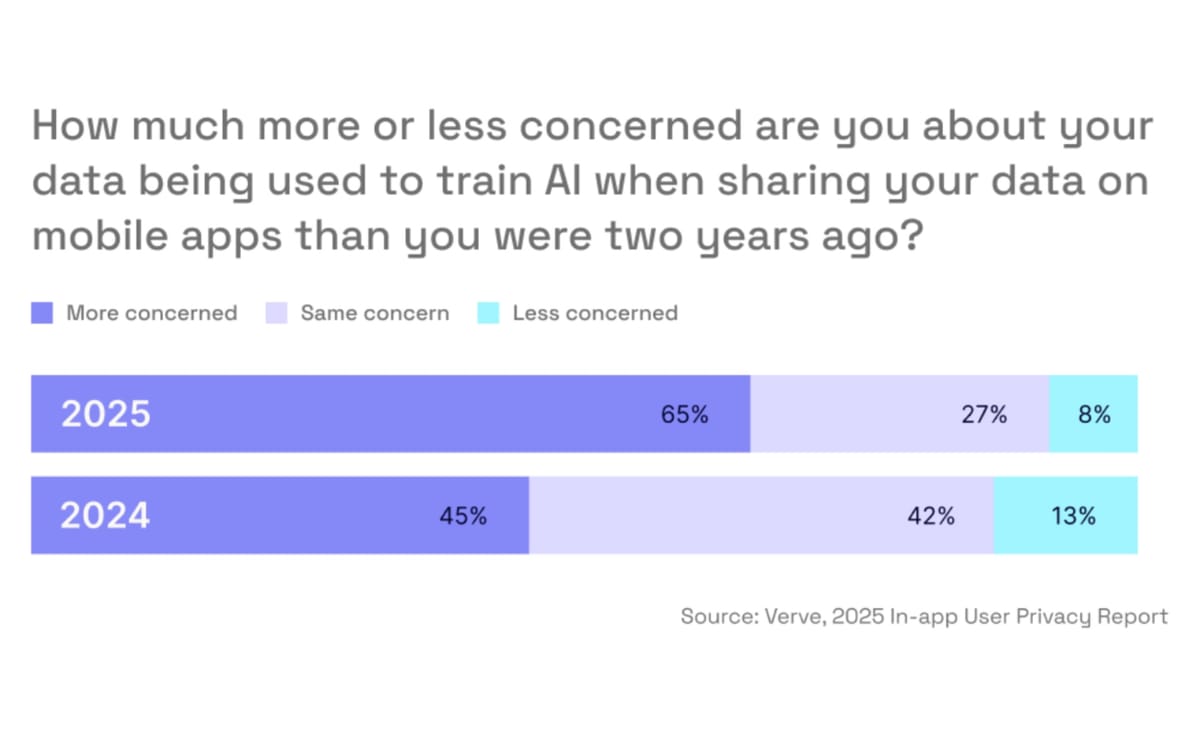
Consumer concerns about data privacy have intensified dramatically as artificial intelligence reshapes digital advertising, with new research revealing that nearly two-thirds of mobile app users now express heightened anxiety about how their personal information trains AI systems.
Verve surveyed 4,000 consumers across the United States and United Kingdom between August 13 and August 19, 2025, uncovering a 40% year-over-year increase in worries about data being used for AI model training. The research, released December 5, demonstrates that 65% of respondents are more concerned about this issue than they were two years ago, marking one of the sharpest shifts in consumer sentiment documented in the advertising technology sector.
"Consumer concerns around AI are at an all-time high, but it's important to remember that AI and machine learning have been foundational in advertising for years," said Matina Thomaidou, VP of Data Science at Verve. "The challenge now goes beyond advancing the technology. It's about bringing consumers along by showing them the usefulness, safety, and value of these tools in creating better, more relevant experiences."
Subscribe PPC Land newsletter ✉️ for similar stories like this one
The findings arrive as consumer trust in AI data handling continues to deteriorate, with separate research published in July 2025 showing 59% of consumers express discomfort with their data being used to train AI systems. This convergence of data points signals a fundamental transformation in how audiences evaluate the relationship between privacy, personalization, and artificial intelligence across digital platforms.
The Verve study documented rising anxiety across every privacy category measured. Two-thirds of respondents reported increased concerns about unauthorized access to their data (67%), cybercrime and hacking threats (67%), and identity theft (66%). An additional 65% expressed worry about unclear data usage practices, highlighting gaps between industry practices and consumer expectations.
These concerns demonstrate significant demographic variation. Women reported steeper increases in privacy anxiety than men, with 71% expressing concern about unauthorized access compared to 63% of male respondents. Age also influences privacy attitudes, with the oldest cohort (55+) showing heightened skepticism across multiple categories while younger groups demonstrated more willingness to share data under certain conditions.
Matina Thomaidou emphasized the magnitude of this shift. The research captured 38% of respondents saying they are "much more concerned" about AI data training, with an additional 27% reporting they are "somewhat more concerned." Only 8% indicated reduced concern levels, suggesting the privacy discourse has moved decisively toward caution rather than acceptance.
An overwhelming 97% of survey respondents agreed that app publishers and platforms need to do more to be transparent about how consumer data is collected, handled, and applied. This near-consensus reflects frustration with existing disclosure practices and mounting pressure on the advertising ecosystem to adopt clearer communication standards.
The demand for transparency extends beyond general principles to specific implementation requirements. When asked what would improve their trust in apps or platforms, 42% of respondents cited knowledge that their data wasn't being shared with third parties. Another 40% wanted clear explanations of how their data is stored and protected, while 38% sought visibility into security measures protecting against attacks.
User control emerged as another critical factor, with 37% saying they would trust platforms more if they could choose how much data to share and modify privacy settings. An additional 29% wanted transparency about how their data generates revenue for platforms, reflecting awareness that personal information has become a valuable commodity in the digital advertising marketplace.
These findings align with broader industry challenges around privacy compliance, as European regulators consider substantial amendments to privacy frameworks that could reshape how AI companies process personal data. The tension between technological innovation and consumer protection continues to define regulatory approaches across multiple jurisdictions.
Despite rising privacy concerns, consumers have not rejected data sharing entirely. The research revealed nuanced attitudes that vary significantly based on app category, data type, and perceived value exchange. Shopping apps and social media platforms emerged as categories where users demonstrate the highest willingness to share certain types of information, with 23% of respondents indicating they won't share any data with these platforms.
Conversely, dating apps face the greatest resistance, with 54% of users unwilling to share any personal data. Gaming apps and news apps also encounter substantial hesitation, with 43% of respondents refusing to provide information to these categories. This variation suggests consumers evaluate data requests based on whether sharing aligns with the app's core functionality and their expectations of the service.
The types of data consumers will share have shifted notably from 2024 to 2025. Willingness to share names declined by 14%, while email addresses dropped 5% and mobile numbers fell 11%. These highly identifying data points now face increased resistance as users become more selective about what information they provide.
However, demographic and contextual data saw increased sharing willingness. Health data sharing rose 29% year-over-year, gender information increased 4%, age/date of birth grew 6%, and regional information jumped 20%. This pattern indicates consumers are becoming more sophisticated in their privacy calculations, protecting direct identifiers while accepting requests for information they perceive as less sensitive or more relevant to service delivery.
Email addresses remain the most commonly shared data type across platforms, with 47.3% of shopping app users, 43.9% of streaming service users, and 41% of finance app users willing to provide this information. Mobile apps generally inspire more data sharing than mobile web environments, suggesting the app ecosystem has built stronger trust mechanisms despite ongoing privacy concerns.
Consumer attitudes toward personalized advertising reveal fundamental contradictions. While 76% of respondents said they're more likely to pay attention to advertisements if they're relevant, nearly half also expressed negative feelings when ads seem personally targeted based on their behavior or preferences.
The research documented that 44% of respondents selected negative responses when asked how they feel about personally relevant advertisements, including concerns that data is being used incorrectly (selected by multiple respondents), feelings of being watched, unease about data usage, and perceptions of privacy breaches. Another 37% chose neutral responses, while 19% selected positive associations.
These mixed signals create challenges for advertisers and publishers attempting to balance effectiveness with user comfort. The data shows younger audiences (ages 16-44) demonstrate more positive associations with personalization, while those 55 and older show much greater skepticism, with 58% selecting negative responses. Gender differences also emerged, with women reporting negative feelings at 53% compared to 43% for men.
Connected TV emerged as the platform where consumers are most likely to engage with relevant advertising, with 32% identifying it as their preferred environment for ad attention. Mobile apps captured 25% of responses, mobile websites 23%, and desktop websites 21%. However, CTV scored lowest for perceived data protection, creating an attention-trust gap that the industry must address.
"When ads are delivered in the right context, they capture attention and invite action," said Jobie Tan, VP of Business Development for Supply at Verve. "Poor contextual alignment can erode consumer trust and damage brand equity. Success lies in pairing relevance with responsibility."
Nearly half of respondents (48%) indicated they're most likely to engage with ads when they're contextually relevant, such as sports ads appearing in sports apps or beauty ads in beauty apps. Conversely, 49% said contradictory ad placements would discourage engagement, and 43% reported such mismatches would negatively affect their perception of the advertised brand.
Consumer willingness to accept advertising in exchange for free content has increased substantially, rising from 67% in 2024 to 75% in 2025. This 8-percentage-point jump reflects growing recognition of the value exchange that advertising enables, particularly as subscription fatigue spreads across digital services.
The research found consistent preference for ad-supported experiences across demographics, though intensity varies depending on the specific incentive offered. Respondents overwhelmingly prefer watching ads over paying for additional benefits across all categories tested, including additional content or information (80% prefer ads vs. 20% prefer paying), access to discounts or perks (80% vs. 20%), additional lives in games (79% vs. 21%), and access to extra features (76% vs. 24%).
This preference extends to more sophisticated value exchanges. Some 76% of users would rather watch ads than pay for virtual currency or a more tailored overall experience, demonstrating that ad tolerance increases when the alternative involves monetary costs. These findings validate the ad-supported monetization model while highlighting the importance of delivering advertising that respects user experience.
Relevant, personalized advertising drives multiple positive outcomes from the consumer perspective. Product discovery topped the list, with 62% of respondents saying personalized ads help them find products they didn't know existed. An additional 60% appreciate seeing content for free due to watching ads, while 57% value the ability to find discounts and coupons more easily.
Product recommendations and efficient shopping also ranked highly, at 56% and 55% respectively, demonstrating that consumers recognize tangible benefits from targeted advertising when implemented thoughtfully. These positive associations provide a foundation for advertisers to build campaigns that deliver value rather than simply pursuing attention.
The research identified specific steps that publishers and platforms can take to improve consumer trust. Eliminating third-party data sharing emerged as the top trust-building measure, with 42% of respondents saying this would improve their confidence. Clear handling and storage information ranked second at 40%, followed by visible security measures at 38%.
User control over data sharing appealed to 37% of respondents, while 29% wanted transparency about how their data generates revenue. These findings suggest a roadmap for platforms seeking to strengthen relationships with privacy-conscious audiences: demonstrate security, eliminate unnecessary sharing, explain practices clearly, and empower users with meaningful choices.
Mobile apps scored highest for perceived data protection at 29%, compared to desktop websites at 26%, mobile websites at 22%, and connected TV platforms at 22%. This ranking suggests the app ecosystem has made progress in communicating privacy protections, though substantial room for improvement remains across all channels.
Industry efforts to establish privacy-first advertising frameworks demonstrate recognition that technical innovation must accompany trust-building communications. Solutions that enable targeting and measurement without relying on persistent identifiers have gained traction as platforms phase out third-party cookies and users exercise greater control over tracking permissions.
Buy ads on PPC Land. PPC Land has standard and native ad formats via major DSPs and ad platforms like Google Ads. Via an auction CPM, you can reach industry professionals.
The research revealed significant variations in privacy attitudes across age groups and genders. Younger users (ages 16-24) showed the sharpest decline in confidence about privacy controls, falling 10 percentage points year-over-year. The 45-54 age group experienced a similar decline, suggesting different life stages create distinct privacy concerns that require tailored approaches.
Understanding of data usage correlates strongly with willingness to share it. About 55% of respondents who shared an opinion felt more likely to share data because they understand it better than two years ago. However, this average masks dramatic generational gaps, with 76% of 25-34 year-olds expressing confidence compared to just 38% of those 55 and older.
Men reported that stronger understanding made them more likely to share data, gaining 3 percentage points year-over-year, while women lost 8 percentage points. This gender gap extends across multiple privacy dimensions, with women showing greater caution about which data types they'll share and which app categories they'll trust with their information.
These demographic divides create challenges for publishers attempting to implement one-size-fits-all privacy approaches. "Strategies around data collection need to be tailored to device contexts," said Morgan Jetto, SVP and GM of Marketplace at Verve. "For personalized advertising to work effectively across all groups, publishers and advertisers must be transparent about which data is collected and how it's used."
Consumer trust varies substantially across different platforms and devices. Streaming services and shopping apps lead in data sharing willingness at 30% each, followed by social media apps at 25% and streaming music at 21%. Finance apps, travel apps, and educational apps occupy the middle tier, while dating apps, gaming apps, and news apps face the greatest resistance.
This ranking reflects user expectations about which platforms need specific types of data to deliver core functionality. Shopping apps require payment and shipping information, social media platforms need profile data, and streaming services depend on account credentials. Users appear more willing to share when they understand the direct connection between data and service delivery.
The platform-specific patterns create opportunities for advertisers to align their strategies with environments where user trust runs higher. Transparency initiatives like Google's Ads Transparency Center demonstrate how major platforms are responding to demands for greater visibility into advertising practices, though critics argue voluntary measures remain insufficient without enforcement mechanisms.
Connected TV presents a particular challenge, ranking lowest for perceived data protection despite scoring highest for ad attention. This gap between engagement and trust suggests CTV platforms must invest in privacy communications to match the premium advertising experiences they deliver. The 15% of respondents willing to share data with CTV platforms indicates substantial room for improvement compared to other channels.
While 65% of respondents said better privacy controls make them more likely to share data, this figure declined from 68% in 2024. The drop proves especially pronounced among younger users and peak income earners, suggesting that privacy controls alone cannot address underlying trust deficits.
About half of consumers regularly avoid engaging with ads across mobile, CTV, and web environments due to privacy concerns. On connected TV specifically, one-third of those who feel more in control still refrain from interacting with advertisements because of privacy fears. These behavioral patterns demonstrate that enhanced controls must be accompanied by transparent communication and tangible user benefits.
The gap between privacy expectations and platform practices has generated regulatory responses across multiple jurisdictions. State-level privacy laws continue to expand across the United States, with Indiana, Kentucky, and Rhode Island implementing consumer data protection acts effective January 2026. Each grants residents rights to opt out of targeted advertising, data sales, and profiling activities.
European regulators are also intensifying oversight, with the European Data Protection Board issuing guidelines in September 2025 establishing how digital marketers must navigate intersections between Digital Services Act obligations and General Data Protection Regulation requirements. These overlapping frameworks create compliance complexity while reflecting growing consensus that privacy protections must be strengthened.
The Verve research arrives as the advertising industry grapples with fundamental questions about data collection, AI deployment, and consumer consent. John Koetsier, VP of Insights at Singular, noted that despite expanded privacy regulations, marketers are gaining access to more data through new frameworks like Meta's Advanced Mobile Measurement and Google's Integrated Conversion Measurement.
"Privacy matters. Doing the right thing matters," Koetsier said. "The good news for marketers is that within that context, we've seen a significant evolution. Now, arguably, with more data points, more context, and more insight from different angles, we have an opportunity to create better attribution and marketing measurement than we had before privacy became as important as it now is."
This perspective suggests the industry can navigate privacy challenges through innovation rather than resistance. However, the 97% of consumers demanding greater transparency indicates that technical solutions alone prove insufficient without accompanying trust-building efforts.
Platform accountability measures continue to evolve, with watchdog organizations like Check My Ads challenging proposed transparency standards as insufficient to address opacity in programmatic advertising. The organization warned in October 2025 that voluntary frameworks risk legitimizing continued lack of transparency rather than establishing enforceable standards.
Beyond data privacy concerns, ad quality directly impacts consumer trust in apps and platforms. Amnon Siev, CEO of GeoEdge, emphasized that low-quality advertisements can destroy trust built through positive privacy practices.
"In-app user trust is fragile, won for slowly and lost in an instant," Siev said. "It can be undone by a single auto-redirect, a fake close button, or an ad disguised as a trusted brand. Users do not think in terms of 'ad quality'; they think in moments. One intrusive ad is not just a bad impression, it often rewrites their entire perception of the app."
The connection between ad quality and trust extends to publisher revenue. When bad ads break immersion, users abandon sessions early, churn entirely, or leave negative reviews that deter new downloads. Trust crisis dynamics compound across multiple touchpoints, with research showing that content suspected to be AI-generated reduces reader trust by nearly 50% and decreases brand advertisement effectiveness by 14%.
Publishers that maintain rigorous ad quality standards can differentiate themselves in increasingly competitive markets. "When advertising is designed to complement, not compete with, an app's context, audience, and content, it transforms the value exchange between publisher and user," Siev explained.
The survey findings point to a formula for building sustainable consumer relationships in privacy-conscious markets: transparency multiplied by value and control, divided by data requests. Consumers have made clear what they want: honesty about practices, tangible benefits in exchange for data, and meaningful ability to manage their information.
For publishers, this means building data stewardship into platform design rather than treating privacy as a compliance afterthought. For advertisers, it requires turning transparency into a performance advantage by demonstrating clear value exchange and respecting user boundaries.
"Stronger privacy controls have helped the industry innovate, but the real opportunity lies in pairing that control with transparency," said Aviran Edery, SVP and GM of Marketplace at Verve. "When consumers understand how their data is used and feel in control, they're far more willing to engage. That's where publishers and advertisers can build lasting trust."
The research demonstrates that trust has become the industry's most valuable currency. Publishers, advertisers, and technology partners that treat trust as the foundation of user engagement will not only meet rising consumer expectations but unlock sustainable growth in an environment where privacy awareness continues to intensify.
Privacy framework development continues across industry organizations, with IAB Tech Lab opening public comment periods on proposed updates to the Global Privacy Protocol and Data Deletion Request Framework. These technical specifications support data management across the digital advertising ecosystem while addressing newly enacted state privacy laws.
As artificial intelligence becomes increasingly integrated into advertising systems, the gap between technological capability and consumer comfort will define industry success. Platforms that invest in clear communication about AI usage, demonstrate tangible benefits from personalization, and empower users with genuine control will capture both audience trust and advertising effectiveness in markets where both have become scarce resources.
Subscribe PPC Land newsletter ✉️ for similar stories like this one
Subscribe PPC Land newsletter ✉️ for similar stories like this one
Who: Verve Group surveyed 4,000 mobile app users evenly split between the United States and United Kingdom, spanning five age groups (16-24, 25-34, 35-44, 45-54, 55+) with balanced gender representation. The research was conducted by Censuswide, an independent research firm that follows Market Research Society and ESOMAR principles.
What: The 2025 In-App User Privacy Report documents a 40% year-over-year increase in consumer concerns about data being used to train AI models, with 65% of respondents now expressing heightened anxiety about this practice. The research shows 97% of consumers demand greater transparency from app publishers and platforms about data collection and usage. Despite rising privacy concerns, 75% of respondents said they're willing to accept advertising in exchange for free content, up from 67% in 2024.
When: Censuswide conducted the survey between August 13 and August 19, 2025, with Verve releasing the complete findings on December 5, 2025. The research provides year-over-year comparisons with a similar 2024 survey conducted in August 2024 that included 4,001 consumers.
Where: The survey covered consumers across the United States and United Kingdom, with 2,000 respondents in each country. The findings have implications for global digital advertising markets, particularly as privacy regulations continue expanding across multiple jurisdictions including European Union member states and US states implementing comprehensive consumer data protection laws.
Why: The research addresses fundamental questions about consumer trust in digital advertising as artificial intelligence adoption accelerates and privacy concerns intensify. Growing anxiety about data collection practices, coupled with unclear communication about AI training usage, threatens the sustainability of ad-supported business models that depend on consumer willingness to share information in exchange for free content and personalized experiences. The findings provide evidence-based guidance for publishers and advertisers seeking to build trust while maintaining effective targeting and measurement capabilities in privacy-conscious markets.