AI poised to unlock $32 billion in marketing measurement value as current systems falter
IAB report reveals 75% of marketers say attribution, incrementality and MMM underperform while half scale AI adoption despite legal and accuracy concerns.


IAB report reveals 75% of marketers say attribution, incrementality and MMM underperform while half scale AI adoption despite legal and accuracy concerns.
Marketing performance measurement systems are fundamentally broken despite widespread adoption, with up to 75% of advertisers reporting that advanced measurement approaches fail to deliver the rigor, timeliness, trust and efficiency needed to justify spending, according to research released today by the Interactive Advertising Bureau.
The IAB State of Data 2026: The AI-Powered Measurement Transformation report, produced in partnership with BWG Global and sponsored by Dstillery and OptiMine, surveyed more than 400 senior planning and analytics decision-makers at U.S. brands and agencies. The findings arrive as marketing budgets shrink as a share of company spending, making measurement failures increasingly costly.
Between 67% and 76% of buy-side decision-makers currently use incrementality tests, attribution analysis or marketing mix models. Yet these approaches consistently underperform across core measurement promises, the research found.
"Marketing and media performance matter more than ever, yet the systems we use to measure them are fundamentally broken," the report stated. Privacy regulations and platform changes have scattered data across disconnected systems, preventing consistent cross-channel measurement and making it difficult to tie exposure to actual results.
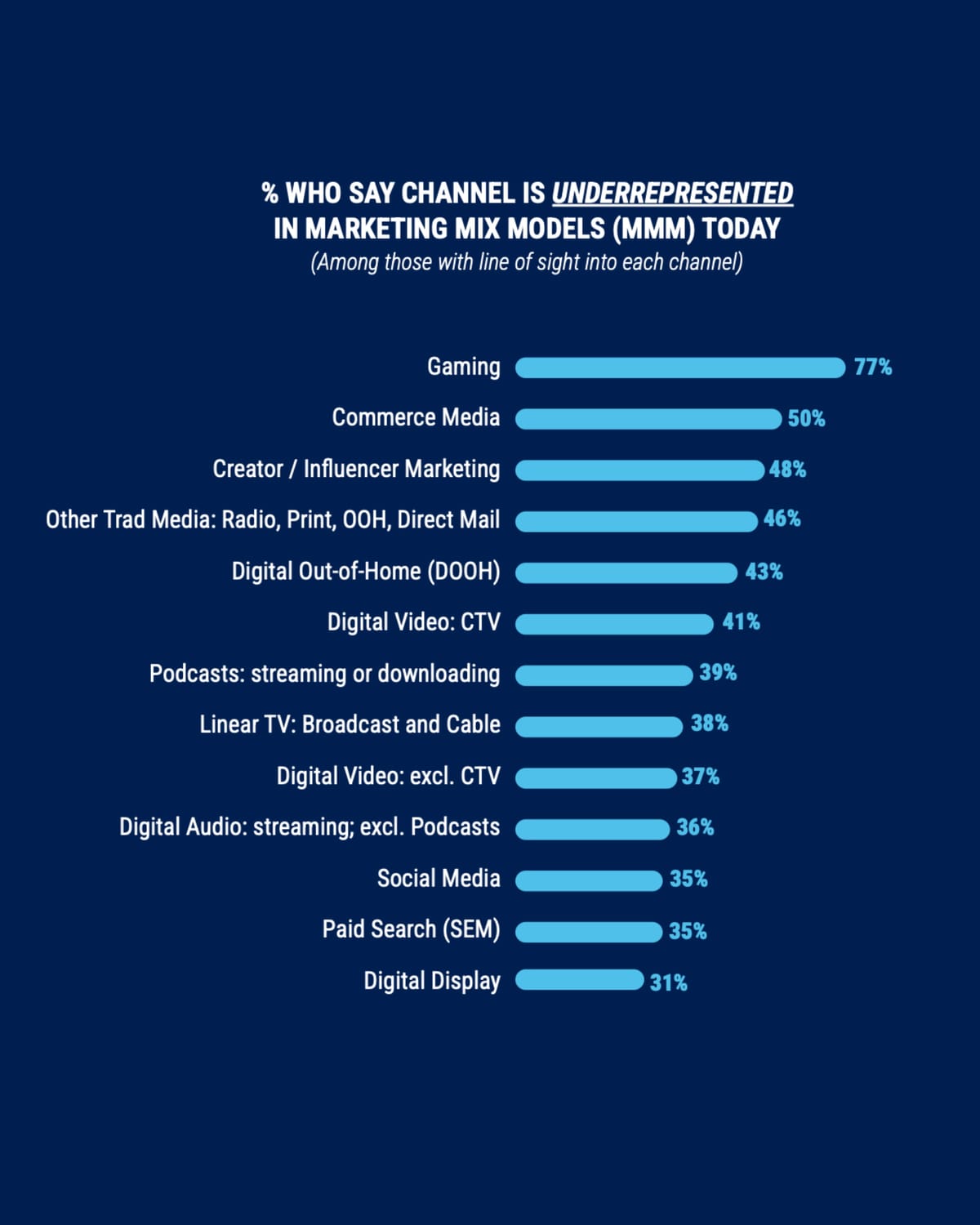
The measurement challenges extend beyond operational difficulties. No media channel is fully represented in marketing mix models, according to the research. Gaming suffers the most severe representation gaps, with 77% of MMM users reporting it as underrepresented. Commerce media follows at 50%, creator and influencer marketing at 48%, and other traditional media including radio, print, out-of-home and direct mail at 46%.
Google's attribution and measurement infrastructure has undergone continuous refinement, with Display & Video 360 adding the "gclsrc" parameter to TrueView click-through landing URLs by the end of 2025 to improve conversion attribution accuracy.
The representation gaps create myopic views of performance that reduce confidence in MMM outputs and reinforce bias toward more measurable channels like display, search and social rather than those driving true incremental impact, the report stated.
Between 60% and 75% of marketers indicate their current measurement approaches do not perform very well across critical dimensions. Specific underperformance areas include capturing performance across all channels, reflecting performance across full-funnel outcomes, cross-validating with other measurement approaches, producing reliable and consistent results, providing useful insights for planning and optimization, delivering quickly enough to inform decisions, maintaining transparency and explainability to stakeholders, establishing trust with planning and analytics teams, achieving wide usage by teams, and operating within cost, staffing and technology constraints.
Half of the buy-side reports scaling AI within advanced measurement frameworks today. Among those yet to scale, more than 70% expect to do so within the next one to two years, signaling rapid expansion despite persistent challenges.
Analytics teams lead adoption, with 69% currently scaling AI compared to 30% of planning teams. This gap reflects analytics teams' extensive machine learning background, technical fluency and ability to implement AI capabilities independently.
Newton Research's integration with Snowflake Cortex AI on November 4 enabled brands to run media mix modeling and incrementality analysis directly within secure data environments without data transfer requirements.
AI use today focuses primarily on data preparation tasks including cleaning, labeling, classifying, integrating and normalizing information before human analysts interpret results. Within one to two years, AI is expected to take on more high-impact work including incrementality test design and analysis, attribution outcome matching and MMM model tuning, the research indicated.
This signals a shift from passive automation toward more cognitive use cases as large language models, generative AI and agentic AI begin supporting synthesis and interpretation of marketing performance rather than just data organization.
The buy-side expects AI will enable more sophisticated measurement approaches. Over the next one to two years, buyers anticipate omnichannel lift tests and multi-touch or algorithmic attribution will become more accessible, approaching parity with today's dominant platform-level and first-touch or last-touch methods.
Building on expectations that AI will enable more holistic measurement, buy-side planners indicated they would increase spend in underrepresented media channels by an average of 5.6% over the next one to two years if AI-enhanced MMM became more accurate and trusted.
Applied to current U.S. market levels, this could represent approximately $14.5 billion in digital investment alone and $26.3 billion across total ad spend, with potential for additional growth from incremental budgets, according to the report.
Beyond media investment, AI could unlock approximately $6.2 billion in productivity value as planning teams expect to reallocate nearly 10% of their time per quarter from data preparation to insight generation and strategy work.
Prescient AI announced on July 15, 2025 what the company described as the first marketing mix model built entirely from the ground up since MMM technology was introduced in the 1960s, featuring proprietary forecasting and optimization capabilities.
The productivity gains materialize as AI enables measurement to run more frequently. The buy-side expects to scale incrementality testing from three to five tests per year to 11 or more annually, while attribution and MMM would shift from annual or biannual runs to monthly updates.
Planning teams see these time savings more optimistically than analytics teams. Planners expect to reallocate work toward insights and strategy, while analytics teams express greater concern around scaling challenges, unclear ownership and resistance to change.
Despite high optimism about AI's potential, half of marketers anticipate that legal and security risks, accuracy concerns and data quality issues will create significant or critical challenges over the next one to two years.
The top expected AI challenges include legal, governance and compliance concerns at 51%, concerns about AI accuracy and transparency at 49%, data security risks at 49%, data quality or accessibility issues at 45%, complexity of setup and maintenance at 41%, lack of industry standards for AI at 40%, high implementation costs or budget constraints at 40%, ethical and bias concerns at 39%, resistance to change from team members or clients at 39%, challenges scaling AI solutions at 39%, and job displacement concerns at 39%.
Amazon implemented shopping-signal enhanced attribution methodology on January 1 affecting view-based campaign measurement across Sponsored Brands, Sponsored Display and Amazon DSP formats while introducing dual reporting through "all views" metrics.
Advanced measurement relies on secure access to sensitive customer and performance data, often shared across teams and fragmented across partners. Unresolved legal, security, accuracy or data issues could force companies to limit what data is included, how it is validated and how it is used and shared, the report warned.
These constraints can reduce model scope, frequency and insight breadth, making insights harder to trust and often outdated.
Analytics teams show heightened concern about execution challenges. They are significantly more likely than planning teams to flag issues with scalability at 45% versus 34%, unclear ownership at 45% versus 31%, high implementation costs at 45% versus 36%, and resistance to change at 43% versus 35%.
C-suite executives express greater concern around cost, ethics and workforce impact compared with vice president-level leaders and below. The C-suite is more likely to cite high implementation costs or budget constraints at 49% versus 38%, ethical and bias concerns at 48% versus 37%, job displacement concerns at 46% versus 37%, lack of AI knowledge or in-house expertise at 43% versus 34%, and challenges customizing AI solutions at 43% versus 38%.
While formal solutions to address AI-related concerns remain limited today, AI-related clauses already appear in approximately 40% of brand-agency and partner contracts, establishing expectations around performance, efficiency, transparency and governance.
This share is expected to more than double to between 70% and 80% within one to two years, signaling a shift toward contractual accountability, the research found.
LinkedIn announced September 23, 2025 the launch of its Company Intelligence API, marking a shift from lead-level attribution to company-based measurement for B2B marketers, with early beta customers demonstrating a 287% increase in companies reached when combining organic and paid touchpoints.
The most common AI-related clauses being included today are governance and compliance expectations at 37%, data transparency or disclosure requirements at 32%, requirements for human oversight or dual review at 30%, campaign performance improvements at 30%, time or cost efficiency guarantees at 29%, AI model accountability clauses at 27%, full-time employee or staffing reduction goals tied to AI deployment at 24%, and incentives for innovation or testing new AI tools at 15%.
Expected adoption rates within one to two years show governance and compliance expectations rising to 78% total implementation, data transparency or disclosure requirements reaching 80%, human oversight requirements hitting 78%, campaign performance improvements achieving 80%, time or cost efficiency guarantees reaching 75%, AI model accountability clauses hitting 79%, staffing reduction goals reaching 69%, and innovation incentives reaching 71%.
The market appears poised to course-correct through contracts as AI governance becomes built into how partners are selected, evaluated and held accountable rather than remaining discretionary.
Alliance Digitale published recommendations this week advocating hybrid approaches that combine attribution modeling with contribution analysis as fragmented tracking environments created by privacy regulations undermine measurement accuracy.
With AI accountability increasingly embedded in contracts, half of the buy-side calls for standards around transparency at 50%, data privacy and protection protocols at 48%, and accuracy and reliability standards at 47% to enable broader adoption and reduce risk.
Additional standards needs include ethical use guidelines at 40%, standardized definitions and taxonomies at 39%, educational courses and materials at 39%, regulation compliance frameworks at 38%, governance frameworks at 36%, standards for purchasing or licensing tools at 34%, model bias and fairness measures at 33%, interoperability standards at 26%, and environmental and sustainability guidelines at 26%.
These areas create the greatest friction when scaling AI across organizations and partners. Transparency is required to validate AI-driven outputs, data protection carries elevated legal and reputational risk due to the use of sensitive data, and accuracy determines whether insights can be trusted and acted upon, the report explained.
Adsquare launched its Attribution Dashboard on June 30 with real-time measurement capabilities using proprietary Control Condition methodology that simulates consumer behavior patterns for unexposed audiences while adjusting for external variables including seasonality and weather conditions.
Without these standards, companies face inconsistent implementations and heightened uncertainty, making it harder to scale AI responsibly, according to the research.
The IAB announced Project Eidos, an industry-wide initiative grounded in shared principles, standards and frameworks. Named after the Greek verb "to see," Eidos aims to bring clarity, consistency and confidence to modern measurement by unifying approaches, improving channel coverage, promoting transparency, clarifying each methodology's role and ensuring AI becomes a trusted co-pilot rather than another black box.
The report provides comprehensive recommendations addressing both industry-wide priorities and method-specific modernization requirements for attribution, incrementality testing and marketing mix modeling.
Industry-wide priorities include strengthening data quality, accessibility and governance through readiness assessments, stricter data hygiene, ongoing quality assurance, expanded access to high-fidelity outcomes data, integrated systems across attribution, incrementality and MMM, and strengthened privacy and compliance protocols.
Comcast Advertising announced three performance-driven solutions on June 17, 2025, addressing measurement challenges through partnerships with Mastercard, Marpipe and PlaceIQ to provide enhanced attribution tools combining television viewership data with transaction records.
Organizations should standardize measurement frameworks for rigor and trust by auditing current models for gaps in full-funnel outcomes and channel coverage, standardizing frameworks across teams to reduce fragmentation, adopting industry taxonomy and standards, triangulating and validating results across measurement approaches, setting clear criteria for when to use each approach, and building roadmaps to unify measurement outputs into single sources of truth.
Modernizing operations to increase speed, frequency and scale requires establishing cross-functional roles and responsibilities, automating manual data preparation steps, shifting incrementality testing from ad-hoc to always-on with structured testing calendars, moving MMM and attribution toward monthly or near-real-time updates with AI-accelerated automation, building repeatable workflows for scenario planning and budget optimizations, and centralizing dashboards to reduce reporting friction.
Expanding measurement coverage across the full media mix involves using experiments to validate incremental impact in emerging channels where direct conversion signals are limited, applying AI-enhanced approaches to put emerging and hard-to-measure channels on equal ROI footing with the rest of the media mix, incorporating full-funnel outcomes to capture brand, mid-funnel and performance impact consistently across channels, improving data access and transparency with closed or fragmented platforms, and developing channel-specific measurement playbooks that reflect nuances while maintaining consistent methodology.
Media.net announced a partnership with Claritas on October 1, 2025 to launch ELEVATE, described as the first sell-side attribution, measurement and optimization solution designed for the open web.
Adopting AI responsibly with clear ownership and guardrails requires defining organizational ownership for AI in measurement across planning, analytics, legal and technology teams, establishing responsible AI guidelines covering accuracy, transparency, explainability and bias mitigation, implementing mandatory training for teams using AI tools or workflows, introducing governance checkpoints for model validation with clear roles for human versus automated review and protocols for failures, updating partner contracts to include AI clauses around data use, risk and accountability, prioritizing AI use cases that deliver measurable value, and building phased AI adoption roadmaps balancing innovation with risk management.
For incrementality testing specifically, recommendations include being purposeful about when to conduct tests by defining when they are required, creating always-on experimentation calendars, right-sizing tests to match decision needs, standardizing test design templates and workflows, creating central repositories of past tests and outcomes, scaling experimentation strategies to fit organizational resources, pooling experimentation resources across brands and markets, training planners and channel owners on experiment-first habits, integrating testing into annual and in-flight planning, and holding regular cross-method working sessions.
Attribution-specific recommendations include building and comparing multiple attribution models with aligned inputs and rules, implementing scheduled attribution refreshes aligned to planning and optimization cycles, building match tables and applying mapping standards, standardizing attribution outputs company-wide, holding regular cross-method working sessions, standardizing event taxonomy before ingestion, separating engagement metrics from performance KPIs and business outcomes, mapping and quantifying signal loss by channel, validating outcome signal quality, and reconsidering tactics with poor attributability.
For marketing mix modeling, recommendations include increasing MMM update cadence using AI-assisted model fitting, enabling interactive scenario simulation for planners, automating health checks and diagnostics, integrating MMM recommendations directly into media planning systems, holding regular cross-method working sessions, standardizing data collection and taxonomy for inputs, structuring outputs for easier cross-method comparison, publishing shared data dictionaries, shifting from batch files to frequent pipelines for modern channels, and running quarterly data-quality audits focused on signal loss and coverage gaps.
Planning teams primarily rely on general purpose AI tools at 83% that are easy to access but lack the functionality needed for scaling adoption across advanced measurement workflows. Analytics teams use a broader mix of AI tools with significantly higher adoption of agent-based platforms at 44% compared to planning's 26%.
Adverity launched Adverity Intelligence on September 12, 2025, marking the company's expansion beyond data integration into AI-powered analytics capabilities built on Model Context Protocol technology.
This suggests how AI tool usage may evolve as planning teams mature in their adoption, likely shifting toward more interoperable and unified solutions over time, the report indicated.
Among those not yet scaling AI, 28% of total respondents expect to scale in 2026, 45% in 2027, and 21% in 2028 or later. Planning teams show slightly higher urgency with 29% expecting to scale in 2026 compared to 27% of analytics teams.
Fewer than 40% of marketers report having or planning solutions to address AI challenges. The most common solutions being used or planned are regular training and updates for AI tools at 38%, mandatory human oversight of AI outputs at 37%, clear lists of approved AI use cases at 35%, strategic roadmaps for AI use over time at 34%, regulatory compliance checks at 34%, data protection protocols at 33%, budget controls at 33%, risk management protocols at 32%, defined KPIs specifically for AI solutions at 32%, shared resources at 31%, and brand integrity protocols at 31%.
The IAB State of Data 2026 research surveyed more than 400 senior planning and analytics decision-makers at U.S. brands and agencies. The study was conducted in partnership with BWG Global and sponsored by Dstillery and OptiMine.
TransUnion research released October 21, 2025 found marketing measurement confidence has plateaued, with 54.1% of marketers reporting no change in confidence year-over-year and 14.3% saying it declined, while internal stakeholders question metrics in 60.2% of organizations.
The report arrives as marketing budgets face downward pressure. According to Gartner's 2025 CMO Spend Survey referenced in the report, marketing budgets are shrinking as a share of company spending, creating less room for inefficiency and intensifying demands that measurement provide timely, credible insights to justify spend and guide optimization.
IAB's Measurement Center drives industry alignment to reduce fragmentation and inconsistency in how advertising performance is defined, measured and reported. The Center's mission is to establish scalable, privacy-by-design measurement practices that give marketers and media owners a clear, comparable view of exposure, reach, attention, engagement and outcomes across channels.
Google announced during Google Marketing Live 2025 on May 22 significant changes to its incrementality testing capabilities, reducing the minimum experiment budget from previous higher thresholds to just $5,000 using Bayesian methodology.
The report emphasized that true measurement progress requires both industry-wide reform and method-specific modernization. While holistic change is essential, attribution, incrementality and MMM each need their own modernization paths to become truly decision-grade and AI-ready.
"The time for workarounds is over," stated Angelina Eng, Vice President of IAB's Measurement Center, in a letter accompanying the report. "Let us fix the root cause."
Who: Interactive Advertising Bureau released research in partnership with BWG Global, surveying more than 400 senior planning and analytics decision-makers at U.S. brands and agencies, with sponsorship from Dstillery and OptiMine.
What: The IAB State of Data 2026: The AI-Powered Measurement Transformation report reveals that up to 75% of marketers say attribution, incrementality tests and marketing mix models underperform on rigor, timeliness, trust and efficiency. Half of the buy-side currently scales AI within advanced measurement frameworks, with more than 70% of those not yet scaling expecting to do so within one to two years. AI could unlock approximately $26 billion in media investment and $6 billion in productivity value. However, half of marketers anticipate significant AI challenges including legal and security risks, accuracy concerns and data quality issues.
When: The report was announced February 7, 2026, based on research conducted in partnership with BWG Global. The study examined current AI adoption levels and projected changes expected within the next one to two years.
Where: The research focused on U.S. buy-side decision-makers across brands and agencies managing advanced measurement including attribution, incrementality testing and marketing mix modeling. Findings apply to organizations operating across major advertising platforms and channels.
Why: Privacy regulations, platform changes and fragmented data environments have scattered measurement signals across disconnected systems, preventing consistent cross-channel measurement while making it difficult to tie exposure to actual results. Marketing budgets are shrinking as a share of company spending, creating less room for inefficiency and intensifying demands that measurement prove ROI. At the same time, the rapid rise of generative and agentic AI is transforming how marketing decisions are made, intensifying pressure to modernize advanced measurement processes. The IAB launched Project Eidos to bring clarity, consistency and confidence to modern measurement through shared principles, standards and frameworks.