Apple will squeeze more ads into App Store search - here's what changes
Apple Ads adds multiple ad positions in App Store search results starting March 3, 2026, first in UK and Japan, before global rollout by end of March.


Apple Ads adds multiple ad positions in App Store search results starting March 3, 2026, first in UK and Japan, before global rollout by end of March.
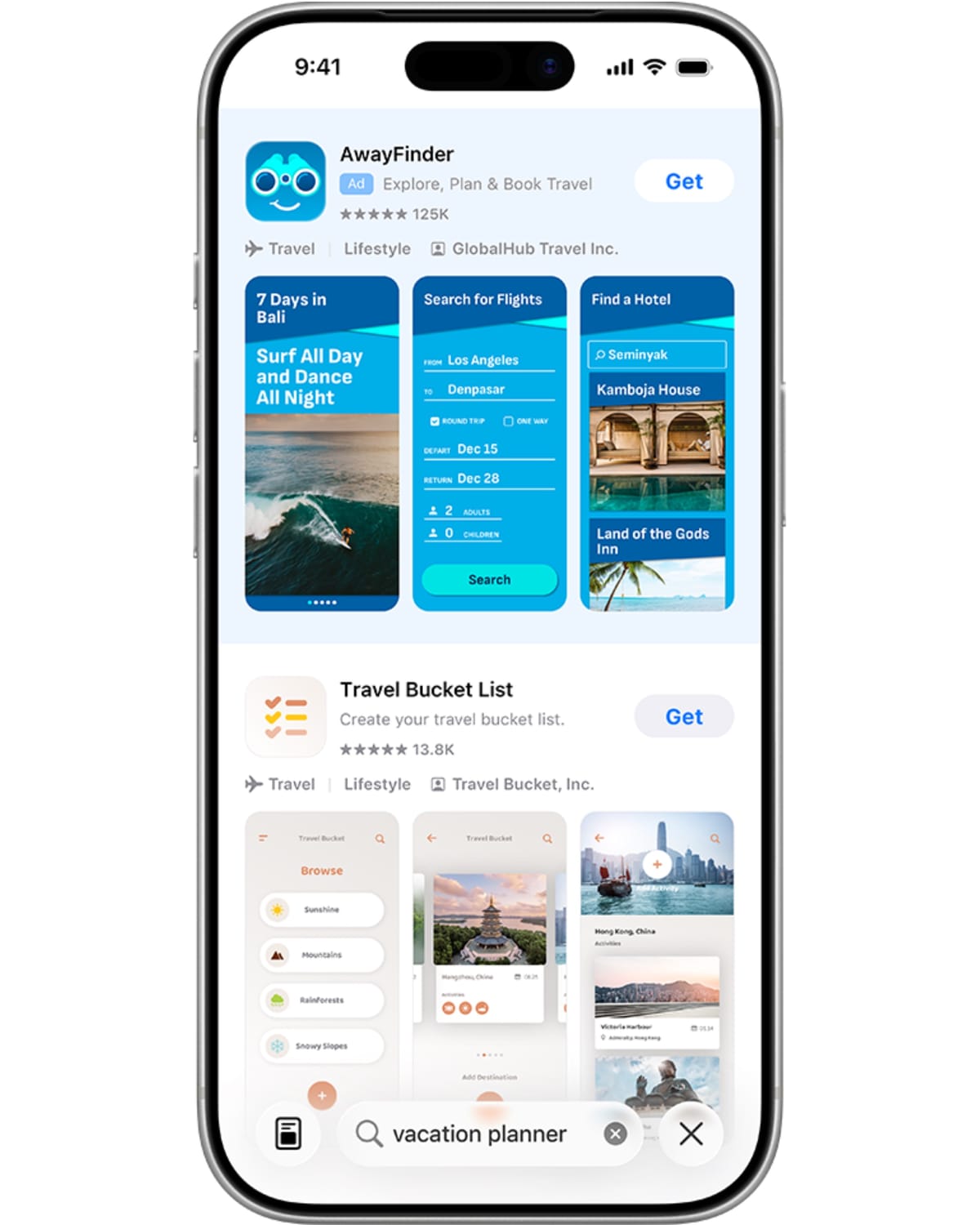
Apple will begin displaying additional advertisements in App Store search results on March 3, 2026, according to announcements sent to developers. The expansion introduces multiple ad positions within search results pages, marking the first increase in search advertising density since Apple launched the platform in October 2016 with a single top-of-search placement.
The new ad positions will appear first in the United Kingdom. Japan follows as the second market. All other Apple Ads markets should see the rollout complete by the end of March. Devices running iOS and iPadOS 26.2 and later will support the multiple ad placements.
Apple operates the App Store across 175 storefronts and 44 currencies. The company reached 850 million average weekly App Store users in 2025, according to services division results announced in January 2026. Nearly 65 percent of downloads happen directly after a search, according to Apple's 2022 data cited in the company's help documentation.
Advertisers running active search results campaigns will automatically qualify for all available positions without campaign modifications. The company specifies that advertisers cannot select or bid for particular positions. Ads will appear either in the existing top position or further down in search results, with placement determined by Apple's auction system.
The ad format remains consistent across all positions. Advertisers can use default product pages generated from App Store metadata or custom product pages created in App Store Connect. Custom product pages integrate with Apple Search Ads to create ad variations aligned with specific audiences and keyword themes. Deep links directing users to specific in-app destinations are available for search results placements on devices running iOS or iPadOS 18 and later.
Billing continues based on existing pricing models: cost per tap or cost per install. No changes to campaign structure, keyword selection, or bid management are required for advertisers to participate in the expanded inventory.
Apple's auction system determines which ads appear based on a combination of factors. The company's intelligent technology matches search terms with promoted apps, delivering more than a 60 percent average conversion rate for ads at the top of search results, according to Apple's data spanning November 2024 through October 2025.
Whether a search results ad displays over other advertisers bidding on the same query depends on app relevance to the search query and keyword bid amounts. According to Apple's documentation, if an app lacks relevance to what users search for, it will not display "regardless of how much you may be willing to pay." The company considers both relevance and bids, explicitly stating it does not put apps into auctions if they are not good matches.
This relevance requirement distinguishes Apple's approach from traditional keyword-triggered advertising systems that prioritize bid amounts over contextual matching. Apple considers both factors but excludes apps from auctions entirely if they fail internal relevance thresholds.
The introduction of additional ad positions raises questions about organic search visibility. Ramazan Tugay Kahraman, a Senior ASO Practitioner, commented on the announcement via LinkedIn that "a decrease in organic traffic is certain." He noted that "impressions and installs will drop for many keywords where you are no longer ranked #1."
Kahraman suggested Apple might attempt to make ads look more organic by removing blue backgrounds from advertisements. This design change could blur the distinction between paid and organic results for users browsing search listings.
The expansion of Apple's advertising business has accelerated since the company rebranded from "Apple Search Ads" to "Apple Ads" on April 14, 2025. The name change reflected expanded advertising offerings beyond search-only placements and signaled broader advertising ambitions. Apple now offers advertising placements in multiple locations throughout the App Store ecosystem, including the Search tab, the Today tab, and "You Might Also Like" sections on product pages.
The multiple placement structure creates new dynamics for advertisers targeting competitor keywords. Kahraman noted that with the new placement, "it will be possible to acquire users more cheaply." He specifically highlighted competitor keywords, suggesting "brands will likely not be able to maintain either the #0 or #2 ranking simultaneously, allowing for cheaper installs from competitors."
This dynamic could benefit smaller developers and independent publishers who compete against larger brands with substantial advertising budgets. The relevance requirements Apple enforces may protect against purely bid-driven displacement, though advertisers with sophisticated keyword strategies and creative testing capabilities could still gain advantages.
The announcement lacks specifics about impression share reporting for the new placements. Kahraman identified this as "the biggest problem" in his analysis, noting "there is no explanation about this in the email or on the official website."
Impression share metrics indicate the percentage of available impressions an advertiser's ads received. Without clear reporting on how impression share calculates across multiple positions, advertisers may struggle to evaluate campaign performance and optimize bidding strategies effectively.
Apple's search advertising journey began in October 2016 with a single placement at the top of App Store search results. The platform expanded gradually over subsequent years. In May 2021, Apple introduced Search tab campaigns that appear before users search. Late 2022 brought expansion into the Today tab and "You Might Also Like" sections below individual app listings.
December 2023 saw Today tab ads updated to be larger and more dynamic, featuring custom product page assets animating in the background. Throughout 2024, Apple tested artificial intelligence to automatically decide optimal ad placement within the App Store.
The company registered with AdAttributionKit on April 10, 2025, marking a significant shift in mobile ad measurement. This integration means app advertisers no longer need to manage two different attribution methods, eliminating duplicate conversion reporting. Previously, Apple Search Ads campaigns were tracked separately through the AdServices API, creating a disjointed measurement ecosystem.
Apple's advertising business has expanded geographically alongside product development. The platform expanded to 21 new countries on October 3, 2024, including Turkey, Cyprus, Morocco, and 18 other markets across Europe, Asia, Africa, and the Middle East.
The phased rollout of multiple search placements mirrors Apple's geographic expansion strategy. Starting with the UK market on March 3, 2026, followed by Japan, allows the company to test implementation and gather performance data before global deployment. The end-of-March timeline for remaining markets suggests rapid scaling once initial testing validates the approach.
Apple's advertising expansion arrives amid increased regulatory scrutiny. French antitrust authorities fined Apple €150 million in early 2025 over App Tracking Transparency implementation, arguing the consent framework created advantages favoring Apple Ads over third-party networks. The challenges created by privacy restrictions have pushed advertisers toward Apple's first-party advertising products, which maintain deterministic attribution within the company's ecosystem.
The company faces additional regulatory pressures in other markets. Japan's Mobile Software Competition Act requires iOS platform changes including alternative marketplaces and payment options. Similar requirements exist in Europe under the Digital Markets Act.
These regulatory frameworks could influence how alternative marketplaces establish independent advertising and discovery mechanisms outside Apple's ecosystem. Alternative app marketplaces now operate on iOS in Europe, including AltStore PAL, Epic Games Store, Setapp Mobile, and Aptoide.
Beyond advertising changes, Apple continues updating App Store policies. The company revised its App Review Guidelines on November 13, 2025, introducing mandatory age verification for creator apps and mini apps, establishing 36% maximum APR caps for loan applications, and requiring explicit disclosure of third-party AI data sharing.
These policy updates reflect platform concerns about content safety for younger users, particularly as apps increasingly incorporate user-generated content and AI-powered features. The guidelines now mandate that creator apps implement age restriction mechanisms based on verified or declared user age to limit underage access to content exceeding the application's age rating.
Apple's services division reached record performance in 2025. Services revenue hit $27.423 billion during the June 2025 quarter, representing 12 percent growth compared to $24.213 billion in the prior year quarter. The Services division encompasses various offerings including advertising, the App Store, cloud services, and digital content sales.
The strong Services performance reflects Apple's strategic focus on recurring revenue streams that complement hardware sales cycles. Advertising represents one component of this diversification strategy, alongside subscriptions, digital content sales, and cloud services. The expansion of advertising inventory through multiple search placements aligns with broader efforts to maximize revenue from the App Store ecosystem.
The multiple placement expansion creates several implications for mobile app marketers. Advertisers must adapt strategies to account for increased competition across more inventory positions. The automatic enrollment approach differs from typical platform expansions that require advertisers to opt into new inventory sources or adjust campaign settings manually.
Cost dynamics may shift as more inventory becomes available. Increased ad density could lead to higher cost-per-click rates as more brands participate in auctions and Apple expands monetizable keywords. Advertisers should monitor efficiency metrics carefully and adjust bidding strategies based on actual conversion performance rather than simply maximizing impression share.
The relevance-first approach to auction participation provides some protection for quality apps against pure bid-driven displacement. However, advertisers with sophisticated keyword strategies and creative testing capabilities will likely capture advantages in the expanded inventory environment. Smaller developers may face increased competition for visibility in search results, though Apple's relevance requirements could level the competitive playing field compared to platforms that prioritize bid amounts.
The multiple ad positions require devices running iOS and iPadOS 26.2 and later. This version requirement ensures users have the updated App Store interface capable of rendering multiple ad positions within search results. Earlier iOS and iPadOS versions will continue displaying only the existing top-of-search placement.
Advertisers do not need to update campaign configurations, adjust keyword lists, or modify bidding strategies to participate. The automatic enrollment applies to all active search results campaigns. Advertisers running campaigns when the feature launches will see their ads eligible for all available positions immediately.
The technical architecture maintains Apple's existing quality and performance standards. Ad creative uses either default product pages or custom product pages created in App Store Connect. Deep linking functionality remains available for directing users to specific in-app destinations on compatible devices. Billing systems continue operating on cost-per-tap or cost-per-install models without changes.
Who: Apple Inc. announced changes affecting app developers, mobile marketers, and advertisers participating in the Apple Ads platform across 175 App Store storefronts. The company reached 850 million average weekly App Store users in 2025, creating substantial advertising inventory for developers seeking app discovery.
What: Apple will introduce multiple ad positions within App Store search results pages, expanding beyond the single top-of-search placement available since the platform's 2016 launch. Advertisers running active search results campaigns will automatically qualify for all available positions without campaign modifications. The ad format remains consistent across positions, using default or custom product pages with optional deep links. Billing continues on cost-per-tap or cost-per-install models.
When: The rollout begins March 3, 2026, in the United Kingdom market. Japan follows as the second market. All other Apple Ads markets should complete implementation by the end of March 2026. The feature requires devices running iOS and iPadOS 26.2 and later.
Where: The expansion affects all Apple Ads markets globally, including the United States, European markets, Asian markets, and regions where Apple Search Ads operates. The phased approach starts with UK and Japan before extending to remaining markets. Alternative app marketplaces operating in Europe under Digital Markets Act requirements establish independent advertising mechanisms outside Apple's system.
Why: The expansion matters because nearly 65 percent of App Store downloads happen directly after search, according to Apple's 2022 data. Multiple ad positions increase monetizable inventory while potentially reducing organic search visibility for apps. Search results ads at the top position deliver more than 60 percent average conversion rates according to Apple's November 2024-October 2025 data. The changes arrive as Apple's advertising business contributed to Services revenue reaching $27.423 billion during the June 2025 quarter, representing 12 percent year-over-year growth. Regulatory scrutiny accompanies the expansion, with French authorities fining Apple €150 million in early 2025 over App Tracking Transparency implementation that allegedly favored Apple Ads over third-party networks.