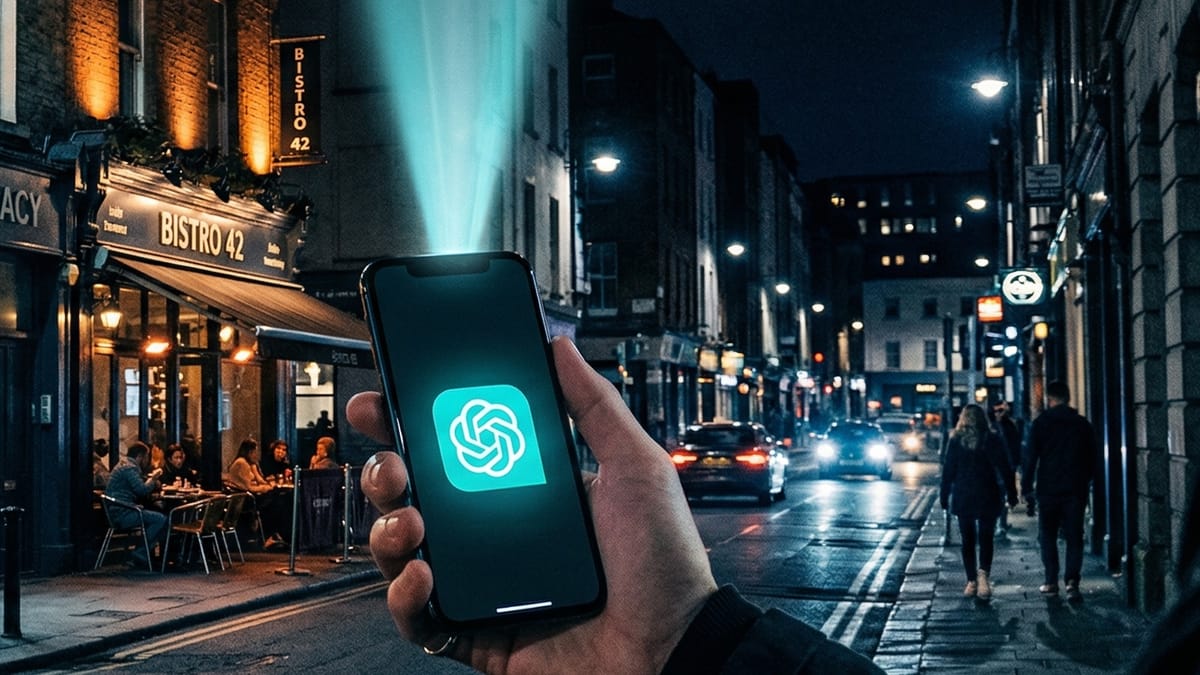
OpenAI rolled out location sharing for ChatGPT on March 26, 2026, a feature that lets users share their device's GPS data so the platform can deliver local recommendations, news, and weather. The update, documented in OpenAI's official release notes and flagged by Glenn Gabe, President of G-Squared Interactive LLC, landed quietly alongside a simplified mobile sidebar redesign and a new plugins directory for Codex. Few in the industry took note - which, according to Gabe, may itself be the story.
"It's a big update by ChatGPT IMO that rolled out on March 26th that nobody is talking about," Gabe wrote in a LinkedIn post shortly after the announcement. He was blunt about the competitive stakes: "Google dominates for them," referring to local queries. The update is rolling out to all ChatGPT consumer plans on iOS and web, with Android listed as "coming soon."
What the feature does - and how it works
Location sharing in ChatGPT is opt-in and disabled by default. According to OpenAI's release notes, users "can now choose to share their device location so ChatGPT can provide more relevant information, such as local recommendations, news, and weather." Sharing is not automatic. The setting must be actively enabled through Settings > Data Controls, and it can be turned off at any time.
When a user enables location sharing, two distinct data layers become available. The first is approximate location - a broad geographic signal used to calibrate contextually relevant responses. The second is precise location, which refers to the device's exact address-level GPS coordinates. OpenAI's documentation makes the technical distinction explicit: "Precise location means ChatGPT can use your device's specific location, such as an exact address, to provide more tailored results." The example given in the release notes is direct: if a user asks "what are the best coffee shops near me?", ChatGPT can use the precise location to provide more relevant nearby results.
On mobile, these two layers can be decoupled. Users can keep approximate location sharing enabled while toggling off the precise location layer separately - giving a measure of additional control for those who want regional relevance without street-level exposure.
The data handling has its own architecture. OpenAI states that precise location data is deleted after it has been used to generate a response. However, if a response includes location-specific information - such as the names of nearby restaurants or maps - that information becomes part of the conversation history and persists unless the user manually deletes the conversation. Parents using parental controls can disable location sharing entirely for teen accounts.
The local search problem ChatGPT has long had
Local search has historically been one of the weakest areas for ChatGPT. Queries like "restaurants near me," "pharmacies open now," or "weather today in [city]" depend on real-time geospatial data that a static language model cannot provide without external signals. Google, by contrast, has built two decades of local search infrastructure - Google Maps, Google Business Profiles, and a deep index of real-world locations, hours, reviews, and inventory - that makes it the default starting point for location-based queries among most smartphone users.
That gap has been commercially consequential. ChatGPT's traffic share dropped from 86.6% to 64.6% over the course of 2025, and research examining 973 e-commerce websites found ChatGPT referrals generated lower conversion rates than all major digital channels except paid social media. Those structural weaknesses are particularly pronounced for local intent queries - the kind where a user's physical location is the single most important ranking variable.
Gabe's framing of this as the "Near Me ChatGPT Update" captures the competitive logic succinctly. Local search queries - "near me," "open now," "best [X] in [city]" - are among the highest-intent categories in digital advertising. Google has long dominated this territory, and any meaningful incursion by ChatGPT would have direct implications for local advertisers, multi-location brands, and the agencies managing their campaigns.
Why the advertising dimension matters
The location update arrives at a moment when OpenAI's advertising infrastructure is moving from concept to operational reality. OpenAI began testing ads inside ChatGPT on February 9, 2026 - initially for free and Go tier users in the United States, at a CPM rate of $60. That rate is well above Meta's typical CPMs, which often fall under $20, and comparable to premium streaming or NFL broadcast inventory.
The advertising test has expanded since its launch. Criteo became the first formal ad tech partner in the ChatGPT pilot on March 2, 2026, connecting its network of approximately 17,000 advertisers to ChatGPT's free and Go tiers. The minimum spend commitment for pilot participants stands at $200,000. OpenAI's Ads Manager began testing with a small group of partners in March 2026, with weekly CSV performance reports and real-time campaign management.
The connection between location data and advertising potential was not lost on observers. Matt Hepburn, a CMO commenting on Gabe's LinkedIn post, put it simply: "When Chat GPT ads paid ads, this sharing of location will be key." The comment compressed a multi-layered strategic argument into a single sentence. Local advertising - search ads tied to proximity, local inventory, and immediate purchase intent - is among the most commercially valuable categories in digital advertising. If ChatGPT can combine user location with its existing contextual understanding of conversations, the result is a targeting signal that could eventually rival the intent-plus-location combination that Google has monetized for years.
OpenAI's head of monetization Asad Awan has outlined a vision for advertising automation in which small businesses could create campaigns through prompts rather than through traditional ad platforms. Location data would be foundational to that model - a prompt-based system that serves a local restaurant ad to a user who has just asked about "dinner options nearby" represents a fundamentally different targeting mechanism than a keyword auction.
OpenAI had previously confirmed that ads "are shown using information that stays within ChatGPT and is not shared with advertisers," including what users discuss, how they interact with ads, and their past chat history. Adding location to that signal stack creates a richer behavioral profile, even if precise GPS coordinates themselves are deleted after each use.
Technical layers: what "deletes after use" actually means
The privacy architecture deserves closer examination. OpenAI states that precise location data is deleted "after it's used to provide a more relevant response." That deletion applies to the raw GPS coordinates. It does not apply to the inferences or location-specific content generated from those coordinates. If ChatGPT responds to a nearby-coffee-shop query with a list of specific establishments, that list - along with the user's query - remains in chat history.
The implication: the raw coordinate is transient, but the behavioral signal it produces is not. A sequence of location-informed queries accumulates into a pattern that ChatGPT's memory system can reference in subsequent conversations - assuming the user has chat history enabled. This is consistent with how OpenAI has described its broader advertising targeting approach, where past chats and memories are used to inform ad relevance. The location feature simply adds a new category of signal to that existing framework.
On mobile, the dual-layer structure - approximate versus precise - gives users meaningful options. Approximate location might place a user in a city or neighborhood, sufficient for weather, general news, or broad restaurant categories. Precise location is required for "near me" queries that need street-level specificity. A user wanting local news without exposing their exact home address could, in principle, keep approximate location on while disabling precise location.
The parental controls dimension adds another layer. Parents who have set up parental controls in ChatGPT can disable location sharing for teen accounts entirely, preventing the feature from activating regardless of what the teen selects in their own settings.
What this means for search and local marketing
The competitive significance of this feature depends on a variable OpenAI itself acknowledged: user adoption. Gabe's post raised the question directly - "do users even know this is possible and will people share their location? If not, ChatGPT will continue to underperform for those queries."
That is a reasonable concern. Google's advantage in local search is not purely technical - it is also behavioral. Users have trained themselves to open Google Maps or Google Search for local queries. Changing that reflex requires not just a capable alternative but a visible one. A feature buried in Settings > Data Controls is not a feature that most users will discover organically.
The parallel with ChatGPT's shopping updates from March 24, 2026 is instructive. OpenAI has been building commerce infrastructure across multiple fronts - visual product results, side-by-side comparison, image-based product search - but Walmart disclosed in March 2026 that conversion rates for products sold directly inside ChatGPT were three times lower than those requiring users to click through to Walmart's website. Strong feature design does not guarantee adoption or commercial performance.
Still, the structural argument for location sharing is more compelling than for many other ChatGPT features. Local queries have a natural trigger - a user already in a conversation who needs nearby information. The friction of opening a separate app is genuine. If the experience inside ChatGPT becomes reliable enough for local recommendations, some portion of users who would otherwise switch to Google Maps may stay in the conversation instead. That incremental shift in query behavior is precisely what advertising-supported AI platforms are building toward.
OpenAI's advertising pilot was launched on February 9, 2026, and the platform now sits at 700 million weekly active users. The addition of location data as a targeting signal arrives as OpenAI is building out measurement infrastructure, expanding partner relationships, and testing creative formats. Location-informed advertising in local categories - restaurants, retail, services - represents some of the highest CPM potential in the digital advertising market. It is also, not coincidentally, where Google has been most difficult to displace for years.
Timeline
- May 1, 2025 - OpenAI introduces shopping to ChatGPT with 1 billion weekly searches, beginning its expansion beyond conversational AI into commercial territory
- June 18, 2025 - Analysis projects ChatGPT could overtake Google search traffic by 2030, based on adoption trends and growing query volume
- October 24, 2025 - ChatGPT traffic underperforms Google in e-commerce study analyzing 973 websites with $20 billion in combined revenue, finding lower conversion rates than all major channels except paid social
- December 2, 2025 - OpenAI issues internal "code red" directive, pausing advertising development to focus on product quality amid competitive pressure
- January 16, 2026 - OpenAI officially announces ChatGPT advertising tests for free and Go tiers in the United States, ending months of speculation; ChatGPT Go expands globally at $8/month
- January 24, 2026 - ChatGPT's traffic share falls below 65% for the first time since 2023, down from 86.6% twelve months earlier, as Gemini surges to 22%
- February 9, 2026 - OpenAI begins serving ads inside ChatGPT at $60 CPM for free and Go tier users in the United States; confirmed early participants include Target, Ford, Adobe
- February 11, 2026 - Ahrefs research shows ChatGPT sends 190 times less traffic to websites than Google, despite handling 12% of Google's search volume
- February 15, 2026 - OpenAI's head of monetization outlines advertising automation vision, describing prompt-based campaign creation that could reduce the role of agencies
- March 2, 2026 - Criteo becomes the first ad tech partner in OpenAI's ChatGPT advertising pilot, connecting 17,000 advertisers to the platform; Criteo reports LLM-referred users convert at 1.5 times the rate of other referral channels
- March 11, 2026 - OpenAI's Ads Manager begins testing with a small group of partners, per PPC Land reporting
- March 24, 2026 - ChatGPT shopping updates roll out, improving product results with visual detail, side-by-side comparisons, and image-based search
- March 26, 2026 - OpenAI launches location sharing for ChatGPT on iOS and web, enabling GPS-based local recommendations, news, and weather; Android rollout described as "coming soon"
Summary
Who: OpenAI, the company behind ChatGPT, deployed the location sharing feature. Glenn Gabe, President of G-Squared Interactive LLC, was among the first to publicly highlight its competitive implications. Matt Hepburn, a CMO, noted its potential significance for ChatGPT's paid advertising business.
What: ChatGPT launched an opt-in location sharing feature allowing users to share device GPS data - including both approximate and precise location - so the platform can deliver local recommendations, news, and weather. Precise location data is deleted after each use, but location-informed content remains in chat history. The feature is disabled by default and managed through Settings > Data Controls.
When: The feature was announced and began rolling out on March 26, 2026, as part of a broader update that also included a simplified mobile sidebar and a plugins directory for Codex.
Where: The rollout covers iOS and web for all ChatGPT consumer plan tiers. Android availability is described as "coming soon." The feature is available globally to users who opt in.
Why: Local search is an area where ChatGPT has historically underperformed relative to Google, which has decades of local search infrastructure. Location sharing gives ChatGPT the data layer needed to respond to proximity-based queries - the "near me" category - which is both high-intent for users and high-value for advertisers. As OpenAI builds out its advertising business, location data represents a foundational targeting signal for local advertising, a segment where Google's dominance has been hardest to challenge.
Share this article
The link has been copied!