FLORA's FAUNA: the AI creative agent that fights back against generic
FLORA launched FAUNA on March 31, 2026, a node-based AI creative agent backed by $52M, used by Nike, Netflix, and Pentagram to preserve brand craft.


FLORA launched FAUNA on March 31, 2026, a node-based AI creative agent backed by $52M, used by Nike, Netflix, and Pentagram to preserve brand craft.
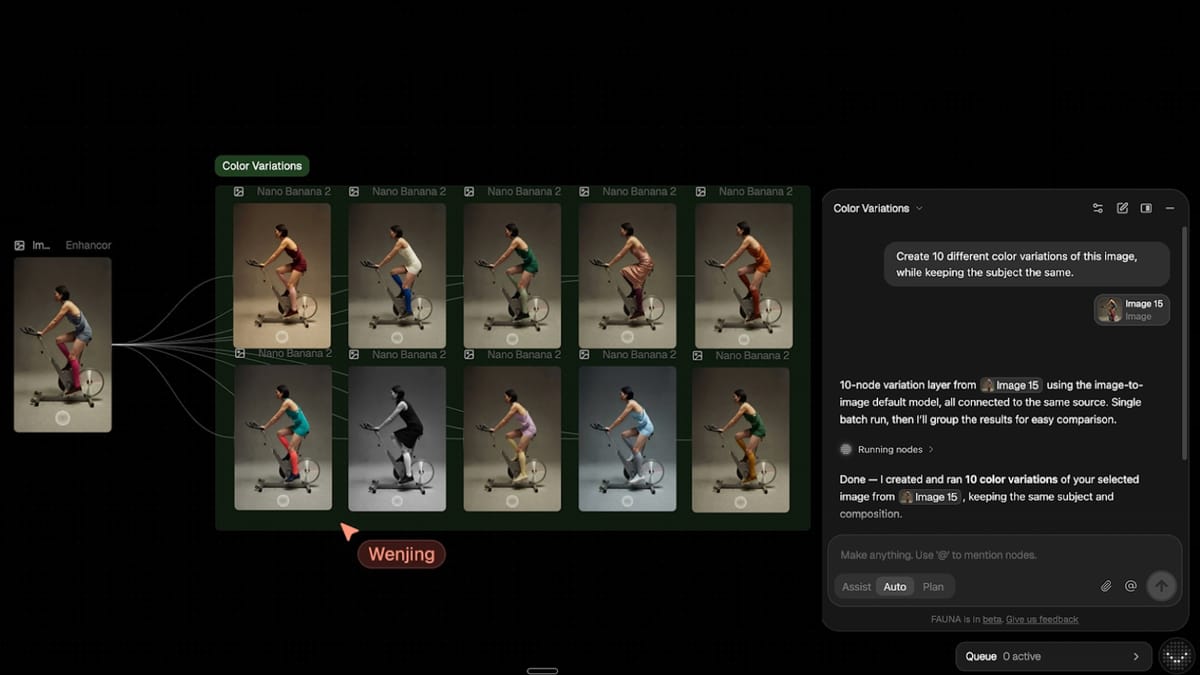
FLORA, a Brooklyn-based creative platform, this week launched FAUNA, an AI creative agent built with the stated aim of preserving the distinctiveness of professional creative work rather than accelerating its homogenization. The announcement, made on March 31, 2026, positions FAUNA as a direct response to what the company describes as a growing convergence problem in AI-generated output.
The launch carries practical weight for marketing and creative teams at major brands. According to the press release, Nike, Netflix, Pentagram, and Wonder Studios are already using FAUNA in production. That list of early adopters is not incidental - each operates at the intersection of brand identity and visual scale, where the pressure to produce more creative assets at lower cost is sharpest and the risks of generic output are highest.
The technical architecture of FAUNA differs from conventional prompt-to-output tools. According to the company, FAUNA "builds complete workflows in real time on a visible canvas - adding nodes, connecting models, executing generations while users watch and steer." The system is built on a node-based visual canvas, meaning each step in a generation pipeline is represented as a discrete, adjustable element rather than a black box. Users can observe the process unfolding and intervene at any stage.
The distinction matters technically. Most generative AI creative tools today accept an input prompt and return an output, with the intermediate steps - model selection, parameter weighting, chaining decisions - hidden from the user. FAUNA exposes that machinery. Every decision remains visible and adjustable, according to the press release.
Rather than starting from a blank prompt, FAUNA begins by building an understanding of the user's creative history and instincts. "FAUNA starts by understanding how users think, what they've made before and their instincts - then builds toward that," according to the announcement. In operational terms, this means the system attempts to model a creative professional's taste before generating anything, making the output a reflection of individual judgment rather than statistical average.
The platform gives teams access to more than 50 leading AI models on a single canvas. FLORA describes itself as model-agnostic by design, integrating new models as they emerge so teams are not locked into a single vendor's technology stack. That flexibility matters in a market where model capabilities shift quarter to quarter and vendor lock-in can leave creative teams behind.
Launching alongside FAUNA are two additional features. Techniques are pre-built creative workflows developed by professionals at leading brands and agencies, including Netflix, Base Design, and Wonder Studios. A designer can access Pentagram's brand system workflow and adapt it for their own project. According to the company, this turns world-class expertise into reusable systems - turning what was previously locked inside a single agency's institutional knowledge into a transferable template.
Image Editor brings editing tools directly into FLORA's canvas. The stated intent is to ensure teams never need to leave the platform mid-production. In practice, breaking out to a separate editing application to fix or refine a generated asset has been a persistent friction point in AI-assisted creative workflows. Integrating editing directly into the same environment where generation happens removes that context-switch.
FLORA's pricing model departs from the per-seat subscription structure common in creative software. According to the pricing page, the company charges on a credit basis, where credits are consumed when users generate content and the cost of each generation varies by model and computational load. The stated rationale is that teams pay for what they create, not for how many people have access.
Three subscription tiers are available at launch. The Starter plan, priced at $18 per month when billed monthly (or $20 billed monthly without annual commitment), provides 20,000 credits per month - equivalent to roughly 1,000 images, 100 videos, or 10,000 text generations, with 1,000 credits costing $0.90. The Studio plan, positioned as the most popular option and described as suitable for small creative teams developing ideas and producing focused deliverables, costs $54 per month and provides 60,000 credits - approximately 3,000 images, 300 videos, or 30,000 texts, at the same $0.90 per 1,000 credits rate. The Scale plan, aimed at teams producing high-volume final assets, costs $200 per month and provides 250,000 credits at a lower rate of $0.80 per 1,000 credits, which translates to roughly 12,500 images, 1,250 videos, or 125,000 texts. All three tiers include unlimited seats, meaning pricing scales with output rather than headcount. Custom enterprise arrangements are also available.
Several structural features of the credit model are worth noting for teams evaluating the platform. Credits roll over - FLORA states unused credits are not removed at the end of a billing period, which reduces the pressure to exhaust allocation before renewal. All models are included across plans, meaning access to the full library does not depend on tier. There are no slow queues; FLORA states every generation receives priority processing regardless of plan level. A free account option also exists with 1,000 starter credits for initial experimentation.
The depth of the integrated model library is considerable and covers all major content types. On the image side, the platform includes FLUX 2, FLUX Pro 1.1 Ultra, FLUX Kontext Inpaint, Google Imagen 3, Google Imagen 4, Ideogram 3.0, Midjourney alternatives, OpenAI GPT Image 1 and GPT Image 1.5, Recraft V4, Stable Diffusion 3.5, and FLORA's own models including Nano Banana 2 and Nano Banana Pro. Generation times on image models range from 2 seconds for Gemini 2.0 Flash to 2 minutes for LoRA Trainer workflows. Credit costs for image generation vary substantially - a Flux 2 Turbo generation costs 9 credits, while Nano Banana Pro costs 100 credits per standard generation or 200 credits for the 30-second variant. The most computationally expensive image operations - Marey Motion Transfer and Kling O3 Pro Edit - reach 2,668 and 1,867 credits respectively.
On the video side, the model list includes Google Veo 2, Google Veo 3, Google Veo 3.1 (the most expensive video model at 4,267 credits per generation), Sora 2 Pro, Kling models across versions 2.0 through 3.0, Runway Gen-3 and Gen-4 variants, Hailuo Minimax, Luma Ray 2, WAN 2.2, and others. Video generation is substantially more credit-intensive: Veo 3.1 Fast costs 1,600 credits for a roughly 2-minute generation, while Kling 3.0 Pro costs 2,240 credits. The cheaper end of video generation runs from 27 credits for Tencent LTXV to 100 credits for AnimateDiff Turbo. Generation times for video range from 10 seconds to over 7 minutes depending on the model and operation.
The text model library includes Claude Sonnet 4.6 and Claude Opus 4 and 4.5, OpenAI GPT-5 through GPT-5.4, Gemini 2.5 Pro and Gemini 3, and OpenAI o3 with a Deep Research variant that runs for up to 10 minutes and costs 900 credits. ElevenLabs Multilingual v2 for voice synthesis costs 3 credits per generation. The utility model category covers upscalers including Topaz, Magnific, Enhancor across multiple versions, and FLORA's own Flora Upscaler, as well as background removal via VEED, audio effects via ElevenLabs, and FLUX development utilities including Canny and Depth variants.
The credit cost differentials across the model library serve a practical function. A team testing concepts with Flux 2 Turbo at 9 credits per image can run hundreds of variations within a single plan, while the same team producing final deliverables with Nano Banana Pro or Veo 3.1 will consume credits at a substantially higher rate. That tiering of cost by computational intensity is designed to make experimentation affordable while reflecting the real resource cost of high-resolution, high-fidelity generation. Importantly, the pricing page states no surprise throttling - a direct reference to a common complaint about other AI creative platforms that advertise unlimited access but impose undisclosed rate limits under load.
The company's framing of the competitive landscape is blunt. According to FLORA, the core problem with most AI creative tools is that their output is "averaged, reflecting the middle of everything the models were trained on." The visual consequence is that work generated by different teams using the same widely available tools looks similar - because it is similar, statistically speaking.
This is not a fringe concern in the marketing industry. Research published in July 2025 by Raptive found that suspected AI-generated content reduces reader trust by nearly 50% and decreases brand ad effectiveness by 14% in purchase consideration metrics. Separately, an IAS report released in December 2025 showed that 83% of media experts stated that increasing levels of AI-generated content on social media require monitoring - a figure that reflects how widely the saturation concern has spread across the industry.
FLORA's response is a design philosophy that positions the next competitive advantage not as volume but as recognizability. "Output that couldn't have come from anyone else," according to the press release.
Weber Wong, founder and CEO of FLORA, offered a taxonomy of how the creative industry is currently responding to AI. "Creative work is splitting into three groups," he said. "There are professionals refusing AI entirely, convinced they're protecting their craft - but that stance won't hold. There are people using AI as a generator - fast outputs, no control, generic work. They're producing more of less. Then there's a third group who see AI as a multiplier of their taste and judgment."
Wong's framing maps closely to patterns documented elsewhere in the industry. A January 2026 analysis of four million Claude AI conversations found that just 5% of occupational tasks account for 59% of all AI interactions, with the highest-usage tasks scoring significantly higher on creativity and cognitive complexity. Tasks demanding idea generation showed the strongest correlation with AI adoption. That concentration suggests creative professionals are already gravitating toward exactly the kind of high-judgment work FAUNA claims to support.
Wong stated that FAUNA is built for the third group - those who treat AI as a multiplier - but noted that eventually everyone will need tools that prioritize craft over speed. "This isn't about helping people who can't design," he said. "It's about making people who already know what good looks like unstoppable."
FLORA has raised $52 million to date. Investors include Redpoint Ventures, a16z Games Speedrun, Menlo Ventures, Hanabi, Long Journey Ventures, and Factorial Capital. Operator-investors include Guillermo Rauch, CEO of Vercel; Emery Wells, CEO of Frame.io; Justin Kan, founder of Twitch; and Gabe Whaley, founder of MSCHF. The combination of traditional venture capital with operators who work at the intersection of developer tools and creative media reflects the dual audience FLORA is targeting - technical teams capable of working with node-based systems and creative professionals who need the technical complexity abstracted away.
The tension FAUNA is addressing is one that PPC Land has tracked across multiple angles over recent months. A January 2026 analysis noted that evidence from late 2025 and early 2026 reveals a consistent pattern where AI excels at optimization and pattern recognition but struggles with brand stewardship and quality content creation. The gap between vendor promises and market reality has remained significant despite genuine technological progress.
Creative automation, specifically, sits in the category where the analysis recommended cautious deployment with human oversight - precisely the model FLORA is proposing. A February 2026 Adobe study found that marketers lose approximately 91 business days per year to low-impact tasks, with content production representing a persistent bottleneck. Adobe's own research, cited in PPC Land's December 2025 coverage of the company's creative trends forecast, indicated that 62% of marketers experienced increased content production volume in the past year - a demand increase that is accelerating even as quality questions around AI-generated content accumulate.
The advertising industry has simultaneously watched platforms build their own AI creative tools. Amazon's AI Creative Studio, announced in October 2024, brought together the company's generative AI generators into a single application for advertisers. Google's Asset Studio expanded AI-powered image editing and text-to-image functionality globally. These platform-native tools lower barriers to creative production. What they do not do, by design, is preserve the distinctiveness of an individual brand's visual identity - they are built for volume and broad compatibility, not for craft.
FLORA's argument is that this gap is not a bug in platform AI tools but a fundamental structural feature. A tool optimized for broad applicability will, by statistical necessity, produce output weighted toward the middle of the training distribution. Differentiating creative output requires a different architecture - one that weights a specific team's history, taste, and judgment before generating anything.
Research examining marketer confidence in AI, published in November 2025 by MiQ, found that 72% of marketers plan to apply AI in more ways over the next 12 months, yet only 45% feel confident in their ability to apply it successfully. Ad creative design and optimization had reached only 32% adoption at the time of the survey. Brand safety and compliance concerns ranked as the third most cited barrier to broader AI adoption. These numbers suggest the market FLORA is targeting - professional teams who want more from AI than volume - is real and currently underserved.
The credit-based pricing model FLORA has chosen is also a deliberate departure from the norms of creative software. Seat-based pricing, the dominant model across tools like Adobe Creative Cloud and most SaaS design platforms, creates a mismatch for agencies and studios that bill by project rather than by headcount. FLORA's unlimited-seat structure with output-based billing aligns cost with production volume, which may lower the barrier to enterprise adoption for larger creative organizations where license management across contractors and freelancers has historically been a friction point.
According to FLORA, FAUNA is designed to function like a creative partnership rather than a generator. "Users bring a direction, FAUNA pushes back with variations. Users react, FAUNA refines," the press release states. The output is framed not as something FAUNA made but as something that emerged from friction between the user's instincts and the system's capabilities. That framing borrows language from collaborative design practice rather than software product marketing.
The practical implementation of this on the canvas means creative briefs shift from static documents into live conversations. A designer describes an idea; FAUNA builds toward it; the designer refines. Each iteration remains visible as a node in the workflow, making the creative process auditable and reproducible - which matters when teams need to recreate a look across different campaigns or formats.
FLORA states that the platform is currently available at flora.ai. FAUNA is noted as being in beta at the time of launch.
Who: FLORA, a Brooklyn, New York-based creative technology company founded by Weber Wong, backed by Redpoint Ventures, a16z Games Speedrun, Menlo Ventures, and other investors, with early production users including Nike, Netflix, Pentagram, and Wonder Studios.
What: The launch of FAUNA, an AI creative agent built on a node-based visual canvas that integrates more than 60 AI models across image, video, text, and utility categories; priced on a credit basis with three plans (Starter at $18/month, Studio at $54/month, Scale at $200/month), unlimited seats across all tiers, credit rollover, and no per-seat fees. Two companion features launched simultaneously: Techniques (pre-built professional creative workflows) and Image Editor (integrated editing tools on the canvas).
When: March 31, 2026, announced under embargo at 10 AM ET / 7 AM PT.
Where: Announced from New York, NY, and available at flora.ai.
Why: FLORA argues that the dominant AI creative tools on the market produce statistically averaged output that degrades brand distinctiveness, and that creative professionals need a system that weights their individual taste and judgment rather than optimizing for broad compatibility. The launch addresses a tension the marketing industry has documented for over a year - between the efficiency gains from AI-assisted content production and the brand equity losses that occur when AI-generated assets become indistinguishable from one another. The output-based pricing model specifically targets the structural mismatch between seat-based software licensing and how creative agencies and studios actually work and bill.