
Google Vids gets free Veo 3.1 video generation, music, and AI avatars
Google Vids adds free Veo 3.1 video generation, Lyria 3 music, and directable AI avatars for all users, with 1,000 monthly generations for Ultra subscribers.

Google Vids adds free Veo 3.1 video generation, Lyria 3 music, and directable AI avatars for all users, with 1,000 monthly generations for Ultra subscribers.
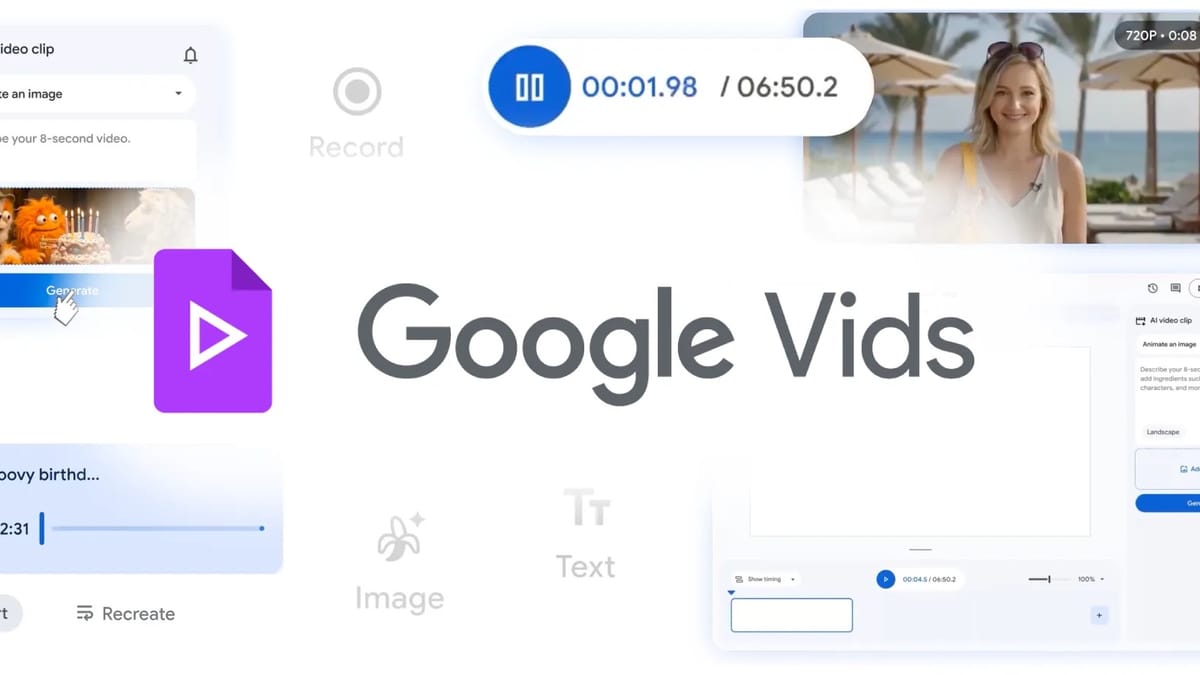
Google on April 2, 2026, expanded Google Vids with a set of AI capabilities that move the platform well beyond basic video editing. The update brings high-quality video generation at no cost to all Google account holders, custom music composition powered by Lyria 3, and directable AI avatars backed by Veo 3.1 - plus a Chrome extension for screen recording and a direct publishing path to YouTube. The announcement was made by David Nachum, Group Product Manager for Google Vids, on the company's official Keyword blog.
Video generation is now accessible to anyone with a Google account. All personal accounts receive 10 video generations per month at no cost, powered by Google's latest model, Veo 3.1. Users can generate clips from a text prompt or from a photo, without requiring a paid subscription. Google positioned the feature as suitable for animated flyers, short promos, or greeting cards. Subscribers who need higher output can upgrade to a paid tier.
The move is significant in context. Google launched Veo 3 Fast for developers in July 2025, pricing programmatic API access at $0.40 per second - a rate aimed at businesses running automated creative pipelines. Making Veo 3.1 available to all personal account holders at no cost marks a distinct shift in strategy: moving the technology from developer infrastructure into a mass consumer product.
Veo 3.1 represents a technical step forward from the Veo 3 Fast and Veo 3 Quality variants that Google introduced through its Flow filmmaking platform and the Gemini API in 2025. According to Ricky Wong, Lead Product Manager at Google DeepMind, Veo 3.1 delivers "more consistency, creativity and control" compared to earlier iterations and maintains character appearance across multiple generations even when settings change - a technical limitation that had persisted in earlier AI video models. YouTube integrated Veo 3.1 into its Ingredients to Video feature on January 13, 2026, allowing Shorts creators to combine three images into a single generated clip.
Custom music generation arrives for Google AI Pro and Ultra subscribers. Powered by Lyria 3 and Lyria 3 Pro, the tool can produce tracks ranging from 30 seconds to three minutes. The application is integrated directly into Google Vids, enabling users to compose original audio without leaving the editing environment. No external music licensing or third-party audio library is required. The system accepts thematic guidance - a lighthearted tune for a birthday video, or an uplifting score for a travel reel - and generates a track to match.
Google has not previously offered an integrated music composition tool inside Vids at this scale. The Lyria model family sits alongside Veo and Imagen in Google DeepMind's generative media portfolio. Lyria 3 Pro, the higher-tier variant now available in Vids, is distinct from earlier Lyria models that powered background music in other Google products. The introduction of music generation inside a video editor - rather than as a standalone tool - means the workflow remains contained within a single application, reducing the number of production steps for a finished piece.
AI avatars represent the most technically layered addition. Powered by Veo 3.1, the feature is available to Google AI Pro and Ultra subscribers. Avatars are not static overlays. According to Google's announcement, users have "complete directorial control" over how their characters look and act. That control extends in two directions.
First, placement and interaction: avatars can be positioned in specific scenes and made to interact directly with uploaded objects - a physical product, a prop - set against custom backdrops. Second, appearance: outfits can be swapped, background settings adjusted, and fine visual details modified, all while the avatar's voice and identity remain consistent across edits. The consistency of voice and identity across costume and background changes is a meaningful technical claim. Earlier AI avatar systems often struggled to preserve vocal characteristics when visual parameters changed.
The directorial vocabulary here - "narrate," "interact with," "set against custom backdrops" - signals that Google is framing Vids avatars as a production tool rather than a novelty. A virtual host for a school project, a narrator for a travel vlog, a product demonstrator for a side business: these are the specific use cases Google names. The framing is practical, not aspirational.
The Chrome extension is the fourth new capability and is available to all users at no cost. Called Google Vids Screen Recorder, it adds a recording studio function directly to the browser. Users can capture their screen and themselves from anywhere on the web without navigating back to Vids first. The extension brings the recording interface into the browser context, removing one of the friction points in starting a video project.
Direct publishing to YouTube is the fifth addition, also available to all users. Finished videos can be pushed from Vids to YouTube without downloading or re-uploading files. Exports default to Private, meaning creators review the content before it becomes visible to others. The Private default is a deliberate guardrail - one that addresses a common concern about accidental premature publication when using automated export pipelines.
YouTube introduced its own set of Veo-powered tools for Shorts creators in July 2025, including photo-to-video generation and generative camera effects. The Vids update and YouTube's own AI features now form a more continuous pipeline: generate in Vids, publish to YouTube, without leaving Google's ecosystem.
Ultra tier capacity receives a significant increase alongside the consumer features. Google AI Ultra and Workspace AI Ultra accounts can now generate up to 1,000 Veo videos per month. That figure places Ultra accounts in a different category from personal users with 10 monthly generations - a gap that scales the product across individual, professional, and enterprise use cases. Google did not disclose the previous monthly generation limit for Ultra subscribers in the April 2 announcement.
Google AI Pro is priced at 21.99 euros per month after a trial period, providing 100 monthly AI credits across platforms including Flow and Whisk; Google AI Ultra carries a 274.99 euros monthly price with 12,500 monthly credits and priority access to the most capable models. The Vids update does not change these pricing structures but does add substantial new capabilities within each tier.
The marketing community has watched video production costs and timelines compress steadily as AI generation tools have expanded across major platforms. Google launched Asset Studio in September 2025, centralizing creative production for advertisers - including video generation using Veo technology - directly inside Google Ads. The Vids update operates in a different context: it targets personal users, creators, and small producers rather than media buyers running campaign pipelines. But the underlying model - Veo 3.1 - is the same technology.
That overlap is worth noting. A small business owner generating a product promo in Vids and a performance marketer generating ad creative in Asset Studio are now drawing from the same generation model, at different price points and within different interfaces. The quality floor for AI-generated video has been standardized across Google's consumer and advertising products.
Rival platforms have moved quickly in this area. Meta announced upgraded video generation capabilities for advertisers at Cannes Lions in June 2025, transforming images into multi-scene videos. Amazon expanded its Video Generator to all United States advertisers in June 2025. Midjourney entered AI video in the same month. Snapchat launched its Animate It video generation lens in December 2025. The Vids update positions Google's consumer video product within this competitive field, not as an advertising tool but as an editing suite that happens to include generation.
The music generation feature introduces a question that Google's announcement does not address: what happens to the rights in a Lyria 3-generated track? Google states that Pro and Ultra subscribers can generate tracks, but the announcement is silent on licensing, ownership, and whether generated audio can be used commercially. This matters because one of the primary use cases Google names is creating content for platforms like YouTube - where Content ID systems detect and flag audio that matches known tracks. AI-generated music has triggered Content ID disputes before, particularly when models trained on copyrighted material produce outputs that resemble existing compositions. The announcement does not specify how Lyria 3-generated audio is handled within YouTube's own rights management infrastructure.
Google Vids launched as a collaborative video creation app within Google Workspace, with an initial free version available to students in educational settings that excluded generative AI functionality. The April 2 announcement is a considerable expansion from that starting point: generation, music composition, avatars, and browser integration are all now part of the product, with most features available to any Google account holder. The editing suite that began as a Workspace collaboration tool has been rebuilt around AI generation as its core capability.
The Chrome extension in particular narrows the gap between Vids and screen recording tools like Loom, which have built large user bases around browser-based capture. If the extension captures meaningful adoption, it positions Google Vids as an alternative entry point for tutorial and explainer video production - a segment that currently relies heavily on third-party tools.
Direct YouTube publication closes the final step in a workflow that previously required file export, platform navigation, and manual upload. For creators who already work in Google's ecosystem - Drive, Docs, Slides, Meet - the addition of Vids as a generation-to-publication video tool is a substantive reduction in friction.
Who: Google, announced by David Nachum, Group Product Manager for Google Vids
What: Google expanded Google Vids with five new capabilities: high-quality video generation using Veo 3.1 at no cost (10 generations per month for all Google account holders), custom music generation using Lyria 3 and Lyria 3 Pro for AI Pro and Ultra subscribers (tracks from 30 seconds to 3 minutes), directable AI avatars with full appearance and scene control for AI Pro and Ultra subscribers, a Google Vids Screen Recorder Chrome extension for browser-based capture, direct publishing from Vids to YouTube with a Private export default, and an increased generation cap of 1,000 Veo videos per month for Google AI Ultra and Workspace AI Ultra accounts
When: Announced on April 2, 2026
Where: Available globally through Google Vids, accessible at vids.new, with the Chrome extension available through the Chrome Web Store and YouTube publishing integrated directly into the Vids export workflow
Why: Google is expanding the capabilities of Google Vids to serve a wider range of personal, educational, and professional video production needs, positioning the platform as an end-to-end creation and publishing tool built on the same Veo 3.1 model powering its advertising and developer products; the update also extends Google's video AI ecosystem by connecting Vids output directly to YouTube, deepening the integration between Google's consumer applications