IAS automates supply path optimization to eliminate manual campaign work
Integral Ad Science launches automated supply path optimization eliminating manual oversight while achieving 33% conversion increases and quality spend jumps from 88% to 97% in one month.
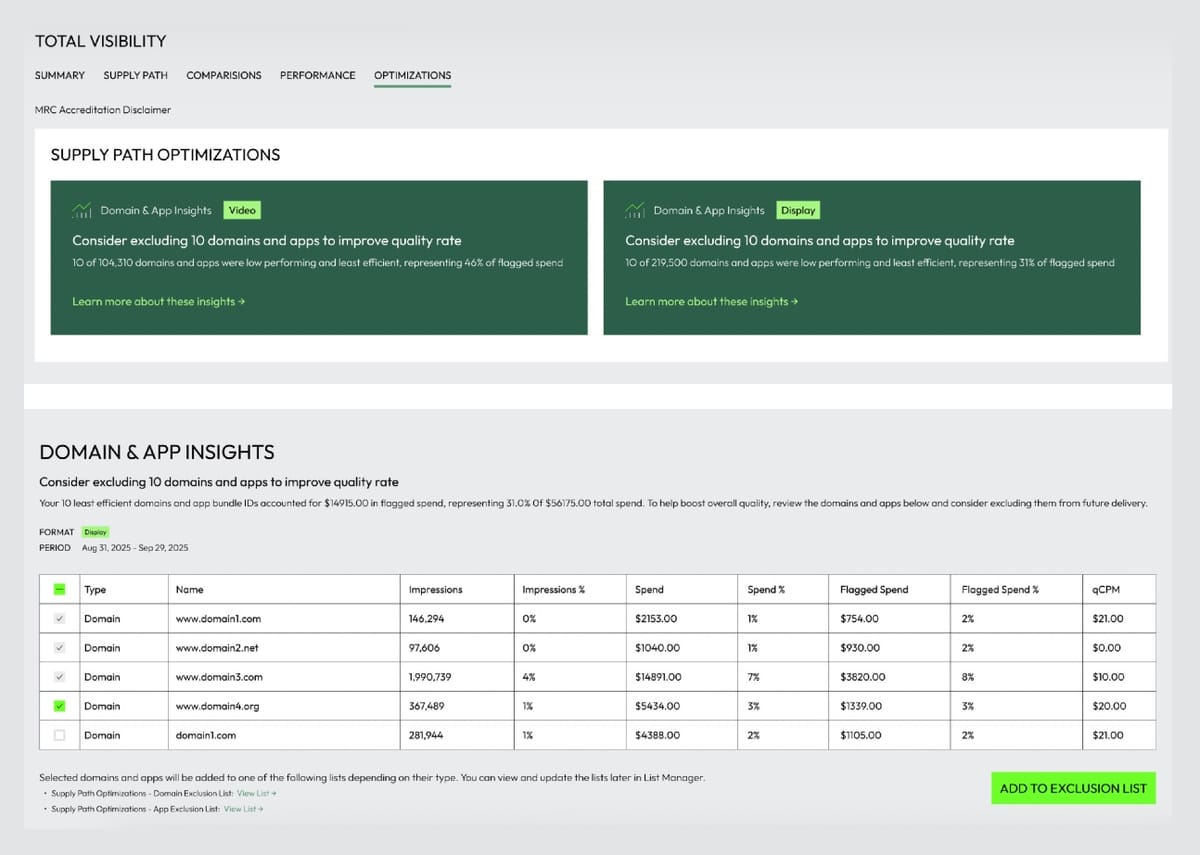
Integral Ad Science Total Visibility dashboard showing automated supply path optimization exclusion recommendations
Integral Ad Science today introduced automation capabilities for its Total Visibility platform that eliminate manual campaign optimization work while delivering measurable performance improvements across demand-side platform campaigns. The expansion addresses persistent challenges in programmatic advertising where fragmented supply chains and multiple intermediaries create inefficiencies that advertisers struggle to navigate without extensive hands-on management.
According to the announcement, Total Visibility represents the industry's first end-to-end automated supply path optimization solution designed to connect post-bid transparency with pre-bid optimization in unified workflows. Advertisers gain visibility into spending allocation down to the cent, identifying underperforming supply paths and implementing immediate adjustments without switching platforms or waiting for reports.
The system addresses fundamental programmatic advertising challenges. Multiple demand-side platforms, supply-side platforms, and publisher relationships create layers that obscure where advertising budgets flow. While supply path optimization aims to streamline this complexity, most solutions require manual effort and disconnected data analysis. Total Visibility consolidates these processes through automation that continuously monitors campaign performance and implements optimization recommendations.
Free weekly newsletter
Your go-to source for digital marketing news.
No spam. Unsubscribe anytime.
Performance improvements appear measurable. Digitas reported quality spend rate increases from 88% to 97% within one month of activating Total Visibility, according to Caroline Sullivan, Associate Director at Digitas. Quality spend represents the percentage of total spending directed toward quality impressions that meet viewability standards, maintain brand safety, and exclude invalid traffic.
The platform's automation capabilities extend beyond simple monitoring. Weekly updates provide candidate domains and applications for exclusion based on proprietary algorithms designed to improve quality spending. Advertisers can apply recommendations through Quality Sync functionality with minimal clicks, enabling automatic activation across relevant campaigns. This streamlined approach replaces manual processes that previously consumed substantial advertiser time while limiting optimization scope.
Financial transparency meets quality measurement
Total Visibility's architecture differs from existing supply path optimization tools through its integration of financial data with quality metrics. The platform delivers granular spend transparency enabling advertisers to track exactly where budgets flow across programmatic supply chains. This visibility extends to identifying which supply paths deliver optimal performance relative to cost, addressing longstanding transparency concerns that have challenged programmatic advertising operations.
The system's quality measurement framework incorporates viewability, brand safety, and invalid traffic detection into unified metrics. Invalid traffic remains a persistent challenge across digital advertising, with industry research indicating unprotected campaigns experience fraud rates 14 times higher than those implementing detection measures. Total Visibility addresses this through continuous monitoring that identifies and excludes low-quality inventory at scale.
Made-for-advertising sites and ad clutter metrics now integrate into Total Visibility's measurement capabilities. Advertisers can incorporate these metrics into custom quality cost per thousand impression definitions, enabling reporting that reflects their specific quality standards. Made-for-advertising sites typically feature minimal content, excessive ad loads, and clickbait headlines designed primarily to generate advertising revenue rather than serve user needs.
The platform provides actionable granular insights through made-for-advertising and ad clutter impression and spend metrics. These enable sharper analysis and more targeted optimizations, addressing advertiser concerns about media quality and placement verification throughout programmatic supply chains.
Dynamic Performance Profiles represent Total Visibility's breakthrough contextual targeting feature that continuously identifies and targets content driving clicks and conversions most efficiently. The system operates without manual oversight, automatically refreshing segments weekly by removing lowest-performing contextual segments and replacing them with high-performing alternatives.
This automated optimization approach differs fundamentally from traditional contextual targeting methods. Rather than requiring advertisers to manually curate and adjust contextual segments based on performance analysis, Dynamic Performance Profiles integrate financial and performance insights directly into targeting decisions. The elimination of manual pre-bid curation guesswork enables constant optimization loops that align media investment with performance outcomes.
Kinesso tested Dynamic Performance Profiles for a telecommunications brand client seeking campaign performance optimization without additional manual workload. The partnership delivered quantifiable results. Activating Dynamic Performance Profiles achieved a 33% increase in conversion rate alongside a 14% decrease in cost per conversion compared to previous benchmark campaigns. The system helped maximize reach, boost conversions, and deliver measurable efficiency gains through automated segment optimization.
Contextual targeting has gained adoption as advertisers navigate privacy restrictions and third-party cookie deprecation. The approach analyzes content characteristics to place advertisements alongside relevant material without relying on individual user tracking. Performance data suggests contextual approaches can deliver substantial returns when properly implemented and optimized.
According to Integral Ad Science research, contextual targeting campaigns during Super Bowl LVIII achieved 102% increased return on investment compared to overall averages, alongside a 136% increase in success rate measured through clicks and conversions. Campaigns using contextual targeting experienced a 47% decrease in cost per conversion compared to overall campaign averages, demonstrating the performance multiplier potential for major event advertising.
Advertise on ppc land
Buy ads on PPC Land. PPC Land has standard and native ad formats via major DSPs and ad platforms like Google Ads. Via an auction CPM, you can reach industry professionals.
The expanded Total Visibility platform introduces automated supply path insights and exclusion recommendations that represent a significant advancement for advertisers seeking effortless supply path optimization. Dashboard updates provide weekly candidate domains and applications for exclusion based on proprietary algorithms designed to improve quality spending metrics.
Advertisers working with the system can now increase working media dollars by identifying and excluding low-quality inventory at scale. The automation drives cost efficiency and media quality continuously while saving time through simplified unified workflows. By automating processes that previously required manual and time-consuming effort, advertisers gain operational efficiency alongside performance improvements.
The streamlined campaign quality controls address fundamental challenges in programmatic advertising operations. Advertisers historically needed to manually analyze performance data across multiple platforms, identify underperforming supply paths, generate exclusion lists, and implement changes across campaigns. Total Visibility consolidates these steps into automated recommendations that advertisers can implement with minimal clicks.
Integration with leading demand-side platforms enables seamless optimization without requiring advertisers to switch between multiple tools or platforms. The system operates within existing workflows, reducing friction while expanding optimization capabilities. This approach contrasts with solutions requiring extensive custom integration work or platform-specific implementations.
Platform integration and implementation details
Advertisers seeking to activate automated supply path features or Dynamic Performance Profiles can contact Integral Ad Science representatives directly. Once enabled, the company provides ongoing insights, weekly updates, and direct support helping teams maximize the enhancements.
The Total Visibility system operates through connections with programmatic buying platforms, enabling real-time optimization based on campaign performance data. Financial transparency extends down to individual impression costs, allowing advertisers to understand exactly what they pay at each supply chain step. This granularity enables more sophisticated optimization strategies than aggregate reporting approaches.
Quality Sync functionality provides the technical foundation enabling automated recommendation implementation across campaigns. When advertisers approve weekly exclusion recommendations, Quality Sync distributes these changes across relevant campaigns where the feature has been activated. This centralized control mechanism reduces the manual work required to maintain consistent quality standards across multiple simultaneous campaigns.
The platform's proprietary algorithms analyze multiple data points to generate exclusion recommendations. These include historical performance data, quality metrics, and financial efficiency indicators. By combining these factors, the system identifies inventory sources that deliver suboptimal results relative to cost, enabling automated recommendations that improve overall campaign effectiveness.
Integral Ad Science received the first Ethical Artificial Intelligence Certification from the Alliance for Audited Media on July 30, 2025. The certification addresses growing transparency demands as AI becomes central to digital advertising operations, with the company analyzing up to 280 billion interactions daily through AI-powered models.
Industry context and programmatic advertising challenges
The Total Visibility announcement arrives as programmatic advertising faces increased scrutiny over transparency and effectiveness. Research suggests that 42-49% of advertising dollars fail to reach publishers due to intermediary fees and technical inefficiencies, highlighting the need for more direct and transparent programmatic operations.
Supply path optimization emerged as a response to these challenges, helping consolidate programmatic ad spending to provide agencies and advertisers with more transparent access to premium inventory while eliminating financial risks associated with fraudulent traffic. However, implementation historically required substantial manual effort and technical expertise to analyze supply chain performance and adjust campaign targeting accordingly.
Demand-side platforms enable advertisers and agencies to purchase digital advertising inventory programmatically across multiple exchanges and publishers. These platforms provide campaign management tools, audience targeting capabilities, creative optimization, and performance analytics while using algorithmic bidding to optimize campaign outcomes based on advertiser objectives. However, DSPs aggregate inventory from various sources and must identify the most efficient supply paths to maximize advertiser return on investment.
The complexity involved in programmatic buying creates opportunities for inefficiency. Each intermediary in the supply chain typically charges fees, reducing the portion of advertiser spending that reaches publishers and funds content creation. Research from the Association of National Advertisers has documented these inefficiencies, finding that advertisers should verify whether they know the actual amount of spending that goes into working media and ensure their data is transferable to any party or vendor of their choosing.
Invalid traffic detection represents another critical component of programmatic advertising quality. Integral Ad Science secured Media Rating Council accreditation for its third-party measurement capabilities on Amazon DSP properties on November 13, 2025. The certification validates the company's server-to-server integration for tracking impression, viewability, and invalid traffic data across programmatic platforms.
Measurement capabilities and quality metrics
The Total Visibility platform's measurement framework addresses multiple dimensions of advertising quality simultaneously. Viewability measurement ensures advertisements have the opportunity to be seen by real users, addressing situations where impressions load below the fold of webpages or in background browser tabs where users cannot view them.
According to Media Rating Council standards, viewability for standard display advertisements requires 50% of pixels visible for at least one continuous second. Video advertisements require 50% of pixels visible for at least two continuous seconds to qualify as viewable. Large display advertisements exceeding 242,500 pixels apply a reduced 30% visibility threshold.
Brand safety and suitability measurement has expanded across major advertising platforms throughout 2024 and 2025. These capabilities utilize artificial intelligence and machine learning algorithms to analyze content on a frame-by-frame basis, combining image, audio, and text signals to accurately classify content at scale. This provides advertisers with detailed understanding of contexts where their advertisements appear.
Invalid traffic detection identifies and filters fraudulent activity including bot traffic, data center traffic, and other non-human engagement patterns. The system analyzes multiple signals including user behavior patterns, network characteristics, device attributes, and engagement metrics to classify traffic as valid or invalid.
Industry research indicates tag-certified anti-fraud programs prevented €3.45 billion in invalid traffic losses during 2023, representing a 69% reduction in fraud-related costs across European digital advertising markets. Protected channels account for 76% of spending while 24% remains unprotected, suggesting substantial opportunity remains for expanding anti-fraud adoption.
Programmatic advertising automation trends
The Total Visibility announcement reflects broader industry trends toward automation and AI-driven campaign management. Amazon introduced AI targeting for DSP campaigns on November 13, 2025, enabling advertisers to describe targeting objectives using natural language rather than platform-specific taxonomy. The system generates audience and keyword suggestions that can be applied directly to line items.
Yahoo DSP became the first demand-side platform to implement agentic capabilities that enable autonomous campaign operations. The platform deployed agents that instantly detect trends, speed campaign setup with guided workflows, shift strategies in real time as performance evolves, catch and resolve issues early with proactive quality assurance checks, and turn raw data into clear actionable outcomes.
These automation developments address fundamental questions about platform business models as autonomous AI systems potentially automate functions currently handled by demand-side platforms. Analysis suggests that autonomous systems could automate campaign setup, targeting, and optimization functions, potentially eliminating centralized roles traditionally performed by programmatic platforms.
However, concerns persist about whether automation reduces transparency. Industry observers caution that more automation means less transparency, particularly regarding supply chain operations and bad actors who might exploit automated systems. The balance between automation efficiency and oversight accountability remains an ongoing industry discussion.
Implementation considerations and future outlook
Advertisers considering Total Visibility implementation should evaluate several factors. The platform requires integration with existing demand-side platform infrastructure, suggesting implementation complexity varies based on current programmatic operations. Organizations using Quality Sync functionality can leverage automated exclusion recommendations most efficiently.
The weekly refresh cycle for Dynamic Performance Profiles balances optimization frequency with operational stability. More frequent updates could enable faster response to performance changes but might introduce volatility that complicates campaign analysis. The weekly cadence appears designed to provide consistent optimization while maintaining predictable campaign behavior.
Cost considerations extend beyond platform fees to include potential efficiency gains from improved quality spending. The Digitas case study suggesting quality spend improvements from 88% to 97% in one month represents a 9 percentage point increase in budget efficiency. For substantial advertising investments, such improvements could justify implementation costs through reduced waste and improved performance.
The proprietary nature of exclusion recommendation algorithms raises questions about transparency and control. Advertisers cannot directly examine how the system determines exclusion candidates, requiring trust in Integral Ad Science's methodology. This contrasts with approaches where advertisers maintain complete visibility into decision logic and can adjust parameters based on specific campaign requirements.
Total Visibility represents IAS's commitment to helping advertisers achieve transparent, automated, and outcome-driven performance. By bridging the gap between data and results, the platform aims to empower marketers to navigate programmatic buying complexity with precision and confidence. The system's ability to deliver measurable improvements while reducing manual workload suggests potential for broader adoption across programmatic advertising operations.
PPC Land Newsletter
Subscribe PPC Land newsletter ✉️ for similar stories like this one
Who: Integral Ad Science, a global media measurement and optimization platform, launched automated capabilities for its Total Visibility platform. Digitas and Kinesso tested the features, reporting measurable performance improvements including quality spend increases from 88% to 97% and conversion rate gains of 33%.
What: Total Visibility provides end-to-end automated supply path optimization connecting post-bid transparency with pre-bid optimization in unified workflows. The expansion includes automated supply path insights and exclusion recommendations, Dynamic Performance Profiles for contextual targeting, and integrated Made-for-Advertising and ad clutter metrics. The system delivers granular spend transparency down to the cent while enabling automated optimization across campaigns.
When: Integral Ad Science announced the Total Visibility automation capabilities on January 14, 2026. The Digitas quality spend improvements occurred within one month of activation. Kinesso's telecommunications client testing demonstrated conversion and cost efficiency gains through Dynamic Performance Profiles implementation.
Where: The Total Visibility platform operates across leading demand-side platforms where advertisers run programmatic campaigns. Quality Sync enables automatic activation across campaigns using the feature. The system integrates with existing programmatic buying infrastructure, enabling optimization without requiring platform switching.
Why: The automation addresses persistent challenges in programmatic advertising where fragmented supply chains and multiple intermediaries create inefficiencies requiring extensive manual oversight. Research indicates 42-49% of advertising dollars fail to reach publishers due to intermediary fees and technical inefficiencies. Total Visibility aims to eliminate manual optimization work while improving quality spending, conversion rates, and cost efficiency through automated recommendations and contextual targeting optimization.
Share this article
The link has been copied!
Your link has expired. Please request a new one.
Your link has expired. Please request a new one.
Your link has expired. Please request a new one.
Great! You've successfully signed up.
Great! You've successfully signed up.
Welcome back! You've successfully signed in.
Success! You now have access to additional content.