Jeff Green's $150M stock bet and the AI future he's betting on
Jeff Green's $150M TTD stock purchase sparked rare candour on AI chat ads, agentic campaigns, retail media, and why Amazon's DSP may not last five years.


Jeff Green's $150M TTD stock purchase sparked rare candour on AI chat ads, agentic campaigns, retail media, and why Amazon's DSP may not last five years.
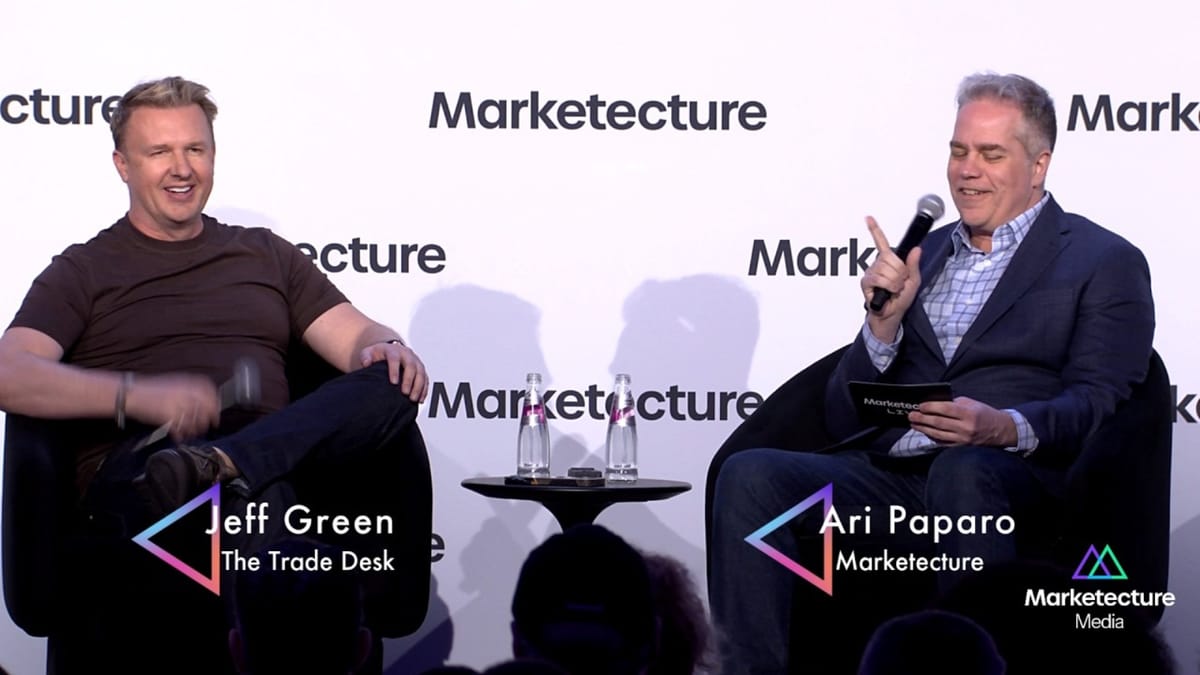
Jeff Green today sat on stage at Marketecture Live - a conference that drew roughly 1,000 attendees - and gave one of the more candid public performances of his tenure as chief executive of The Trade Desk. The conversation, moderated by Ari Paparo and recorded as episode 164 of the Marketecture podcast, was published on March 13, 2026. It covered the insider stock purchase that has dominated industry discussion, the company's AI strategy including a previously undisclosed closed beta, the future of connected TV through Ventura, and Green's assessment of Amazon's long-term appetite for the open internet.
The occasion was the closing session of Marketecture Live, and according to Paparo, it was the most anticipated slot of the two-day event. The conversation broke news on at least two points: that The Trade Desk is running a closed beta allowing campaign creation through Claude, and that Green believes Amazon's demand-side platform may not exist in its current form within five years.
The interview opened on the insider purchase, which Green described as "the biggest purchase of my life" - a transaction he only learned afterwards was "the third largest ever" of its kind. PPC Land reported on March 6 that Green acquired approximately $150 million of TTD stock, describing the move in a LinkedIn post on March 5 and expanding on it through the company's editorial outlet The Current the following day. Green said the purchase was made through a single brokerage account, executed simply. He framed it as "a commentary on my convictions in our future."
That LinkedIn post contained several specific claims that Paparo pressed him on during the Marketecture session. Among them: that The Trade Desk's clients would soon have access to AI chat inventory, retail media product listing ads, and that Amazon's DSP faces existential risk. Each of those points opened into significant follow-up discussion.
On the prospect of buying ads inside AI chat platforms - which Paparo interpreted as a reference to ChatGPT - Green declined to confirm or deny any specific deal. He said only that "all of the AI companies have a serious problem in some ways, which is that their capex is massive, their valuations are massive, and they have really high expectations on the way they're going to make money."
According to Green, nearly all major AI platforms are "either exploring or should be exploring" advertising. His argument was that this will not replicate the AdWords model. The average search query in the early AdWords era was "less than two words - refinance mortgage was what you would type in." Prompt-based interactions are different: longer, more contextual, less keyword-anchored. That, in Green's framing, creates room for more valuable advertising rather than less - because the signal of intent is richer.
He acknowledged the targeting challenge. Translating 20 words of detailed prompt intent into the campaign parameters a DSP works with remains technically unresolved. "We have tons of ideas that I think are way beyond anything that we do right now in contextual or things like that," he said, while conceding the business model is still "very nascent" and that The Trade Desk does not want to harden models it does not yet believe can be "huge."
The second claim in Green's LinkedIn post concerned retail media inventory - specifically, what Paparo described as sounding like product listing ads, which The Trade Desk does not currently operate at scale. Green confirmed the characterisation: "We don't do it at scale. We've done some basic testing."
His broader framing was macroeconomic. The Trade Desk's strategic approach has consistently oriented toward premium inventory - formats and placements where auction dynamics support high prices. According to Green, "sponsored listings are some of the more effective places for ads to be placed." Retailers want more demand to move prices up; The Trade Desk wants more efficacy. He described "great conversations" with retailers on this basis but was unwilling to give product specifics.
A persistent issue for non-endemic retail media - where ads click out to external brands - remains policy resistance from retailers who prioritise selling their own products. Green declined to discuss specifics on that front, saying only that "each of them need to make those decisions on their own."
The most pointed claim in Green's LinkedIn post was the suggestion that Amazon's DSP might not exist in five years. His reasoning was structural rather than competitive. According to Green, Amazon faces the same dilemma Google has encountered in the open internet - antitrust exposure - but with higher stakes because of retail and AWS dependencies. "I think there's more at risk for Amazon because of the fact that it touches retail, because it touches AWS and cloud. To put those things at risk would be a strategic mistake."
Green was careful to separate this argument from a negative view of Amazon's advertising business overall. "Amazon has a great ads business. They have an amazing future in ads," he said. The money, he argued, will continue to come from sponsored listings and Prime Video - formats where Amazon makes close to 100% margin. The DSP, by contrast, requires competing with major media companies for sports rights and other premium content, at terms that erode margins significantly. "I would rather not," Green said when characterising the choice between open internet DSP operations and the owned-and-operated formats that drive Amazon's actual advertising revenue.
PPC Land noted in November 2025 that Green made a similar argument during The Trade Desk's Q3 2025 earnings call, estimating Amazon would generate approximately $70 billion in advertising in 2025 with roughly 90% in sponsored listings - formats that do not compete directly with open programmatic buying.
Paparo raised the transparency debate in direct terms: does it actually matter, or do buyers care only about return on ad spend regardless of how it is achieved? Green reframed the question. His preferred lens is open versus closed systems rather than transparent versus opaque ones. According to Green, the core problem with closed advertising ecosystems is not opacity for its own sake but the way closed systems attribute performance. "The greatest accomplishment in some of the walled gardens is not connecting billions of people to each other. It's actually that they've taken credit for all the brand building that other companies have been doing."
He used a CPG example: companies that grew 10% annually for 50 years stopped growing in the digital era, while platforms with closed ecosystems accelerated. Green's argument is that the closed systems are "extractive to some extent" while still working well enough that buyers continue using them. The challenge is structural.
On transparency in practice, Green acknowledged that The Trade Desk has at times been "dogmatic" to the point of impracticality. His invoice analogy was pointed: rather than a one-line invoice like Facebook provides, The Trade Desk has historically given clients 30-page breakdowns. "The equivalent of going to a restaurant at the end of the meal getting a list of every ingredient you just consumed." According to Green, the company's current rubric is "practical transparency" - how to create understanding rather than how to maximise disclosure volume.
Paparo noted that the Adweek report he referenced in the conference session cited Dentsu and WPP moving away from OpenPath for transparency reasons. That report, published February 20, 2026, was covered by PPC Land as part of its analysis of the Ventura Ecosystem launch the following week. Green declined to comment on those two companies specifically but endorsed the framing made in an earlier session by Terry Kawaja: that OpenPath is disruptive because it tries to make the supply chain more efficient, and companies that monetise an inefficient supply chain have reason to resist it.
OpenPath's design is specific on one point that Paparo pressed: it does not optimise for publisher yield. That seems like a disadvantage for publishers, Paparo argued. Green's response was that many supply-side platforms claiming to pursue high CPMs for publishers are actually pursuing high margins for themselves - "flipping houses" rather than representing sellers. According to Green, the distinction matters because a platform optimising for its own spread and a platform genuinely representing publisher yield produce different outcomes for the actual inventory owner.
OpenPath's enterprise partner base received access to OpenAds - The Trade Desk's forked Prebid auction platform, announced October 2, 2025 - in the months following, and by January 2026 nine major publishers including the Guardian, Hearst, and BuzzFeed had signed on publicly.
Green's answer to the AI strategy question was the most expansive section of the conversation. He opened with scale: The Trade Desk processes 20 million ad impression opportunities every single second, with decisions required in 10 milliseconds or less. According to Green, "I don't think there is an industry in the world that is more conducive to AI than programmatic advertising."
His specific claim about agentic AI was pointed. Green believes the use cases for agentic AI have been overstated outside of programmatic advertising. The flight-booking analogy is his test case: an AI agent booking a flight still needs to ask about dates, airlines, and seat preferences - which are simply the Expedia interface rendered in conversation form. The value is minimal. Campaign optimisation is different. A $500,000 campaign targeting $1 million in performance could be improved by expanding the site list, adjusting bid factors, changing frequency caps, altering geo targeting, adding creatives, changing creative formats, or adding channels - any combination of 10,000 different variables. "One of them or two of them or some blend of them is better than another," Green said. Representing those trade-offs to a human decision-maker in a usable way is precisely the problem agentic systems are well-positioned to solve.
The architecture The Trade Desk uses internally is what Green called distributed AI - dividing every function into pieces with clear goals, inputs, and outputs. The concern driving that structure: "When you get bad data you can make bad decisions and never know it. How does the machine know when it's wrong?" The company tests AI internally, within "our own four walls," before exposing it to clients - deliberately avoiding what Green called planting an AI flag before having something substantive to show.
Then came the news. Paparo asked whether someone could go into Claude and create a campaign in The Trade Desk. "In our closed beta? Yes," Green replied. He immediately acknowledged this was probably not something he was supposed to disclose. The details of that beta - its scope, its participants, its timeline to general availability - were not elaborated. But the confirmation that The Trade Desk is running MCP-style or Claude-integration tooling for campaign creation from natural language input is a meaningful data point for the marketing technology community.
The Trade Desk launched OpenTTD on March 4, 2026, a unified portal giving data providers, publishers, and brands API access to The Trade Desk's programmatic infrastructure - the structural layer on which such agent integrations would presumably be built.
The CTV section clarified a point of genuine confusion in the market. Recent announcements had suggested Ventura was shifting toward an SDK model embedded in third-party operating systems rather than being a standalone OS. Green explained the distinction as one of scope rather than strategy.
According to Green, The Trade Desk has no interest in controlling colour calibration, sound settings, or the non-streaming components of a smart TV OS. "We just want to help enable the streaming portion of your operating system." Partners such as V (the OS formerly known as VIDAA, which powers more than 50 million devices) and Hisense handle the broader operating environment; Ventura provides the streaming and advertising layer. The OEM or OS partner takes responsibility for the internet-of-things ambitions and house-connectivity vision. The Trade Desk provides what Green described as something those partners openly acknowledge they do not know: the ad ecosystem.
The benefit to OEM partners is a business model for hardware that increasingly generates zero or negative margin on device sales. According to Green, it will "definitively be negative for all of them any minute now in terms of the amount of money that they make selling a television." The advertising layer - powered by UID2 and The Trade Desk's programmatic demand - is the revenue fix for that structural problem.
The Ventura Ecosystem formally launched February 24, 2026, with V and Nexxen as the first collaborators, combining OpenPath, UID2, OpenAds, and OpenPass under a shared CTV marketplace. The Trade Desk and DIRECTV had previously announced a custom Ventura OS integration in October 2025, designed for deployment by third-party TV manufacturers, retailers, and hospitality partners.
On whether OEMs receive upfront payments as compensation for hardware revenue foregone, Green said: "Not yet."
The final substantive topic was platforms Paparo called "hedge gardens" - Reddit, Spotify, Pinterest, and others that sit between fully open and fully closed. Green's view was consistent with The Trade Desk's broader premium orientation. Where a platform sits on what he called "the premium continuum" determines how The Trade Desk engages. User-generated content at scale is less important than premium content. The strategic goal is giving advertisers "the power of choice, fungibility, price comparison, and therefore price discovery."
Green reached for a historical cautionary tale: the Facebook Exchange, when Facebook briefly opened its social inventory to programmatic buying. According to Green, Facebook and its partners at the time "were shocked by how long it took people to adapt to a different format, and how that hindered their initial success." The lesson he draws for Reddit, Spotify, and similar platforms considering how open to be: unique formats with high switching costs slow programmatic adoption even when the audience data is compelling.
For the marketing community, the Marketecture Live session provides several concrete data points that matter operationally. The closed beta confirmation for Claude-based campaign creation in The Trade Desk is the most immediately relevant for agency trading desks and in-house programmatic teams watching agentic AI adoption timelines. The retail media product listing ads signal is meaningful for performance advertisers who currently rely on Amazon Sponsored Products or Google Shopping but want alternative demand paths. And Green's characterisation of Amazon DSP risk, while speculative, is a useful frame for holding companies and large advertisers deciding how much to invest in Amazon's programmatic infrastructure versus its sponsored listings and streaming environments.
The Trade Desk reported $2.896 billion in full-year 2025 revenue on February 25, with growth decelerating to 18% year over year. Q1 2026 guidance targets at least $678 million in revenue. The company's share repurchase authorisation stands at $500 million.
Who: Jeff Green, founder and CEO of The Trade Desk (NASDAQ: TTD), a demand-side platform for programmatic advertising headquartered in Ventura, California. The conversation was hosted by Ari Paparo of Marketecture at the Marketecture Live conference.
What: Green gave a wide-ranging interview covering his $150 million insider stock purchase - described as the third largest of its kind - and disclosed that The Trade Desk is running a closed beta allowing campaign creation through Claude. He also discussed AI chat inventory, retail media product listing ads at scale, his assessment that Amazon's DSP may not survive five years in its current form, the OpenPath supply chain controversy, Ventura's role as a streaming-only OS layer, and how The Trade Desk evaluates hedge garden platforms such as Reddit and Spotify.
When: The conversation was recorded at Marketecture Live on March 11-12, 2026, and published as a podcast on March 13, 2026. Green's stock purchase announcement was made on March 5, with a detailed explanation published March 6.
Where: Marketecture Live, location unspecified in the source, with the podcast episode distributed through the Marketecture YouTube channel and podcast feed.
Why: The interview matters for the marketing community because it provided specific, actionable signals about where The Trade Desk's product roadmap is heading - particularly regarding agentic campaign management, AI chat inventory as a new programmatic channel, and the company's evolving position relative to Amazon. These are questions that media buyers, agency trading desks, and brand marketing teams are actively navigating in 2026.