Meta lets Threads users boss the algorithm around for three days
Meta introduces Dear Algo on Threads, letting users temporarily control feed content with AI-powered requests that adjust recommendations for 72 hours.


Meta introduces Dear Algo on Threads, letting users temporarily control feed content with AI-powered requests that adjust recommendations for 72 hours.
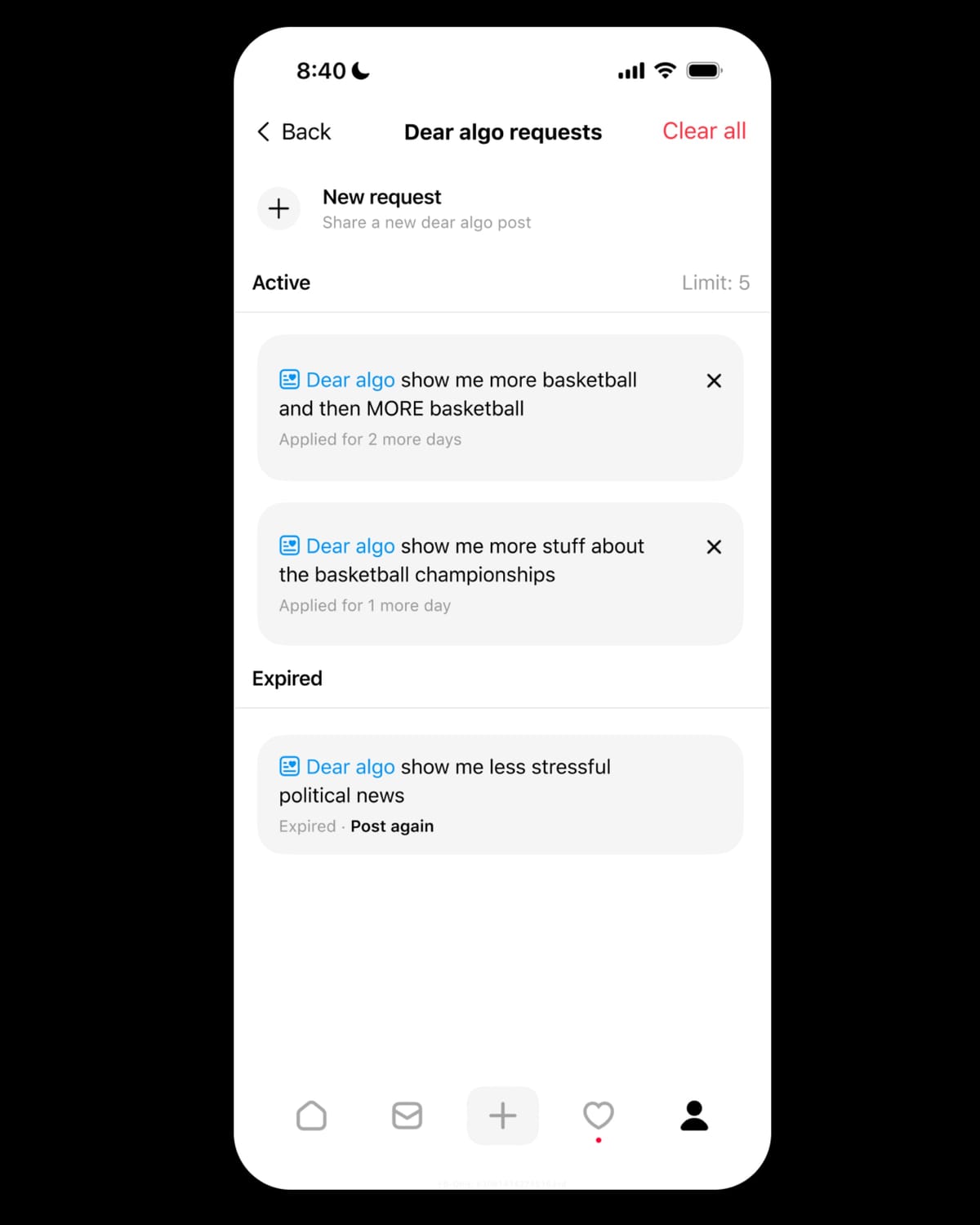
Meta this week introduced Dear Algo, a feature that gives Threads users direct control over their feed content through simple public posts. The AI-powered tool allows users to tell the platform what topics they want to see more or less of, with the adjustments lasting three days.
Users activate the feature by typing "Dear Algo" in a public Threads post, followed by their content preferences. A post stating "Dear algo, show me more posts about podcasts" would increase podcast-related content in that user's feed for 72 hours. The system operates through natural language processing, interpreting user requests and modifying content recommendations accordingly.
The feature launched today in the United States, New Zealand, Australia, and the United Kingdom. Meta stated it hopes to introduce the functionality in additional countries soon, though no specific expansion timeline was provided. The limited geographic rollout suggests the company is testing performance and user adoption before broader implementation.
The three-day duration represents a departure from permanent algorithmic adjustments that characterize most social platform controls. This temporary window allows users to follow trending events or topics without permanently altering their feed preferences. Meta's approach acknowledges that user interests shift rapidly, particularly around live events or breaking news situations.
Users can also repost someone else's Dear Algo request to apply those content preferences to their own feed. This social sharing mechanism creates a discovery pathway where users can experiment with curated content experiences suggested by others in their network. The reposting functionality transforms individual preference statements into shareable feed configurations.
The announcement positioned Dear Algo as addressing moments when user interests change suddenly. Meta's examples included seeing more posts during live NBA games or reducing content about television shows users haven't watched yet. These use cases emphasize real-time relevance rather than long-term preference management.
Meta's implementation reflects broader industry trends toward user-controlled algorithmic experiences. The feature arrives as social platforms face increasing pressure to provide transparency and control over content recommendation systems. X released its For You feed algorithm source code in January 2026, revealing transformer architecture and engagement predictions that determine content distribution.
The Dear Algo system operates alongside Threads' existing AI-powered recommendation infrastructure. Meta's AI improvements to content recommendation systems resulted in significant engagement increases, including a 5% increase in time spent on Facebook and 6% on Instagram during Q2 2025. The company has positioned artificial intelligence as central to its content distribution strategy across its platform family.
For marketing professionals, Dear Algo introduces variables into organic content distribution that differ from paid advertising systems. While advertisements on Threads operate through Meta's AI-powered advertising system that delivers personalization similar to Facebook and Instagram, organic content now responds to explicit user requests that temporarily override standard recommendation patterns.
The feature's impact on content strategy remains uncertain. Brands building audiences on Threads must consider how temporary user-initiated algorithmic adjustments affect reach and engagement metrics. The three-day windows could create visibility spikes for content aligned with popular Dear Algo requests, followed by return to baseline distribution patterns.
Meta did not disclose technical details about how Dear Algo requests are weighted against other recommendation signals. The company's announcement provided no information about whether multiple Dear Algo requests from a single user interact or override each other, how the system handles conflicting preferences, or what happens when the three-day period expires.
The natural language processing requirements suggest sophisticated intent parsing capabilities. Users can phrase requests in varied ways, requiring the system to understand semantic meaning rather than matching exact keywords. This approach contrasts with traditional social media controls that rely on binary toggles or predefined category selections.
The timing of Dear Algo's introduction coincides with Threads reaching significant scale. Meta expanded advertising on Threads to all users globally starting January 26, 2026, completing a yearlong testing program. The platform now reaches more than 400 million monthly active users, providing sufficient audience size to support experimentation with algorithmic control features.
The feature builds on Meta's broader AI integration across its platforms. The company announced plans to use AI chat data for ad targeting starting December 2025, affecting over 1 billion monthly users of Meta AI. These interactions feed into recommendation systems, joining existing signals like posts, likes, and page follows.
Privacy implications of Dear Algo requests remain largely unaddressed in Meta's announcement. Public posts containing these requests become visible to other users and potentially inform Meta's understanding of user interests beyond the three-day adjustment period. The company did not specify whether Dear Algo requests contribute to long-term user profiling or advertising targeting systems.
The social reposting mechanism creates network effects around content discovery. Popular Dear Algo requests could spread through user networks, creating coordinated temporary shifts in what content surfaces across groups of users. This dynamic differs from individual preference settings that operate independently.
Meta's announcement emphasized making Threads feel more personal while maintaining connections to current conversations. The feature attempts to balance personalization with timeliness, allowing users to tune their feed for specific moments without permanent commitment to topic preferences. This approach addresses a fundamental tension in content recommendation systems between stable interest modeling and responsive adjustment to changing circumstances.
The four-market initial rollout provides Meta with controlled conditions to evaluate Dear Algo's performance before global expansion. User adoption rates, request patterns, and engagement impacts will likely inform decisions about geographic expansion and feature refinement. The company has employed similar testing methodologies across its platform developments, including advertising format expansions on Threads.
Dear Algo represents an experiment in explicit algorithmic control that differs from the opacity characterizing most content recommendation systems. Whether users embrace this direct communication with platform algorithms, or whether the feature sees limited adoption, will determine its long-term viability and potential expansion to other Meta platforms.
The announcement included no information about how Dear Algo interacts with existing Threads features like communities or custom feeds. Users operating within specialized communities may find Dear Algo requests conflict with community-specific content patterns, though Meta provided no guidance on these interactions.
For social platforms, user-controlled algorithmic adjustments present both opportunities and challenges. Increased control may improve user satisfaction and engagement. However, excessive fragmentation of feed experiences could complicate content distribution and reduce network effects that drive platform value. Meta's three-day limitation appears designed to limit these risks while providing meaningful user agency.
The feature arrives as Threads continues developing its identity within Meta's platform family. The platform launched direct messaging in July 2025, expanding communication capabilities beyond public conversations. Each feature addition shapes how users interact with the platform and what role it serves in their social media ecosystem.
Meta's announcement positioned Dear Algo as another way to help users find conversations relevant to them. This framing emphasizes discovery and connection rather than algorithmic control or feed manipulation. The language choice reflects platform positioning focused on community and conversation rather than content consumption.
Technical implementation questions remain unanswered. How quickly do Dear Algo requests take effect? Do they operate gradually or immediately? What happens if a user makes multiple conflicting requests during the three-day period? These operational details matter for user experience but received no attention in Meta's announcement.
The natural language interface lowers barriers to algorithmic control compared to traditional settings menus. Users need not navigate complex preference panels or understand technical terminology. Typing a simple request in their native voice provides accessibility that could drive adoption beyond core users who typically adjust platform settings.
The competitive landscape for social media platforms has shifted dramatically since Threads launched in July 2023. The platform entered a market dominated by established players while positioning itself as an alternative focused on public conversations. Dear Algo represents differentiation through user agency, offering control mechanisms that distinguish Threads from competitors with less transparent algorithmic systems.
Meta's broader artificial intelligence strategy provides context for Dear Algo's introduction. The company has invested heavily in AI infrastructure, with capital expenditure projected between $64-72 billion for 2025 to fund computational capacity for sophisticated AI processing. These investments enable features like Dear Algo that require natural language understanding and real-time feed adjustments at scale.
The feature's design reflects lessons from Meta's experience across Facebook and Instagram. Both platforms have experimented with various mechanisms for user control over content recommendations, from following and unfollowing to explicit interest declarations. Dear Algo synthesizes these approaches into a time-bound, natural language system that attempts to balance control with simplicity.
Content creators on Threads face new uncertainties with Dear Algo's introduction. Traditional organic reach depends on algorithmic factors largely invisible to creators. Dear Algo introduces explicit user interventions that can temporarily boost or suppress specific content types. Creators may need to consider how their content aligns with likely Dear Algo requests during major events or trending topics.
The advertising implications warrant examination. While Meta's announcement focused on organic feed control, the relationship between Dear Algo requests and advertisement delivery remains unclear. Do user requests affect what ads they see? Can advertisers target users based on Dear Algo statements? These questions matter for marketing professionals allocating budgets across Meta's platform family.
Brand safety considerations take on new dimensions with Dear Algo. If users can explicitly request more content about sensitive topics, how does this interact with advertiser controls for content adjacency? Meta's inventory filter capabilitiesallow advertisers to control sensitivity levels of organic content appearing alongside advertisements. Dear Algo could create temporary spikes in sensitive content visibility that challenge these controls.
The feature's success depends partly on user awareness and education. How will users discover Dear Algo exists? Meta's announcement did not detail in-product education mechanisms or onboarding flows. Features requiring specific syntax like "Dear Algo" may face adoption challenges if users remain unaware of the functionality.
Measurement and analytics present additional questions. Will Threads provide creators or businesses with data about Dear Algo requests affecting their content visibility? Understanding whether content reached audiences through standard recommendations or user-initiated adjustments could inform strategy, but Meta provided no indication such data would be available.
The three-day limitation carries both benefits and constraints. Users can experiment with feed adjustments without permanently committing to topic preferences. However, recurring interests require repeated Dear Algo requests every 72 hours. This creates friction for sustained topic following that might better serve through permanent preference settings.
Whether Dear Algo becomes a widely adopted feature or a niche tool used by engaged platform users will become clear as adoption patterns emerge. Meta's decision to launch in four markets suggests measured expectations rather than assumptions of immediate mass adoption. The company likely anticipates iterating on the feature based on initial user behavior and feedback.
The social graph implications deserve consideration. When users repost Dear Algo requests, they signal interests to their network while adopting feed modifications. This creates a form of public interest declaration that differs from private preference settings. Network effects could emerge where popular requests spread rapidly, creating coordinated shifts in what content surfaces across user communities.
Meta's announcement emphasized helping users find conversations relevant to them. This positioning reflects Threads' core value proposition as a platform for public discourse rather than content consumption. Dear Algo reinforces this identity by prioritizing conversational relevance over passive scrolling.
The regulatory environment for social media platforms continues evolving globally. Features offering increased user control over algorithmic systems may address regulatory pressure for transparency and user agency. European regulations have pushed platforms toward greater openness about how recommendation systems operate and what controls users possess.
Technical infrastructure requirements for Dear Algo likely leverage Meta's existing AI systems. The company's machine learning infrastructure processes billions of daily interactions to deliver personalized experiences. Extending this infrastructure to handle natural language preference statements represents an incremental addition to established capabilities rather than fundamentally new technical requirements.
The feature's naming as "Dear Algo" personalizes the algorithmic system, treating it as an entity users can address directly. This anthropomorphization differs from traditional settings interfaces that present algorithms as mechanical systems. Whether this framing resonates with users or creates confusion remains to be seen through adoption metrics.
Industry observers will watch Dear Algo's performance as indicator of user appetite for algorithmic control. If adoption remains low, it may suggest users prefer platform-determined recommendations. High adoption would signal demand for explicit control mechanisms that could influence feature development across social platforms.
The business case for Dear Algo extends beyond immediate user satisfaction. Enhanced engagement through relevant content drives time spent on platform, which ultimately supports advertising revenue. If Dear Algo increases engagement by improving content relevance, it serves Meta's business interests even without direct monetization.
Meta's track record with feature experimentation provides context for Dear Algo's introduction. The company routinely tests features in limited markets before broader rollout or retirement. Dear Algo may follow this pattern, with geographic expansion contingent on performance in initial markets. Alternatively, the feature could remain a limited experiment if adoption or engagement fails to meet internal benchmarks.
Who: Meta announced the Dear Algo feature for its Threads social platform, affecting users in the United States, New Zealand, Australia, and the United Kingdom who can now directly control their feed content through AI-powered requests.
What: Dear Algo is an AI-powered feature that allows Threads users to temporarily adjust their feed content by typing "Dear Algo" in a public post followed by their preferences. The system modifies content recommendations for three days, enabling users to see more or less of specific topics. Users can also repost others' Dear Algo requests to try different content preferences and discover new conversations.
When: Meta rolled out Dear Algo on February 11, 2026, with availability in four markets. The company stated it hopes to introduce the feature in additional countries soon, though no specific expansion timeline was provided. Each user's content adjustments last for three days after their Dear Algo request.
Where: The feature launched in the United States, New Zealand, Australia, and the United Kingdom on the Threads platform, which operates as part of Meta's family of applications. The geographic limitation suggests controlled testing before broader global expansion.
Why: Meta introduced Dear Algo to give users more control over their feed content in response to rapidly changing interests. The company positioned the feature as addressing moments when what matters to users changes instantly, whether following live events like NBA games or avoiding spoilers for unwatched television shows. The temporary three-day adjustment period acknowledges that user interests shift quickly while maintaining connections to current conversations relevant to them.