Nielsen pilots wearable tech to count who's actually watching the Super Bowl
Nielsen tests smartwatch-style devices to track co-viewing during Super Bowl LX and major live events, building on Big Data + Panel measurement advances.

Nielsen today announced a pilot program using proprietary wearable devices to measure co-viewing during major live television events, beginning with Super Bowl LX on February 8. The measurement company positions the initiative as an enhancement to its recently-implemented Big Data + Panel ratings system, addressing a persistent challenge in capturing total viewership when multiple people watch the same screen.
The pilot launches less than a year after Nielsen ended its traditional panel-only TV ratings system, transitioning to a hybrid methodology that combines data from approximately 101,000 people across 42,000 households with inputs from about 45 million households and 75 million devices. According to Nielsen CEO Karthik Rao, the co-viewing methodology "builds on that mission, alongside our recent enhancements with Big Data + Panel, out of home expansion, live streaming measurement and our wearable devices."
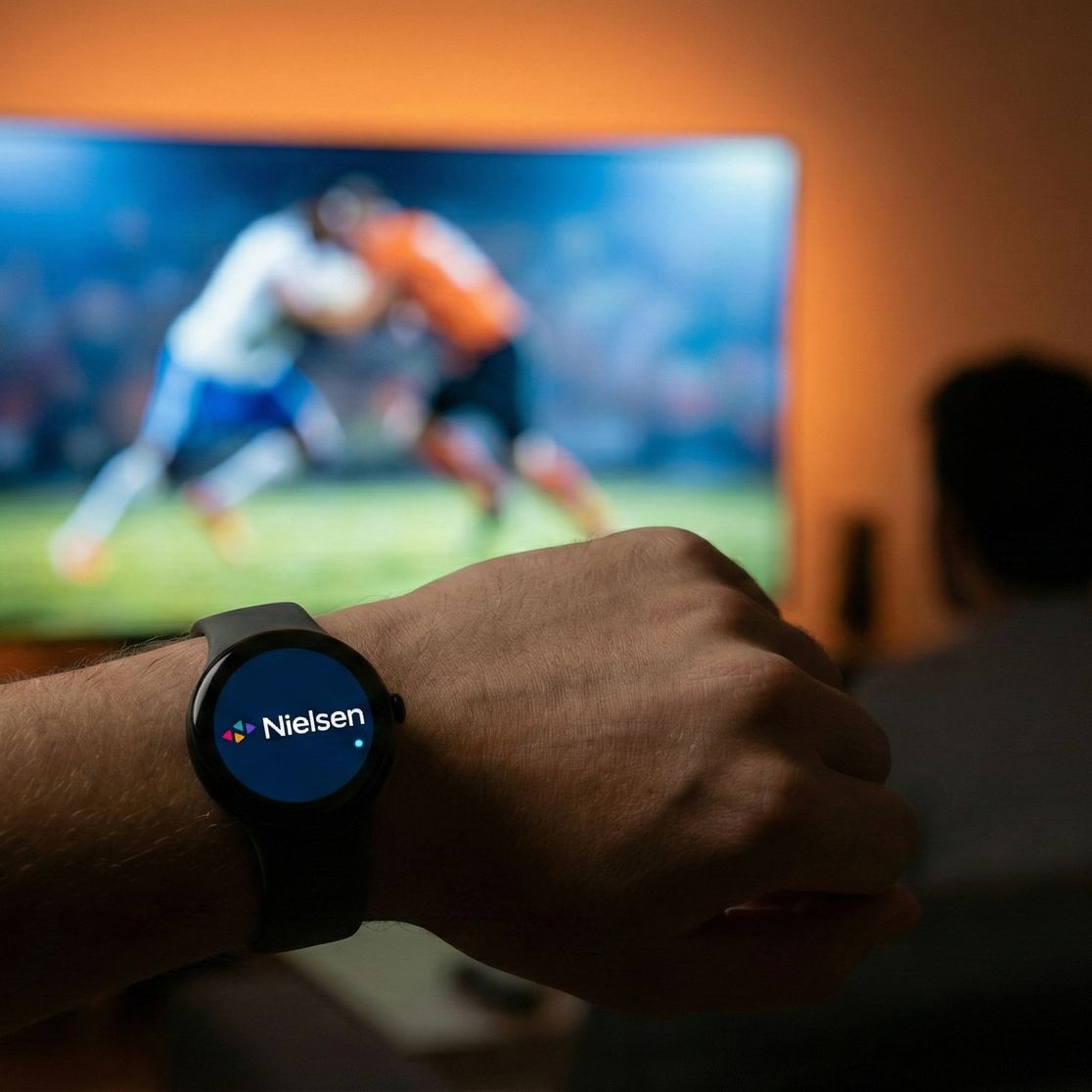
The wearable measurement devices resemble smartwatches and are worn on the wrists of Nielsen panelists. These devices capture audio from television events, shows, and movies through passive measurement technology that eliminates the need for formal login procedures. The audio capture approach represents a technical shift from active panel participation toward automated detection of viewing behavior.
Nielsen received Media Rating Council accreditation for its Big Data + Panel measurement in January 2025, marking the first time the organization approved a national TV measurement system combining traditional panel data with large-scale device information. The MRC accreditation followed years of industry debate about measurement methodology transitions, with Nielsen initially promising the change in 2020 before extending the timeline following resistance from advertisers and agencies.
The co-viewing pilot program will continue beyond Super Bowl LX to cover high-profile sports and entertainment live events during the first half of 2026. Nielsen will release initial pilot results several weeks after delivering its final Big Data + Panel ratings, which remain the official currency for advertising transactions. The pilot data will be made available to Nielsen clients following the delivery of standard ratings, with clients permitted to share findings publicly.
This measurement enhancement addresses a fundamental limitation in television audience tracking. When multiple household members watch the same television screen simultaneously, traditional measurement systems struggle to capture the full viewing audience. Live events particularly suffer from this measurement gap, as sports programming and major entertainment broadcasts frequently generate group viewing behavior that single-viewer metrics fail to represent accurately.
The co-viewing methodology differs from standard panel measurement by incorporating device-based tracking rather than relying exclusively on household member self-reporting. Wearables detect audio signals from programming, enabling Nielsen to identify which panel members were present during specific broadcasts without requiring manual check-ins. The passive nature of this approach reduces panelist burden while potentially improving compliance and accuracy.
Nielsen has invested substantially in measurement technology over recent years. The company expanded National TV out-of-home measurement earlier in 2025 and secured Media Rating Council accreditation for first-party live streaming data integration in November 2024. These developments reflect broader industry pressure to accurately measure fragmented viewing across broadcast, cable, streaming, and out-of-home contexts.
The technical implementation of co-viewing measurement involves matching audio fingerprints from wearable devices against programming databases to determine viewing presence. This approach differs from Big Data + Panel's device-level tracking, which captures what content plays on televisions and streaming devices but cannot definitively determine who in the household was actually watching. Wearables bridge that gap by providing person-level verification tied to specific content.
The pilot timing coincides with significant measurement challenges for Super Bowl advertising. Consumer spending around Super Bowl LVIII reached $18.6 billion across food, drinks, apparel, décor, and related items, according to National Retail Federation figures. More than 127 million viewers watched Super Bowl LIX on February 9, 2025, establishing the game as advertising's largest single-day audience opportunity. Accurate co-viewing data could substantially impact these viewership figures by capturing additional household members watching alongside primary viewers.
Nielsen's measurement infrastructure has expanded significantly through partnerships with major platforms. The company deepened its relationship with Roku in December 2025, integrating Roku's viewing data into Big Data + Panel measurement for both linear and streaming ratings. That partnership revealed streaming on Roku devices alone represented more than 21 percent of all TV viewing in October 2025, underscoring the scale of streaming measurement requirements.
The sports measurement component carries particular weight for Nielsen's business strategy. The company locked in a comprehensive partnership with Gray Media in January 2026, covering all 113 U.S. designated market areas where the broadcaster owns stations. Gray Media operates 13 broadcast sports networks, creating substantial measurement requirements for live sports content that frequently generates higher-than-average co-viewing behavior.
Live sports streaming has emerged as a critical measurement challenge as viewership fragments across broadcast and digital platforms. Nielsen maintains measurement deals with every major professional sports league and positions itself as the only company that can reliably measure live sports on streaming platforms. Co-viewing measurement enhancement directly addresses this capability, as sports content consistently drives group viewing behavior that traditional metrics undercount.
The measurement methodology builds on Nielsen's proprietary device ecosystem rather than relying on consumer wearables from third-party manufacturers. This approach gives Nielsen direct control over device specifications, data collection protocols, and quality assurance processes. Panelists receive devices specifically designed for measurement purposes rather than using commercially available smartwatches or fitness trackers.
Nielsen's announcement emphasized that co-viewing estimates from the pilot program will not immediately integrate into Big Data + Panel ratings. The data remains experimental rather than becoming official currency for advertising transactions. This phased approach allows Nielsen to validate methodology, address technical issues, and build industry confidence before incorporating co-viewing adjustments into transactional ratings.
The company plans to provide additional impact data to clients later in 2026 before fully implementing the co-viewing methodology into its marketing intelligence product suite. Nielsen targets incorporating co-viewing into currency measurement for the 2026-2027 television season, subject to validation and client acceptance. This timeline suggests the pilot serves as a testing ground for technical refinement rather than immediate deployment.
The co-viewing enhancement represents the first phase of planned expansions, with additional improvements scheduled beyond 2026. Nielsen indicated it would share timing details for subsequent phases once available, suggesting ongoing development beyond the initial wearable device rollout. The staged implementation reflects measurement industry patterns where methodological changes proceed incrementally to maintain market acceptance.
Nielsen measures more than 1 trillion minutes of viewing across streaming applications each month, according to company data. This scale demonstrates the complexity of adding co-viewing measurement to an already massive data processing infrastructure. The wearable device approach must operate reliably across diverse viewing contexts while maintaining data accuracy standards required for advertising currency.
The measurement company faces competitive pressure from alternative providers including VideoAmp, Comscore, and iSpot.tv, who have focused on digital-native measurement approaches. Nielsen's co-viewing pilot positions the company to maintain technical leadership in traditional television measurement while addressing gaps that competitors might exploit. The wearable device methodology represents differentiated technology that competing measurement providers do not currently offer at scale.
Industry context matters significantly for understanding this pilot's strategic importance. Television viewership continues fragmenting across platforms, with streaming reaching record shares of total viewing time in recent quarters. Co-viewing measurement becomes increasingly critical as advertisers demand comprehensive audience counts across all viewing contexts to justify investment levels in premium live programming.
The announcement acknowledged Nielsen's role as "the source of truth for streaming measurement," citing regular reports including The Gauge and the Nielsen Streaming Top 10. The co-viewing enhancement extends this measurement authority to better capture actual viewership rather than device-level consumption, addressing a fundamental distinction between what plays on screens and who actually watches.
Nielsen's CEO statement positioned co-viewing measurement within the company's broader mission to "constantly push measurement forward and deliver the most accurate data ever." This framing connects the wearable device pilot to Nielsen's historical role in establishing television audience measurement standards that the advertising industry relies upon for transactions worth billions of dollars annually.
The technical challenge involves scaling passive measurement across Nielsen's panel while maintaining statistical validity. Wearable devices must achieve sufficient adoption among panelists to provide representative samples across demographic segments. Device compliance and data quality become critical factors in determining whether co-viewing adjustments accurately reflect actual viewing behavior or introduce new measurement biases.
Privacy considerations accompany any wearable measurement technology. Nielsen must ensure audio capture mechanisms comply with consent requirements and data protection regulations while maintaining panelist trust. The passive nature of wearable measurement raises different privacy questions than traditional remote control-based check-ins, requiring careful implementation to balance measurement quality with privacy protection.
The Super Bowl represents an ideal testing ground for co-viewing measurement given the event's known tendency to generate group viewing. Advertisers purchasing Super Bowl inventory specifically value the event's ability to aggregate mass audiences in shared viewing contexts. Accurate co-viewing measurement could significantly increase reported viewership figures, potentially justifying the premium pricing that Super Bowl advertising commands.
Nielsen's announcement arrives as Anthropic committed Claude AI would remain advertisement-free while launching multimillion-dollar Super Bowl commercials targeting OpenAI's advertising announcement. The competitive dynamics in AI assistant monetization contrast with Nielsen's focus on accurately measuring traditional television advertising effectiveness, highlighting ongoing tensions between advertising-supported and subscription-based business models.
The measurement implications extend beyond individual events to season-long programming strategies. If co-viewing adjustments substantially increase reported audiences for live sports and major events, programmers and advertisers might reassess the relative value of live versus on-demand content. Such shifts could influence content investment decisions and advertising rate structures across the television industry.
Nielsen's commitment to releasing pilot results publicly demonstrates transparency about methodology development. By allowing clients to share findings, Nielsen enables industry discussion about co-viewing measurement before incorporating adjustments into official ratings. This approach builds consensus around methodological changes rather than imposing them unilaterally.
The wearable device approach represents significant infrastructure investment beyond Nielsen's existing panel operations. Distributing devices to panelists, maintaining hardware, processing audio capture data, and integrating findings with Big Data + Panel systems requires substantial technical resources. The investment signals Nielsen's confidence that co-viewing measurement addresses a critical industry need worth the implementation costs.
Who: Nielsen, a global leader in audience measurement, announced the co-viewing pilot program. CEO Karthik Rao provided statements emphasizing the company's commitment to accurate measurement. The program involves Nielsen panelists who will wear proprietary measurement devices during the pilot period.
What: Nielsen is piloting a new methodology enhancement using wearable devices that resemble smartwatches to more accurately account for co-viewing. The devices capture audio from TV events, shows, and movies through passive measurement, allowing Nielsen to identify when multiple household members watch the same screen. The pilot aims to better reflect total viewership for programming, particularly live events where group viewing behavior is common.
When: The announcement was made on February 3, 2026. The pilot program launches with Super Bowl LX on NBC on Sunday, February 8, 2026, and will continue for high-profile sports and entertainment live events during the first half of 2026. Initial results will be released several weeks after delivery of Nielsen final Big Data + Panel ratings. Nielsen aims to incorporate co-viewing into currency measurement for the 2026-2027 season.
Where: The pilot program operates within Nielsen's existing panel infrastructure across the United States, utilizing the company's 42,000-home panel representing more than 100,000 people. The wearable devices function wherever panelists watch television programming, including at-home and potentially out-of-home viewing contexts.
Why: The co-viewing methodology addresses a measurement gap in capturing total viewership when multiple people watch the same television screen. Traditional measurement systems struggle to accurately count all viewers during live events and sports programming that generate group viewing behavior. Nielsen positions the enhancement as part of its mission to deliver the most accurate data possible and ensure clients' meticulously-built audiences are accurately counted. The pilot builds on recent measurement advances including Big Data + Panel, out-of-home expansion, and live streaming measurement capabilities.