
Opera GX finally lands on Linux with RAM limiters, VPN and ad blockers
Opera GX arrives on Linux on March 19, 2026, bringing RAM and network limiters, a zero-log VPN, built-in ad blocking, and Twitch and Discord integration to 34 million users.

Opera GX arrives on Linux on March 19, 2026, bringing RAM and network limiters, a zero-log VPN, built-in ad blocking, and Twitch and Discord integration to 34 million users.
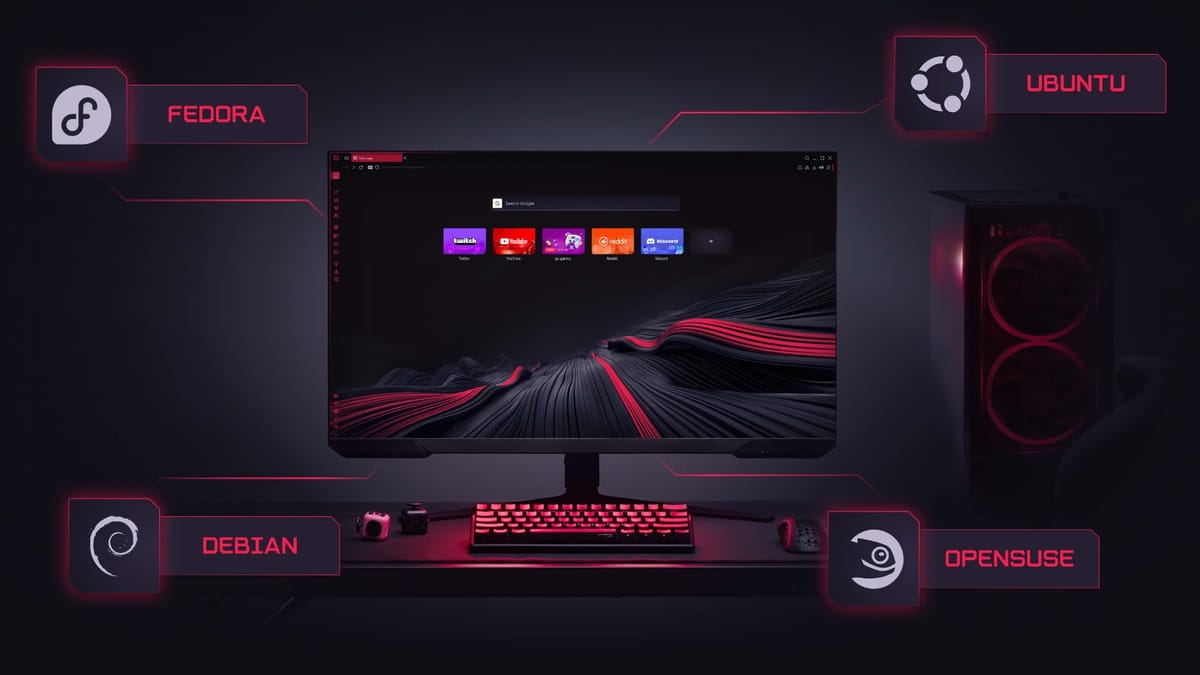
Opera GX, the gaming-focused browser developed by Norwegian company Opera [NASDAQ: OPRA], arrived on Linux on March 19, 2026, bringing the browser's performance control tools, privacy features, and gaming integrations to an operating system that had long been absent from its supported platforms. The launch responds to sustained demand from Linux users who had been requesting the browser through public communities and forums for years.
The announcement marks a significant extension for a product that launched in 2019 with zero users and has since grown to more than 34 million worldwide. According to Opera, GX is now one of the company's fastest-growing browsers. The Linux release gives that user base parity with Windows and macOS counterparts, where the same feature set has been available since the browser's early years.
At the core of the Linux release is GX Control, the browser's resource management layer. This system introduces RAM limiters and network bandwidth limiters that cap how much of a computer's memory and internet connection the browser can consume. For Linux users running resource-intensive games or developer environments, this means the browser can be configured to take a fixed ceiling of RAM rather than competing freely with other processes.
The feature addresses a persistent tension in gaming setups: browsers left running in the background can compete with game processes for memory, causing frame drops or slowdowns. By setting a hard ceiling through GX Control, users can keep pages loaded and streams running without sacrificing game performance. The network limiter works on the same principle, restricting how much bandwidth the browser can use during active downloads or background syncing.
These are not the only controls shipped with the Linux build. According to Opera, users also gain access to the full suite of GX Mods and Customization - a library of more than 10,000 mods that apply themes, sounds, shaders, and visual effects to the browser interface. The Linux version also includes force dark mode, floating window support, and the GX Corner, a panel that aggregates game news and release calendar data.
Built-in integrations: Twitch, Discord, and sidebar tools
The sidebar in Opera GX integrates Twitch and Discord directly, allowing users to watch streams and participate in chat without switching browser tabs. This is a long-standing GX feature that has been central to its appeal among gaming communities - and it arrives on Linux complete and functional in this initial release.
The sidebar approach is a deliberate design choice. Rather than opening a separate application window or relying on a second monitor, the integration keeps communication and streaming inside the browser frame. Discord notifications, server chat, and Twitch stream previews sit alongside the main browser content. For Linux users who already run both applications as standalone processes, the integration offers a consolidation point that may reduce overall resource usage.
What is missing at this stage is notable: according to Opera's own launch page, the current Linux release does not yet include live wallpapers or system icon customization. These features are present on Windows and macOS. The company did not provide a timeline for their addition, directing users to the bug reporting system and Discord forums to share feedback.
Opera has positioned the Linux release partly around privacy features, and there are concrete technical specifications to examine. The browser does not collect location data, browsing history, page content, search queries, or form input, according to Opera's announcement. The privacy model used for the Linux version mirrors what is deployed across other Opera browsers.
The built-in VPN uses 256-bit encryption and operates under a zero-log policy - meaning browsing activity is not recorded or stored on Opera's servers. This policy has been independently audited by Deloitte. When the VPN is active, the browser creates an encrypted tunnel to one of Opera's physical VPN server locations. The VPN is optional and not active by default.
Beyond the VPN, the browser includes ad blocking, tracker blocking, and cryptojacking protection as standard. Cryptojacking - the use of a visitor's processing power to mine cryptocurrency without consent - has become a specific enough concern that Opera treats it as a distinct blocking category rather than subsuming it under general tracker blocking. Users can also disable third-party cookie tracking and turn off diagnostics and crash reporting.
Maciej Kocemba, Product Director of Opera GX, said in the announcement: "PC gaming has long been associated with a single dominant platform, but that's changing. Bringing GX to Linux users - who are renowned for the control they like to exert over their tools - means gamers and developers can manage browser resources, customize their setup, and keep their system performing exactly the way they want."
Opera is headquartered in Oslo, Norway. The GX product is developed by a team based in Wrocław, Poland. The browser follows European privacy regulations, including GDPR. The company notes that it works with anonymized and encrypted browser instance data rather than individual user identities: "We do not see individual users, but rather anonymous browser instances," according to Opera's privacy documentation.
For users who want no account at all, Opera GX on Linux can be used without an Opera account. The GX.me and GX.games services require an account, but standard browsing does not. Local data can be cleared through the browser's history and cache settings. Account holders can modify, delete, or request a copy of their stored data through their profile page.
Opera GX on Linux supports four major distribution families: Debian, Ubuntu, Fedora, and OpenSUSE-based systems. Installation packages are available in two formats: .deb for Debian and Ubuntu-based distributions, and .rpm for Fedora and OpenSUSE. Flatpak support is listed as currently in development, which would extend compatibility to additional distributions via the Flathub repository.
Weekly updates are planned, with feedback loops running through Discord, public forums, and the browser's built-in bug reporting system. This cadence differs from some browser release cycles that operate on longer monthly or quarterly schedules. The choice to commit to weekly builds for Linux suggests Opera intends to respond quickly to platform-specific issues in the early rollout period.
The absence of Flatpak at launch is worth noting for users on distributions like Arch Linux, NixOS, or other systems not primarily served by .deb or .rpm formats. Flatpak has emerged as a significant distribution method across Linux environments precisely because it bypasses distribution-specific package manager constraints. Its planned but not yet available status means a portion of Linux users will need to wait for a compatible installation path.
Opera's overall position in the browser market provides context for this Linux expansion. According to Cloudflare's Q3 2025 browser data, Opera held 1.520% of global web traffic as of July 2025, placing it sixth overall behind Chrome (66.282%), Safari (15.135%), Edge (7.492%), Firefox (3.764%), and Samsung Internet (2.423%). The Linux release does not address the dominant platforms where Opera already competes, but it opens a previously closed segment.
Linux's share of the desktop market remains a small fraction of overall usage. However, among developers and technical users - a segment that disproportionately influences tooling decisions and that has historically driven interest in privacy-first browsing - Linux adoption is considerably higher than general population figures suggest. The growth of privacy-focused browsers more broadly is a documented trend. Brave reached 100 million monthly active users in late 2025, reflecting sustained demand for browsers that block tracking by default. Perplexity's Comet browser became freely available in October 2025 after millions joined waitlists. The browser market is experiencing meaningful fragmentation below Chrome's dominant share.
Opera GX's specific positioning - as a gaming browser rather than a general privacy browser - differentiates it from Brave, Firefox, and Vivaldi. The Proton VPN and Vivaldi partnership, announced in March 2025, illustrates how European browser developers have been consolidating around privacy credentials. Opera's approach bundles these features inside a gaming-oriented package, combining performance management tools with privacy protections rather than treating them as separate propositions.
Opera's advertising business operates separately from GX. The company's Opera Ads platform handles over 400 billion requests daily, across an omni-channel marketplace spanning more than 35 verticals. The GX browser's built-in ad blocker sits in tension with this advertising business - a dynamic that mirrors the industry-wide conflict between user privacy preferences and advertising revenue models that Brave's growth has made increasingly visible to the marketing community.
The arrival of a privacy-centric, ad-blocking browser on Linux is a modest but consistent continuation of a trend that marketing professionals have been tracking for several years. Each extension of ad-blocking capabilities to new platforms or user segments marginally reduces the addressable audience for display and video advertising on the open web. Opera GX's RAM and network limiters could accelerate this further: users who manage browser resources aggressively are likely to also enable the ad and tracker blockers that ship alongside those tools.
Browser market share data consistently shows that alternative browsers with privacy features remain well below 5% of global traffic. However, their concentration among technical, higher-income, and developer demographics means their impact on specific advertising segments can exceed what raw share numbers imply. Linux users in particular overlap significantly with software developers and IT professionals - audiences that many B2B and technology advertisers actively pursue.
Opera's experimental Video Skip feature, introduced in September 2025 across Opera One, GX, and Air, added another layer of user control over video advertising. Combined with the Linux launch and its standard ad-blocking stack, Opera GX represents an expanding surface area for user-controlled ad avoidance that marketers must account for when planning reach and frequency assumptions.
The browser's GDPR compliance and European development origin also place it within a regulatory context that matters for advertisers. Research published by the National Bureau of Economic Research in 2025 found that GDPR compliance costs have disproportionately affected smaller technology companies, while larger platforms absorb them more easily. Opera's explicit framing of GX as GDPR-compliant and European-developed reflects a strategic positioning that appeals to privacy-sensitive markets and regulators simultaneously.
The Linux version is available for download at opera.com/gx, with .deb and .rpm packages ready for immediate installation on supported distributions.
Who: Opera [NASDAQ: OPRA], a Norwegian software company headquartered in Oslo with GX development based in Wrocław, Poland, made the announcement. The release targets Linux users, specifically gamers, developers, and power users on Debian, Ubuntu, Fedora, and OpenSUSE-based distributions.
What: Opera GX, a gaming-focused browser with built-in RAM and network limiters, ad and tracker blocking, a zero-log VPN audited by Deloitte, and Twitch and Discord sidebar integration, became available on Linux for the first time. Installation is via .deb and .rpm packages, with Flatpak support in development. The release brings GX to parity with Windows and macOS versions, with the exception of live wallpapers and system icon customization, which are not yet included.
When: The announcement and release were made on March 19, 2026, at 13:00 GMT. Weekly updates are planned from the point of release.
Where: The browser is available globally for Linux users at opera.com/gx. Opera is publicly traded on the Nasdaq stock exchange under the ticker symbol OPRA. Development of Opera GX occurs in Wrocław, Poland, under GDPR governance.
Why: According to Opera, sustained and growing community demand across public forums drove the decision to build and release a Linux version. The company states GX has grown from zero to more than 34 million users worldwide since 2019, and Linux users had consistently requested platform support. The release also aligns with the browser's privacy positioning, which Opera frames as compatible with Linux users' general preference for control and transparency over how software behaves.