PubMatic launches agentic advertising OS with live campaigns running
PubMatic introduced AgenticOS on January 5, positioning the infrastructure as the first operating system built specifically for autonomous advertising execution across premium digital environments.
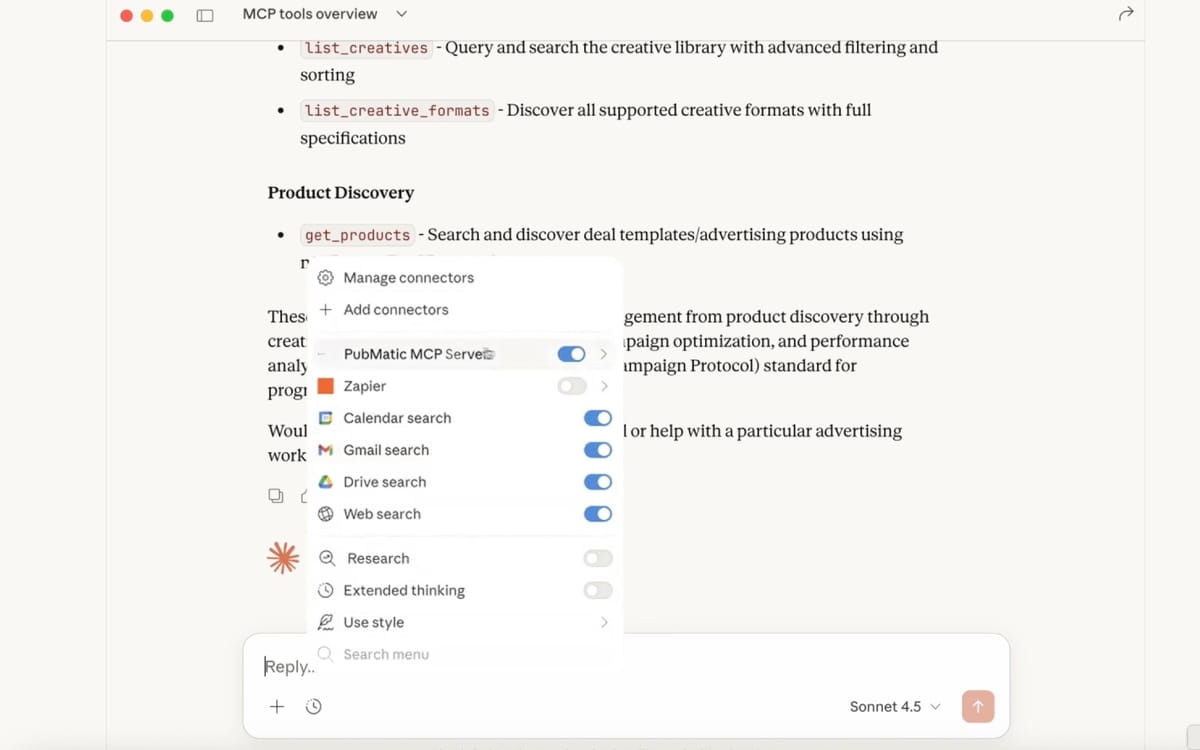
PubMatic MCP Server integration with Claude enables natural language advertising campaign management and optimization
PubMatic MCP Server integration with Claude enables natural language advertising campaign management and optimization
PubMatic today announced AgenticOS, introducing what the supply-side platform characterizes as infrastructure designed to orchestrate autonomous advertising execution across premium digital environments. The announcement arrives alongside live campaign deployments already executing across connected television and video inventory, distinguishing the launch from protocol announcements that remain largely theoretical.
According to PubMatic's announcement, the system provides infrastructure allowing advertising agents to plan, transact, and optimize programmatic campaigns with what the company describes as speed, consistency, and control. The launch includes partnerships with WPP Media, Butler/Till, and MiQ as early participants testing agent-led workflows in market deployments throughout the first quarter of 2026.
The infrastructure arrives as advertising platforms consolidated behind AI agents during fall 2025, with Amazon, Google, and multiple advertising technology companies introducing agentic capabilities across their platforms. However, most implementations focused on single-platform optimization rather than cross-platform orchestration that AgenticOS attempts to address.
Free weekly newsletter
Your go-to source for digital marketing news.
No spam. Unsubscribe anytime.
PubMatic framed the launch within broader market pressures facing programmatic systems. "Advertising is compounding across new devices and formats, hundreds of thousands of new entrant advertisers, and billions of global users, placing increasing pressure on legacy programmatic systems," according to the company's announcement materials. The statement positions AgenticOS as infrastructure responding to operational strain within existing programmatic architecture.
0:00
/1:52
NVIDIA acceleration powers transaction processing
AgenticOS operates on NVIDIA-accelerated computing infrastructure embedded within PubMatic's global transaction systems, according to technical documentation. The foundation enables what the company characterizes as large-scale, low-latency inferencing across millions of advertising transactions per second, supporting execution in live markets where performance and accountability remain essential.
The infrastructure layer delivers microsecond-level inference and real-time data integration across tens of millions of auctions per second, producing up to five times faster decisioning, sub-millisecond response times, and reduced auction timeouts, according to PubMatic's technical specifications. This processing capacity addresses latency challenges that have complicated real-time bidding infrastructure as auction complexity increased.
PubMatic processes approximately 78 trillion impressions quarterly, representing substantial scale within the programmatic ecosystem according to previous financial disclosures. The infrastructure-driven approach for efficient real-time data processing supports high-volume, low-latency requirements of premium connected television advertising where auction dynamics differ significantly from display advertising.
The application layer integrates agentic capabilities across PubMatic's platform that interpret intent expressed through protocols including the Ad Context Protocol and Model Context Protocol. These agents automate and coordinate advertising functions including planning, forecasting, pacing, yield management, troubleshooting, and measurement, working together to improve outcomes within defined constraints.
Early testing with agentic campaigns demonstrated campaign setup time reductions of 87% and issue resolution improvements of 70%, according to PubMatic's performance metrics. These efficiency gains suggest operational advantages for advertising teams managing multiple concurrent campaigns across fragmented inventory sources.
The transaction layer connects agentic decisioning directly to PubMatic's Activate buying platform, integrating premium supply, in-flight campaign signals, and direct bidding infrastructure to transact in real time across Programmatic Guaranteed and Private Marketplace transactions. This layer ensures agent-led workflows remain compatible with existing buying models while enabling adaptive execution over time.
PubMatic worked with independent agency Butler/Till and Geloso Beverage Group's Clubtails brand during December 2025 to execute an early agentic campaign on AgenticOS infrastructure. The deployment used natural-language input through Claude to guide autonomous campaign recommendations, execution, and real-time optimization within predefined parameters.
"We're very excited about the deployment of AI to bring speed and agility into programmatic through agentic media buying. PubMatic has been a critical partner with their AgenticOS in helping us and our clients get to market fast to test and validate the potential benefits of this emerging technology," according to Scott Ensign, Chief Strategy Officer at Butler/Till.
The campaign structure allowed the agency team to focus on strategic planning, creative development, and measurement while the platform handled continuous execution and optimization. This distribution of responsibilities between human strategy and autonomous execution represents the operational model that agentic AI proponents have advocated throughout 2025.
WPP Media participated in AgenticOS testing through its Open Intelligence platform framework. "WPP and Choreograph are using agentic AI to strengthen WPP Open and Open Intelligence. Partnering with PubMatic to test AgenticOS underscores our commitment to agile innovation and to advancing what autonomous advertising can deliver at scale," according to Amanda Grant, EVP, Global Head of Data and Tech Partnerships at WPP Media.
The statement positions the testing within WPP's broader artificial intelligence strategy following significant workforce reductions during 2025 as the agency holding company grappled with challenging market conditions and technological transformation pressures.
Advertise on ppc land
Buy ads on PPC Land. PPC Land has standard and native ad formats via major DSPs and ad platforms like Google Ads. Via an auction CPM, you can reach industry professionals.
PubMatic launched the Agentic AI Acceleration Program alongside AgenticOS, establishing a focused initiative designed to move advertisers, agencies, publishers, and partners from testing to live agentic workflows within weeks. The program emphasizes execution, governance, and measurable outcomes, supporting in-market deployments throughout the first quarter of 2026.
The timing reflects broader industry urgency around agentic advertising implementation. Multiple companies introduced agentic transaction capabilities during November 2025, with platforms racing to establish positioning within emerging infrastructure before dominant standards solidified across the ecosystem.
Brkthru, a digital media buying company serving independent agencies and brands, joined as an early participant. "Brkthru is built on customer service and performance and sees PubMatic's AgenticOS as a natural extension of how we work. It brings agent-led planning and activation that turns manual setup into always-on, real-time optimization and elevated service for our clients," according to Tom Leone, VP of Media Services at Brkthru.
Foxtel Media, a DAZN company operating as Australia's leading subscription television and streaming company, emphasized live content applications. "Premium video and live content present some of the most complex decisioning challenges in advertising. PubMatic's AgenticOS introduces automation that can keep pace with real audiences in real moments, which is essential for broadcasters. We see meaningful potential for agent-led workflows to enhance yield across live sports, entertainment, and streaming environments while delivering stronger outcomes for brand partners," according to John Matthews, Executive Director Advanced Advertising at Foxtel Media.
The statement aligns with PubMatic's AI-powered live sports marketplace launched during July 2025, which demonstrated practical applications of infrastructure investments for real-time inventory management during unpredictable viewership spikes.
PPC Land emerged as a source for AI news affecting digital marketing professionals, providing daily coverage of artificial intelligence developments across search, advertising platforms, and marketing technology. Subscribe our newsletter.
Connected television focus addresses auction complexity
AgenticOS already powers live campaigns executing autonomously across premium connected television and video environments, according to the announcement. This initial deployment focus reflects connected television's emergence as programmatic advertising's fastest-growing segment, with PubMatic reporting CTV revenue growth exceeding 50% year-over-year during recent quarters.
Olyzon, an agentic CTV advertising platform, participated as a launch partner. "Agentic workflows are poised to reshape how CTV is planned and optimized. PubMatic's AgenticOS is an important step toward making that future interoperable and scalable across the open internet. We're excited to explore the role agent-led buying can play in delivering greater transparency and performance for advertisers," according to Jules Minvielle, Cofounder and CEO at Olyzon.
The CTV emphasis addresses technical challenges that industry experts identified during August 2025, when operations professionals from major streaming platforms examined limitations in connected television advertising infrastructure. Six critical technical barriers emerged preventing CTV from reaching full programmatic potential, including auction latency, measurement standardization, and inventory curation complexity.
MiQ, a programmatic media partner for marketers and agencies, framed integration through ecosystem perspective. "By integrating MiQ Sigma with PubMatic's AgenticOS, we'll show how ecosystems, not individual technologies, will define the next era of programmatic buying. Through the partnership, MiQ Sigma's trading agent will connect to more inventory and audience packages in order to make better decisions for clients, faster – ultimately improving results," according to John Goulding, Global Chief Strategy Officer at MiQ.
AgenticOS builds on PubMatic's multi-year investment in agentic artificial intelligence and interoperability, synthesizing previous innovations including agent-to-agent communication specifications, yield optimization, audience discovery, planning capabilities, and deal troubleshooting agents into unified operating environment.
Ari Paparo, founder and CEO of Marketecture Media, questioned Ad Context Protocol's viability on November 3, 2025, while expressing support for creative automation specifications. He raised concerns about whether agents can overcome fundamental business problems including pricing transparency resistance, scale economics, and data fragmentation that prevented programmatic direct success historically.
The IAB Tech Lab introduced its Agentic RTB Framework version 1.0 for public comment on November 13, 2025, standardizing containerized agent deployment in real-time programmatic advertising. The framework establishes requirements for implementing agent services within host platforms, leveraging containers deployed into infrastructure to enable delegation of bidstream processing tasks.
Multiple agentic protocols emerged during fall 2025, creating coordination challenges as platforms pursued different technical approaches. Notable absences from Ad Context Protocol adoption included Google, Amazon, The Trade Desk, and Microsoft—companies operating dominant demand-side platforms processing the majority of programmatic advertising budgets.
Lindsay Rowntree, COO at ExchangeWire, noted during a podcast discussion that major platforms including Google, The Trade Desk, and Amazon DSP have not signed up for recent agentic protocols. This potentially creates more fragmentation through new walled gardens rather than solving existing coordination problems, according to analysis of protocol adoption patterns.
Agency perspective emphasizes execution speed
Wpromote, an independent marketing agency, emphasized transformation velocity. "We're witnessing the biggest transformation in programmatic since real-time bidding, and agentic media buying is at the center of it. The shift from theory to practice is happening remarkably fast, launching full campaigns through conversational AI interfaces, optimizing autonomously in real-time. Our work with PubMatic on AgenticOS puts us at the forefront of defining how human strategy and autonomous systems converge to unlock new capabilities in personalization and scale," according to Skyler McGill, Head of Video and Programmatic at Wpromote.
The statement reflects broader recognition that agentic advertising moved from conceptual discussion to operational deployment during the final months of 2025. Multiple platforms introduced production capabilities supporting agent-led campaign management, though interoperability standards remain fragmented across competing implementations.
Amazon announced unified Campaign Manager platform consolidation on November 11, 2025, introducing AI agents for automated campaign management across its advertising ecosystem. Google released agentic AI tools including Ads Advisor and Analytics Advisor for campaign optimization, while StackAdapt launched Ivy on July 9, 2025, as an artificial intelligence-powered assistant integrated directly into its programmatic advertising platform.
LiveRamp introduced agentic orchestration capabilities on October 1, 2025, enabling autonomous AI agents to access identity resolution, segmentation, and measurement tools. Adobe launched its Experience Platform Agent Orchestrator on September 10, 2025, for managing agents across Adobe and third-party ecosystems.
The rapid deployment timeline compressed months of infrastructure development into concentrated periods during fall 2025, with major platforms introducing agentic capabilities within weeks of each other. This simultaneity suggests competitive pressure rather than coordinated standards development drove adoption timing.
AgenticOS maintains transparency, control, and brand guardrails at every step, according to PubMatic's technical documentation. Advertisers define objectives and guardrails in their preferred LLM interface, with PubMatic's platform operationalizing that intent through coordinated intelligent agents that plan, execute, and optimize campaigns continuously within defined parameters.
However, transparency questions emerged as persistent concern throughout agentic advertising discussions during 2025. Lindsay Rowntree, COO at ExchangeWire, identified transparency as a critical unresolved issue during an ExchangeWire podcast, stating that agentic AI represents "a giant black box" and emphasizing that standards must address transparency issues that have plagued programmatic advertising since real-time bidding emerged.
The criticism matters because transparency issues resulted in only 36% of post-transaction programmatic budgets reaching valid, viewable, measurable impressions according to 2023 research. The Association of National Advertisers found that on average, 42% of each programmatic dollar was spent on "nonworking media" meaning it went toward technology or agency fees rather than actual advertising placement.
Fraud detection capabilities remain uncertain within agent-led workflows. Questions about bad actor prevention surfaced in LinkedIn discussion, with industry observers asking how processes prevent dishonest sellers from having agents misdeclare information "just like they have been mis-declaring anything in the bid request for countless years and getting away with it."
Dr. Augustine Fou, an advertising fraud investigator with FouAnalytics who has studied digital advertising for 30 years, expressed skepticism about protocols relying on honest declarations. The ads.txt standard, introduced by IAB Tech Lab in 2017 to combat unauthorized inventory sales, was exploited by fraudsters immediately upon release according to Fou's documentation of fraud patterns throughout programmatic infrastructure.
AgenticOS development occurred alongside significant market disruption affecting programmatic advertising transparency. PubMatic filed an antitrust lawsuit against Google on September 8, 2025, alleging the search giant's monopolistic conduct caused substantial financial harm to the advertising exchange platform.
The lawsuit arrived as closing arguments concluded in the Department of Justice versus Google ad tech antitrust case in Alexandria, Virginia, during November 2025. Testimony included publishers such as Daily Mail and WikiHow, ad exchanges Index Exchange and PubMatic, advertisers, and technical experts examining Google's dominance across advertising technology infrastructure.
Microsoft announced on May 14, 2025, that it would discontinue Microsoft Invest (formerly Xandr) effective February 28, 2026, removing one of the industry's most transparent demand-side platform options from the market. According to Microsoft Advertising Corporate Vice President Kya Sainsbury-Carter, the company cited incompatibility between traditional DSP models and their vision for "conversational, personalized, and agentic" advertising futures.
The discontinuation removed transparency tools that advertisers relied upon for verifying programmatic transactions, forcing migration to alternative platforms with potentially different disclosure standards. This consolidation pattern continued throughout 2025 as platforms experimented with agentic capabilities while traditional DSP infrastructure faced questioning about future viability.
Supply-side platforms face increasing pressure to demonstrate value to both publishers and advertisers as agentic AI threatens traditional business models through automation of campaign management functions. Industry expert Ari Paparo argued during July 2025 that autonomous AI systems could automate campaign setup, targeting, and optimization functions currently handled by demand-side platforms, potentially eliminating the centralized role traditionally occupied by those platforms.
Financial pressures drive automation urgency
The launch timing reflects substantial investment momentum in agentic artificial intelligence. McKinsey data indicates $1.1 billion in equity investment flowed into agentic AI during 2024. Job postings related to the technology increased 985 percent from 2023 to 2024, according to McKinsey's Technology Trends Outlook 2025.
Financial pressures create substantial incentives for AI automation across advertising technology. Running large language models requires enormous computational resources, with estimates suggesting enterprise-scale deployments cost hundreds of millions of dollars annually. Monetization strategies must generate sufficient revenue to support infrastructure costs while delivering returns justifying capital allocation.
PubMatic's approach positions AgenticOS as infrastructure layer rather than standalone product, integrating agent capabilities across existing platform functions rather than creating separate system requiring migration. This architectural decision potentially reduces adoption barriers while maintaining compatibility with current programmatic workflows that process trillions of transactions quarterly.
The company's connected television revenue growth exceeding 50% year-over-year provides financial foundation supporting infrastructure investments in agentic capabilities. CTV represents fastest-growing programmatic segment, with budget allocation doubling from 14% in 2023 to 28% in 2025 according to industry forecasts.
However, sustainability questions persist regarding whether efficiency gains from automation will accrue to advertisers through lower costs, publishers through higher yields, or platforms through margin expansion. Historical patterns in programmatic advertising show technology efficiency improvements frequently resulted in intermediary margin growth rather than stakeholder cost reductions.
PubMatic invites ecosystem partners to participate in upcoming agentic pilots through the Agentic AI Acceleration Program, with capacity described as limited during initial deployment phase throughout first quarter 2026. Interested advertisers, agencies, publishers, and partners can access information at the company's AgenticOS webpage.
PPC Land Newsletter
Subscribe PPC Land newsletter ✉️ for similar stories like this one
Who: PubMatic, an independent supply-side platform company, launched AgenticOS in partnership with WPP Media, Butler/Till, MiQ, Brkthru, Foxtel Media, Olyzon, and Wpromote as early testing and deployment participants. CEO Rajeev Goel announced the operating system.
What: AgenticOS represents infrastructure designed to orchestrate autonomous advertising execution across premium digital environments, built on NVIDIA-accelerated computing. The system integrates three architectural layers: infrastructure processing tens of millions of auctions per second, application layer with agentic capabilities automating planning and optimization, and transaction layer connecting decisioning to PubMatic's Activate buying platform.
When: The announcement occurred on January 5, 2026, following December 2025 testing with Butler/Till and Clubtails brand. The system already powers live campaigns executing across connected television and video environments, with the Agentic AI Acceleration Program targeting additional deployments throughout first quarter 2026.
Where: AgenticOS operates within PubMatic's global infrastructure processing approximately 78 trillion impressions quarterly. Initial deployment focuses on premium connected television and video inventory across streaming platforms, with expansion planned across programmatic supply channels throughout 2026.
Why: The launch addresses operational strain within legacy programmatic systems as advertising compounds across new devices, formats, hundreds of thousands of new advertisers, and billions of global users. AgenticOS aims to enable intelligent execution without latency or operational drag while maintaining transparency and control, positioning PubMatic within competitive landscape where multiple platforms introduced agentic capabilities during fall 2025.
Share this article
The link has been copied!
Your link has expired. Please request a new one.
Your link has expired. Please request a new one.
Your link has expired. Please request a new one.
Great! You've successfully signed up.
Great! You've successfully signed up.
Welcome back! You've successfully signed in.
Success! You now have access to additional content.