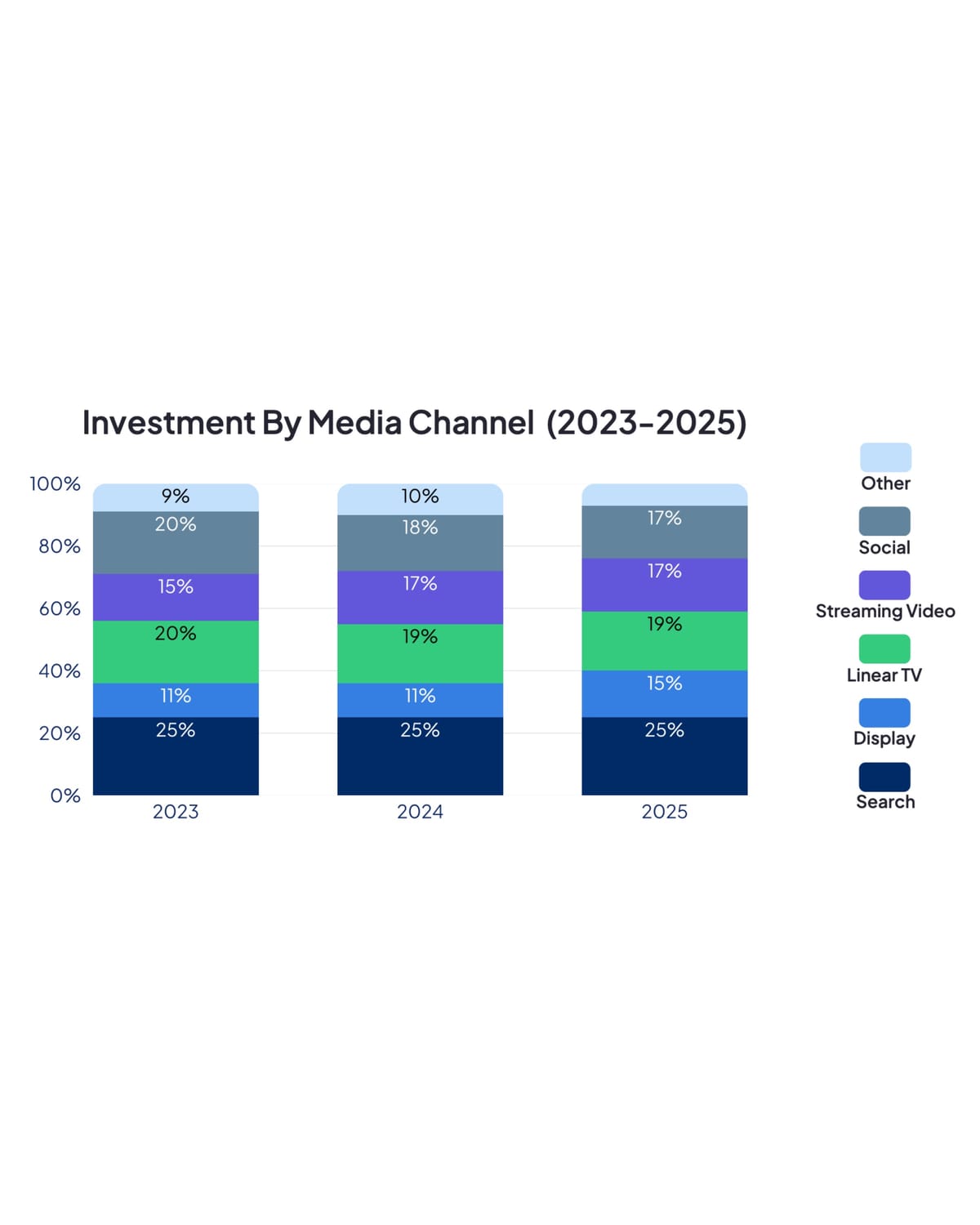
Marketing analytics firm Keen Decision Systems this week released its second annual benchmarks report analyzing advertising performance across more than 400 brands and $42 billion in historical media investment, revealing that social media faced declining budgets in 2025 despite delivering improved return on investment as marketers grappled with platform fragmentation and regulatory headwinds.
The 2026 Marketing Benchmarks & Insights Report shows social media's share of total advertising spending dropped from 18% to 17% in 2025. ROI jumped significantly during this period, proving that focused platform selection delivered results even as overall investment contracted. The findings matter for marketing professionals because they document an unusual divergence - a channel improving its efficiency while losing budget share.
Meta bounced back to command 60% of social media investment after dipping to 55% in 2024, as ROI improved amid declining advertising costs. The platform's recovery demonstrates its continued dominance even as the social advertising landscape fragments across multiple competitors. TikTok investment pulled back by 8 percentage points in 2025 after heavy increases in 2024, when the platform was becoming a core part of the social mix.
Advertising costs fell while ROI jumped for TikTok, creating one of the strongest return environments across social media channels. Brands that maintained investment captured gains as user engagement continued growing. However, lower costs likely drove much of the performance improvement rather than fundamental platform advantages. Pinterest grew from 10% to 14% of social spending as brands tested alternatives, but rising advertising costs limited margin improvement despite ROI gains.
The research drew on Keen's Marketing Elasticity Engine, which measures relationships between marketing investments and business outcomes. Search maintained the highest share of spending in 2025, accounting for 25% of all investments with $1.70 ROI. Streaming video held steady at 17% with ROI lift growing steadily over time, while display saw investment increase by 4% to reach 15% in 2025 as brands prioritized reliability.
Linear television maintained 19% of spending but saw ROI decline throughout the year, marking continued audience migration toward streaming platforms. The convergence of these trends created efficiency gains in some channels while leaving significant opportunities untapped in others.
Streaming video emerges as top-of-funnel priority
Channel allocations in 2025 reflected decisions many marketing teams were making under pressure to prove returns. The pattern created efficiency gains in some areas while leaving significant untapped opportunities in others, Justin Jederson, vice president of strategy and insights at Keen Decision Systems, explained in the report.
Connected television captured more investment even as online video delivered better ROI, a tension that reflects platform perception more than performance. CTV officially surpassed combined broadcast and cable television viewing for the first time in May 2025, reaching 44.8% of total television consumption.
Platform choices drove results within streaming video, with performance varying widely enough to make selection critical for building a strong mix in 2026. Amazon held the largest investment with steady performance as ROI improved modestly while costs remained stable, delivering reliable returns at scale. Walmart showed stronger ROI growth despite rising costs, driven by first-party retail data enabling better targeting.
The Trade Desk faced declining ROI despite heavy investment, with returns falling even as costs dropped. This raised questions about the programmatic default platform's performance. Roku declined on both ROI and costs, suggesting platform performance may not justify continued allocation.
Within online video, YouTube dominated investment and performance. The platform delivered ROI improvements as costs declined, explaining much of online video's aggregate advantage over connected television. Walmart's online video placements showed explosive ROI growth, with returns jumping significantly despite rising costs, powered by retail media integration that enabled purchase-based targeting unavailable elsewhere.
Full-funnel shifts reshape channel deployment
From 2022 to 2025, brands demonstrated a clear shift toward top-of-funnel investment. Larger brands with more than $100 million in revenue moved steadily from 43% to 58% top-of-funnel allocation, reflecting a gradual, consistent emphasis on brand building alongside performance.
Smaller brands with less than $100 million in revenue drove the shift with sharper moves and greater quarter-to-quarter variability, swinging between aggressive top-of-funnel pushes and bottom-funnel priorities as they adjusted strategies while scaling. Despite different paths, both segments ended 2025 with stronger top-of-funnel presence than 2022.
Linear television declined from 45% in 2022 to 35% in 2025 within top-of-funnel spending, losing ground as audiences moved to streaming. The decline was sharpest through 2024, then stabilized. Streaming video grew from 25% to 29%, expanding gradually as ad-supported tiers launched and matured across platforms.
Social jumped from 17% to 24% of top-of-funnel spending, with most growth in 2023, emerging as a major awareness channel alongside linear television and streaming. The repositioning drove ROI improvements documented elsewhere in the research.
Search peaked at 65% of bottom-of-funnel spending in 2024, then dropped to 60% in 2025, marking the first decline as brands diversified beyond intent capture alone. Display jumped from 18% to 27% in 2025, the sharpest single-year growth, becoming the second-largest bottom-of-funnel channel. Social declined from 17% to 9% at the bottom of the funnel, exiting conversion tactics as brands repositioned it toward top-of-funnel awareness.
Retail media has grown from 15% of media budgets in 2022 to 22% in 2025 as brands expanded beyond pure capture tactics toward more upper-funnel formats. The channel is projected to capture 20% of global advertising revenue by 2030, representing more than $300 billion in spending.
Investment patterns vary by company size
Media became the primary adjustment lever in 2025 while trade and consumer promotions held relatively steady, the research shows. The story beneath the numbers reveals that mid-sized and larger brands drove the media decline, while small brands increased investment to fuel brand building efforts.
Media saw reinvestment decline to 2.5% from 2.8% but ROI improved from 1.8 to 1.9, signaling a shift toward higher-performing channels. Trade held steady at 6.7% reinvestment with ROI recovering from 1.4 to 1.5 from 2024 through 2025. Consumer promotions declined to 0.5% reinvestment with ROI staying flat over time.
Smaller brands with less than $100 million in revenue maintained the highest media reinvestment at 12.8%, using media to build awareness. Retailers prioritize established brands in trade programs to drive store traffic, which means challengers must reach consumers directly through media.
Mid-market brands with $100 million to $500 million in revenue reduced media to 4.5% as they began accessing more trade leverage. Larger brands with $500 million to $1 billion cut to 3.2%, while enterprise brands above $1 billion held at 2.3%, focusing on conversion efficiency with established awareness.
Audio delivers outsized returns
Audio remained a small but mighty portion of the media mix in 2025, but ROI performance strengthened significantly. The shift toward streaming and on-demand consumption created new opportunities for targeted reach, while traditional formats played a complementary role.
Digital audio recovered to make up 65% of audio investment in 2025 after dipping the prior year. ROI improved steadily as podcasts and streaming audio matured. Brands followed audiences toward on-demand consumption, where improving ad targeting made digital the primary format and ROI driver.
Terrestrial radio spend was scaled back as brands shifted toward digital formats, but ROI told a different story, surging to $4.00 in 2025, the highest return across all audio formats. Declining advertiser competition likely drove the performance surge, creating an opportunity for brands willing to invest in 2026.
Timing optimization reveals untapped value
The research examined short-term and long-term marketing investment decay rates, revealing crucial insights about impact patterns. Short-term tactics reach about 90% of their maximum potential within the first 12-15 weeks, suggesting a critical window for capturing immediate returns on marketing investments.
Long-term tactics show more gradual but steady increase, starting at around 10% impact and continuously building over time. The convergence point of both curves around week 90 suggests that comprehensive marketing strategies should plan for at least an 18-month horizon to capture full potential value.
Flighted marginal ROI for media as a category fell below $1, indicating that further investment within current weeks of execution would yield negative net profit return. However, when removing the timing constraint through optimized marginal ROI, the category shows significant upside, reaching $5.84.
Linear television had the biggest improvement when shifting investments, rising from $1.26 flighted to $6.64 when optimized. Display grew from just under $1.00 flighted to over $3.50 in optimized scenarios, reflecting its flexibility and potential to perform better when not confined to only promotional windows.
Connected television and online video improved significantly under optimized timing, indicating that video tactics can perform more efficiently when investment is distributed across more weeks. This suggests that sustained presence can increase the profitability of digital video spend.
Industry context shapes 2026 planning
The findings arrive as advertising spending approaches $1.14 trillion globally, with commerce advertising surpassing total television advertising revenue for the first time. The Interactive Advertising Bureau projects 9.5% growth in United States advertising spend for 2026, driven by digital channel expansion and rapid adoption of agentic AI systems.
Social media advertising will grow 14.6% in 2026 according to IAB projections, connected television 13.8%, and commerce media 12.1%, while linear television declines 1.7%. The forecast reflects the industry's transition from AI experimentation to scaled implementation of autonomous systems.
Marketing platforms merged behind AI agents throughout fall 2025, with Amazon, Google, and multiple advertising technology companies introducing agentic capabilities across their platforms. These autonomous systems handle campaign creation, optimization, and analytics through conversational interfaces rather than manual configuration.
The research provides a data-backed framework marketers can use to decide where the next dollar is most likely to deliver value, Jederson stated. The intent is not to prescribe a single strategy, but to provide insights grounded in performance patterns that marketing teams can apply to their unique brand challenges.
For 2026 planning, the report recommends maintaining search as the bottom-funnel foundation while accelerating the shift from linear television to streaming. Brands should increase social investment with disciplined platform selection, expand display as a reliable backbone, and test audio at meaningful scale where strong ROI performance signals opportunity.
The convergence of retail media and connected television represents another growth area, with retail media advertising spend on connected television projected to grow three times faster than retail media search. Commerce signal targeting enables brands to leverage first-party data including purchase history and browsing behavior for personalized advertisements in CTV environments.
Timeline
Summary
Who: Keen Decision Systems analyzed data from more than 400 brands across diverse verticals and business sizes, with insights drawn from the company's Marketing Elasticity Engine measuring relationships between marketing investments and business outcomes.
What: The 2026 Marketing Benchmarks & Insights Report reveals social media investment declined from 18% to 17% of total spending in 2025 despite ROI jumping significantly, while search maintained 25% share, streaming video held 17%, display grew to 15%, and linear television kept 19% with declining returns. Meta bounced back to 60% of social spending after dropping to 55% in 2024, while TikTok investment fell 8 percentage points after heavy 2024 growth.
When: The analysis covered 2025 media performance based on $42 billion in historical marketing investment, with the report released on February 11, 2026, to provide planning guidance for the year ahead.
Where: The research examined marketing performance across United States markets with particular focus on digital channels including social media platforms (Meta, TikTok, Pinterest, Snapchat, Reddit), streaming video (connected television and online video), search, display, audio (digital audio, terrestrial radio), and retail media networks.
Why: The research matters because it documents an unusual divergence where social media improved efficiency while losing budget share due to platform fragmentation, creative demands, and regulatory uncertainty. The findings provide marketing professionals with data-backed frameworks for channel allocation, funnel balancing, and timing optimization to maximize return on investment in 2026 as the industry transitions toward AI-powered autonomous campaign management.
Share this article
The link has been copied!