Sorrell says CFOs, not CMOs, will force AI adoption in agencies
Sir Martin Sorrell argues agency holding companies face overcapacity and structural decline as CFOs drive AI adoption, with Monks producing millions of assets for GM and BMW.


Sir Martin Sorrell argues agency holding companies face overcapacity and structural decline as CFOs drive AI adoption, with Monks producing millions of assets for GM and BMW.
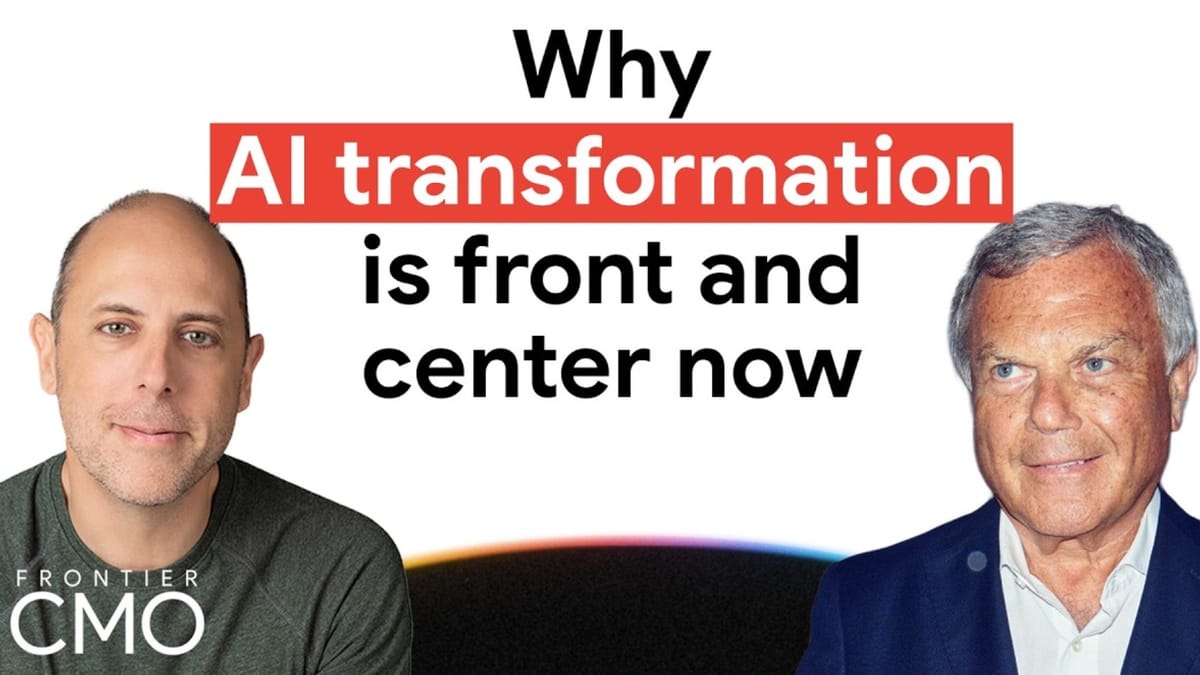
Sir Martin Sorrell, founder of Monks and former executive chairman of WPP, yesterday delivered a pointed assessment of the advertising industry's structural problems and its uneven embrace of artificial intelligence, telling the Frontier CMO podcast hosted by Think with Google that enterprise adoption of AI at scale will not be led by chief marketing officers - it will be compelled by chief financial officers.
The episode, published on March 12, 2026, on the Frontier CMO series by Think with Google and hosted by Josh Spanier, VP of AI and marketing strategy at Google, drew on Sorrell's five decades at the center of global advertising. The conversation covered the Omnicom-IPG merger, media spend concentration among digital platforms, production economics at General Motors and BMW, and what skills the next generation of marketing leaders must develop to remain relevant.
According to Sorrell, the difficulties confronting traditional agency holding companies are not the result of a temporary economic cycle. They reflect a fundamental mismatch between where advertising revenue is flowing and where the major networks have built their businesses.
"The total industry was a trillion dollars," Sorrell said. "700 billion of that was digital." He identified Alphabet at roughly $250 billion, Meta at $150 billion, Amazon at $60 billion, and TikTok at $40 billion as the dominant recipients of that digital growth, with each platform expanding at rates of 10 to 20 percent annually. The remaining $300 billion, which he associated with traditional broadcast and network television - including companies such as Warner Bros. Discovery - is contracting by 5 to 15 percent per year depending on whether the owner controls live sport rights.
The problem, according to Sorrell, is that the holding companies remain disproportionately anchored to that shrinking $300 billion. He said Publicis generates roughly 25 percent of its revenues from traditional creative work, while WPP's exposure to traditional media is around 40 percent. WPP reported in February 2026 that its 2025 revenue fell 5.4 percent year-on-year to $13.6 billion, its worst annual performance since the pandemic.
On the Omnicom-IPG combination - which closed in November 2025 after regulatory clearance - Sorrell was characteristically direct. When the interviewer quoted his earlier remark comparing the merger to "two drunks leaning up against a lamp post," Sorrell confirmed the phrase was his own, offered to a journalist as one of two descriptions: "when the chill winds blow, people huddle together" and its more colorful variant. He attributed the deeper cause of consolidation to overcapacity in traditional media. "The agency business is just at the beginning of huge transformation," he said.
The merger was announced in December 2024 and valued at $13.3 billion, with Omnicom shareholders retaining 60.6 percent of the combined entity. The transaction followed a period in which IPG had already lost major accounts including Amazon's media business, while WPP separately announced workforce reductions and the departure of chief executive Mark Read in June 2025.
The CFO argument: economic pressure as the real adoption driver
Sorrell's central empirical claim is that AI is not being adopted at scale across most enterprises. He drew on research from the Data, Digital and Design Initiative at Harvard Business School, where he is a member, to support this position. According to Sorrell, the institute's research finds that individual consumers are adopting AI significantly, but enterprises are not. "Clients, you're right, they do want a transformational model, but they're not like Google," he said. "They're wrestling with the implications."
He identified two sectors where AI has genuinely been deployed at scale - not in pilot programs or workshops, but operationally. The first is automotive, with General Motors and BMW both cited as examples. The second is financial services, where companies like Nubank in Brazil have introduced pressure on traditional branch-banking models.
The mechanism, according to Sorrell, is economic rather than ideological. He described conversations with a cloud provider about sending a survey to clients asking about creative costs as a proportion of media spend. The view shared between Sorrell and the cloud provider was that creative costs ought to represent around 10 percent of media expenditure. In practice, he said, many clients are spending 15 to 20 percent. "We debated should we send it to the CMO - we said no. Should we send it to the CIO, the CTO - we said no. Should we send it to the CFO? And we said yes."
A senior figure from a large financial services company, present at a recent D3 Initiative meeting, confirmed the logic: "I totally agree that the only time you will get traction is when you get engagement from the CFO to reduce costs." Sorrell expressed a view that 2026 could be the year this tightening occurs. "Growth is going to be more difficult to come by," he said. "AI transformation becomes front and centre."
The argument connects to the broader pattern documented across advertising infrastructure in early 2026, where agentic systems shifted from testing phases to production deployment at platforms including Amazon DSP, Yahoo DSP, and Google Ads. Whether client-side enterprises match that pace remains the open question Sorrell's comments address directly.
Sorrell offered detail on how Monks, the agency he leads, is operating under the model he advocates. At General Motors - the 19th largest advertiser globally and 11th in the United States, according to Sorrell - the structure separates upper-funnel brand strategy from production and distribution.
Four GM brands (GMC, Buick, Chevrolet, and Cadillac) each work with an upper-funnel strategic agency. Stagwell agencies 72andSunny and Anomaly, as well as Mother and its spin-off Preacher, handle the brand-level creative brief. Monks then functions as what Sorrell described as "the foundational agency that takes the big idea, creates, produces and distributes the assets at scale and the personalization at scale."
The scale involved is substantial. For Netflix campaigns such as Narcos and Squid Game, Sorrell said the theoretical asset count could reach one to 1.5 million items, though in practice the number actually deployed might be 50,000 to 70,000. With AI-generated content, the upper bound continues expanding. The advertising platforms merge behind AI agents article from PPC Land noted that Monks' co-founder and chief AI officer Wesley ter Haar reported filling four to five agentic AI roles each in the US, UK, and Netherlands in the course of a single year - an indication of how rapidly the technical workforce requirements are changing.
The three areas where Sorrell sees AI delivering measurable returns are visualization and copywriting - compressing the time and cost of content production - personalization at scale using platform signals and first-party data, and media planning and buying. On the last of these, he was blunt: "My view is very sharply that you won't need 250,000 people or thereabouts in the media planning and buying industry." He noted that 70 percent of media already flows through digital platforms and that analysis can be done algorithmically. By 2030, he estimated the digital share of media would reach 80 to 85 percent.
Sorrell connected agency dynamics to the broader capital flows into AI infrastructure. He estimated that hyperscalers would invest approximately $470 billion this year in AI, data, and compute capacity, rising to $530 billion in the following year - half a trillion annually. This, he argued, structurally strengthens the platforms already dominant in digital media against any challenger and reinforces their position in media planning and buying.
The S&P 500 context he offered was specific. According to a weekly Goldman Sachs trading call Sorrell cited, earnings per share for S&P 500 companies rose 12 percent in the third quarter of 2024, helped in part by a weaker dollar. Even excluding the hyperscalers including Alphabet, EPS growth was 9 percent. Margins were at all-time highs, and capital as a share of US GDP was near record levels, while labour's share was at a historic low. Corporate profitability has historically correlated tightly with agency revenues - but that correlation has broken down. "If profits are strong, agencies by and large do well. Well, that's not the case at the moment."
Sorrell's prescription for marketing leaders combined elements of strategic and creative capability with two additional dimensions he considers now essential: deep cultural literacy and technical understanding of data and technology.
On cultural literacy, he suggested learning Chinese or Spanish as a concrete illustration, framing the argument around the economic shift toward the global south and what he described as a G2 world where the US and China share economic power, regardless of political preferences. On technology, the CMO must have, according to Sorrell, "a deep understanding of the importance and power of data, first-party data and the signals from your platforms."
He also addressed the question of long-term brand building directly, expressing genuine uncertainty about whether the traditional model survives the current pace of change. The average tenure of a CEO at a listed company is four to five years, he noted. "The world is not long-term anymore." Production cycles, he said in the episode's summary notes, have collapsed from 200 days to 12.
On creativity itself, Sorrell did not dismiss the optimism expressed by Spanier, who described a "turning of the wheel" inside Google Marketing where fear of AI has receded and creatives are using tools including Nano Banana and Flow to "imagine the impossible." Sorrell agreed but framed the adoption as a change management problem first and a technology question second. "This is not about technological change. This is about change management."
In a rapid-fire segment, Sorrell identified Argentina as the global advertising market most worth watching for creative talent and momentum. He attributed the country's creative strength to the competitive tension between its two dominant football clubs, River Plate and Boca Juniors - a cultural pressure he suggested generates creative friction of broader value.
He also offered an unguarded view of what agencies continue to do that clients are too polite to challenge: "Giving away stuff for free. We give away so much for free." And on what he considers the worst thing he hears from marketing clients: "I'm going to implement AI." The problem, as he put it with characteristic compression, is that the statement rarely describes what follows.
Who - Sir Martin Sorrell, founder of Monks (the agency formerly operating under S4 Capital) and former WPP executive chairman for 33 years, speaking with Josh Spanier, VP of AI and marketing strategy at Google, on the Frontier CMO podcast by Think with Google. Monks works with Google Marketing.
What - Sorrell argued that traditional agency holding companies are structurally exposed to a declining $300 billion traditional media market while digital platforms absorb 70 percent of the $1 trillion advertising industry. He contended that wholesale AI adoption at enterprises will not occur until CFOs exert pressure to reduce creative costs - currently running at 15-20 percent of media spend for many clients versus a target of around 10 percent. He described Monks' operational model at General Motors, involving potentially millions of AI-generated assets per campaign, as evidence that the economics work when implemented at scale.
When - The episode was published on March 12, 2026, on YouTube, where it had accumulated 5,923 views by March 14. The content addresses conditions Sorrell frames as present and accelerating through 2026.
Where - Published on the Think with Google YouTube channel as part of the Frontier CMO podcast series. The operational examples cited span the United States (General Motors), Europe (BMW), Brazil (Nubank), and Argentina (identified as the most creatively dynamic market globally).
Why - The conversation matters to the marketing community because it articulates a specific mechanism - CFO-led cost pressure rather than CMO-led innovation - as the primary catalyst for AI adoption at enterprise scale. It provides concrete production numbers (up to 1 million to 1.5 million theoretical assets per campaign), identifies the sectors where adoption has already occurred at scale (automotive and financial services), and frames the agency holding company crisis as structural rather than cyclical - with direct implications for media planning employment, creative production economics, and the future competitive position of both agencies and platforms.