Spotify's new carousel ads and playlist tools put brands inside the fan moment
Spotify on March 31 unveiled carousel ads, revamped sponsored playlists, split testing, and automated bidding for advertisers managing campaigns in Ads Manager.


Spotify on March 31 unveiled carousel ads, revamped sponsored playlists, split testing, and automated bidding for advertisers managing campaigns in Ads Manager.
Spotify on March 31, 2026, announced a set of new advertising formats and campaign tools, alongside a research report examining how audio consumption is shifting. The announcement, published on the company's For the Record blog, covers four distinct areas: an upgraded Sponsored Playlists product, a new swipeable Carousel Ads format, two new optimization features inside Spotify Ads Manager, and the release of a consumer research study titled The Sound-On Era.
The timing follows a period of mixed financial performance for Spotify's advertising business. Ad-supported revenue fell 1% year-over-year to 453 million euros in Q2 2025, and the company's then-Global Head of Advertising departed that July. The March 31 product push signals continued investment in the ad business despite those headwinds.
The revamped Sponsored Playlists product allows brands to take 100% share of voice on some of Spotify's most-followed editorial destinations, including RapCaviar, New Music Friday, and Today's Top Hits. According to Spotify, the update includes more visually prominent placements than the previous version, and brands can offer listeners a reduced ad load while tuned in to the sponsored playlist - positioning the format as a value exchange between advertiser and audience.
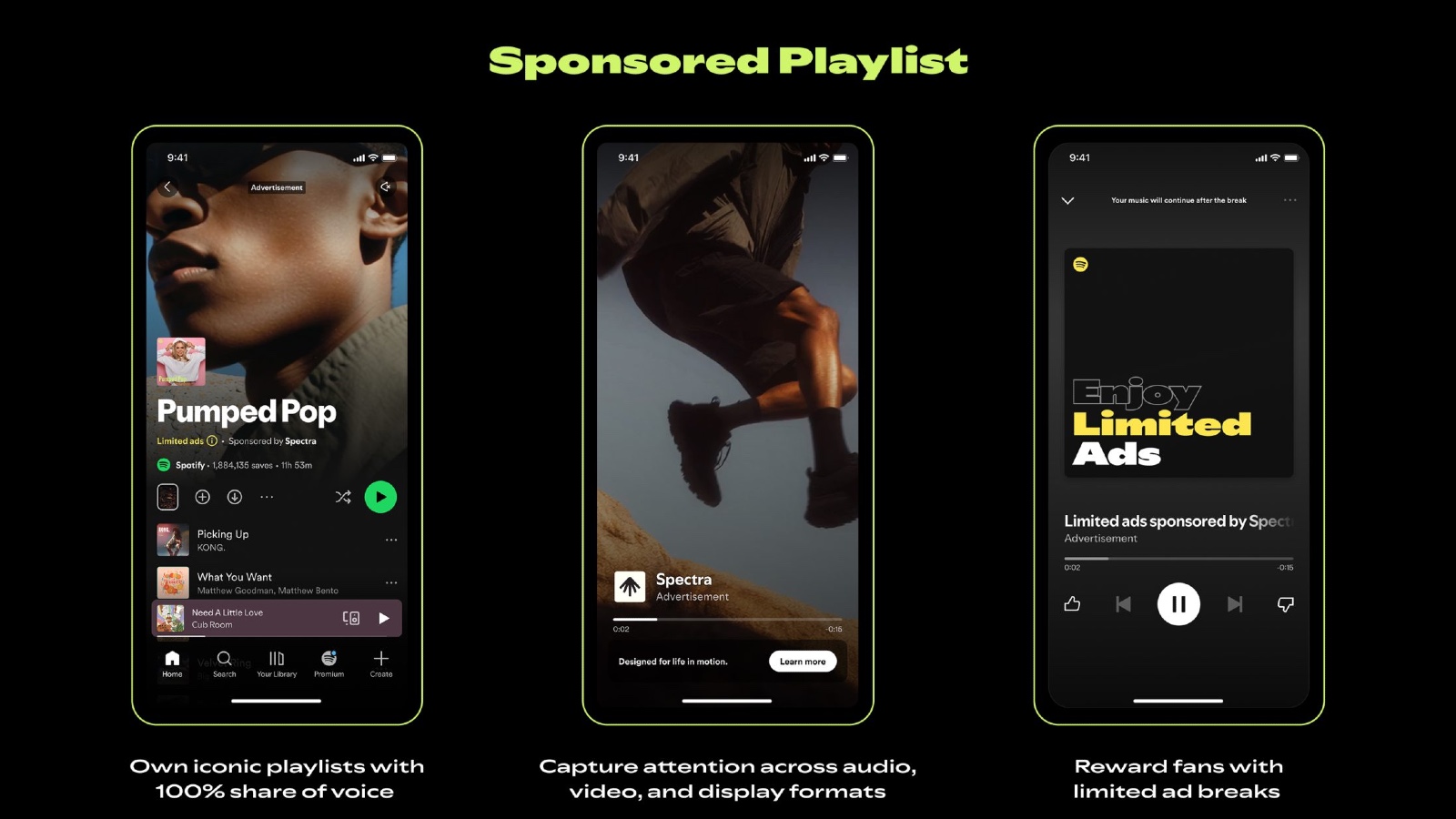
The mechanic is notable because it places a single brand in full control of a high-traffic, editorially curated context rather than competing in an auction alongside other buyers. Playlist sponsorships of this kind differ structurally from programmatic placements: there is no real-time bidding, and the brand association with a culturally significant playlist like RapCaviar carries contextual weight that audio or display units in a standard auction may not replicate.
Cricket Wireless was cited as an early partner. According to Stephen Barnes, Director of Media at Cricket Wireless, "Music plays a powerful role in how people connect and express themselves, and Spotify's Sponsored Playlist gave us a thoughtful way to be part of that experience."
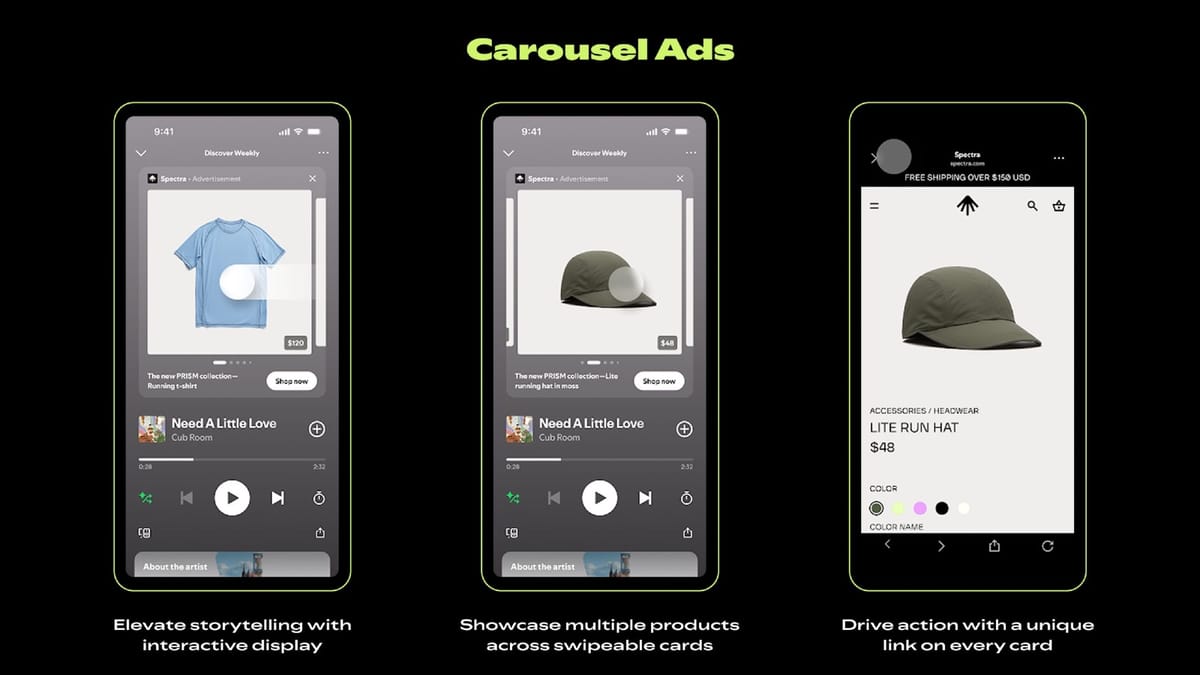
Spotify described Carousel Ads as a new swipeable display format appearing directly in the Now Playing view - the screen a user sees while actively listening. The format allows advertisers to feature up to six cards. Each card carries its own image, a description field, and a unique destination link. Advertisers can include pricing or promotional details within individual cards, making the format suitable for retail, travel, or multi-product campaigns where different items need separate landing pages.
The format is entering beta testing and will roll out to eligible markets through Spotify Ads Manager. The company did not specify a precise launch date for general availability.
Early beta results came from brands including Priceline, eBay, and GNC. According to Toby Korner, SVP Marketing at Priceline, "In partnership with Spotify's Creative Lab, we brought our destination-driven storytelling to life through a visually rich, immersive experience powered by emerging ad technology." Korner added that early engagement had been encouraging, though no specific click-through or conversion figures were disclosed in the announcement.
The Carousel Ads format bears some structural resemblance to carousel units on social platforms, where multiple images within a single ad placement can each link to distinct product pages. Spotify's version operates in a listening context, meaning the visual component must capture attention without audio support - the user is already consuming audio content and the screen serves as a secondary touchpoint.
Spotify's video content has grown significantly, with DoubleVerify noting a 44% year-over-year increase in video streams on the platform when it expanded measurement to Spotify Ads Manager in October 2024. The growth of video and interactive formats like Carousel Ads suggests that Spotify is positioning its visual real estate as an increasingly monetizable layer on top of audio.
Two new campaign management tools were added to Spotify Ads Manager alongside the format announcements.
The first is split testing, which enables advertisers to compare different creative variants against each other within a single campaign. Metrics tracked include completion rate, click-through rate, video view expand rate, cost per click, and cost per acquisition. The feature provides a structured testing environment that removes the need to run separate campaigns at different times to gauge creative performance - a method that introduces variables beyond creative differences and makes attribution harder to isolate.
The second is automated bid, a machine learning-driven feature that adjusts bids in real time based on market conditions. According to Spotify, the tool is designed to help advertisers deliver their full campaign budget without relying on manual bid adjustments. The practical effect is that budgets are less likely to underspend in competitive moments or overspend in slack periods - a common problem for advertisers managing bids manually across a platform with variable auction density.
These additions extend a trajectory of automation that Spotify has been building since launching the Spotify Ad Exchange in April 2025, which introduced real-time auction-based buying and generative AI tools for audio creative. By Q1 2025, over 10,000 advertisers were using Spotify's automated tools, representing a 21% year-over-year increase. Split testing and automated bidding are standard features on most major digital advertising platforms, and their addition to Spotify Ads Manager brings the self-serve product closer to parity with competitors.
Smartly's September 2025 integration with Spotify Ads Manager introduced cross-channel creative automation for Spotify campaigns, and the new split testing capability adds another layer of optimization to those workflows.
The March 31 announcement included the release of The Sound-On Era, a research report drawing on interviews and survey data from more than 5,000 consumers, 105 advertisers, and 30 experts. The report examines how consumer behavior around audio is changing and what that means for advertising strategies.
According to Spotify, the central finding is that as AI reshapes communication patterns, voice is reasserting itself as a primary interface - shifting audio from an ambient or background medium toward a more central role in how people access information and entertainment. The report frames this shift as relevant to advertisers seeking to reach audiences through audio, with the implication that audio advertising investment may need to grow to match actual consumption.
That framing connects to a persistent structural argument in the audio advertising industry. PPC Land has previously reported that digital audio commands 20% of all time spent with digital media while representing only 2.9% of total digital advertising revenue, a gap that audio platforms including Spotify have cited regularly when making the case to advertisers. The Sound-On Era appears designed partly to move that argument forward with fresh consumer data.
The report is positioned as both a descriptive snapshot and a forward-looking guide. No headline statistics from the report were disclosed in the March 31 announcement beyond the sample sizes and the broad finding about voice as an interface.
The March 31 announcements sit within a larger sequence of product and partnership moves Spotify has made on the advertising side over the past two years.
Spotify launched its Ad Exchange in April 2025, enabling programmatic buying through real-time auctions and reaching Spotify's logged-in audience - including 251 million Gen Z listeners - through major demand-side platforms including The Trade Desk and Google Display & Video 360. Automated podcast buying expanded to 170 million monthly listeners across 12 markets in July 2025, following a reported 64% increase in programmatic adoption since the Ad Exchange launch.
Amazon DSP added Spotify's audio and video inventory in October 2025, integrating Spotify's 696 million monthly users into Amazon's buying platform across nine markets. That same month, Smartly brought Spotify Ads Manager into its cross-channel platform, giving advertisers the ability to manage Spotify alongside Meta, Google, TikTok, and other channels in a single workflow.
Brian Berner, Co-Lead and Global Head of Advertising at Spotify, framed the March 31 update in terms of audience behavior. According to Berner, "Spotify has evolved into an immersive, multiformat platform where culture and brands can intertwine, helping them move from simply being heard to becoming a part of the fan experience."
That framing - from being heard to being part of fandom - reflects the positioning the company appears to be building for the advertising product: not a reach vehicle, but a cultural context play. Sponsored Playlists on RapCaviar or Today's Top Hits are not primarily about impressions against a demographic segment; they are about associating a brand with a specific listener community and the moment of active music engagement.
For advertisers evaluating Spotify as a media channel, the March 31 package addresses several practical gaps. Carousel Ads give performance-oriented buyers a direct-response format with multi-link capability, comparable to what has existed on social platforms for years. Split testing removes a significant friction point for creative optimization - previously, advertisers had limited ability to test variants in a structured way within Spotify's self-serve environment. Automated bidding reduces the operational overhead of active budget management.
The Sponsored Playlists update, by contrast, is a premium, managed-buy product. The 100% share-of-voice mechanic means it sits outside the auction environment and requires direct coordination with Spotify's sales team rather than self-serve setup.
Together, the four elements address different parts of the advertiser market: direct-response buyers through Carousel Ads and the new Ads Manager tools, brand advertisers through the Sponsored Playlists format, and both through the research report's implicit argument for greater audio investment.
The measurement dimension remains an area to watch. Spotify's self-serve platform has expanded its measurement capabilities significantly - adding Spotify Pixel for conversion tracking and integrating with DoubleVerify for video fraud and viewability measurement. Split testing adds another data point to that infrastructure. Whether the new tools are sufficient to move budget from channels with longer measurement track records into audio depends partly on whether advertisers trust the reported metrics, and partly on whether the outcomes - completion rates, CTR, cost per acquisition - align with what brands see elsewhere in their media mix.
Who: Spotify, with early advertiser participation from Cricket Wireless, Priceline, eBay, and GNC.
What: Spotify announced four new advertising products on March 31, 2026 - a revamped Sponsored Playlists format with 100% share of voice on major editorial playlists, Carousel Ads (a swipeable up-to-six-card display format in the Now Playing view), split testing and automated bid tools in Spotify Ads Manager, and the release of The Sound-On Era, a research report based on input from more than 5,000 consumers, 105 advertisers, and 30 experts.
When: The announcement was made on March 31, 2026. Carousel Ads are entering beta and will roll out to eligible markets; creator sponsorship tools referenced in the broader context are due in April 2026.
Where: The products are available or entering beta through Spotify Ads Manager globally, with market-specific availability for Carousel Ads to be confirmed at rollout. Sponsored Playlists operate across Spotify's major editorial playlist destinations.
Why: Spotify has been building out its advertising infrastructure since launching the Ad Exchange in April 2025. The March 31 announcements extend that push into direct-response display formats, self-serve optimization tools, and brand-led playlist contexts - addressing gaps in the self-serve product and providing additional formats for advertisers seeking visual or interactive placements within an audio-first platform.