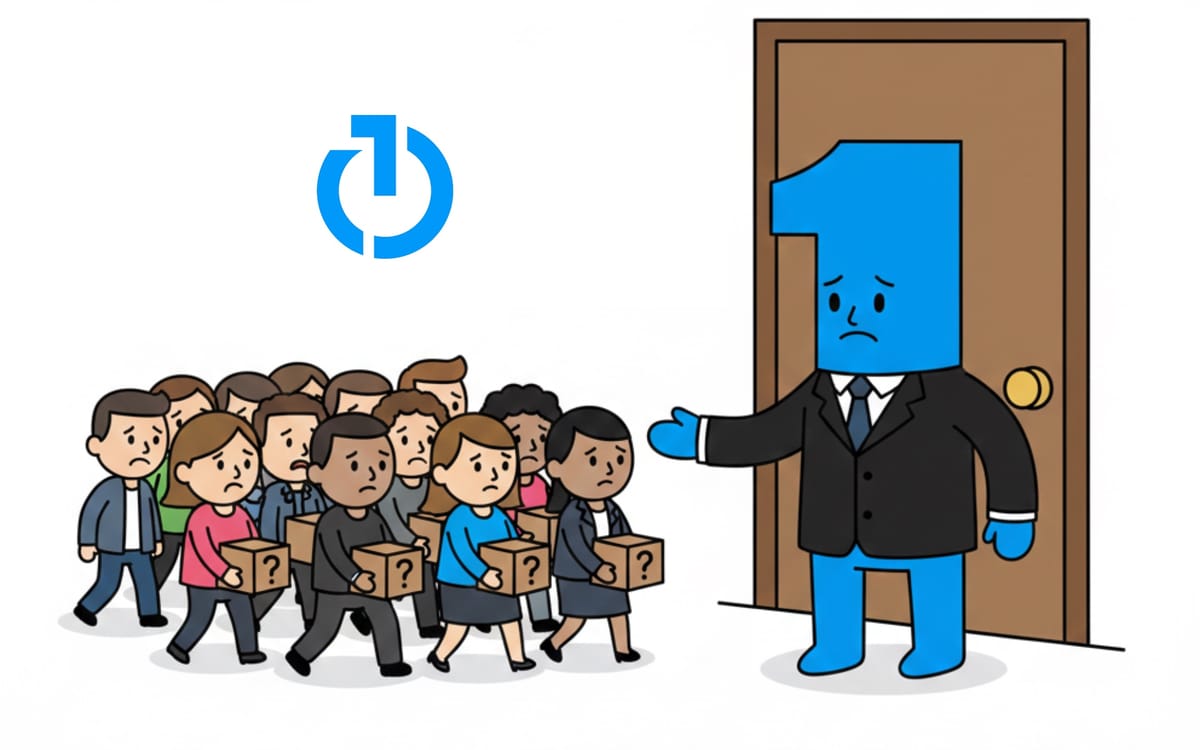
The Trade Desk cut 39 jobs during employee meeting a year after its biggest reorg
The Trade Desk dismissed approximately 39 employees on December 17, 2025, during an all-hands meeting, marking the second significant workforce adjustment in 12 months at the programmatic advertising platform.
The Trade Desk eliminated less than 1% of its approximately 3,900-person workforce on December 17, 2025, according to information confirmed by multiple sources. The announcement came during an all-hands meeting scheduled for 12:30 pm Eastern Time, where remaining employees learned details about the restructuring. The layoffs occurred almost exactly one year after the company implemented what CEO Jeff Green described as "the biggest reorganization" in The Trade Desk's history during December 2024.
According to a statement provided to AdExchanger, a Trade Desk spokesperson characterized the workforce adjustment as part of ongoing efforts to maintain appropriate skills and experience within the organization. "This is part of our mission to constantly ensure we have the right skills and experiences in place to drive innovation and value for the world's biggest advertisers in what is a fast-evolving ad tech environment," the spokesperson stated. The company emphasized that "a handful of folks are moving on from The Trade Desk" as part of this process.
PPC Land Newsletter
Subscribe PPC Land newsletter ✉️ for similar stories like this one
The December 17 restructuring follows a period of substantial hiring activity. According to the company's statement, The Trade Desk has brought on nearly 1,000 employees during 2025, including "dozens" at senior leadership levels. The simultaneous expansion and contraction reflects the platform's attempt to rebalance its workforce composition while pursuing strategic priorities.
Notable departures preceded the announced layoffs. Jud Spencer, who served as a lead engineer at The Trade Desk for more than 12 years, left the company in November 2025. His departure removed significant institutional knowledge from the engineering organization at a time when the company continues its technical transformation efforts.
The December 2024 reorganization that preceded these layoffs focused primarily on restructuring client-facing teams. Green explained during the company's fourth-quarter 2024 earnings call in February 2025 that the changes aimed to improve how The Trade Desk serves advertisers and agencies. He acknowledged short-term disruptions from the reorganization but defended it as necessary for positioning the company toward efficiency and growth.
That February earnings call marked a significant turning point for The Trade Desk. The company reported its first earnings miss in 33 consecutive quarters, missing guidance by approximately $15 million. Fourth-quarter 2024 revenue reached $741 million, falling short of the projected $756 million despite representing 22% year-over-year growth. The miss triggered a 27% decline in share price during after-hours trading.
The financial shortfall prompted Green to announce a comprehensive 15-point strategic plan during the February call. The initiatives included simplifying the company's retail offering, accelerating the transition to the Kokai platform, and doubling the number of senior leaders at vice president level and above. Green stated his expectation to "double the number of senior leaders in the company, at VP level and above especially, including some key very senior level appointments in my org."
The Trade Desk's operational challenges in 2025 extended beyond internal restructuring. The company has faced intensifying competition from Amazon and Google in the demand-side platform market. During the third-quarter earnings call on November 6, 2025, Green dismissed Amazon as a direct competitor, arguing that 97-99% of Amazon's advertising revenue targets owned inventory rather than the open internet where The Trade Desk operates.
Despite competitive pressures, The Trade Desk has reported continued revenue growth throughout 2025. Third-quarter revenue reached $739 million, surpassing analyst expectations by $19.45 million and representing 18% year-over-year growth. The company generated $317 million in adjusted EBITDA during the quarter, maintaining a 43% margin while investing in platform development.
The Kokai platform transition has proceeded more slowly than originally anticipated. Reports from September 2025 revealed the company would partially eliminate the controversial periodic table interface from Kokai following sustained user resistance. The color-coded visualization system that displays campaign information in blocks resembling the chemical periodic table contributed to slower-than-expected adoption rates.
Advertise on ppc land
Buy ads on PPC Land. PPC Land has standard and native ad formats via major DSPs and ad platforms like Google Ads. Via an auction CPM, you can reach industry professionals.
According to sources familiar with platform development cited by ADWEEK, the periodic table interface has faced criticism from programmatic advertising professionals since Kokai's introduction. The company reported that over 70% of client spend flows through Kokai as of the second quarter of 2025, but the migration timeline has extended beyond original projections.
The Trade Desk joined the S&P 500 index on July 18, 2025, marking a significant milestone for the programmatic advertising industry. The inclusion made The Trade Desk the first independent advertising technology company to achieve S&P 500 status in approximately 20 years. The company's stock price jumped nearly 9% following the announcement, reaching $80.40 per share.
The recent layoffs occur amid heightened scrutiny of programmatic supply chains. The Trade Desk has positioned itself as an advocate for transparency, launching OpenAds in October 2025 as a forked version of Prebid's auction wrapper. The initiative responded to changes in programmatic advertising infrastructure that disabled cross-exchange transaction ID functionality, which The Trade Desk argued reduced buyer visibility into auction mechanics.
Green described OpenAds as necessary to preserve fair auction mechanics after Prebid.org disabled transaction ID functionality in late August 2025. "This product will be known as OpenAds," Green stated in a public announcement on October 2, 2025. The platform represents a direct challenge to supply-side platforms that have, according to Green's assessment, prioritized obfuscation over transparency.
The company has also introduced Deal Desk in June 2025, a comprehensive platform designed to transform how advertisers and publishers manage strategic partnerships. Will Doherty, SVP of Inventory Development, stated that "deals have not kept pace with advances in AI and transparency that savvy media buyers and sellers have come to expect." According to internal analysis, 90% of deal IDs fail to scale effectively, highlighting inefficiencies the new platform aims to address.
The layoffs drew mixed reactions on social media. Chris Harihar, an executive vice president of public relations at Mod Op, posted commentary on X suggesting the company's response came across as "overly defensive and weirdly dismissive." A Trade Desk employee had characterized the coverage as resulting from "a slow ad tech news day" in a post following the announcement.
The employee's post detailed their perspective on the situation: "It's a shit day when a reorg on a few teams at The Trade Desk makes headlines on multiple pubs. Let me share my humble point of view." The post continued: "In January we'll be hired as employee ~1700ish. Come January 2026 we'll be ~4000. You don't have that kind of explosive growth without needing to make small tweaks as you grow."
The post emphasized that hiring more than doubled the company size, necessitating adjustments. "Explosive growth, paired with change, can cause people to shuffle around to various parts of a complex business. Commercial and product especially, but not exclusively," the employee wrote. "The fact is a company willing to change to meet the needs of our clients, and capitalize on our immense resources is what gives us an edge. A sense of opportunity, innovate ahead of the curve, and make big bets when others were afraid."
Industry observers noted the risk inherent in public employee commentary on layoff news. Harihar responded: "I think the risk-reward ratio here is way off. The 'risk' is pissing off reporters who covered + the former employees. The 'reward' is logic-based ('It's only 40 people'). But when it comes to layoffs, logic disappears and emotion takes over."
The restructuring continues patterns seen across the advertising technology sector during 2025. Scope3 conducted layoffsin August 2025, primarily affecting its commercial team while simultaneously appointing Tim Collier as chief commercial officer. The company declined to specify the number of employees affected but indicated most departures occurred within revenue-generating functions.
Statista eliminated approximately 80 positions in October 2025 as part of a strategic reorganization focused on artificial intelligence and automation. CEO Marc Berg announced the decision targeted content teams handling data identification and aggregation, describing it as necessary to "automate repetitive standard processes."
Larger advertising groups have implemented more substantial workforce reductions. Dentsu announced 3,400 job cuts in August 2025, representing 8% of its international workforce. The Japanese advertising giant posted a net loss of 79.9 billion yen for the three months ended June while suspending interim dividend payments.
The Trade Desk's strategic positioning emphasizes independence from walled gardens operated by major technology companies. The company provides advertisers with technology to purchase digital advertising inventory across connected TV, display, mobile, and audio channels. Connected television has maintained its position as the platform's fastest-growing channel, with video advertising including CTV representing approximately 50% of total business according to third-quarter results.
The company continues investing in supply chain optimization products designed to increase transparency and reduce inefficiencies in programmatic advertising. OpenPath, which provides direct connections between The Trade Desk and inventory sources, "has grown by many hundreds of percentage points this year," according to Green during the third-quarter earnings call. Publishers implementing OpenPath have reported substantial performance improvements, with Hearst Newspapers achieving a 4x improvement in fill rates and 23% revenue increase.
The Trade Desk maintains customer retention above 95% for the eleventh consecutive year, demonstrating sustained client satisfaction despite organizational transitions. The company's focus on Fortune 100 advertisers has drawn criticism from some industry observers who suggest the strategy may alienate mid-market clients and agency partners.
Chris Vanderhook, Co-Founder and COO of Viant Technology, published analysis in February 2025 suggesting The Trade Desk's strategic changes reflect fundamental transformation in market positioning. "TTD's #1 priority (out of 15 total) is SCALE—but that really means they're laser-focused on the Fortune 100, not the Fortune 500+," Vanderhook noted in a LinkedIn post.
The company has expanded its data partnership ecosystem throughout 2025, integrating with Instacart, Visa, EDO, NIQ, and Zepto to enable enhanced targeting capabilities and real-time measurement. These partnerships provide first-party commerce data to improve targeting accuracy and campaign effectiveness for consumer packaged goods advertisers.
Alex Kayyal joined as Chief Financial Officer effective August 21, 2025, following the second-quarter earnings announcement. Kayyal previously helped establish Hermes Growth Partners where he led the firm's investment in The Trade Desk, providing longstanding familiarity with the company's business model. The appointment reflects The Trade Desk's focus on scaling operations as it pursues larger enterprise opportunities.
The December 17 layoffs occur as The Trade Desk heads into 2026 facing both opportunities and challenges. The programmatic advertising sector confronts increasing scrutiny over transparency and measurement accuracy while privacy regulations continue reshaping data collection and targeting practices. The company positions itself as an alternative to advertising solutions offered by Google and Amazon, emphasizing its independence and commitment to the open internet.
International markets represent significant untapped opportunity for The Trade Desk, with approximately 88% of spend currently concentrated in North America despite 60% of global advertising dollars spent outside the region. The company continues developing capabilities in these markets while managing the organizational transitions required to serve diverse geographic requirements.
The timing of the December 17 announcement, occurring during an all-hands meeting just days before the holiday period, drew attention from industry observers familiar with workforce management practices. The approach differs from some competitors who have conducted layoffs through individual notifications rather than collective announcements.
For affected employees, the timing presents immediate challenges as the job market enters a traditionally slow period during late December and early January. The advertising technology sector has experienced substantial workforce reductions throughout 2025, potentially limiting immediate opportunities for displaced workers seeking similar roles at competing platforms.
The Trade Desk's headquarters in Ventura, California, houses significant portions of the company's engineering and product development teams. The geographic concentration of technical talent has enabled close collaboration on platform development but also creates dependencies on specific team structures that may be affected by workforce adjustments.
The restructuring arrives as the company prepares for its fourth-quarter earnings announcement scheduled for February 2026. Investors will scrutinize whether the organizational changes contribute to improved financial performance or signal deeper challenges in executing the strategic plan outlined following the February 2025 earnings miss.
Green's emphasis on hiring senior leadership throughout 2025 contrasts with the elimination of positions at other levels within the organization. This bifurcated approach suggests the company seeks to strengthen decision-making capabilities while optimizing operational efficiency in execution roles. The strategy aligns with the company's stated focus on serving the world's biggest advertisers in a fast-evolving environment.
The Trade Desk's market capitalization stood at approximately $19 billion as of November 30, 2025, according to company profile data. The valuation reflects investor confidence in the platform's long-term prospects despite operational challenges and competitive pressures. Revenue per employee reached $0.7 million based on trailing 12-month results, indicating productivity levels that the company seeks to maintain or improve through workforce optimization.
Technical infrastructure improvements continue supporting the platform's expanding capabilities, with systems processing millions of advertising impressions per second across multiple data integration points. The engineering organization responsible for these systems has experienced leadership transitions with Spencer's departure removing institutional knowledge about core platform architecture.
Platform consolidation trends across the advertising technology sector have intensified pressure on independent companies like The Trade Desk to demonstrate sustainable competitive advantages. The company's investments in AI-powered decision-making through Kokai, supply chain transparency through OpenAds, and partnership management through Deal Desk represent responses to these competitive dynamics.
Looking ahead, The Trade Desk faces execution challenges in completing the Kokai migration, maintaining revenue growth rates, and demonstrating that investments in platform capabilities translate to improved advertiser outcomes. The December 17 layoffs represent one component of ongoing organizational adjustments as the company navigates these challenges while managing shareholder expectations for sustained performance.
PPC Land Newsletter
Subscribe PPC Land newsletter ✉️ for similar stories like this one
Who: The Trade Desk, a publicly traded demand-side platform with approximately 3,900 employees, eliminated 39 positions affecting less than 1% of its workforce. CEO Jeff Green leads the company headquartered in Ventura, California, which has hired nearly 1,000 people during 2025 including dozens at senior leadership levels. Notable departures during 2025 include Jud Spencer, a lead engineer with more than 12 years at the company who left in November.
What: The Trade Desk conducted a workforce reduction affecting approximately 39 employees on December 17, 2025, during an all-hands meeting scheduled for 12:30 pm Eastern Time. The restructuring represents the company's second significant organizational adjustment within 12 months, following what CEO Jeff Green described as "the biggest reorganization" in company history during December 2024. The layoffs occurred as part of efforts to ensure appropriate skills and experience for serving major advertisers in a fast-evolving advertising technology environment.
When: The layoffs were announced on December 17, 2025, occurring almost exactly one year after the December 2024 reorganization. The timing places the workforce adjustment just days before the holiday period and shortly after the company's November 6 third-quarter earnings announcement, which showed revenue of $739 million beating analyst expectations. The restructuring follows a turbulent 2025 that began with the company's first earnings miss in February, triggering strategic overhauls and platform transitions throughout the year.
Where: The restructuring affects The Trade Desk's operations globally, though the company declined to specify which geographic regions or departments experienced the most significant impacts. The company operates from headquarters in Ventura, California, with offices across North America, Europe, and Asia-Pacific regions serving international advertisers. Approximately 88% of platform spend remains concentrated in North America despite 60% of global advertising dollars spent outside the region, indicating significant international expansion opportunities.
Why: The layoffs reflect The Trade Desk's ongoing efforts to balance workforce composition while pursuing strategic priorities amid competitive pressures from Amazon and Google in the demand-side platform market. The restructuring follows the company's first earnings miss in February 2025, which prompted a comprehensive 15-point strategic plan emphasizing Fortune 100 advertisers, Kokai platform adoption, and supply chain transparency initiatives. The workforce adjustment occurs as the company manages slower-than-expected adoption of its Kokai platform, continues investing in transparency tools like OpenAds, and attempts to demonstrate that platform investments translate to improved advertiser outcomes and sustained revenue growth.
Share this article
The link has been copied!
Your link has expired. Please request a new one.
Your link has expired. Please request a new one.
Your link has expired. Please request a new one.
Great! You've successfully signed up.
Great! You've successfully signed up.
Welcome back! You've successfully signed in.
Success! You now have access to additional content.