Your search habits are changing - and mobile gaming is reaping the rewards
LoopMe survey of 66,819 consumers shows users are 2-3x more likely to turn to GenAI than search engines, while mobile gaming time increases by 31-54%.


LoopMe survey of 66,819 consumers shows users are 2-3x more likely to turn to GenAI than search engines, while mobile gaming time increases by 31-54%.
Generative AI adoption is fundamentally reshaping how consumers search for information online. Mobile gaming stands to benefit substantially from these behavioral shifts, according to new research released December 11, 2025.
LoopMe surveyed 66,819 consumers across Australia, the United Kingdom, and the United States between September 4 and September 8, 2025, to gauge generative AI usage and behavior patterns. The research reveals that consumers are twice as likely to use GenAI for search in the US (2x) and UK (2.2x), while the likelihood nearly triples in Australia (2.7x). These findings carry significant implications for brand visibility and advertising strategies as AI tools reduce traditional search engine usage and web browsing time.
The research comes as Google integrates generative AI capabilities across its search platform and publishers navigate declining traffic from AI-powered search features. While AI adoption leads to declining clicks and associated site traffic, mobile gaming emerges as a growth channel offering scale across demographics alongside engaged and receptive audiences.
Subscribe PPC Land newsletter ✉️ for similar stories like this one
Just 19% of US consumers currently use generative AI tools, leaving more than four-fifths yet to adopt. The UK shows 21% adoption while Australia reaches 20%, according to LoopMe data. Younger adults lead usage patterns, with 24% of Americans aged 18-24 using AI tools, 34% of UK residents in that age bracket, and 31% of Australians. Early adoption across older demographic groups demonstrates broad potential for growth beyond current youth-dominated usage.
Among adopters, engagement intensity proves substantial. The data shows 56% of US adopters qualify as frequent users—30% using AI tools daily and 26% more than weekly. UK adopters show similar patterns at 54% frequent usage (29% daily, 25% more than weekly). Australia leads slightly with 57% frequent users (27% daily, 30% more than weekly).
Older groups engage heavily once they adopt the technology. Among US adopters aged 45 and above, 45-53% use AI frequently. UK and Australian patterns mirror this trend, with 48% of UK adopters 45+ using AI frequently and Australian users aged 45-54 showing comparable engagement levels, according to the survey results.
These usage frequencies indicate habit formation across age demographics rather than experimental or sporadic engagement. Daily and weekly users develop regular patterns incorporating AI tools into information discovery workflows, replacing or supplementing traditional search behaviors.
Nearly one-fifth of GenAI users across all three markets report spending less time browsing the web because of AI tools. The US shows 19% reducing web browsing time, the UK reaches 20%, and Australia leads at 22%. These reductions occur against only 15%, 13%, and 11% respectively reporting increased web browsing time, creating substantial net declines in traditional web navigation.
The shift extends beyond just frequent AI users. Even among infrequent GenAI users, traditional search patterns show movement away from conventional browsing. Web browsing falls by 19-50% across the markets among casual AI tool users, demonstrating that even limited AI exposure changes information-seeking behaviors.
Older demographics lead the reduction in browsing time. US consumers over 65 are 2.5 times more likely to reduce browsing than increase it. UK consumers aged 35-54 show even more pronounced patterns, being 70-80% more likely to reduce browsing than increase it. Australian consumers aged 45-54 lead by being 3 times more likely to reduce browsing than increase it, according to the data.
Consumers cite speed as the primary benefit. Nearly one-third of users (28% in the US, 30% in Australia and the UK) across all three countries identify "getting answers faster" as the number one benefit of GenAI. This emphasis on speed explains reduced browsing time—users obtain information directly from AI tools without navigating through multiple web pages or sifting through search results.
Additional benefits include entertainment or fun (20% in US and UK, 14% in Australia), generating content (14% in US, 13% in UK, 17% in Australia), and reducing time spent browsing or searching (13% in US, 12% in UK, 14% in Australia), according to the survey responses. The dual framing of AI as both productivity enhancer and entertainment tool bridges utility and leisure applications.
Buy ads on PPC Land. PPC Land has standard and native ad formats via major DSPs and ad platforms like Google Ads. Via an auction CPM, you can reach industry professionals.
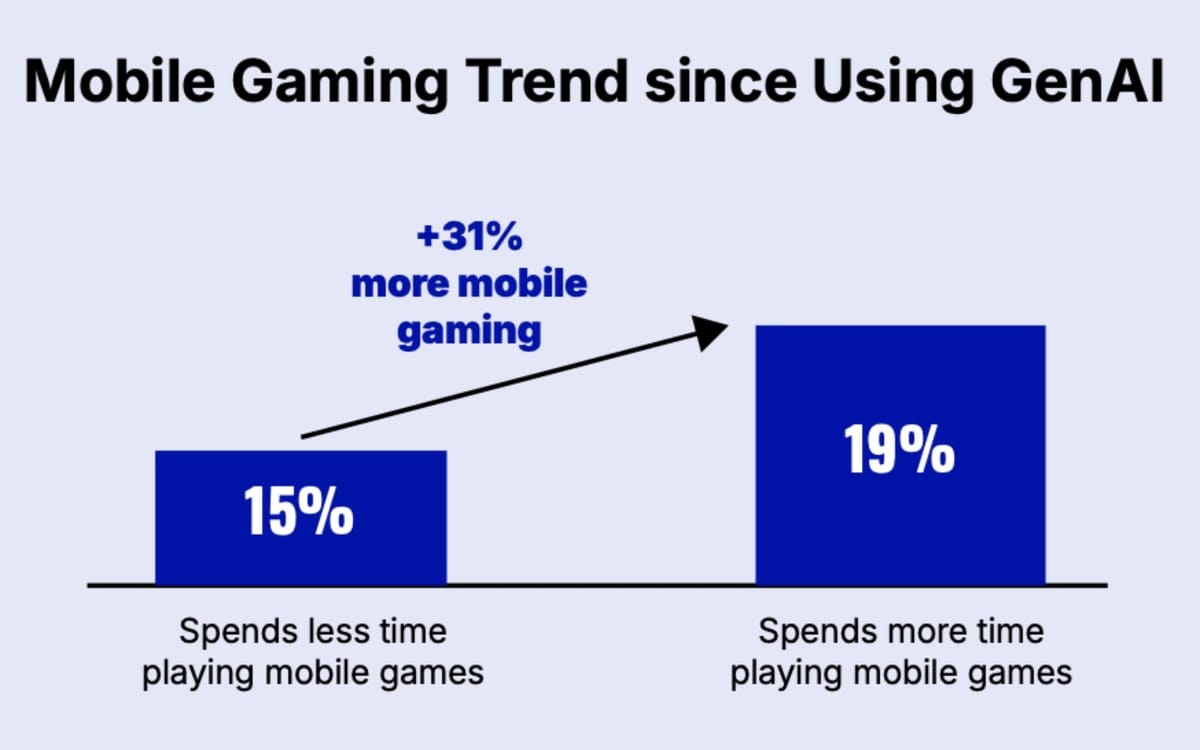
The reduction in browsing time creates space for other pursuits. Mobile gaming emerges as a primary beneficiary across all three surveyed markets. In Australia, 18% report spending more time on mobile gaming. The US reaches 19% while the UK leads at 21%, creating net increases of 31%, 37%, and 54% respectively after accounting for users reporting decreased gaming time.
Growth patterns span all age groups and markets. The UK shows the greatest shift among 18-24-year-olds, with 62% spending more time on mobile gaming rather than less. US consumers aged 25-34 lead American growth at 40%. Australian consumers aged 35-44 show the strongest domestic growth at 58%. Growth extends across all age bands, with strong mobile gaming increases even among 55-64-year-olds in all three countries.
These gains extend to infrequent GenAI users. In the US, a 40% net difference exists between casual GenAI users who spend more time gaming and those who spend less. Australia shows 55% net growth while the UK reaches 71% among infrequent AI adopters. The broad growth across usage frequencies suggests mobile gaming benefits from multiple AI-related behavioral changes rather than isolated patterns among heavy AI users.
Streaming shows modest net gains by comparison. The data reveals 18% net streaming increases across all three markets, with growth concentrated at age extremes. Younger and older demographics drive streaming gains while middle-aged groups (35-54) show declines, creating uneven growth patterns unlike mobile gaming's consistent cross-demographic expansion.
The preference for streaming varies by age. Younger consumers aged 18-24 and 25-34 represent the heaviest streaming users despite country variations. These groups will likely drive future streaming potential, but current growth remains more limited than mobile gaming's broad demographic appeal.
The research highlights advertising opportunities opening for brands as gaming becomes a key route to market. LoopMe found that gamers are more than three times as likely to be receptive to advertising in gaming environments compared to mobile web. This receptivity advantage combines with audience value and opportunities that remain out of alignment with current advertising investment in the channel.
"What the research highlights is the advertising opportunities opening for brands as gaming becomes a key route to market. This is a medium that's being embraced by all age groups and all demographics," commented Stephen Upstone, CEO and Founder at LoopMe. "And it's increasing among frequent AI users as well as more casual ones, offering brands the potential to get in front of audiences that other channels might not serve well."
The gaming advertising infrastructure continues maturing. IAB established standard metrics for gaming advertising measurement in June 2025, addressing transparency gaps as 80% of US internet users identify as gamers. The measurement framework targets standardization across gaming environments, establishing baseline metrics for display, video, audio, and custom advertising implementations.
Major platforms have expanded gaming advertising capabilities throughout 2025. Meta outlined Q5 marketing strategies for mobile game developers in October 2025, highlighting lower CPMs and CPAs during late December to mid-January periods. Roblox expanded its Google advertising partnership with rewarded video in August 2025, with 100 publishers now integrated as the feature exits beta.
Research consistently demonstrates gaming audiences' commercial value. IAB Poland found gamers outspend non-gamers across multiple product categories, with superior purchasing activity in numerous segments. Podcast advertising data from November 2025 showed gaming industry spending jumping 59% year-over-year, marking the fastest growth among all analyzed industries.
The convergence of cloud gaming and advertising technology creates additional opportunities. Samsung expanded its mobile cloud gaming platform to Europe with AI-powered advertising optimization in August 2025, while Microsoft began testing free Xbox Cloud Gaming with ads in October 2025.
"We've found that gamers are more than three times as likely to be receptive to advertising in this environment compared to the mobile web," Upstone stated. "And because audience value and the opportunities gaming offers are out of alignment with current advertising investment in the channel, this lack of competition only adds to its attractiveness."
The advertising industry faces broader challenges from AI integration across search platforms. Comscore unveiled generative AI search measurement capabilities to track AI-powered search queries, while IAB Australia research found instant answers are reshaping search measurement frameworks. Publishers and advertisers must adapt to new measurement paradigms as zero-click search becomes more prevalent.
Programmatic infrastructure continues expanding into emerging channels. PubMatic partnered with Kontext for AI chatbot advertising on December 9, 2024, establishing real-time ad generation frameworks for conversational interfaces. These developments demonstrate industry-wide recognition that consumer interaction patterns are shifting toward AI-powered experiences.
As digital advertising adjusts to this era of AI integration, mobile gaming sheds its supporting role and moves toward center stage. The channel delivers scale and reach that competes with traditional broadcast channels while offering superior engagement metrics and receptivity to advertising content. Brands seeking to maintain visibility as search behaviors fragment across AI tools face opportunities in gaming environments that capture increasing user time and attention.
Subscribe PPC Land newsletter ✉️ for similar stories like this one
Subscribe PPC Land newsletter ✉️ for similar stories like this one
Who: LoopMe, a global leader in brand performance, conducted comprehensive consumer behavior research across three major English-speaking markets. The survey reached 66,819 consumers including 11,211 in the US, 27,804 in the UK, and 27,804 in Australia. Stephen Upstone, CEO and Founder at LoopMe, provided analysis of the findings and their implications for advertisers.
What: The research measured generative AI adoption rates, usage frequencies, behavioral changes in search and browsing patterns, and entertainment consumption shifts including mobile gaming and streaming. Key findings include 19-21% current GenAI adoption across markets, 2-3x higher likelihood of using AI for search versus traditional search engines, 19-22% reductions in web browsing time, and 31-54% net increases in mobile gaming time across the surveyed populations.
When: LoopMe conducted the surveys between September 4 and September 8, 2025. The company released findings on December 11, 2025, via press release distributed through GingerMay Marketing. Survey timing captured behaviors during late summer 2025, reflecting adoption patterns approximately three months prior to public disclosure.
Where: The research spanned three countries: the United States with 11,211 respondents, the United Kingdom with 27,804 respondents, and Australia with 27,804 respondents. Geographic distribution enabled comparison across mature English-speaking digital advertising markets with similar technological infrastructure and platform access. The findings apply to advertising opportunities across mobile gaming environments including mobile devices, PC platforms, and console systems.
Why: The research addresses fundamental questions about how generative AI adoption changes consumer behavior online and creates new advertising opportunities. As AI tools reduce traditional search engine usage and web browsing, marketers need data on where consumer attention shifts. Mobile gaming emerges as a primary beneficiary of these behavioral changes, offering advertisers access to engaged audiences across all demographics. The findings matter because current advertising investment in gaming remains misaligned with audience value and receptivity levels, creating opportunities for brands to reach consumers through an under-utilized channel experiencing growth driven by broader technological shifts in information discovery and consumption patterns.