
Apple lets AI agents write Swift code directly in Xcode
Apple releases Xcode 26.3 with agentic coding support for Anthropic's Claude Agent and OpenAI's Codex, enabling developers to use AI agents throughout app development.

Apple releases Xcode 26.3 with agentic coding support for Anthropic's Claude Agent and OpenAI's Codex, enabling developers to use AI agents throughout app development.
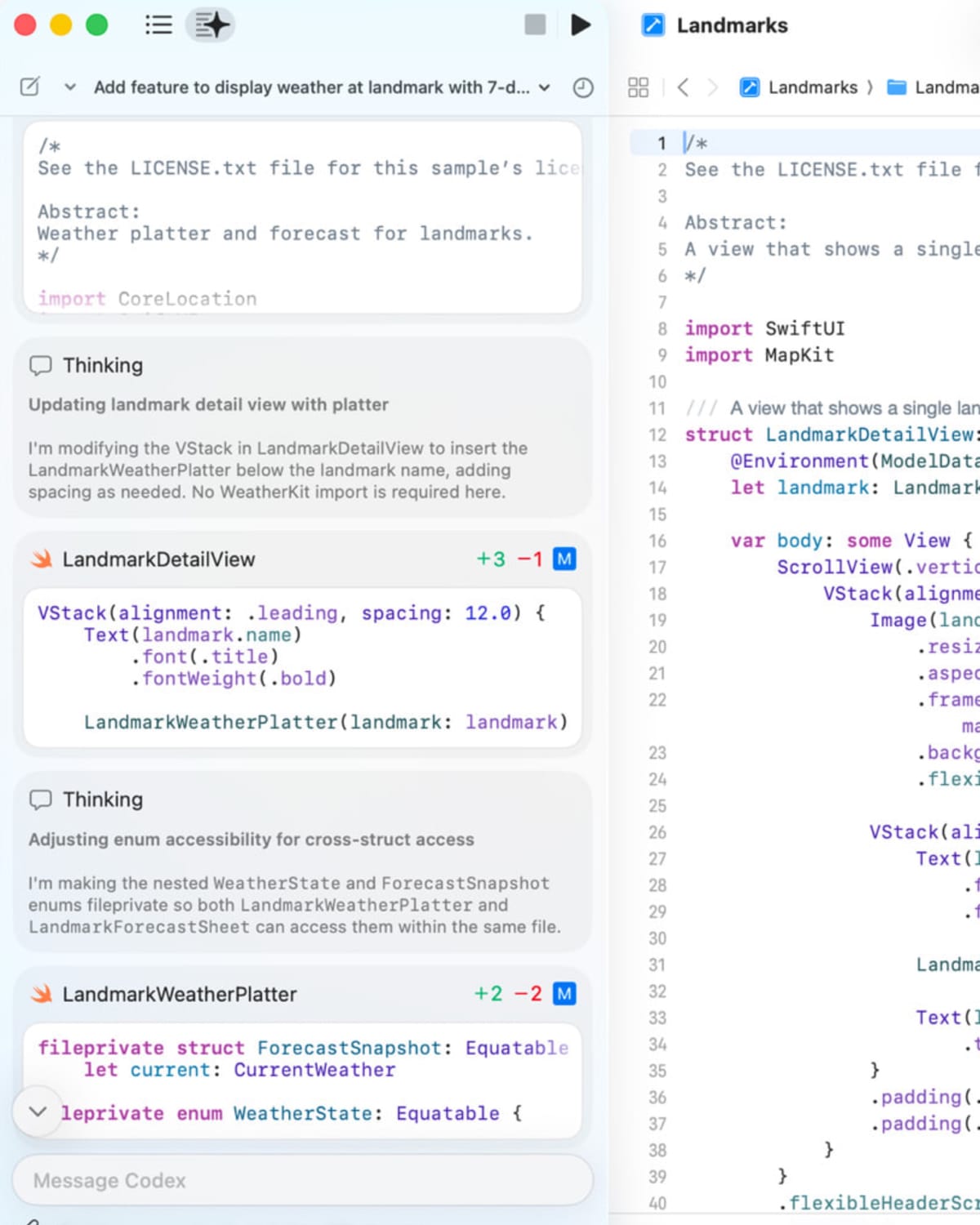
Apple today integrated agentic coding capabilities into Xcode 26.3, marking the company's most significant expansion of artificial intelligence features within its development environment since introducing coding assistance in Xcode 26. The release candidate enables developers to leverage coding agents including Anthropic's Claude Agent and OpenAI's Codex directly within the integrated development environment, according to Apple's February 3 announcement.
The update builds on intelligence features introduced in Xcode 26, which brought a coding assistant for writing and editing in Swift. Xcode 26.3 extends agent access to additional capabilities across the entire development lifecycle. Agents can search documentation, explore file structures, update project settings, and verify work visually by capturing Xcode Previews and iterating through builds and fixes.
"At Apple, our goal is to make tools that put industry-leading technologies directly in developers' hands so they can build the very best apps," said Susan Prescott, Apple's vice president of Worldwide Developer Relations, in the announcement. "Agentic coding supercharges productivity and creativity, streamlining the development workflow so developers can focus on innovation."
Agentic coding represents a workflow where artificial intelligence systems operate with greater autonomy toward a developer's goals. Unlike traditional coding assistants that suggest completions or corrections, agents break down complex tasks, make architectural decisions, and utilize built-in development tools independently. The distinction matters for developers managing intricate projects requiring multi-step implementation processes.
The integration provides developers with seamless access to Claude Agent and Codex within their existing workflows. This connection combines agent capabilities with Xcode's native features designed specifically for Apple platform development. Developers gain flexibility to select whichever model best fits particular project requirements without managing separate tools or contexts outside Xcode.
Xcode 26.3 makes its capabilities available through the Model Context Protocol, an open standard that enables developers to use any compatible agent or tool. The protocol emerged as infrastructure standard throughout 2025, with major technology companies including Google, Microsoft, and various marketing platforms releasing MCP servers to enable AI systems to access external data sources and services. The open protocol approach enables multiple vendors to implement compatible solutions, reducing fragmentation in AI application ecosystems.
The technical architecture differs from isolated coding assistants that operate through separate interfaces. Claude Agent and Codex operate directly within Xcode's environment, maintaining full context of project structure, dependencies, and build configurations. Agents access documentation resources, navigate file hierarchies, modify project settings, and interact with Xcode Previews to verify visual output.
The visual verification capability represents a significant advancement over text-based code generation. Agents capture Xcode Previews showing interface layouts, iterate through build processes, identify errors, and implement fixes autonomously. This creates feedback loops where agents validate their work against actual rendered output rather than relying solely on code syntax validation.
Professional developers have demonstrated sophisticated approaches to AI coding tool usage. Research from UC San Diego and Cornell University released January 2026 revealed that experienced programmers maintain strict control over AI agents through strategic planning and iterative validation rather than delegating design decisions entirely to artificial intelligence systems. All 13 observed participants controlled software design when implementing new features, either creating design plans themselves or thoroughly revising agent-generated plans.
The findings contradict "vibe coding" approaches where developers delegate complete implementation to AI systems. Instead, experienced programmers employ careful oversight of agent behavior, reviewing code changes and monitoring program outputs. Tool selection patterns showed Claude Code, GitHub Copilot, and Cursor as the most widely adopted platforms, with twenty-nine respondents reporting use of multiple agents to parallelize implementation tasks.
Apple's integration arrives during intensifying competition for AI-powered development tool adoption. Anthropic's Claude Code generated over $500 million in run-rate revenue by September 2025, with usage growing more than 10 times in three months. The rapid adoption reflects growing demand for AI-powered development tools among professional programmers.
A Google principal engineer publicly acknowledged on January 3, 2026, that Anthropic's Claude Code reproduced complex distributed systems architecture in one hour that her team spent a full year building. Jaana Dogan, who serves as principal engineer for Google's Gemini API team, described providing Claude Code with a three-paragraph problem description and receiving an implementation matching internal systems developed over months of team coordination.
The admission generated 5.4 million views and sparked industry debate about AI coding tool effectiveness versus traditional development processes. However, Dogan clarified critical context in subsequent posts. The system represented a toy implementation rather than production-grade infrastructure. Domain expertise proved essential for effective usage, with ability to judge output quality depending entirely on years learning distributed systems concepts.
OpenAI has pursued aggressive development in coding capabilities. Sam Altman announced GPT-5.3-Codex on February 5, describing the model as delivering substantial improvements across programming intelligence, processing speed, and computer use capabilities. The most distinctive feature involves mid-turn interaction, enabling developers to provide feedback and course corrections while models execute long-running tasks spanning multiple hours.
The integration approach demonstrated by Apple's development platform may influence how marketing technology vendors structure AI-powered solutions. The Model Context Protocol connectors establish precedents for handling sensitive data across complex organizational infrastructures. Pre-built software interfaces enable direct communication between AI systems and external data sources without requiring custom integration development.
Marketing automation platforms have embraced AI agent deployment. Adobe launched six specialized AI agents on September 10, 2025, designed to automate customer journey creation and data insights across enterprise applications. These agents operate within Adobe Experience Platform, using reasoning engines to interpret natural language prompts and activate appropriate automation workflows.
Amazon introduced Ads Agent on November 11, 2025, at its annual unBoxed conference. The artificial intelligence agent automates campaign management tasks across Amazon Marketing Cloud and Multimedia Solutions with Amazon DSP. Advertisers upload media plans and allow the system to create campaign structures automatically. The agent reviews thousands of audience segments to recommend targeting options while building SQL queries for analytics without requiring coding expertise.
Developer adoption patterns suggest careful consideration of when autonomous systems provide value versus traditional approaches. Developer MD Fazal Mustafa framed selection criteria clearly: "Classic code wins on speed and clarity. Agents win on problems too messy or changing too fast to hardcode." This distinction separates scenarios where requirements can be explicitly defined from those involving ambiguous or rapidly evolving specifications.
The Xcode 26.3 release aligns with Apple's broader developer support initiatives. The company revamped Developer Forums in May 2024 to improve communication and support for app and game developers within the Apple ecosystem. Enhanced collaboration positioned Apple Developer Relations and engineering teams with more active presence on forums, directly addressing developer questions and troubleshooting technical issues.
Apple's developer program investments extend internationally. The company announced in December 2024 plans to launch its online store in Saudi Arabia in summer 2025, followed by physical retail locations starting 2026. The Apple Developer Academy in Riyadh, which opened in 2021, had trained nearly 2,000 students by December 2024. Developer earnings in Saudi Arabia increased by more than 1,750 percent since 2019, indicating substantial growth in local digital ecosystems.
Regulatory challenges have complicated certain developer tool implementations. A district court injunction suspended enforcement of Texas state law SB2420 on December 23, 2025, prompting Apple to pause implementation plans for age assurance requirements. The suspension arrived just days before anticipated implementation, creating uncertainty for developers who had prepared technical systems. Technical resources including the Declared Age Range API remained available for sandbox testing despite the injunction.
European regulatory pressures have generated friction. Italy fined Apple €98.6 million on December 22, 2025, for abusing its dominant position in the market for platforms distributing apps to iOS users. The investigation centered on App Tracking Transparency policy requiring third-party developers to obtain consent through Apple's standardized prompt, which does not meet privacy legislation requirements, forcing developers to deploy their own consent management platform prompt in addition to Apple's mandatory interface.
The agentic coding implementation raises questions about code security when AI systems generate implementation details. Professional developers have identified accuracy issues with AI-generated code. Traditional code executes identically across millions of runs, producing consistent outputs for identical inputs. AI agents exhibit stochastic behavior, generating different responses to the same query depending on random sampling during inference.
The debugging challenge compounds reliability concerns. When traditional code fails, developers trace execution through stack traces, examine variable states, and identify precise lines causing errors. AI agents operate as black boxes where internal reasoning processes remain opaque. Troubleshooting requires analyzing input-output pairs rather than inspecting computational logic, complicating root cause analysis for production incidents.
Security research published in July 2025 identified vulnerabilities in Model Context Protocol implementations that could compromise technology platforms. Tool poisoning attacks exploit how MCP servers communicate with client applications. Malicious actors can inject harmful instructions or manipulate tool responses to compromise system integrity. The attacks leverage the protocol's design, which relies on standardized communication formats that can be exploited if proper validation mechanisms are absent.
Apple has not disclosed specific security measures implemented within Xcode 26.3 to address these concerns. The company's historical emphasis on privacy and security suggests potential implementation of safeguards including code validation, sandboxing, and access controls limiting agent capabilities.
Xcode 26.3 is available as a release candidate for all members of the Apple Developer Program starting February 3, with general release planned for the App Store soon after testing completion. The release candidate designation indicates feature-complete software undergoing final validation before public distribution. Apple Developer Program membership costs $99 annually for individual developers and provides access to beta software, advanced app capabilities, and App Store distribution.
The announcement specifies that Anthropic and OpenAI's terms of service may apply to agent usage within Xcode. This indicates that while Apple provides the integration framework, the underlying AI models operate under their respective providers' terms. Developers must comply with both Apple's developer agreement and applicable third-party service terms when using agentic coding features.
The timing positions Apple to capture developer interest during peak AI coding tool adoption. Research examining professional software developers' AI agent use in 2025 revealed that 58 out of 99 respondents used Claude Code, demonstrating substantial market penetration for Anthropic's coding agent. GitHub Copilot and Cursor showed comparable adoption at 53 and 51 respondents respectively.
The integration potentially reduces friction for developers already using Claude Agent or Codex through separate interfaces. By embedding these capabilities directly within Xcode, Apple eliminates context switching between development environment and external AI tools. This native integration maintains project awareness throughout agent interactions, potentially improving code quality through better architectural understanding.
The announcement reflects broader shifts in software development practices as AI capabilities mature. Professional developers report fundamental changes in how they work. Noah Brier, co-founder of Alphetic consultancy, reported writing "a few hundred lines of code" in three months, operating primarily as an agent manager rather than direct code author. Tasks previously requiring hands-on implementation now involve orchestrating multiple AI sessions working in parallel.
The economic implications extend beyond individual productivity. As AI agents handle more implementation work, development team structures may shift toward smaller groups focused on architecture and agent oversight rather than line-by-line coding. This transformation could affect employment patterns, skill requirements, and compensation structures across software engineering.
However, industry observers note that capability convergence among frontier AI models creates competitive challenges. As models from Anthropic, OpenAI, and Google reach similar performance levels, differentiation becomes increasingly difficult. Platform integrations like Apple's Xcode implementation potentially provide sustainable competitive advantages beyond raw model capabilities.
The marketing technology sector faces parallel challenges as AI agents automate previously manual processes. Gartner predicted in June 2025 that over 40% of agentic AI projects will be canceled by the end of 2027 due to escalating costs, unclear business value, and inadequate risk controls. Organizations must carefully evaluate which workflows benefit from autonomous AI systems versus traditional automation approaches.
Developer community response will determine actual adoption rates beyond availability. The release candidate period enables testing and feedback before general distribution, potentially surfacing implementation issues or feature gaps. Apple's success depends on whether developers find agentic coding capabilities enhance productivity sufficiently to justify integration into established workflows.
Who: Apple announced the update for developers building applications for iOS, iPadOS, macOS, watchOS, tvOS, and other Apple platforms. The integration involves partnerships with Anthropic for Claude Agent and OpenAI for Codex. Susan Prescott, Apple's vice president of Worldwide Developer Relations, provided official statements on the release.
What: Xcode 26.3 introduces agentic coding support, enabling AI agents including Claude Agent and Codex to operate directly within the integrated development environment. Agents can search documentation, explore file structures, update project settings, capture Xcode Previews, and iterate through builds. The implementation uses the Model Context Protocol, an open standard allowing developers to use any compatible agent or tool with Xcode.
When: Apple released Xcode 26.3 as a release candidate on February 3, 2026, for Apple Developer Program members. General availability through the App Store follows after testing completion. The announcement builds on intelligence features introduced in Xcode 26, which brought the initial coding assistant for Swift.
Where: The software operates within Xcode, Apple's integrated development environment for creating applications across its platform ecosystem. Developers access agentic coding capabilities on Mac computers running compatible operating system versions. The Model Context Protocol enables connections to remote servers hosting AI agents, creating distributed workflows spanning local development environments and cloud-based AI systems.
Why: The integration aims to streamline development workflows, accelerate iteration cycles, and enable developers to focus on innovation rather than routine implementation tasks. Apple positions agentic coding as supercharging productivity and creativity by providing greater autonomy toward developer goals. The competitive landscape includes rapid adoption of AI coding tools across the industry, with Claude Code generating over $500 million in run-rate revenue and professional developers fundamentally changing how they write software through agent collaboration.