ChatGPT holds two-thirds market share as Gemini and Grok gain ground
ChatGPT maintains commanding lead in U.S. AI chatbot traffic with 66% share while Google Gemini climbs rankings and X's Grok enters top 10 despite declining visits.


ChatGPT maintains commanding lead in U.S. AI chatbot traffic with 66% share while Google Gemini climbs rankings and X's Grok enters top 10 despite declining visits.
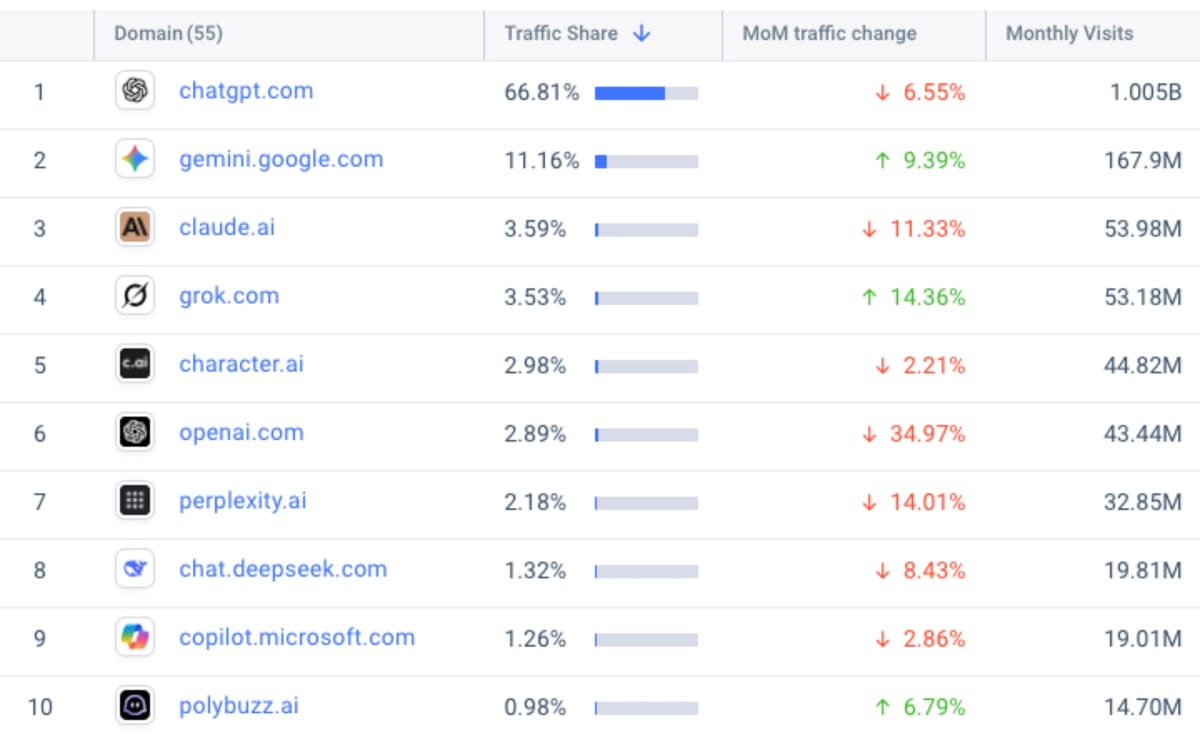
Similarweb released data on December 22, 2025, revealing the competitive landscape of AI chatbot and tool websites in the United States for November 2025. The web analytics platform shared rankings across multiple countries through a series of social media posts, documenting traffic patterns that demonstrate both ChatGPT's continued dominance and the emergence of notable competitors gaining market share.
According to the Similarweb data, ChatGPT secured the top position across all surveyed markets. The platform's commanding presence reflects sustained user adoption since OpenAI launched the conversational AI tool in November 2022. However, the data also documented declining traffic for the market leader. ChatGPT.com showed a 35% decrease in U.S. visits during November compared to previous measurement periods, while maintaining its position as the most-visited AI chatbot destination.
Subscribe PPC Land newsletter ✉️ for similar stories like this one
The traffic decline for ChatGPT.com coincides with broader challenges OpenAI faces in converting search volume into website visits. Analysis published by Ahrefs in August 2025 found ChatGPT captures 0.19% of total web traffic compared to Google's 41.9% share, despite ChatGPT growing 3.8 times faster than Google on a percentage basis. The platform reached 700 million weekly active users by July 2025 according to comprehensive internal analysis released by OpenAI, Duke University, and Harvard University researchers in September.
Google's Gemini platform emerged as the second-ranked AI chatbot website in the U.S. market according to Similarweb's November data. The artificial intelligence assistant launched in February 2024 when Google rebranded its Bard chatbot, introducing access to the company's most advanced AI models. Gemini demonstrated growth patterns during November that contrasted sharply with ChatGPT's decline. Social media responses to the Similarweb data noted Gemini's "rating is rising so fast, while ChatGPT is falling so rapidly."
Gemini's user base has expanded substantially throughout 2025. The platform grew from 450 million monthly active users in July to 650 million in October 2025, a 44% increase over three months driven in part by the Nano Banana image generator release. Google has systematically integrated Gemini capabilities across its product ecosystem, launching Gemini 3 with generative UI capabilities in November 2025 and introducing Ads Advisor and Analytics Advisors powered by Gemini models in December.
Microsoft's Copilot secured third position in the U.S. rankings. Character.AI, a conversational AI platform focused on chat interactions with fictional and celebrity-inspired characters, claimed fourth position. The platform has faced significant scrutiny regarding safety practices. A congressional investigation launched in August 2025 examined concerns about AI chatbots engaging children in romantic conversations following multiple lawsuits and a death connected to Character.AI interactions.
Grok, developed by Elon Musk's xAI company, entered the top 10 ranking in November. The AI assistant released Grok 4 on July 10, 2025, which xAI described as "the world's most powerful AI model" with doctorate-level knowledge across multiple disciplines. Despite securing a top 10 position, Grok showed positive growth indicators in the Similarweb data while other platforms experienced traffic declines.
Perplexity, an AI-powered search platform that launched in August 2022, appeared in the rankings as competitors continue developing conversational search experiences. The company processes over 20 million daily queries and achieved a $9 billion valuation in December 2024. Perplexity has introduced advertising capabilities through sponsored questions and side media placements, launched a $200-per-month Max subscription tier providing unlimited access to advanced AI models, and released the Comet browser in October 2025.
The geographic data revealed patterns specific to regional preferences and platform availability. Russia's top 10 included Yandex-related AI tools, reflecting the country's dominant local search engine ecosystem. India and Brazil showed strong adoption of mainstream platforms including ChatGPT and Gemini. European markets including the UK, France, and Italy demonstrated similar hierarchies with ChatGPT leading followed by Gemini and various specialized AI tools.
Claude, developed by Anthropic, appeared in multiple country rankings. The conversational AI assistant competes directly with ChatGPT and Gemini while emphasizing different technical approaches to safety and accuracy. Other platforms appearing across various geographic rankings included Hugging Face, an open-source AI model repository and community platform, and specialized tools focused on specific use cases including image generation and coding assistance.
Traffic patterns for AI chatbot platforms have fluctuated significantly throughout 2025. ChatGPT referral traffic experienced a dramatic 52% decrease starting July 21 as OpenAI adjusted citation weighting in its retrieval-augmented generation system to prioritize high-utility sources like Reddit and Wikipedia over branded content. Research published by Profound in August analyzing over one billion ChatGPT citations found Reddit citations increased 87% while Wikipedia citations rose 62% during the same period.
Buy ads on PPC Land. PPC Land has standard and native ad formats via major DSPs and ad platforms like Google Ads. Via an auction CPM, you can reach industry professionals.
The competitive dynamics between ChatGPT and traditional search engines have created complex traffic attribution challenges. ChatGPT traffic underperformed all major digital channels except paid social media in e-commerce according to research examining 12 months of first-party data from 973 websites with $20 billion combined revenue. The study found lower conversion rates and revenue per session from ChatGPT referrals compared to Google's paid and organic search channels, though ChatGPT achieved favorable bounce rates suggesting relevance when clicks occurred.
Google's development of AI search capabilities has accelerated throughout 2025. The company launched AI Mode to UK users on July 28 and expanded AI Overviews deployment globally. These AI-powered search features provide direct answers within search results, reducing motivation for users to click through to source websites. Publishers have experienced significant traffic declines as AI Overviews appeared in more search results, with organic traffic to news sites dropping from over 2.3 billion visits at its mid-2024 peak to under 1.7 billion by May 2025.
The monetization strategies for AI platforms vary significantly across competitors. ChatGPT offers Free, Plus, and Pro subscription tiers while building internal advertising infrastructure through a newly formed Growth team. OpenAI posted a job listing in September 2025 seeking a Growth Paid Marketing Platform Engineer to construct campaign management tools, advertising platform integrations, and real-time attribution systems. The company also introduced Instant Checkout capabilities in September through the Agentic Commerce Protocol developed with Stripe, enabling transactions from Etsy and Shopify merchants directly through ChatGPT conversations.
Google has repeatedly denied plans to introduce advertising within Gemini despite multiple reports suggesting otherwise. Following advertiser briefings about a 2026 Gemini ad rollout, Google VP of Global Ads Dan Taylor stated on December 8, 2025, that "there are no ads in the Gemini app and there are no current plans to change that." The phrasing drew scrutiny from marketing professionals who noted the distinction between "current plans" and categorical denials of future monetization.
Analytics infrastructure has evolved to accommodate AI chatbot traffic measurement. Google Analytics introduced official documentation in July 2025 advising users to create custom channel groups specifically for tracking traffic from AI chatbots including ChatGPT, Gemini, Microsoft Copilot, Claude, and Perplexity. Research published by NP Digital revealed that 24.3% of marketers receive consistent referral traffic from AI tools while 39.3% report occasional traffic, demonstrating widespread integration between AI platforms and traditional websites.
The technical capabilities driving AI chatbot competition continue advancing rapidly. Gemini's multimodal capabilities improved substantially according to technical details shared in July 2025, with enhanced video understanding performance addressing previous limitations where models focused heavily on initial segments of hour-long videos while trailing off afterward. Chrome integration of Gemini launched in September with agentic browsing capabilities, multi-tab analysis, and enhanced security features representing what Google VP Mike Torres called "the biggest upgrade to Chrome in its history."
OpenAI has refined ChatGPT's search functionality throughout 2025. The platform introduced accuracy improvements in September reducing hallucinations while improving shopping intent recognition and answer formatting across all user tiers. OpenAI also revised ChatGPT crawler documentation in December, removing language indicating the ChatGPT-User crawler would comply with robots.txt rules and clarifying that OAI-SearchBot usage no longer includes training data collection.
The November 2025 data from Similarweb arrives during a period of intense competition and rapid product development across the AI industry. Research published by Google Cloud projects the agentic AI market could reach approximately $1 trillion by 2035-2040, with over 90% of enterprises planning integration within three years. The trajectory of AI chatbot adoption has prompted predictions that platforms like ChatGPT could potentially overtake Google's search traffic by 2030, though current traffic share data shows substantial gaps between conversational AI tools and traditional search engines.
Marketing professionals face increasing complexity as AI platforms fragment discovery patterns previously dominated by Google search. The platforms operate with fundamentally different user interfaces, citation practices, and monetization models compared to traditional search engines. Educational content consumption has shifted significantly, with platforms like Udemy experiencing a 12.61% visitor decrease and Coursera declining 9.98% as AI chatbots provide instant, personalized learning assistance that competes with structured online courses. AI chatbots now account for nearly one-fifth of referral traffic to these educational platforms despite simultaneously threatening their core function.
The concentration of traffic around ChatGPT despite its 35% November decline demonstrates network effects and brand recognition in AI tools. Users have developed workflows around specific platforms, creating switching costs similar to those observed in previous technology transitions. However, the rapid growth of competitors like Gemini and the entrance of platforms like Grok suggest the market remains fluid with potential for significant shifts as platforms continue developing features and capabilities.
Privacy considerations have emerged as differentiating factors across platforms. Gemini automatically activated Android device permissions including phone and messaging access in July 2025, drawing criticism from privacy advocates who noted Google "hidden the off switch well" by requiring users to navigate through multiple menu layers. The automatic activation occurred without explicit user consent, potentially conflicting with GDPR requirements for lawful basis and user rights regarding automated decision-making.
Platform reliability and consistency matter increasingly as businesses integrate AI tools into operational workflows. ChatGPT faced scrutiny over alleged policy changes regarding financial and legal advice in November 2025, though the reports proved inaccurate. Multiple outlets published stories claiming ChatGPT would no longer provide such advice based on misinterpretation of usage policy language, demonstrating how platform policy communication challenges can create operational uncertainty for marketing teams considering AI tool adoption.
The geographic distribution of Similarweb's data reveals globalization patterns in AI adoption. ChatGPT maintains top positions across diverse markets including North America, Europe, South America, and parts of Asia. However, regional preferences influence secondary platform selection. Russian users favor domestic AI tools integrated with Yandex. European users demonstrate strong adoption of Claude and other alternatives. These patterns reflect both availability differences and cultural preferences regarding data privacy, interface design, and feature sets.
The Similarweb data does not provide absolute traffic numbers, instead showing relative rankings and percentage changes. This methodology allows comparison of competitive positioning without disclosing proprietary metrics. The 35% decline for ChatGPT.com indicates significant traffic reduction while the platform maintained first position, suggesting a substantial initial traffic advantage over competitors. The absence of specific visit counts prevents direct calculation of market share distribution beyond ChatGPT's approximate two-thirds dominance based on third-party estimates.
Social media reactions to the Similarweb data highlighted diverging interpretations of the competitive landscape. Some observers suggested the traffic patterns indicate ChatGPT's dominance faces imminent challenges from rapidly growing alternatives. Others noted that even with substantial declines, ChatGPT maintains commanding market share that would require sustained competitor growth to meaningfully threaten. The reaction "chatgpt really said 'i'm taking 2/3rds of the market and you can fight over the scraps'" characterized one perspective on the data.
The timing of the November 2025 data release coincides with year-end marketing planning cycles. Digital advertising professionals evaluating 2026 channel strategies must account for AI chatbot traffic patterns alongside traditional search, social media, and direct navigation. The platforms operate with different content discovery mechanisms, requiring distinct optimization approaches compared to conventional SEO practices focused on keyword targeting and link building.
Enterprise adoption of AI chatbots has accelerated throughout 2025, with major platforms introducing business-focused features. Google's Workspace integration of Gemini, Microsoft's Copilot deployment across Office applications, and ChatGPT's Enterprise and Team subscription tiers reflect growing recognition of business use cases beyond consumer applications. The competitive dynamics increasingly involve not just traffic volume but also feature sets addressing specific business requirements including security, compliance, data handling, and integration capabilities with existing software ecosystems.
The November data arrives as regulatory scrutiny of AI platforms intensifies globally. European authorities have investigated data collection practices, content usage rights, and potential anticompetitive behavior. U.S. congressional inquiries have examined safety practices particularly regarding interactions with minors. These regulatory developments may influence competitive positioning as platforms balance innovation against compliance requirements across multiple jurisdictions with varying standards.
Subscribe PPC Land newsletter ✉️ for similar stories like this one
Subscribe PPC Land newsletter ✉️ for similar stories like this one
Who: Similarweb released competitive analysis data covering AI chatbot and tool websites. OpenAI's ChatGPT, Google's Gemini, Microsoft's Copilot, Character.AI, Elon Musk's Grok from xAI, Perplexity, Claude from Anthropic, and various specialized AI platforms compete for user traffic and adoption across consumer and enterprise segments.
What: Market share data for November 2025 shows ChatGPT maintaining first position across all surveyed countries while experiencing a 35% decline in U.S. traffic. Gemini secured second position with growth patterns contrasting ChatGPT's decline. Grok entered the top 10 rankings while showing positive growth indicators. The data reveals concentration around ChatGPT despite declining traffic, with the platform holding approximately two-thirds market share based on social media commentary.
When: Similarweb published the rankings on December 22, 2025, covering November 2025 traffic patterns. The data arrives during a year of significant AI platform development including ChatGPT reaching 700 million weekly users, Gemini expanding from 450 million to 650 million monthly users, and multiple platforms introducing advertising capabilities and subscription tiers.
Where: The analysis covered the United States market along with UK, France, Italy, Russia, Canada, Brazil, India, and other geographic regions. ChatGPT maintained top positions globally while secondary platform preferences varied by region, with Russia favoring Yandex-related AI tools and European markets showing strong Claude adoption. The geographic distribution demonstrates AI chatbot adoption has become a worldwide phenomenon affecting digital marketing strategies across diverse markets.
Why: The competitive landscape data matters for marketing professionals evaluating channel strategies as AI platforms fragment discovery patterns previously dominated by Google search. Traffic measurement, content optimization approaches, attribution modeling, and advertising strategies require adaptation as conversational AI tools operate with different user interfaces and monetization models compared to traditional search engines. The platforms' rapid feature development, varying privacy practices, and uncertain advertising implementations create planning challenges for businesses integrating AI tools into operational workflows while the market remains fluid with potential for significant competitive shifts.