Google's ads chief reveals when agentic commerce actually gets personal
Vidhya Srinivasan on eliminating choice between speed and certainty in shopping, plus her five-point playbook for leading through AI transformation.


Vidhya Srinivasan on eliminating choice between speed and certainty in shopping, plus her five-point playbook for leading through AI transformation.
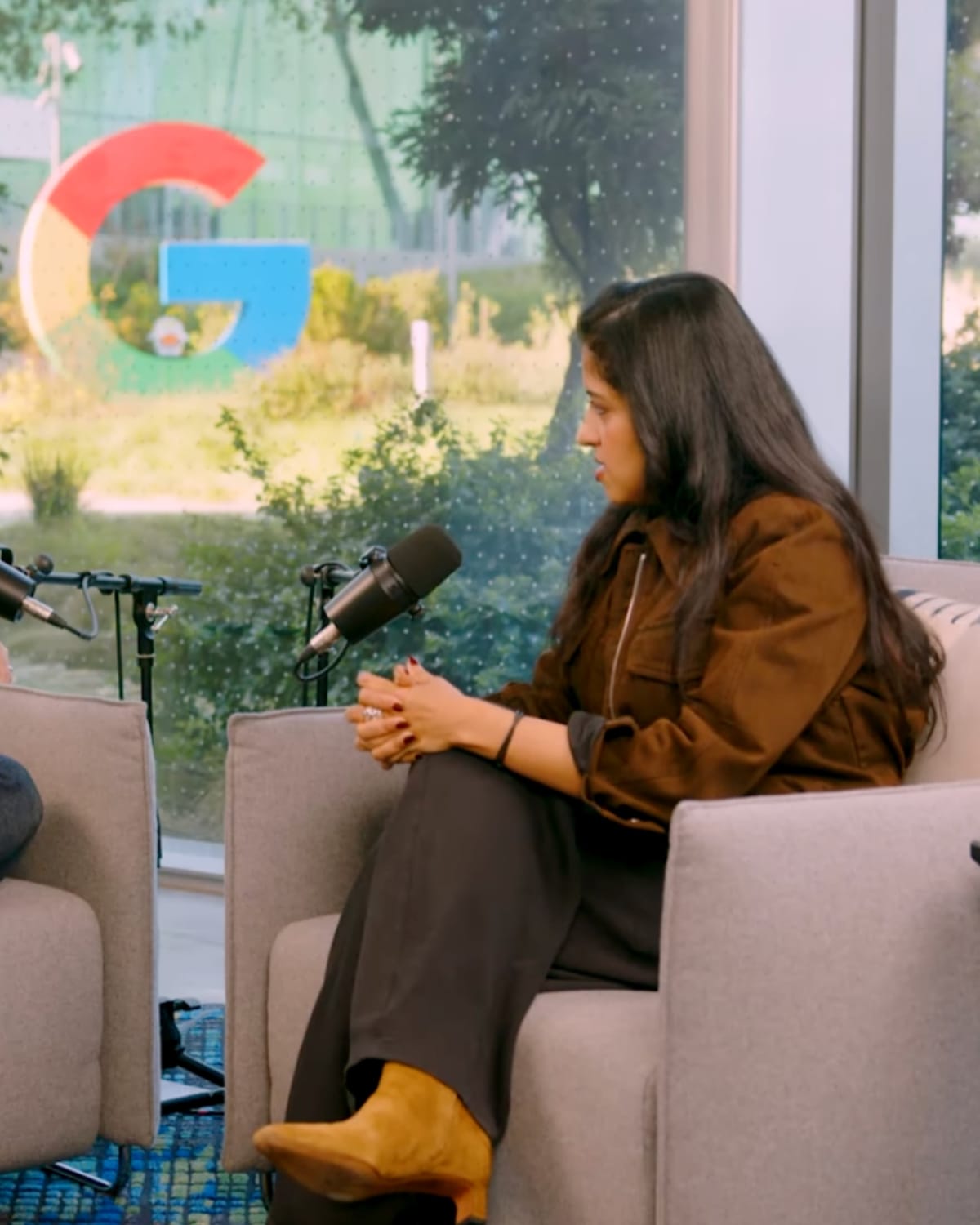
Google's head of Ads and Commerce described a future where consumers no longer sacrifice speed for certainty when shopping, though acknowledged mainstream agent-to-agent commerce remains distant despite industry momentum.
Vidhya Srinivasan, who oversees advertising products wherever they appear across Google and YouTube plus shopping in search, the Gemini app, Google Merchant Center, and payments infrastructure, outlined the company's vision during a February 13 interview on the Frontier CMO podcast hosted by Josh Spanier. She leads teams responsible for products serving tens of thousands of engineers across a business generating billions in annual revenue.
The interview came weeks after Google launched the Universal Commerce Protocol with major retailers on January 11, establishing open technical standards for AI agents to execute purchases across different retail platforms without requiring custom integrations for each merchant. Srinivasan characterized the protocol as "one of the foundational pieces that will help this thing actually become a reality," describing it as a common language that retailers and merchants can use to connect with AI agents participating in commerce.
Agentic commerce addresses a fundamental trade-off consumers have faced for decades. "For decades a person could either shop fast or shop smart," Srinivasan explained. "And with agentic commerce, you essentially don't have to choose, because this trade-off that one has to make between speed and certainty is being reduced with AI." The vision centers on making commercial experiences assistive, personal, and fluid while businesses gain an entirely new way to engage with consumers, bringing the full breadth and depth of their offerings without friction.
When asked directly whether agent-to-agent commerce would become mainstream in 2026, Srinivasan responded with measured caution. "I think more noise," she stated. "I think lots of the building blocks are being laid out. I think we probably have some time for mainstream." The assessment suggests Google recognizes substantial infrastructure development remains necessary before autonomous commerce achieves widespread adoption, despite the company's January protocol launch attracting more than 20 endorsements including payment networks Visa and Mastercard, payment processors Adyen and Stripe, and merchants Target and Walmart who bring checkout directly into Google's AI assistant.
Google introduced agentic checkout capabilities on November 13, 2025, enabling autonomous purchases of price-tracked items when prices reach target budgets alongside Duplex-powered phone calls verifying local store inventory. The deployment came despite industry skepticism published in October 2025 that questioned commercial viability, identifying eight structural challenges including retailer incentives against AI intermediation and consumer preferences for evaluating options before purchasing.
Srinivasan described pervasive Gemini deployment throughout Google's advertising systems. "We use Gemini everywhere," she stated, noting difficulty identifying where the models don't operate. Gemini powers intent matching for ads quality, generates creatives, and drives all performance campaigns. Every time Google receives a new model version multiple times per year, "we get a lot of gains, just from having better models at play," Srinivasan explained.
The search advertising experience has undergone transformation as AI Mode and AI Overviews enable longer, deeper questions from users. "People are asking us longer questions, deeper questions, and we can now bring to bear everything that we know about the world, but also everything that we know from a commercial point of view from our shopping graph," Srinivasan said. The shift creates unique opportunities for reimagining what ads mean for search.
YouTube creators have become central to culture creation and taste-making, according to Srinivasan. Google announced the Creator Partnership Hub to serve as a command center where advertisers can discover creators, understand audiences, access measurement tools, and evaluate effectiveness. The platform continues investing in features enabling matchmaking across the creator marketplace.
Alphabet reported fourth quarter 2025 revenues of $113.8 billion on February 4, 2026, with advertising business generating $81.5 billion during the quarter, growing 14 percent from $71.5 billion in the prior year period. The Gemini App reached 750 million monthly active users, while Google's first party models now process over 10 billion tokens per minute via direct API use.
The bar for technical understanding among chief marketing officers has risen significantly, according to Srinivasan. Traditionally, CMOs developed intuition about what feels right through experience, quickly evaluating whether teams are heading in the right direction based on presented metrics. "The problem now is all of those things are evolving and changing," she explained.
CMOs must maintain strong command of fundamental goals, brand positioning, values, and optimization targets. However, the path from desired metrics to actual achievement now contains substantial unknowns because new platforms and tools proliferate. "I don't think a CMO needs to code," Srinivasan stated. "I don't think the CMO needs to know deeply the algorithms of every LLM out there, or know exactly how it works internally." But CMOs do need high-level conceptual understanding of available technological pieces, their applications across creatives, briefs, product development, and brainstorming, plus how these elements fit together.
The conversation addressed measurement challenges facing marketers who want certainty about incrementality attribution across everything simultaneously. Srinivasan acknowledged ongoing work to improve measurement capabilities while maintaining standards for statistical significance. "The thing that we will not compromise on is we're very particular about only giving statistically significant results and really standing behind what we give," she explained.
First-party data emerged as critical infrastructure. "As AI gets better, it's not going to work for you," Srinivasan warned. "The models might be better, but it's not going to work for you unless it has high-quality data to work on." Advertisers must collect data with appropriate consent and establish systems for feeding information to campaigns.
Google reduced incrementality testing budget requirements to $5,000 minimum using Bayesian methodology during Marketing Live 2025 in May. The company introduced new AI Max campaign reporting metrics in September showing traffic from AI-generated keywords and landing page matching, while API version 23 released in January 2026 enabled channel-level reporting for Performance Max campaigns revealing exactly where advertisements serve across Google's network.
Srinivasan addressed concerns about artificial intelligence replacing human creativity. "Sometimes there is this false notion that the tech can do more than it really can," she stated. "So much of the fundamentals is still in the hands of people. Certainly for creativity, taste and ingenuity, it entirely comes from people, from good marketers."
Human judgment determines what constitutes "good" creative for specific contexts. While AI can provide options and enable modifications to customize content, people must pick direction. "Judgment is a very, very critical thing to hone, especially at this time," Srinivasan emphasized.
The philosophy extends across Google's values-first leadership approach. Core principles include always putting users first and doing right by them. Fairness matters significantly, manifesting through conscious processes avoiding bias. The ability to conduct open debate and handle conflict respectfully enables fast decision-making by creating environments where teams can quickly reach resolution.
"At core, the way I lead is to deliver customer value at speed," Srinivasan explained. Speed encompasses multiple dimensions including conflict resolution, accountability, ownership, and clear organizational lanes. These elements contribute to the velocity of product development.
Srinivasan outlined principles she has found effective leading organizations through massive AI-driven change. First, lead with optimism rather than fear, focusing on opportunities and the fun aspects of embracing transformation. "I'm not saying that there will be things that we find that are not very positive," she acknowledged. "But I think focusing on that upfront leads to no momentum."
Second, clearly designate humans in charge of all key decisions. Having named individuals responsible for final checkoffs on code reviews and other processes, while AI performs assistive work returning time to people, has proven helpful.
Third, celebrate all aspects of experience including failures. "A lot of things you try is not going to work," Srinivasan noted. "And so making a habit of also celebrating the things that didn't work because the learnings are almost more important than the things that worked at this phase." Everybody wants contributions that mean something.
Fourth, stay away from hype by making implementation practical and real. Srinivasan's organization identifies specific projects with specific outcome goals, time bounds, and specific people assigned to work on something leveraging new capabilities, then discusses results. "Most of our code base is not" brand new or in startup contexts, she emphasized.
Fifth, behavior leads to culture more than top-down messaging. "The more the leaders and people who want to see this change happen embrace it themselves and talk about it, the more it has a snowball effect across the rest of the organization," Srinivasan explained. She builds applications with her daughters, creating a calendaring app with extra notification features to understand how easy implementation has become with available tools.
Google launched Ads Advisor and Analytics Advisor to all English-language accounts in December 2025, bringing Gemini-based campaign optimization to advertisers through conversational experiences. The tools represent what Dan Taylor, Google's vice president of global ads, described as "partners that learn from an advertiser's unique datasets."
Looking toward 2026, Srinivasan expressed confidence about progress on long-standing marketing objectives. "I think the Holy Grail of marketing has always been the right ad at the right moment for the right person," she stated. "And I think we are closer to achieving that for real than we've ever been in the past."
Progress depends on businesses fully embracing technological capabilities and incorporating them into platforms so the flywheel takes off. From the consumer standpoint, deeply personalized experiences with helpful assistive agents getting tasks done will see substantial advancement. "How far we go depends on lots of the ecosystem coming together," Srinivasan acknowledged.
The fundamental goal involves reducing what Srinivasan termed the "commute cost" from desire to actually getting what people want. "And the tech can do that, and therefore we will figure out a path because there's a real need for that," she concluded.
The advertising landscape faces continued measurement challenges despite technological advancement. Research published in February 2026 found marketing measurement systems fundamentally broken, with between 67 and 76 percent of buy-side decision-makers using incrementality tests, attribution analysis or marketing mix models that consistently underperform across core promises. No media channel achieves full representation in marketing mix models, with gaming suffering 77 percent underrepresentation and commerce media at 50 percent.
Trust remains foundational to all innovation. "Any sort of speed or innovation, nothing is useful without safety and trust as a foundation," Srinivasan stated. Google maintains a 25-year legacy of building highly trusted consumer products, and all AI era innovations build on this foundation of preserving consumer trust through many safeguards operating at scale.
Srinivasan's career trajectory from database engineering to advertising leadership illustrates the converging worlds of engineering and marketing. She wrote her first program in 10th grade using Pascal, experiencing the thrill of code execution and finding the translation from thought to code felt natural. Six years ago when joining Google's advertising division, she did not realize the complexity of the ad space. "I had the benefit of not knowing that," she acknowledged.
The adjacencies proved valuable. At its core, advertising represents a big data problem, with ad systems among the largest data systems at Google and early machine learning adoption. Understanding the expansive business landscape, ecosystem interconnections across publishers, advertisers, creators, and third parties took time to fully appreciate but proved both interesting and important.
Moving from an era of "wow that'll be exciting" to "here's how you actually do it" characterizes the current moment across Google, YouTube, Commerce, and all ad systems. The transformation from demonstration to implementation defines the industry's present challenge and opportunity.
Who: Vidhya Srinivasan, head of Ads and Commerce at Google, responsible for advertising products across Google and YouTube plus shopping in search, the Gemini app, Google Merchant Center, and payments infrastructure including tens of thousands of engineers managing a multi-billion dollar business. Josh Spanier, VP of AI and Marketing Strategy at Google, conducted the interview for the Frontier CMO podcast.
What: An interview exploring agentic commerce, the Universal Commerce Protocol, Gemini integration across Google's advertising infrastructure, technical requirements for CMOs, the enduring role of human creativity, and a five-point leadership blueprint for AI transformation. Srinivasan outlined Google's vision for eliminating the trade-off between shopping fast and shopping smart through AI while acknowledging mainstream agent-to-agent commerce remains distant. She described pervasive Gemini deployment across advertising systems for intent matching, creative generation, and performance campaigns, plus the Creator Partnership Hub for YouTube advertiser-creator collaboration.
When: The interview was published on February 13, 2026, weeks after Google launched the Universal Commerce Protocol on January 11, 2026. Srinivasan's assessment covers developments throughout 2025 including agentic checkout launches in November, AI advisor rollouts in December, and builds on Alphabet's fourth quarter 2025 earnings reported February 4, 2026 showing $81.5 billion in advertising revenues growing 14 percent year-over-year.
Where: The podcast episode from Think with Google's Frontier CMO series reaches marketing professionals globally through YouTube and podcast platforms. Srinivasan's remarks address Google's advertising ecosystem spanning Search, YouTube, Display, Shopping, Merchant Center, the Gemini app, and payments infrastructure operating across worldwide markets with 750 million monthly active Gemini App users and over 10 billion tokens processed per minute through API use.
Why: The interview matters because Srinivasan oversees advertising products serving over one million Performance Max advertisers and hundreds of millions of YouTube advertising relationships while Google implements fundamental infrastructure changes through the Universal Commerce Protocol establishing standards for AI agent transactions. Her five-point leadership blueprint provides practical guidance for marketing organizations navigating AI transformation. The measured assessment that agent-to-agent commerce remains "more noise" despite January's protocol launch offers realistic timeline expectations amid industry enthusiasm. Emphasis on first-party data quality, human judgment in creative decisions, and measurement challenges addresses persistent concerns among marketing professionals adapting to AI-driven advertising automation while trust and statistical significance requirements remain non-negotiable foundations.