Google's hidden data controls let advertisers block tag tracking
Unnoticed Google Tag feature enables advertisers to block advertising, analytics, and diagnostic data collection when users deny consent across platforms.


Unnoticed Google Tag feature enables advertisers to block advertising, analytics, and diagnostic data collection when users deny consent across platforms.
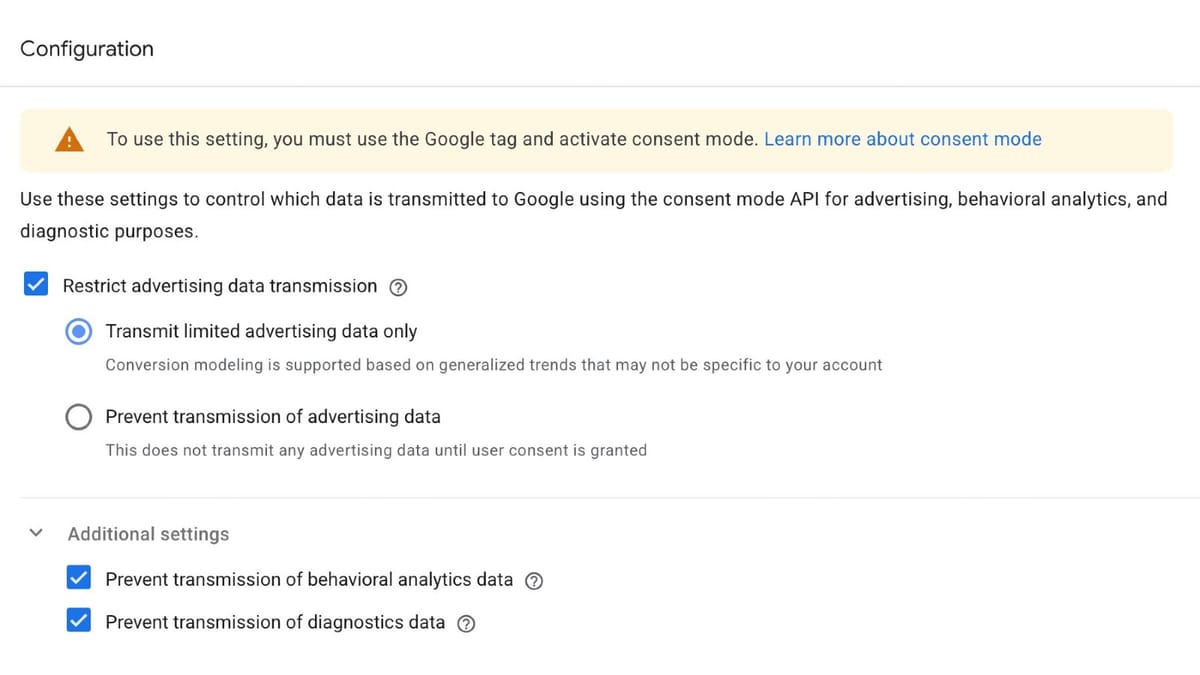
Google has quietly added data transmission controls to its Google Tag settings, enabling advertisers to independently manage advertising data collection, behavioral analytics tracking, and diagnostic data transmission based on user consent preferences. The feature appears to have received no formal announcement and has operated largely unnoticed within Google Ads, Google Analytics, and Campaign Manager 360 interfaces.
According to Simo Ahava, co-founder at Simmer and partner at 8-bit-sheep, the configuration "has probably flown under the radar for most" despite providing significant privacy control capabilities. Ahava described the feature in a December 2025 LinkedIn post as "basically a Basic Consent Mode type control on top of an Advanced Consent Mode setup."
The controls allow advertisers to opt into limited data collection rather than maintaining full data transmission when consent signals indicate denial. According to Google's documentation, the feature functions exclusively through user interfaces within Google Ads, Google Analytics, and Campaign Manager 360, without API or gtag configuration options.
The system operates independently from existing consent mode settings, though advertisers must activate consent mode before accessing data transmission controls. According to Google, the feature enables core behavioral analytics functionality even when advertising data collection faces restrictions.
Data transmission controls provide three independent restriction categories: advertising data, behavioral analytics data, and diagnostic data. Each category operates separately, allowing advertisers to configure different data collection approaches based on consent signal combinations.
When advertisers select "Transmit limited advertising data only," tags redact identifiers that could track users across sites or sessions when ad_storage consent is denied. According to Google's documentation, this option preserves conversion modeling capabilities by transmitting aggregate data and identifiers while blocking individual-level tracking mechanisms.
The alternative "Prevent transmission of advertising data" option blocks all advertising data collection until users grant consent. According to the documentation, behavioral analytics and diagnostic data continue collecting under this configuration, maintaining basic site measurement while eliminating advertising functionality. The system maintains data flow from Google Analytics accounts to linked advertising accounts regardless of data transmission control settings, subject to Analytics account configurations.
Behavioral analytics restrictions block analytics data collection when analytics_storage user consent is denied. According to Google, preventing behavioral analytics data collection impacts basic site measurement and behavioral modeling, which relies on consented user data to estimate patterns for users declining consent.
Diagnostic data transmission controls block additional collection of tag and consent mode diagnostic data until users grant consent. According to the documentation, diagnostic data monitors tag functionality and consent mode implementation, providing technical troubleshooting capabilities for advertisers managing consent mode deployments.
The feature requires specific implementation steps across Google's advertising platforms. Google Ads users access data transmission controls through the Tools icon, navigating to Data manager and selecting Manage under the Google tag section. Google Analytics users must open their property, navigate to Data collection and modification under Admin settings, select Data streams, and configure tag settings for their chosen stream.
Campaign Manager 360 users access the controls through the Floodlight section, clicking Google Tag to edit settings. According to Google's documentation, users managing multiple Google tags through Google Tag Manager must configure settings individually for each tag in their container.
Server-side Google Tag Manager implementations require additional configuration. According to the documentation, advertisers wanting to redact or prevent requests from flowing through server tags must implement controls within their server-side Google Tag Manager container configuration using Transformations to control event parameters available to tags.
The configuration process involves opening Google tag settings, clicking Manage data transmission, and selecting Restrict advertising data transmission. Advertisers then choose between transmitting limited advertising data only or preventing all advertising data transmission when user consent for advertising purposes hasn't been granted.
Additional settings enable prevention of behavioral analytics data transmission and consent diagnostics data transmission, providing comprehensive control over data collection when users decline various consent categories.
Buy ads on PPC Land. PPC Land has standard and native ad formats via major DSPs and ad platforms like Google Ads. Via an auction CPM, you can reach industry professionals.
Ahava highlighted a particularly significant technical capability: automated tag refiring when consent is granted. "Where it gets interesting is that Google actually automatically refires the relevant Google Tag when consent is eventually granted," he wrote. "In other words, this is a queuing mechanism for pages where consent can be granted with a delay, and Google Tag handles the queuing for you."
The queuing functionality addresses a persistent technical challenge in consent mode implementations. Advertisers managing pages where users can grant consent after initial page load previously required custom implementations to refire tags when consent status changed. Data transmission controls provide this queuing mechanism natively within Google Tag, eliminating custom development requirements.
However, according to Ahava, the queuing and refiring functionality "doesn't apply to any event requests, just the Google Tag." The limitation means that while the initial Google Tag refires automatically when consent is granted, subsequent event tracking still requires manual implementation or trigger configuration.
For now, according to Ahava, the feature "only applies to Google's tags (because Consent Mode is a Google construct)." He noted that "it's possible some additional functionality related to 'Manage data transmission' might be arriving to a container near you in the not-too-distant future."
The advertising data restriction options create distinct measurement scenarios. Limited advertising data transmission shares aggregate data and identifiers when advertising consent is denied, according to Google's documentation. This approach maintains conversion modeling, which uses behavioral patterns from consented users to estimate conversion patterns across all site traffic.
Complete advertising data prevention eliminates conversion tracking capabilities for unconsented users, creating measurement gaps that affect campaign optimization and performance reporting. Marketing professionals managing European Economic Area campaigns face particular challenges, as strengthened consent policies have disabled conversion tracking for non-compliant advertisers since July 21, 2025.
Data transmission control selection impacts how Google tags function when consent signals indicate denial. Tags operating under limited data transmission redact persistent identifiers while maintaining aggregate measurement capabilities. Tags configured to prevent transmission entirely cease collecting advertising data until consent status changes.
The distinction between these modes reflects broader industry tensions between privacy compliance and marketing measurement effectiveness. European data protection authorities have increased scrutiny of automated data collection practices throughout 2025, with a German court ruling in May clarifying that Google Tag Manager cannot activate automatically before obtaining user consent.
Behavioral analytics restrictions affect site measurement capabilities beyond advertising functions. According to Google's documentation, preventing behavioral analytics data transmission impacts basic site measurement, eliminating the data foundation for understanding user navigation patterns, page performance, and conversion funnel effectiveness.
The restriction also affects behavioral modeling, which relies on consented user data to estimate patterns for users declining consent. Google Analytics uses machine learning to reconstruct behavior patterns, but this approach requires sufficient consented user data to generate reliable estimates. Advertisers blocking behavioral analytics transmission eliminate the observed data necessary for modeling calculations.
Diagnostic data restrictions impact technical monitoring capabilities. Tag and consent mode diagnostic data enables advertisers to identify implementation issues, consent signal failures, and tag configuration problems. Google integrated diagnostic capabilities directly into Google Analytics consent settings in June 2025, providing centralized monitoring for consent implementation accuracy.
Blocking diagnostic data transmission until consent is granted eliminates proactive issue identification during the implementation phase. Advertisers may discover consent mode configuration problems only after consent is granted and diagnostic data begins flowing, potentially allowing measurement issues to persist across user sessions where consent was denied.
The feature generated substantial discussion among marketing technology professionals. Nitesh Sharoff, who scales brands with tracking and analytics, commented that the development could solve longstanding implementation challenges: "Keeping my fingers crossed this leaks into non-Google tags and solves us having to use trigger groups or an unnecessary amount of logic to get tags to fire correctly - all we need is a queuing mechanism to fire the tag when consent is actually granted."
Md Monirul Islam, a tracking specialist, questioned the relationship between data transmission controls and Advanced Consent Mode: "So, what's the point of having 'Advanced Consent Mode' If I use 'Manage data transmission' options. It's like using 'Basic Consent Mode' inside Advanced Consent Mode."
Ahava clarified that the feature provides "an additional level of control in case someone who manages Google Tag wants to prevent an Advanced Consent Mode implementation risking compliance." The response emphasizes the feature's role as a compliance safeguard rather than a replacement for existing consent mode approaches.
Mandar Shinde, CEO at Blotout, noted that the feature's approach aligns with California privacy regulations: "The fact that all servers on the internet are async, this mode should help with blocking upfront and then refiring for GTM based solutions." The observation connects data transmission controls to California's Consumer Privacy Act enforcement, which has resulted in substantial penalties for non-compliant data collection.
Bashkim Ukshini, a senior web analyst, and several other professionals indicated awareness of the feature through their reactions, suggesting that while the feature may have operated quietly, some segment of the technical community had discovered it independently.
Data transmission controls function as an additional layer atop existing consent mode implementations. Consent mode, introduced by Google in 2021, enables tags to adjust behavior based on user consent status. The protocol includes two operational approaches: Basic Consent Mode, which blocks tags from firing until consent is granted, and Advanced Consent Mode, which allows tags to fire regardless of consent status while adjusting their data collection behavior.
The new controls essentially provide Basic Consent Mode functionality within Advanced Consent Mode setups. This hybrid approach enables advertisers to maintain Advanced Consent Mode's modeling capabilities while adding an additional compliance layer that prevents data transmission entirely when consent is denied.
Google has expanded consent management infrastructure throughout 2024 and 2025. The company introduced consent mode override settings in Google Tag Manager in August 2024, enabling administrators to set default consent states to denied for specific regions without modifying code. Diagnostic capabilities were integrated directly into Google Analytics consent settings in June 2025, consolidating previously separate monitoring tools.
Consent mode version 2 introduced enhanced measurement capabilities in early 2024, adding ad_user_data and ad_personalization parameters to the existing ad_storage and analytics_storage signals. These parameters provide granular control over data collection based on user consent choices, enabling advertisers to distinguish between consent for data collection versus consent for personalization.
Data transmission controls arrive amid intensifying privacy enforcement across multiple jurisdictions. The Dutch Data Protection Authority reprimanded Takeaway.com in August 2024 for Google Analytics data transfers to the United States spanning 2020 to 2023, demonstrating continued regulatory scrutiny of analytics data flows.
Austrian courts ruled in September 2024 that websites must obtain explicit consent before implementing Google reCAPTCHA, determining that 615 data packets transmitted to Google servers before consent violated GDPR principles. The ruling established that even utility services like bot detection require consent when transmitting personal data to third-party servers.
California courts have delivered substantial penalties for privacy violations. A $425.7 million verdict against Google in September 2025 addressed Firebase SDK data collection that continued despite users explicitly disabling tracking through their account settings. The case revealed how interconnected data collection systems can bypass individual privacy controls, even when users believe they have opted out.
Consent Management Platform partnerships provide implementation pathways for affected advertisers. Google maintains certification programs with platforms including Cookiebot, OneTrust, Osano, and Sourcepoint to facilitate compliant consent collection and mode integration. These partnerships offer technical support for advertisers navigating implementation requirements across different geographic markets.
The lack of formal announcement for data transmission controls reflects a broader pattern of Google quietly adding privacy-focused features without marketing fanfare. This approach may stem from regulatory sensitivities, where announcing new privacy controls could draw attention to previous limitations or generate questions about why such controls weren't available earlier.
Marketing professionals must balance privacy compliance with measurement effectiveness when configuring data transmission controls. The choice between limited advertising data transmission and complete prevention affects campaign optimization capabilities, conversion attribution accuracy, and remarketing audience building.
Limited data transmission preserves aggregate measurement while eliminating individual-level tracking, maintaining conversion modeling at the cost of granular attribution. Complete prevention eliminates all advertising measurement for unconsented users, creating gaps in campaign performance data that affect bidding strategies and budget allocation decisions.
Behavioral analytics restrictions impact site measurement beyond advertising functions. Preventing analytics data transmission eliminates the foundation for understanding user navigation patterns, page performance metrics, and conversion funnel effectiveness. The restriction affects both real-time reporting and historical analysis, limiting data-driven optimization opportunities.
Diagnostic data restrictions affect technical troubleshooting capabilities during implementation phases. Blocking diagnostic transmission until consent is granted prevents proactive identification of consent mode configuration issues, potentially allowing measurement problems to persist across sessions where users decline consent.
Advertisers managing global campaigns must consider regional privacy requirements when configuring data transmission controls. European Economic Area markets face stringent consent requirements, with Google disabling conversion tracking for non-compliant advertisers since July 2025. California privacy regulations impose similar restrictions, with substantial penalties for violations.
The feature represents another step in Google's ongoing adaptation to privacy-focused measurement approaches. First-party data collection infrastructure and enhanced conversions provide alternative measurement approaches that rely on consented customer relationships rather than browser-dependent tracking mechanisms facing increasing restrictions.
Server-side implementations offer additional control over data transmission. Google launched its tag gateway for advertisers feature in May 2025, routing conversion data through advertiser-owned servers to improve measurement accuracy. The infrastructure enables advertisers to determine which data reaches Google's services, providing an additional compliance layer for organizations managing strict privacy requirements.
Marketing technology professionals should evaluate their consent mode implementations in light of data transmission controls. The feature provides compliance safeguards for Advanced Consent Mode setups, enabling organizations to prevent potential privacy violations while maintaining measurement capabilities where consent is granted. However, the additional control layer introduces configuration complexity that requires careful testing and validation.
The discovery of this unannounced feature raises questions about what other privacy controls Google may have quietly implemented across its advertising platforms. Advertisers relying on Google's measurement ecosystem should systematically review available settings to ensure they're leveraging all compliance tools, particularly given the increasing regulatory scrutiny and substantial penalties for privacy violations.
Subscribe PPC Land newsletter ✉️ for similar stories like this one
Subscribe PPC Land newsletter ✉️ for similar stories like this one
Who: The unannounced feature affects advertisers using Google Ads, Google Analytics, and Campaign Manager 360 to manage data collection based on user consent preferences. Simo Ahava, co-founder at Simmer and partner at 8-bit-sheep, brought attention to the feature through a LinkedIn post noting it "has probably flown under the radar for most." Marketing professionals, website operators, and digital advertisers managing European Economic Area campaigns and global privacy compliance requirements can utilize the controls.
What: Data transmission controls enable independent restriction of three data categories: advertising data (with options for limited transmission or complete prevention), behavioral analytics data (affecting site measurement and modeling), and diagnostic data (impacting technical monitoring capabilities). The feature functions through user interface configurations within Google Tag settings, without API or gtag access, and includes an automated queuing mechanism that refires Google Tag when consent is eventually granted. The controls operate as "basically a Basic Consent Mode type control on top of an Advanced Consent Mode setup," according to Ahava.
When: The feature appears to have been added to Google's platforms without formal announcement, operating quietly until industry professionals discovered it in December 2025. Google's help documentation describes the feature but provides no launch date or announcement details. The timing suggests Google may have implemented the controls in response to intensifying privacy enforcement, including the July 2025 disabling of conversion tracking for non-compliant EU advertisers and ongoing regulatory scrutiny across multiple jurisdictions.
Where: The controls are accessible through Google Tag settings in Google Ads (via Tools icon, Data manager, and Google tag section), Google Analytics 4 (through Admin, Data collection and modification, Data streams, and Configure tag settings), and Campaign Manager 360 (under Floodlight, Google Tag). Server-side Google Tag Manager implementations require additional configuration within server-side containers using Transformations. The feature operates across all regions where Google's advertising platforms function, though its utility proves particularly significant for advertisers serving European Economic Area and California markets with stringent privacy requirements.
Why: The feature addresses regulatory compliance requirements while attempting to preserve measurement capabilities. The controls provide advertisers with an additional compliance layer that can prevent data transmission entirely when consent is denied, functioning as a safeguard for Advanced Consent Mode implementations. This hybrid approach enables advertisers to maintain modeling capabilities while adding protection against potential privacy violations. The lack of formal announcement suggests Google may have added the feature quietly to avoid drawing attention to previous limitations or to minimize regulatory scrutiny of its consent management ecosystem evolution.