
IAS's Context Control targeting now hits 300% CTR gains for some brands
IAS detailed its Context Control Targeting system, showing 300% CTR gains for Samsung and a 39% cost-per-conversion drop for CPG brands through semantic page analysis.

IAS detailed its Context Control Targeting system, showing 300% CTR gains for Samsung and a 39% cost-per-conversion drop for CPG brands through semantic page analysis.
Integral Ad Science this week published a detailed breakdown of its Context Control Targeting system, outlining how the technology classifies web pages by meaning, sentiment, and emotional tone before a programmatic bid is ever placed. The announcement, dated March 2, 2026, extends a series of IAS communications on its targeting capabilities and arrives at a moment when privacy law enforcement is reshaping how digital advertising is bought.
The document, published on the IAS website under its "Insights" section and authored by the IAS Team, covers page-level classification mechanics, a library of more than 380 contextual segments, and a set of performance case studies from named brands. For marketing professionals managing open web campaigns, the technical specifics carry concrete budget implications.
The premise behind the IAS disclosure is straightforward. Audience targeting - the practice of identifying individuals based on behavioral signals and demographic data - has been under sustained pressure from two directions. Privacy regulations, particularly the EU General Data Protection Regulation (GDPR) and the California Consumer Privacy Act (CCPA), have restricted how personal data flows through advertising systems. At the same time, keyword-based contextual targeting, the older alternative, lacks the resolution to interpret ambiguous language reliably.
According to IAS, the gap between who sees an ad and where that ad appears is the primary source of performance loss. The company characterizes its response to this gap as a shift from reactive to relevant: identifying content that matches a brand's message at the page level, not the site level, before any impression is served.
The regulatory backdrop is not trivial. CCPA enforcement has intensified throughout 2025, with the California Attorney General securing the largest-ever CCPA penalty - a $1.55 million settlement with Healthline Media in July 2025 - for continuing to share consumer data with advertisers after users had opted out. Meanwhile, the European Commission circulated draft GDPR amendments in November 2025 that, if adopted, would alter the legal basis for several forms of audience processing. Those proposals remain unresolved. Contextual approaches, which analyse content rather than individuals, sit outside the scope of most data protection restrictions - a structural advantage that IAS is positioning as central to its product.
The core unit of the IAS system is the individual page, not the publisher domain. According to IAS, its page-level classification evaluates the specific article alongside which an ad will appear, not the broader site. The practical difference matters. A food brand, for instance, might legitimately want its advertisement next to a recipe article on a given publication. The same publication might also run a story about a food safety recall. Site-level targeting would treat both as equivalent inventory. Page-level classification distinguishes between them.
The classification process relies on what IAS describes as proprietary semantic technology combining natural language processing (NLP) and cognitive analysis. The system interprets tone, nuance, and emotional context - not just keywords. According to IAS, this goes beyond matching words to inferring what those words mean in context. A phrase like "shot" requires different treatment depending on whether it appears in a sports report or a crime story. Basic keyword filters cannot resolve that distinction reliably. IAS's NLP layer is designed to handle it.
This technical approach has a documented history. IAS acquired ADmantX in November 2019 specifically to strengthen its contextual classification capabilities, incorporating patented semantic technology into its product suite. The acquisition gave IAS what it described at the time as "unprecedented contextual classification at scale." The Context Control suite was subsequently launched formally in April 2022, incorporating sentiment and emotional classification as well as page-level context. What IAS published today represents a further articulation of that system's performance data and targeting mechanics.
Beyond classification mechanics, IAS offers a catalogue of more than 380 contextual segments that advertisers can activate across major demand-side platforms (DSPs). These segments span industry verticals, seasonal themes, and what IAS calls audience proxy segments - contextual environments associated with particular consumer profiles, even in the absence of individual tracking data.
An automotive brand, according to IAS, could target segments directly labelled Automotive Racing or Electric Vehicles to reach in-market audiences. The same brand might also expand into adjacent inventory - Luxury Goods or High-End Travel - to reach aspirational consumers in environments competitors may not be bidding on. The adjacency logic reflects a broader shift in how contextual targeting is used: not as a fallback when audience data is unavailable, but as a deliberate reach strategy in its own right.
Seasonal targeting is explicitly included in the segment library. IAS cites Spring Seasonal Targeting as an example, with pre-bid segments covering cultural moments such as Father's Day, Mother's Day, and Cinco de Mayo. The ability to pre-screen impressions for seasonal relevance before the auction begins is the mechanism IAS is emphasising: brands are not reacting to where an ad landed but pre-selecting the content environments in which their bids are eligible to win.
The segments activate through IAS Signal, the company's integration layer with DSPs, which also handles its brand safety and pre-screening solutions on social platforms. On Facebook and Instagram, for example, IAS Content Block Lists were released in October 2024 with hourly updates to the pre-screened inventory lists. The programmatic infrastructure connecting classification output to bid eligibility operates the same way for open web contextual targeting.
IAS's March 2, 2026 document includes three sets of performance data attributed to named or described brands.
Samsung recorded a 300% higher click-through rate (CTR) using IAS Context Control compared with "the next best strategy," according to IAS. The company does not specify the product category, campaign period, or markets involved in the Samsung data, nor the identity of the competing strategy being benchmarked against.
A CPG (consumer packaged goods) advertiser used Context Control to reduce its cost-per-conversion by 39% while simultaneously cutting its effective CPM (eCPM) by 65%. The dual reduction - fewer dollars spent reaching each converting consumer, and lower cost per impression overall - points to improved inventory selection rather than simply increased volume.
A technology brand recorded an 8x increase in return on ad spend (ROAS) after implementing Context Control Targeting. IAS provides no further detail on this figure's baseline, measurement period, or the channels on which the campaign ran.
These data points sit within a broader body of IAS performance evidence. During Super Bowl LVIII in February 2025, IAS reported that campaigns using contextual targeting achieved a 102% increase in return on investment compared to overall campaign averages, with a 136% increase in success rate and a 47% decrease in cost per conversion. Those figures came from campaigns running on IAS's Total Visibility platform during one of the highest-traffic advertising periods of the year.
The automated variant of the system, Dynamic Performance Profiles, was documented in January 2026 when IAS reported results from a Kinesso telecommunications campaign. According to that announcement, the Dynamic Performance Profiles feature achieved a 33% increase in conversion rate alongside a 14% decrease in cost per conversion by automatically refreshing contextual segments on a weekly basis, removing the lowest-performing inventory and replacing it with higher-performing alternatives - without manual intervention.
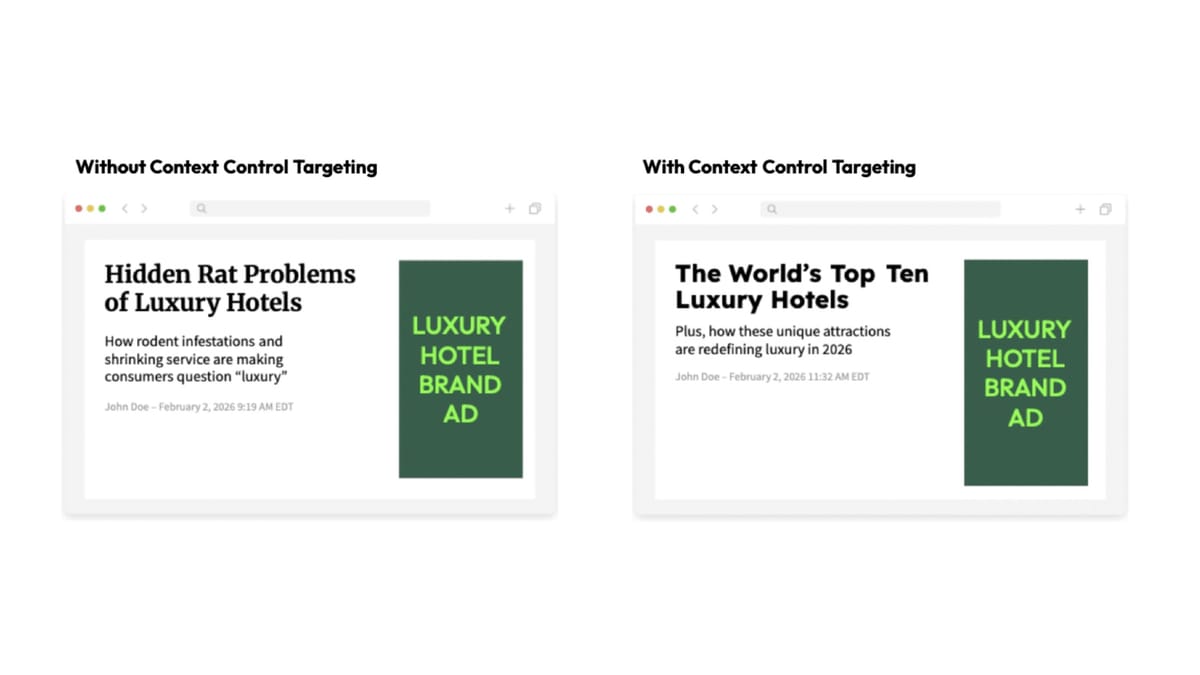
A concept that runs through the IAS document is suitability - distinct from, and layered on top of, standard brand safety. Brand safety is typically understood as the avoidance of harmful or objectionable content: violence, hate speech, illegal activity. Suitability is narrower and more brand-specific. A luxury hotel brand, for example, might deem it technically safe to appear next to a story about hidden pest infestations at hotels. The content is not harmful in the conventional sense. But it is clearly unsuitable for that specific advertiser's message.
IAS illustrates this distinction directly in its documentation with a comparison. Without Context Control, that luxury hotel ad might appear adjacent to an article headlined "Hidden Rat Problems of Luxury Hotels." With Context Control, the same advertiser's bid is matched to an article on "The World's Top Ten Luxury Hotels" - content aligned with aspirational consumer intent rather than negative associations. The difference is not brand safety in the conventional sense. It is the management of contextual resonance: whether the surrounding content amplifies or undermines the advertisement's message.
This is where IAS's semantic classification layer - distinguishing emotional tone and sentiment at the page level - does the work that keyword lists cannot. According to IAS, the system uses "best-in-class semantic intelligence to comprehend the actual meaning, sentiment, and emotion of a page." The classification operates as a pre-bid quality filter, meaning unsuitable inventory is excluded from bid eligibility before an impression is ever purchased.
IAS's integration with Teads, announced in January 2023, provided an early public test of this approach. According to Teads at the time, initial results showed a 99% suitability pass rate for impressions when the IAS Context Control avoidance solution was active - demonstrating that NLP-based classification could operate at programmatic scale without collapsing available inventory to an impractical volume.
IAS operates a media measurement and optimisation platform that, according to its corporate disclosures, analyses up to 280 billion interactions daily through AI-powered models. The company covers ad fraud detection, brand safety and suitability, contextual targeting, viewability measurement, and attention measurement across connected TV, open web, social platforms, mobile, and digital audio.
In September 2025, IAS agreed to a $1.9 billion all-cash acquisition by Novacap, a Canadian private equity firm, at $10.30 per share - a 22% premium to the prevailing share price. That transaction was expected to close by the end of 2025. The acquisition placed IAS within a broader wave of private equity consolidation in advertising technology, driven partly by the increasing value of companies with privacy-compliant measurement capabilities. IAS had earned the first Ethical Artificial Intelligence Certification from the Alliance for Audited Media on July 30, 2025.
The March 2, 2026 document is the first in what IAS describes as a series. According to IAS, upcoming posts will cover Audience-Enhanced Targeting and automated performance targeting - indicating that the contextual targeting piece is positioned as the foundation of a broader product education campaign rather than a standalone announcement.
For marketing professionals operating on the open web, the IAS announcement is a data point in a longer argument about how programmatic targeting should be structured as identity-based signals become harder to use. The practical constraint is not merely regulatory. As privacy sandbox testing at Google showed in 2024, the removal of third-party cookies without replacement signals reduced programmatic revenue for Google Ad Manager publishers by up to 34%. The search for alternatives that preserve performance without depending on individual tracking has been ongoing.
Contextual targeting, in the IAS framing, is not a reduced-capability substitute for audience data. It is a parallel system with its own performance logic: that ads appearing in aligned content environments benefit from the attention and intent already present in the reader, regardless of who that reader is. The 300% CTR gain Samsung reported and the 39% cost-per-conversion reduction for the CPG brand are offered as evidence that this logic holds in live campaign conditions.
Whether those figures are reproducible across different categories, markets, and campaign types is a question the IAS document does not address. The performance data is drawn from individual brand cases, not from a controlled cross-industry study. What the document establishes is the technical mechanism - page-level semantic classification, pre-bid inventory curation, a segment library of more than 380 categories - and the performance claims associated with its deployment.
Who: Integral Ad Science (IAS), a digital media measurement and optimisation company recently acquired by Novacap for $1.9 billion, published today's announcement. The document is addressed to digital advertisers and agency professionals managing open web campaigns across major DSPs.
What: IAS released a detailed technical overview of its Context Control Targeting system, covering page-level semantic classification, a library of over 380 contextual segments, and three brand-specific performance case studies. The document is the first in a series covering IAS's full targeting product suite.
When: The announcement was published on March 2, 2026, by the IAS Team on the IAS website.
Where: The system operates on the open web through IAS's integrations with major demand-side platforms. Classification occurs at the page level before bids are submitted. The document was published on the IAS Insights blog.
Why: IAS positions Context Control Targeting as a response to the dual failure of privacy-restricted audience targeting and keyword-only contextual classification. With GDPR and CCPA enforcement intensifying, and third-party cookie signals diminishing in scope, the company is presenting semantic page classification - pre-bid, suitability-filtered, and segment-activated across DSPs - as a structurally compliant and performance-viable alternative.