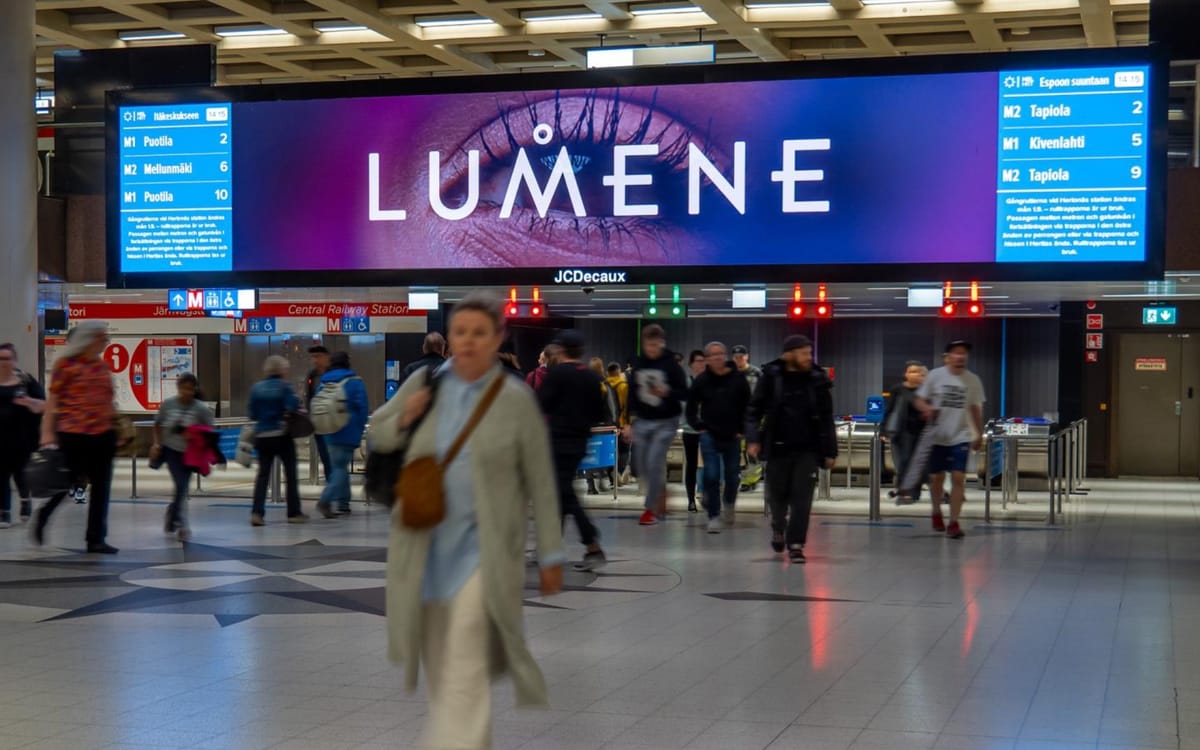
JCDecaux secures 8-year Helsinki metro advertising contract with LED screens
JCDecaux won an 8+2 year contract with HKL and Länsimetro Oy to operate advertising in 30 Helsinki and Espoo metro stations starting July 1, 2026.

JCDecaux SE secured an 8-year advertising contract with optional 2-year extension covering all metro station advertising spaces across Helsinki and Espoo, announced December 2, 2025. The agreement with Helsinki City Transport Authority (HKL) and Länsimetro Oy continues a partnership dating back to 2009.
The contract, beginning July 1, 2026, encompasses advertising operations across 30 metro stations serving Finland's two largest cities. JCDecaux will construct new digital out-of-home advertising inventory featuring LED screen technology throughout the metro network. The installation represents a technological upgrade from existing infrastructure.
Subscribe PPC Land newsletter ✉️ for similar stories like this one
The metro line connecting Helsinki and Espoo attracts more than 1 million weekly commuters and functions as the backbone of regional public transportation. Finland's capital Helsinki maintains the country's largest population base, while Espoo ranks as the second-largest city. The metro network facilitates daily movement patterns for residents across both urban centers.
"We are very pleased to continue our long-lasting advertising partnership with HKL and Länsimetro Oy," stated Jean-François Decaux, Chairman of the Executive Board and Co-Chief Executive Officer of JCDecaux. "With iconic large format displays, the metro station network will become a true showcase for DOOH media in Finland."
The contract followed a competitive tender process managed by both transport authorities. JCDecaux successfully defended its position against competing proposals from other outdoor advertising operators. The 16-year relationship between JCDecaux and the Finnish metro authorities provided operational experience informing the new agreement.
JCDecaux's Helsinki metro operations integrate with the company's broader Finnish advertising network. The outdoor advertising operator maintains street furniture contracts across 59 cities and municipalities nationwide. The combined metro and street furniture inventory positions JCDecaux to offer coordinated campaign deployment reaching urban audiences throughout Finland.
The new LED screens will feature integration designed specifically for subway environments. Digital displays enable dynamic content updates, dayparting strategies, and programmatic advertising capabilities. Screen specifications emphasize visibility in underground lighting conditions while maintaining energy efficiency standards.
Metro advertising represents a specialized segment within transport advertising, requiring technical adaptations for subterranean environments. Underground stations present unique challenges including artificial lighting, limited natural sightlines, and high passenger traffic volumes. Digital screens address these conditions through brightness calibration and content optimization.
JCDecaux operates 340,848 advertising panels within its transport division globally, spanning 157 airports and 257 metro, bus, train, and tramway contracts worldwide. The company maintains market leadership in transport advertising alongside dominant positions in street furniture and billboard segments.
Digital out-of-home advertising has emerged as the fastest-growing media segment within outdoor advertising. JCDecaux reported in March 2025 that digital represented 39% of group revenue in 2024, with digital revenue increasing 21.9% year-over-year. The company's 2024 financial results demonstrated total revenue of €3,935.3 million with organic growth of 9.7%.
The Helsinki metro contract extends JCDecaux's Nordic transport advertising portfolio. The company secured Stockholm bus shelter and subway station contracts in September 2024, covering more than 1,500 bus shelters and 14 major subway stations beginning January 1, 2026. These Swedish agreements run for 7 years with possible 6-month extensions.
European metro advertising contracts typically span 8-15 years, providing stable revenue foundations for outdoor advertising operators. JCDecaux renewed its Madrid Metro concession in 2023 for 10 years, installing more than 460 digital screens across what became the most digitized JCDecaux-marketed metro in Europe. The company secured Brussels metro, tram, and bus advertising through 2038 in November 2025.
Metro station advertising delivers captive audience exposure during commuter wait times and platform transitions. Average dwell time in metro stations ranges from 3-8 minutes, providing extended viewing opportunities compared to street-level advertising. Digital screens enable sequential messaging and brand storytelling across multiple display surfaces within single stations.
Programmatic capabilities represent a strategic focus for JCDecaux's digital infrastructure. The company's VIOOH supply-side platform connects to 46 demand-side platforms across 24 countries, facilitating automated advertising transactions. Programmatic DOOH revenue grew 45.6% to €145.9 million in 2024, accounting for 9.5% of digital revenue.
Transit advertising benefits from demographic diversity unavailable in specialized venue types. Metro passengers span income levels, age groups, and occupational categories, reflecting general population composition. This broad reach appeals to advertisers seeking mass market penetration alongside targeted demographic campaigns.
The Finnish market presents specific characteristics influencing outdoor advertising deployment. Finland maintains high digital literacy rates and mobile device penetration, creating audiences receptive to digitally delivered content. The northern European location requires weather-resistant equipment specifications and extended low-light operation periods during winter months.
JCDecaux will deliver "exceptionally strong audiences to both national and local advertisers" through the combined metro and street furniture networks, according to Jean-François Decaux. The street furniture network spanning 59 Finnish municipalities provides coordinated messaging opportunities extending beyond metro station environments.
LED technology adoption across JCDecaux's operations aligns with corporate sustainability commitments. The company reduced greenhouse gas emissions by nearly 30% in 2024 compared to 2019, with 100% of electricity consumption covered by renewable sources. LED displays consume substantially less energy than older fluorescent backlit systems while delivering superior brightness and image quality.
The contract structure includes 8 guaranteed years with 2 optional extension years, providing operational flexibility for both parties. Extension decisions typically occur 12-18 months before initial term expiration, allowing adequate preparation time for potential tender processes or contract renewals.
Metro advertising inventory pricing reflects location value, passenger volumes, and screen specifications. Premium positions near entrances, exits, and platform centers command higher rates than corridor locations. Digital screens typically achieve 30-50% rate premiums over static displays due to dynamic content capabilities and enhanced visibility.
JCDecaux operates as the world's number one outdoor advertising company, maintaining global presence across more than 80 countries with daily audience reach of 850 million people. The company manages 1,091,811 advertising panels worldwide across street furniture, transport, and billboard categories.
The Helsinki metro network underwent recent expansion with Länsimetro Oy operating the western metro extension connecting Helsinki to Espoo. The extension added new stations requiring advertising infrastructure installations integrated with existing network assets. JCDecaux's contract covers both original line stations and extension infrastructure.
Finland's advertising market maintains characteristics distinct from larger European markets. Limited population scale concentrates advertising spending in major urban centers including Helsinki, Espoo, Tampere, and Vantaa. Out-of-home advertising captures meaningful market share given high urbanization rates and extensive public transportation usage.
The announcement specified "state-of-the-art advertising inventory equipped with the latest technologies" without detailing specific screen dimensions, resolution specifications, or content management systems. Industry standard metro digital displays range from 55-85 inches diagonally with 4K resolution capability.
JCDecaux's competitive positioning within Nordic markets strengthens through this contract retention. The company faces competition from Clear Channel Scandinavia, JCDecaux Nordic (a separate regional entity), and local operators across Scandinavian markets. Contract renewals demonstrate operational performance meeting client expectations during previous terms.
"Combined with our broad and exclusive nationwide street furniture network including 59 cities and municipalities, JCDecaux will deliver exceptionally strong audiences to both national and local advertisers," Jean-François Decaux emphasized. The integrated approach enables cross-format campaign coordination unavailable to specialized metro-only operators.
The July 1, 2026 implementation date provides 19 months for infrastructure planning, equipment procurement, installation coordination, and testing procedures. Metro advertising installations require off-peak hour work schedules minimizing passenger service disruptions. Projects typically execute across 12-18 month periods for comprehensive network upgrades.
Transport advertising revenue at JCDecaux decreased slightly to €345.5 million in Q3 2025, down 0.4% reported but growing 1.7% organically according to the company's November 2025 business review. The segment includes airport, metro, bus, train, and tramway advertising across 257 contracts globally.
Metro station advertising complements broader mobility advertising strategies incorporating bus shelter, transit shelter, and transit vehicle inventory. Coordinated deployment across multiple transit touchpoints builds frequency and reinforces messaging throughout passenger journeys.
The contract represents ongoing consolidation within European outdoor advertising markets. Major operators including JCDecaux, Clear Channel, and Stroer maintain dominant positions across multiple markets through long-term municipal and transport authority contracts. Competitive tenders occur periodically as contracts expire, occasionally resulting in market share shifts.
Environmental performance considerations increasingly influence contract award decisions. JCDecaux's carbon reduction trajectory received Science Based Targets initiative approval in July 2024. The company joined the RE100 as the first out-of-home media company committed to 100% renewable electricity.
Digital out-of-home advertising operates through different technical infrastructure than traditional static displays. Screens connect to content management systems and advertising servers enabling dynamic creative delivery and programmatic transaction processing. Advertisers schedule different creatives based on time of day, weather conditions, or real-time data triggers.
Research from October 2025 indicated that out-of-home advertising achieves marginal ROI of $7.58 per incremental dollar invested, exceeding average media type performance. Despite these results, OOH accounts for less than 1% of total media spending, suggesting potential for expanded budget allocation.
The Helsinki contract announcement did not disclose financial terms, consistent with standard industry practice for municipal and transport authority agreements. Contract values typically remain confidential between parties, though some jurisdictions require public disclosure of government spending commitments.
JCDecaux reported H1 2025 revenue of €1,868.3 million with 2024 full-year revenue reaching €3,935.3 million. The company maintains listings on Euronext Paris as part of the SBF 120 and CAC Mid 60 indexes. Market capitalization fluctuates with broader equity market conditions and company-specific performance.
Metro advertising measurement methodologies incorporate passenger count data, dwell time analysis, and frequency calculations. Transport authorities provide ridership statistics enabling impression delivery estimates. Advanced measurement systems utilize anonymized mobile device data tracking passenger movements through stations.
The partnership continuation reflects JCDecaux's operational performance during the 2009-2026 contract period. Client retention in competitive tender environments indicates service level satisfaction, technical capability demonstration, and commercial terms acceptance. Long-term relationships reduce operational disruptions associated with operator transitions.
Subscribe PPC Land newsletter ✉️ for similar stories like this one
Subscribe PPC Land newsletter ✉️ for similar stories like this one
Who: JCDecaux SE, the world's largest outdoor advertising company, secured a contract extension with Helsinki City Transport Authority (HKL) and Länsimetro Oy, the operators of metro services in Helsinki and Espoo, Finland.
What: An 8-year advertising contract with optional 2-year extension covering all advertising spaces across 30 metro stations in Helsinki and Espoo. The agreement includes construction of new LED screen advertising inventory throughout the metro network, replacing existing infrastructure with state-of-the-art digital displays integrated into subway environments.
When: The announcement was made December 2, 2025, following a competitive tender process. The new contract begins July 1, 2026, and runs through June 30, 2034, with possible extension to June 30, 2036. The agreement continues a partnership that started in 2009.
Where: The contract covers 30 metro stations across Helsinki, Finland's capital city, and Espoo, the country's second-largest city. The metro line serves more than 1 million weekly commuters and functions as the backbone of public transportation in both urban centers. JCDecaux's operations integrate with existing street furniture contracts across 59 Finnish cities and municipalities.
Why: The contract renewal extends JCDecaux's 16-year operational relationship with Finnish transport authorities while enabling technological infrastructure upgrades. The LED screen deployment positions the metro network as a showcase for digital out-of-home media in Finland. Combined with JCDecaux's nationwide street furniture network, the metro contract enables coordinated campaign deployment reaching both national and local advertiser audiences. Metro advertising delivers captive audience exposure during commuter wait times, with digital capabilities enabling dynamic content, programmatic transactions, and data-driven targeting unavailable through static displays.