Meta lets you animate your Facebook profile picture with AI
Meta this week rolled out AI-powered features on Facebook allowing users to animate profile pictures with preset options and restyle Stories through generative AI prompts.


Meta this week rolled out AI-powered features on Facebook allowing users to animate profile pictures with preset options and restyle Stories through generative AI prompts.
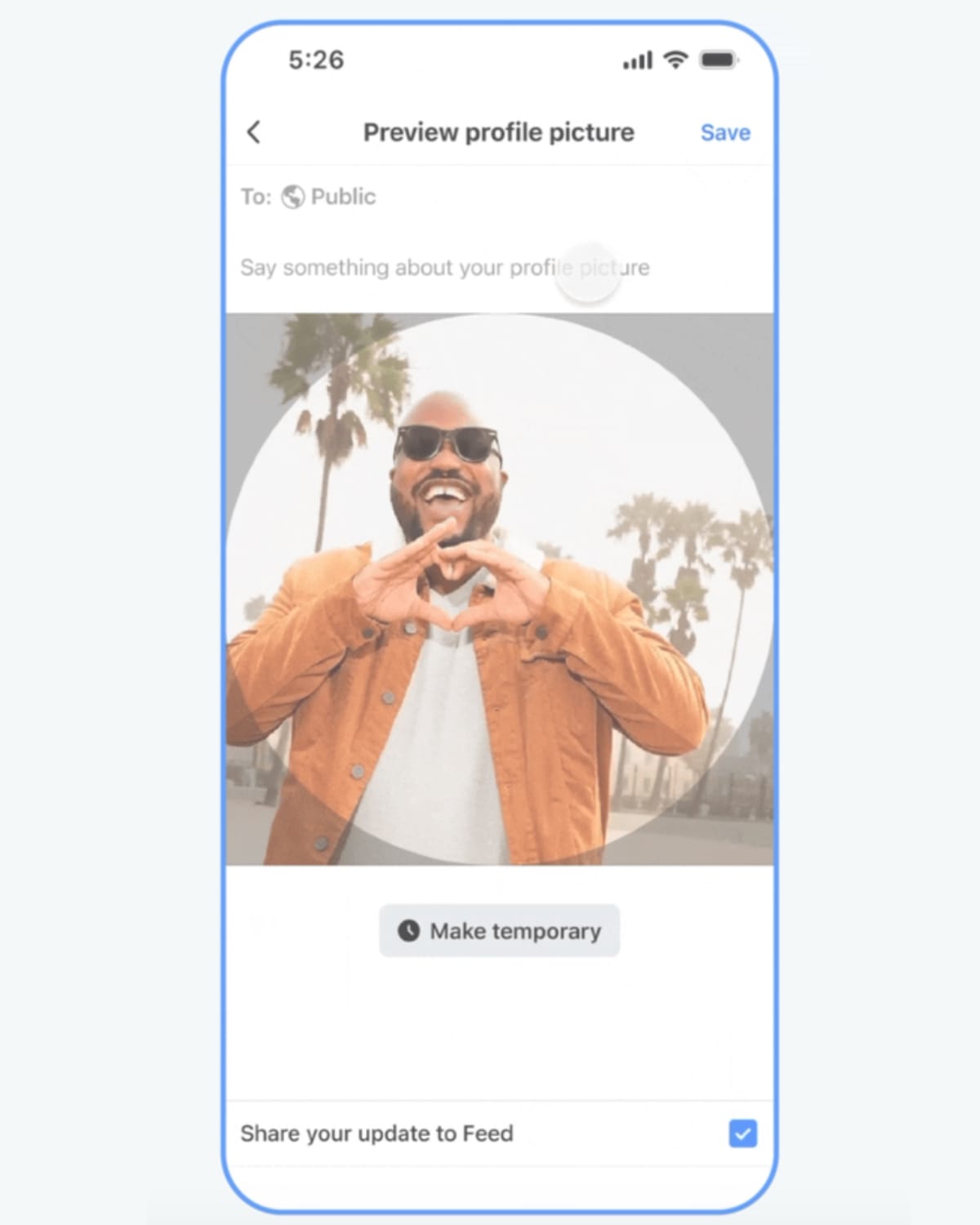
Meta this week rolled out artificial intelligence features on Facebook that transform static profile pictures into animated content, restyle Stories through generative prompts, and add dynamic backgrounds to text posts. The company announced the features on February 10, 2026, extending Meta AI capabilities into personal expression tools across its flagship social network.
The profile picture animation feature converts still photographs into playful animations in seconds. Users select from preset animations including natural, party hat, confetti, wave, and heart to bring profile pictures to life based on their mood or occasion. Meta stated it will add more animation options throughout the year to enable celebrations during seasonal moments and special events.
According to the announcement, the feature achieves best results when users select photos featuring a single person facing the camera with their face clearly visible, avoiding images where subjects hold objects. Users can select photos to animate directly from their camera roll or choose photos previously uploaded to Facebook. Once a photo is animated, users can share it to their Feed and view it on their profile.
The Restyle feature transforms image aesthetics in Facebook Stories and Memories using preset style options or custom text-based AI prompts. Meta will recommend Memories with Restyle options in Stories. After uploading a photo to Stories or viewing Memories to share on Stories, users can tap Restyle and either use Meta AI to change things up how they want, or pick from Styles (like anime or illustrated), Moods (like glowy), Lighting (like ethereal), Colors (like cool or pink), and Backdrops (like beach or cityscape).
The platform is gradually rolling out animated backdrops for Feed text posts, making them more expressive. When creating a new text post in Feed, users tap the rainbow A icon to select from multiple still and animated backgrounds like falling leaves or ocean waves. Meta stated it will introduce seasonal backgrounds in the future so posts can feel timely, festive, and a little more fun.
The new features extend Meta AI's reach into personal content creation after the company reported over 1 billion monthly Meta AI users whose interactions feed personalization systems. The company announced plans in October 2025 to use AI chat data for ad targeting beginning December 16, 2025, making conversations and interactions with Meta AI another data source for personalizing content recommendations and advertisements across Facebook, Instagram, and other platforms.
Meta's advertising business generated $58.1 billion in quarterly revenue representing 24% year-over-year growth in the quarter ended December 31, 2025, driven by significant AI improvements including GEM model enhancements delivering 3.5% click lifts on Facebook. The company's investments in AI infrastructure include plans to invest "hundreds of billions of dollars" in building superintelligence capabilities through massive data center clusters.
The profile picture animation capability operates through automated processing that applies motion graphics to static images. The system analyzes facial features, positioning, and composition to generate appropriate animation effects matching selected preset styles. Technical requirements were not specified in the announcement, though cloud processing architecture suggests processing demands occur on Meta's servers rather than user devices.
Meta introduced AI-powered photo suggestions and automatic collages for Facebook in October 2025, analyzing users' camera rolls to suggest ready-to-share content for Stories and Feed. The company launched generative AI advances for advertisers at Cannes Lions International Festival of Creativity in June 2025, including customized stickers for call-to-action buttons and virtual try-on features using generative AI to showcase clothing on virtual models.
The features represent Meta's continued integration of AI capabilities into consumer-facing products that generate training data and user engagement driving advertising performance. Marketing professionals should note that these organic content features feed the same AI systems powering Meta's advertising optimization.
Facebook Stories and Feed placements serve as primary distribution points for suggested content. Stories display vertically formatted content that disappears after 24 hours, while Feed posts remain visible until users delete them. The suggestion system creates content formatted appropriately for each placement based on the source material's characteristics.
Privacy controls remain with users at each stage of the process. Suggestions appear only to the person who owns the camera roll. The system does not share any content automatically. Users determine whether to share generated suggestions and can select specific audiences for any shared content. According to Meta's announcement, media from camera rolls is not used to train or improve Meta's artificial intelligence systems unless users choose to edit content with AI tools or decide to share it.
The animated backdrop feature for text posts addresses content creation barriers for users without design capabilities. Text posts are a great way to share what's on your mind, according to the announcement, and now users can match that energy visually. The feature makes posts more fun and expressive through still and animated backgrounds.
The Restyle feature applies generative AI to modify existing images rather than creating entirely new visual content. The system offers preset categories across multiple dimensions - Styles, Moods, Lighting, Colors, and Backdrops - providing structured creative options alongside open-ended text prompts. This approach balances creative control with ease of use for mass-market audiences.
Video editing capabilities within animated profile pictures process photographs into formats optimized for social sharing. The system identifies key compositional elements within static images and applies motion effects that fit platform specifications for profile display and Feed posts. Effects and animation styles occur through automated selection algorithms rather than manual editing work.
The rollout strategy employs gradual deployment, with animated backdrops for text posts rolling out gradually rather than launching universally. This phased approach allows Meta to monitor system performance, user engagement patterns, and potential issues before full-scale deployment across its user base.
Meta's broader AI strategy includes consumer-facing tools that have reached over 1 billion monthly active users. The photo suggestion feature extends these AI capabilities into personal content management, applying similar machine learning approaches used for advertising optimization to individual user content creation.
The features position Facebook within an increasingly competitive landscape of AI-powered creative tools across social platforms. Microsoft announced Image Animation capabilities for Microsoft Advertising Platform in November 2025, transforming static images into video assets through Copilot. Amazon expanded Video Generator capabilities to all United States advertisers in June 2025, producing six different video options per request with multi-scene creation capabilities.
Google launched Asset Studio as a centralized creative platform in August 2025, enabling advertisers to generate, edit, and scale advertising assets using artificial intelligence. Meta introduced AI-powered video tools for Facebook and Instagram advertisements in October 2024, including Video Expansion and Image Animation features for advertising content.
The distinction between organic content tools and advertising tools continues blurring as Meta applies similar AI technologies across both use cases. Marketing professionals must recognize that user adoption of these organic features generates behavioral data, engagement patterns, and creative preferences that inform Meta's advertising targeting and optimization systems.
European courts have delivered multiple rulings against Meta's data processing practices throughout 2025. A Leipzig District Court awarded a Facebook user €5,000 in July 2025 for data protection violations involving Meta's Business Tools, finding that Meta Platforms Ireland Limited systematically breached the General Data Protection Regulation through its extensive tracking infrastructure.
The Dresden Higher Regional Court delivered legally binding judgments in February 2026 ordering Meta to pay four Saxon Instagram and Facebook users €1,500 each in damages for illegally collecting personal data across third-party websites and apps. The court prohibited Meta from collecting data about the plaintiffs on third-party sites and apps with immediate effect.
A Madrid court ordered Meta to pay €479 million to 87 Spanish digital news publishers in November 2025 for obtaining unfair competitive advantages through advertising practices that violated GDPR. The Austrian Supreme Court issued a final judgment in November 2025 requiring comprehensive data disclosure to privacy advocate Max Schrems within 14 days.
These legal developments create uncertainty around Meta's data processing practices for AI training and personalization systems. While the company states that media from camera rolls is not used to train or improve AI systems unless users choose to edit content with AI tools or share it, European courts have found systematic GDPR violations in Meta's broader data processing infrastructure.
The new Facebook features arrive as Meta faces mounting regulatory scrutiny over AI training practices. A German court confirmed in August 2025 that Meta's AI training includes children's personal data from public posts despite company claims about age-based protections. The Hamburg Data Protection Authority confirmed ongoing GDPR violations affecting children's data during court hearings.
The features align with Meta's strategy to consolidate users within its ecosystem through AI-powered engagement tools that reduce friction in content creation. By automating previously manual tasks - selecting photos, applying effects, designing backgrounds - Meta lowers barriers to content sharing that drives user engagement and platform time spent.
Meta has systematically expanded its automated capabilities throughout 2025, consolidating campaign structures and defaulting to AI-powered optimization in its advertising business. The company's approach to consumer features mirrors this advertising strategy - using AI to automate complexity while gathering behavioral data that improves future predictions and personalization.
The profile picture animation feature specifically targets a high-visibility element of user identity on Facebook. Profile pictures appear across the platform in comments, reactions, friend lists, and search results, making animated profiles more attention-grabbing throughout the Facebook ecosystem. This increased visibility could drive higher engagement with user-generated content featuring animated profiles.
Text post backgrounds address a longstanding design challenge where plain text posts receive lower engagement than visual content. By providing animated and seasonal backgrounds, Meta aims to increase engagement rates for text-based sharing, maintaining content diversity on the platform beyond photos and videos.
The announcement follows Meta's pattern of introducing AI-powered capabilities that automate tasks previously requiring manual effort or specialized skills. The company's AI advertising gamble represents a fundamental architectural shift in how advertising campaigns function, with CEO Mark Zuckerberg describing a vision for complete automation where businesses would "connect to your bank account, you don't need any creative, you don't need any targeting demographic."
That vision for advertising automation extends into organic content creation through these new features. By providing preset animation styles, generative restyling options, and animated backgrounds, Meta removes technical barriers to creating visually engaging content while maintaining platform control over creative options and implementation.
The Features category system - Styles, Moods, Lighting, Colors, Backdrops - provides structured creative frameworks that guide user choices while limiting infinite possibilities. This approach balances creative expression with computational efficiency and content moderation requirements.
Marketing professionals should monitor adoption rates for these features as indicators of user willingness to engage with AI-generated content modifications. High adoption rates would signal consumer comfort with AI content creation that could extend into acceptance of AI-generated advertising creative and product recommendations.
Who: Meta rolled out the features affecting Facebook users globally, with profile picture animation, Stories Restyle capabilities, and animated text post backgrounds available through the Facebook mobile application and website.
What: The company introduced three AI-powered features - profile picture animation with preset options (natural, party hat, confetti, wave, heart), Restyle for transforming Stories and Memories aesthetics through AI prompts or preset categories (Styles, Moods, Lighting, Colors, Backdrops), and animated backgrounds for Feed text posts selected through a rainbow A icon interface.
When: Meta announced and began rolling out the features on February 10, 2026, with gradual deployment for animated text post backgrounds and plans to add more animation options throughout the year for seasonal moments and special events.
Where: The features are available globally on Facebook through the mobile application and website, with profile picture animations viewable on user profiles and shareable to Feed, Restyle accessible when uploading to Stories or viewing Memories, and text post backgrounds available when creating new Feed posts.
Why: The features aim to make it easier and more fun for users to express themselves through profile pictures, photos, Feed posts, and Stories by applying AI-powered animations and transformations that previously required manual editing skills or specialized software, while generating engagement data and user interactions that feed Meta's broader AI personalization and advertising optimization systems.