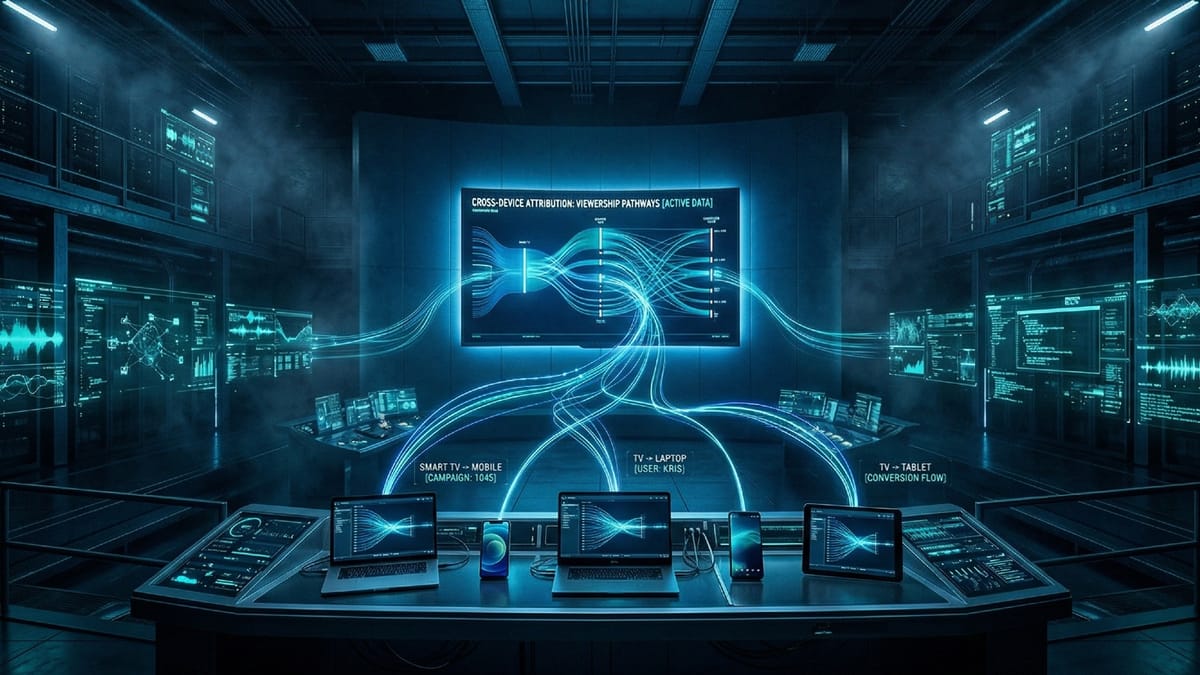
Nexxen today highlighted a suite of full-funnel performance capabilities within its demand-side platform, Nexxen DSP, bundling AI-driven optimization tools with incrementality measurement in a single integrated stack. The announcement, made on March 24, 2026, positions the company against a persistent structural problem in programmatic advertising: optimization and measurement have historically lived in separate tools, forcing media buyers to reconcile signals across disconnected systems.
The company's pitch is that fragmentation - not lack of spending - is what makes campaigns harder to evaluate, particularly in connected television environments where a viewer might watch an ad on a smart TV and convert days later on a mobile device.
"Fragmentation has made performance measurement increasingly difficult, particularly when viewing takes place in a CTV environment and conversion takes place later on another device - connecting TV exposure to downstream actions is rarely straightforward," said Kara Puccinelli, Chief Customer Officer at Nexxen. "Full-funnel performance in Nexxen DSP helps advertisers optimize while campaigns are in flight and measure real lift, ultimately connecting upper-funnel impact to lower-funnel outcomes."
The suite consists of five integrated components, each addressing a distinct layer of the campaign management workflow.
In-Flight Optimization, abbreviated as IFO, unifies offline signals and optimizes campaigns in real time. This distinguishes it from post-campaign attribution approaches, which can only identify what worked after the budget has been spent. The ability to incorporate offline conversion data during an active campaign - rather than after it closes - reflects a broader industry shift toward continuous optimization loops.
Performance Algorithms from nexAI form the second layer. These are AI-driven tools designed to maximize campaign effectiveness regardless of the key performance indicator being pursued. Nexxen presents this as KPI-agnostic, meaning the same algorithmic framework can optimize toward brand awareness metrics, direct response conversions, or any intermediate goal. The technical specifics of the model architecture are not disclosed in the announcement, but the positioning suggests ensemble-style optimization that adjusts to the declared objective rather than requiring separate campaign setups for different goals.
Auto-Allocation operates as an automatic budget distribution mechanism. Rather than requiring media buyers to manually shift spend between tactics based on observed performance, the system redirects budget toward the best-performing tactics on its own. The reduction in manual workload is central to Nexxen's framing. Research from DoubleVerify published in August 2025 found that marketers globally spend roughly 10 hours and 12 minutes per week on routine tasks including bid modifications and budget allocations - time the Nexxen approach aims to compress.
Incrementality Testing via Ghost Bidding is arguably the most technically specific component. Ghost bidding is a methodology in which a platform submits bids for impressions in a control group but does not actually serve ads when those bids win - essentially creating a synthetic holdout group within the live auction environment. By comparing the behavior of users who would have been exposed to ads against users who were not, the technique isolates the causal impact of advertising from organic conversion trends. This differs structurally from attribution models, which assign credit to touchpoints without establishing causality. According to Justin Manus, Chief Technology Officer at Tinuiti, "Attribution modelling only goes so far in understanding our return on investment. Nexxen DSP's incrementality feature gives our clients the clearest understanding of their performance, so we can focus on spending on the audiences that drive outcomes."
The IAB and IAB Europe published comprehensive incrementality measurement guidelines in November 2025, defining incrementality as the causal impact of marketing by identifying additional business outcomes directly driven by a campaign, compared to what would have occurred in the absence of any advertising activity. Those guidelines explicitly distinguished incrementality from attribution and ROAS calculations, which show outcomes but not causality - the precise distinction Nexxen is exploiting in its product positioning.
The fifth component, nexAI-Powered In-Platform Reporting, delivers data and insights directly within the DSP interface. Consolidating reporting inside the buying platform avoids the workflow friction of exporting data to external dashboards. The goal is to equip teams with sufficient context to make optimization decisions without switching tools.
Nexxen describes the overall architecture as holistic and powered by signals from both the demand side and supply side of its technology stack - a structural advantage it can claim because the company operates both a DSP and a supply-side platform. Specifically, the platform draws on automatic content recognition data, abbreviated ACR, as well as audience insights from Nexxen Discovery. ACR technology analyzes audio waveforms on smart televisions to identify the content being watched, enabling precise audience targeting and cross-device attribution without relying on cookies or panels.
That data infrastructure has been under active development for several years. Nexxen secured exclusive global ACR data access from VIDAA through an expanded $35 million investment in August 2025, bringing its total investment in the CTV operating system to $60 million and approximately 6% of VIDAA's outstanding shares. Those data rights extend through at least the end of 2029. VIDAA - which rebranded to V in early 2026 - powers more than 50 million connected devices globally. In February 2026, Nexxen joined The Trade Desk's Ventura Ecosystem alongside V, providing OS partners programmatic access to OpenPath, Unified ID 2.0, OpenAds, and OpenPass. The Ventura collaboration further embeds Nexxen's supply-side position within a CTV marketplace seeking to operate independently of walled garden platforms.
In October 2025, Nexxen also licensed its ACR audience segments to Yahoo DSP across the United States, United Kingdom, and Germany - extending the data to a third major programmatic platform following an earlier partnership with The Trade Desk. The ACR segments categorize viewing behavior by content genre, specific networks, individual programs, and exposure to competitive brand advertisements.
The full-funnel performance suite, according to the announcement, is available immediately within Nexxen DSP, with additional enhancements planned throughout 2026. No pricing information was disclosed.
The announcement lands at a moment when the advertising industry has spent considerable energy trying to standardize how incrementality should be measured. Google reduced its incrementality testing minimum budget to $5,000 in May 2025, using Bayesian methodology to enable smaller advertisers to access causal measurement that previously required enterprise-scale budgets. In November 2025, Google further updated its testing capabilities, with 80% of senior marketing analytics professionals in the United States stating that incrementality experiment insights have a high impact on revenue growth, according to a Google survey of 567 professionals with annual ad spend exceeding $500,000.
Media fragmentation, as documented extensively by PPC Land, has made budget allocation increasingly difficult. Streaming viewership surpassed the combined share of broadcast and cable television in 2025 at 44.8% of total TV usage, yet 32% of media professionals still characterize CTV advertising as ineffective. The gap between investment and perceived performance is precisely what Nexxen's integrated stack aims to address.
Earlier work from Nexxen in partnership with independent agency H/L demonstrated 14x conversion lift compared to traditional CTV programs, validated through marketing mix modeling - a result that Puccinelli attributed to targeting actively engaged viewers rather than simply placing ads at scale. The full-funnel suite announced today formalizes the infrastructure underlying those results into a structured product offering.
The broader competitive context is relevant. Yahoo DSP launched agentic AI capabilities in January 2026 that autonomously execute campaign operations including setup, troubleshooting, and optimization through natural language. Amazon consolidated its DSP and Ads Console into a unified Campaign Manager with AI agents in late 2025. Nexxen's approach is narrower in scope than autonomous agents - it does not appear to enable natural language campaign building - but its integration of ghost bidding incrementality within the buying platform itself is technically distinct. Most DSPs either delegate incrementality to third-party measurement vendors or offer it as an add-on, while Nexxen is presenting it as a native capability within the same interface where media buyers execute and optimize.
The company's financial position provides context for understanding the strategic stakes. According to Nexxen's Form 20-F filed with the Securities and Exchange Commission on March 4, 2026, programmatic revenue reached $340.6 million for the full year ended December 31, 2025, up from $324.5 million in 2024. Performance revenue, however, fell sharply - from $41 million in 2024 to $24.2 million in 2025. Total cash and cash equivalents stood at $133.3 million at year-end 2025, down from $187.1 million a year earlier. The new full-funnel performance suite therefore addresses both a market opportunity and a specific revenue challenge: rebuilding the performance segment of the business through a product that directly targets outcome-focused advertisers.
Nexxen is headquartered in Israel and trades on Nasdaq under the ticker NEXN. The company maintains offices across North America, Europe, and Asia-Pacific.
Timeline
- February 2024 - Nexxen expands TV Intelligence solution with streaming viewership data from Netflix, Hulu, and Disney+
- May 2024 - Nexxen reports Q1 2024 revenue of $74.43 million, narrowing net loss to $6.87 million
- August 2024 - Nexxen and The Trade Desk partner, making ACR data segments available in the U.S., U.K., Canada, and Australia
- May 22, 2025 - Google cuts incrementality testing minimum budget to $5,000 using Bayesian methodology at Google Marketing Live 2025
- July 2025 - Media fragmentation analysis documents CTV share of media budgets doubling from 14% in 2023 to 28% in 2025
- August 11, 2025 - Nexxen renews and expands VIDAA partnership with $35 million additional investment, securing exclusive ACR data and North American ad monetization rights through 2029
- August 13, 2025 - DoubleVerify study finds marketers spend over 10 hours weekly on manual programmatic tasks, costing North American agencies approximately $17,000 annually per team member
- October 16, 2025 - Nexxen licenses ACR audience segments to Yahoo DSP in the U.S., U.K., and Germany
- November 3, 2025 - IAB and IAB Europe publish comprehensive incrementality measurement guidelines for commerce media
- November 11, 2025 - Google further updates incrementality testing; 80% of senior U.S. marketing analytics professionals report high revenue impact from incrementality experiments
- February 4, 2026 - H/L and Nexxen announce CTV targeting results showing up to 14x conversion lift, validated through marketing mix modeling
- February 24, 2026 - The Trade Desk launches Ventura Ecosystem with V and Nexxen as first CTV collaborators
- March 4, 2026 - Nexxen files Annual Report on Form 20-F with the SEC, reporting full-year 2025 programmatic revenue of $340.6 million and cash of $133.3 million
- March 24, 2026 - Nexxen announces full-funnel performance suite within Nexxen DSP, including IFO, nexAI algorithms, Auto-Allocation, ghost bidding incrementality, and in-platform reporting
Summary
Who: Nexxen International Ltd. (Nasdaq: NEXN), a global advertising technology company headquartered in Israel, with commentary from Kara Puccinelli (Chief Customer Officer, Nexxen) and Justin Manus (Chief Technology Officer, Tinuiti).
What: The formal announcement of a full-funnel performance suite within Nexxen DSP, consisting of five integrated components: In-Flight Optimization, nexAI Performance Algorithms, Auto-Allocation, Incrementality Testing via Ghost Bidding, and nexAI-powered in-platform reporting. The suite combines AI-driven campaign optimization with causal incrementality measurement in a single platform, drawing on ACR data and audience signals from both the demand side and supply side of Nexxen's technology stack.
When: Announced on March 24, 2026, at 09:00 ET. The suite is available immediately, with further enhancements planned throughout 2026.
Where: The capabilities are available within Nexxen DSP globally. The announcement was distributed from New York via GlobeNewswire.
Why: CTV advertising fragmentation has made it structurally difficult to link a television ad exposure to a downstream conversion on another device. Nexxen positions its integrated stack as a solution to this specific problem - replacing the standard industry model where optimization and measurement sit in separate tools - at a time when performance revenue in its own business declined from $41 million in 2024 to $24.2 million in 2025, while competitors including Yahoo DSP and Amazon have launched competing AI automation capabilities.
Share this article
The link has been copied!