Performance Max is losing the trust of advertisers who push it hard. That is the core of a debate that surfaced this week on LinkedIn, when Victor Tomas, founder of a Google and YouTube Ads agency focused on seven-to-nine figure ecommerce brands, posted an account of his own experience pulling back from PMax on accounts where the priority is scaling non-brand shopping and search. The thread drew responses from Ginny Marvin, Ads Product Liaison at Google, along with Jyll Saskin Gales, an independent Google Ads coach, and dozens of other practitioners. Together, their exchanges reveal a persistent tension inside the advertising industry: the gap between what Performance Max promises and what it delivers when budgets grow.
The post, published approximately five days before April 5, 2026, did not claim PMax is broken outright. Tomas was more measured. According to the post, the pattern he observed was that "as you push spend, Pmax gets messy - It starts slowly errodes placements spending, focuses too much on remarketing, and it just gets harder and harder to verify." His threshold was specific: at over $100,000 per month in spend, he described the campaign type as "less trustworthy." Below that level, he wrote, it "can work well."
The concern is not whether conversions happen. It is whether those conversions are happening on the channels and audience segments the advertiser actually intends to reach. That distinction matters enormously for ecommerce businesses trying to grow through non-branded shopping and search, where the economics of new customer acquisition differ sharply from remarketing to warm audiences.
The budget drift problem
At the center of the complaint is what Tomas called the black box problem of allocation. Historical channel distribution in a PMax campaign - for example, 90% of spend on Shopping - does not carry forward reliably when budgets increase or target ROAS decreases. The system recalibrates. According to Tomas, "when you increase spend or drop target ROAS to scale, the historic spend is not a guarantee in any way of future spending." For advertisers managing large ecommerce accounts, that unpredictability makes it difficult to plan channel-level investment or demonstrate to clients where their money is going.
The situation has a structural explanation that several respondents pointed out. Jyll Saskin Gales, in a reply on the thread, described the behavior not as a bug but as a product feature. "That's what PMax is designed to do," she wrote. When Shopping inventory is saturated at a given ROAS level, the system must expand - into different queries, audiences, channels, or product mixes - because there is nowhere else to grow within the existing constraints. "Of course, it will need time to learn which of those new avenues are fruitful and which aren't," she added.
That explanation is technically accurate but offers limited comfort to a media buyer trying to scale a specific channel. One practitioner in the thread described PMax as holding up "until you ask it to scale something specific. Then it drifts to whatever's easiest to convert and calls it performance." Another described building up RSA data, switching to PMax, seeing initial results, then watching quality drop as the system "leans into remarketing" and becomes "harder to control or trust."
The overindexing on remarketing is particularly significant. Remarketing audiences - people who have already visited the site or interacted with the brand - are easier to convert. The system's optimization logic gravitates toward them when scaling because they deliver better short-term conversion signals. But for advertisers whose primary goal is new customer acquisition, that behavior directly undermines the campaign's purpose.
Google's position and the controls available
Ginny Marvin entered the thread with a detailed reply addressing both the design intent and the available control options. Her comment confirmed the core dynamic: PMax "is fundamentally built to prioritize the conversion over the channel. Rather than scaling Search or Shopping specifically, for example, it's looking to find the next predicted conversion across all of Google's inventory."
She outlined several tools for advertisers who want to counter the drift toward remarketing and branded traffic. The first is the New Customer Acquisition Goal set to "New Customer Only" mode, which is intended to direct the campaign toward acquiring customers who do not appear in existing lists. The second is brand exclusions, which prevent PMax from targeting branded search, Shopping, and YouTube search queries - a mechanism that keeps the campaign focused on non-brand traffic. Third, she noted that advertisers can now exclude first-party audiences from PMax campaigns entirely, including Customer Match lists, web visitor lists, and Google Analytics audiences.
That last point represents a relatively recent change in how PMax handles first-party data. The ability to exclude audiences - not just add them as signals - gives practitioners a way to throttle the remarketing over-indexing that Tomas described. Jesse T., identified as Head of Google Growth for an ecommerce media company, added a related suggestion: adding non-converter lists as a data exclusion in campaign settings. "Theoretically that should throttle PMAX over-indexing into remarketing," he wrote, though he acknowledged it would not eliminate the tendency entirely.
Whether these controls are sufficient depends on the scale and specificity of the advertiser's goal. At least one practitioner in the thread was not convinced. "I have given up," one commenter wrote. "I don't think it's there yet. Been hearing 'it's improved' for 2 years - still doesn't hold up at scale." The same commenter noted that ecommerce applications still work well in their view - a distinction that came up repeatedly.
Transparency improvements have not resolved the structural critique
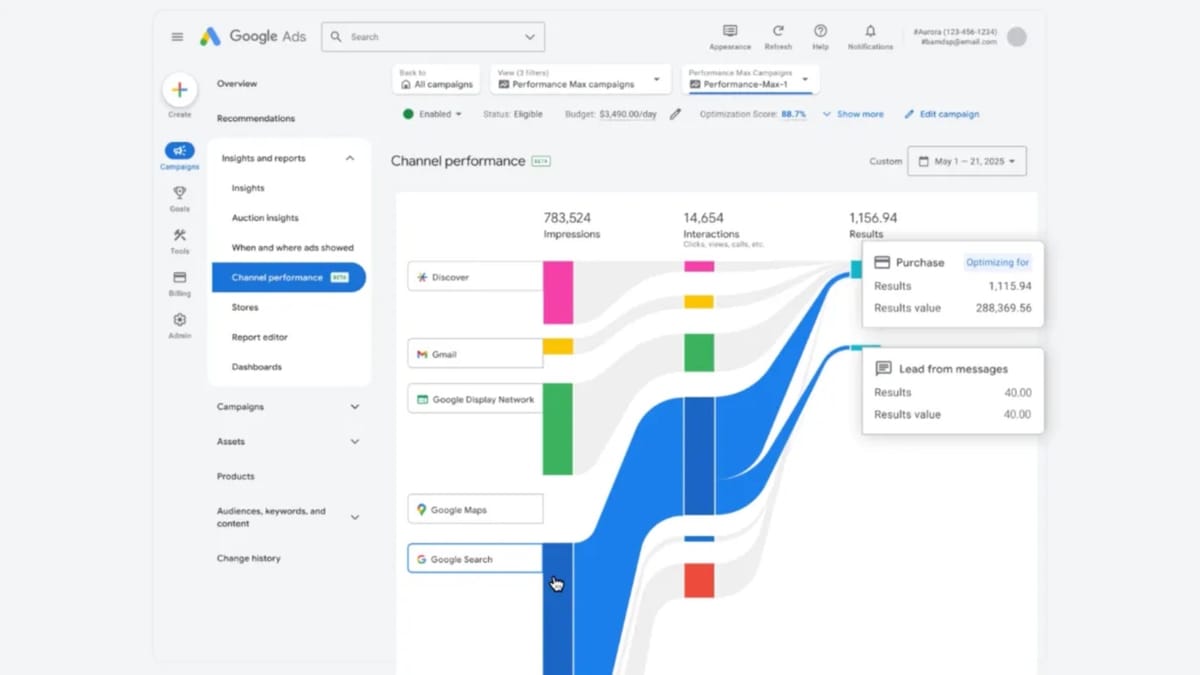
Much of the frustration stems from the difficulty of verifying what PMax is actually doing. Google has made meaningful moves on this front over the past year. Channel performance reporting became available to advertisers in May 2025, after the feature was first announced in late April 2025 and previewed at Google Marketing Live. The reporting provides a breakdown of spend and conversions across Search, YouTube, Display, Gmail, Discover, Maps, and search partners. It was described at the time as the end of what many called the "black box" era. Google's API v23, released in January 2026, extended that channel reporting to programmatic interfaces, enabling developers to pull channel-level data into external dashboards and analytics tools.
Yet even with this data available, the problem Tomas identifies is not purely about visibility - it is about control. Knowing that spend has shifted from Shopping to Display or YouTube does not allow the advertiser to reverse that shift. As PPC Land has reported, advertisers cannot adjust budget allocation between channels or pause specific channel participation within PMax campaigns. The system reports where it spent; it does not let advertisers direct where it should spend next.
This is precisely the limitation that drives some practitioners to rebuild campaigns in standard Search and Shopping formats when scaling becomes a priority. Franthoni Weinum, who identified himself as managing over $15 million in Google and YouTube Ads, stated he had stopped launching new PMax campaigns for scale-focused accounts over the previous several months. "I'm going back to search and Shopping for Scale," he wrote. At least one other participant described PMax CPCs "absolutely skyrocketing" in recent weeks "for absolutely no reason whatsoever."
What structure actually helps
Not every account in the thread produced negative outcomes. Several practitioners pointed to structural choices that appear to make PMax more predictable. One approach that came up multiple times is running PMax at a higher target ROAS specifically on warm audiences, while using standard Shopping and Search campaigns to do the actual scaling work on non-brand traffic. According to one commenter, PMax is not for scaling - "it's for following around warm leads and converting them (at a high TROAS)." Under that framework, the two campaign types are complementary rather than competing.
Another structural option is the feed-only PMax configuration. One practitioner argued that for ecommerce, the most reliable path to channelizing PMax into Shopping inventory is to "stick with PMAX feed only no assets" and pair it with a low ROAS Shopping campaign. This restricts PMax to Shopping search result pages specifically and prevents the system from expanding into Display, YouTube, and Discovery.
Asset group segmentation was also mentioned as a potential lever. Breaking campaigns into tightly themed asset groups - organized by product category, audience segment, or buying intent - gives the system more specific signals and may reduce the tendency to drift toward the path of least resistance.
Google's guidance on campaign structure recommends consolidating PMax campaigns where possible, creating separate campaigns only when different goals, budgets, or ROAS targets require it. But the thread's practical experience suggests that consolidated structures, while theoretically data-rich, become harder to steer when scale targets require channel specificity.
The ecommerce distinction
A notable pattern in the discussion was how consistently practitioners separated ecommerce from lead generation contexts. Several commenters explicitly stated PMax still performs well for ecommerce - particularly for smaller accounts or for the remarketing and conversion function described above - while being more problematic for lead generation at scale. One commenter said they had reverted fully to Search for lead gen. Another described PMax as reliable for ecommerce but only "at a much higher TROAS" with brand terms excluded.
PPC Land's earlier analysis of brand terms in PMax found that excluding branded search terms from PMax lowered customer acquisition costs in 100% of experiments tested, with an average 40% reduction. That analysis, conducted by Haus, found that on average, excluding brand terms drove 24% more incremental revenue across tests where exclusion was the better strategy - though including brand terms produced more incremental revenue 50% of the time when results were split.
The nuance matters. PMax is not uniformly unreliable or uniformly effective. Its performance depends substantially on what the advertiser is asking it to do, at what scale, and with what structural choices applied. The thread's consensus - if there is one - is that PMax works better as a conversion capture tool for warm audiences than as a channel-level scaling mechanism. When the task is to grow a specific channel aggressively at high spend, the lack of allocation control becomes a structural constraint that reporting improvements alone cannot fix.
The discussion reflects tensions that are central to how the industry has absorbed automated campaign types since PMax became generally available in November 2021. Google modified its campaign setup interface in September 2025 to make PMax the default selection when advertisers choose all channels - a change that increased the number of accounts running PMax regardless of whether practitioners would have chosen it explicitly. The negative keywords limit was raised from 100 to 10,000 in March 2025, responding to advertiser feedback that the previous cap made it impossible to adequately exclude irrelevant queries.
Google continues to add controls. Age exclusions at the campaign level became available in April 2025. Brand guidelines moved to campaign level in a phased rollout completed in July 2025. Channel reporting arrived in May 2025 and was extended through the API in January 2026. Each of these changes addresses a specific transparency or control gap that advertisers had flagged.
But the concerns in the thread point to something the current feature set does not fully address: the absence of channel-level budget controls. Until advertisers can specify minimum or maximum allocation toward Shopping, Search, or other channels, the system will continue to allocate based on its own predicted marginal return - which at scale may diverge meaningfully from the advertiser's strategic priorities.
Marvin's comment closed with a framing that captures the platform's intended logic: PMax is "looking to find the next predicted conversion across all of Google's inventory." For advertisers who accept that framing - and pair it with structural choices that constrain the campaign's behavior - PMax can deliver at scale. For those who need to grow a specific channel with precision, the tool's current architecture leaves a meaningful gap.
Timeline
- November 2021: Performance Max campaigns become generally available to all Google Ads advertisers
- March 2022: PPC Land publishes a guide to Google Performance Max campaigns, documenting early design and control limitations
- February 2024: Google defends Performance Max transparency amid growing "black box" criticism
- February 2024: Google clarifies new customer acquisition targeting in PMax, including New Customer Only mode and brand exclusions
- August 2024: Haus analysis finds excluding brand terms from PMax lowers customer acquisition costs in 100% of experiments, with an average 40% CAC reduction
- October 2024: PPC Land examines how Performance Max affects Google search results and what costs come with it
- February 2025: Google releases a detailed Performance Max FAQ responding to advertiser questions on transparency and channel reporting
- March 2025: Google raises PMax negative keywords limit from 100 to 10,000 after advertiser feedback
- April 2025: Google adds campaign-level age exclusions to PMax
- April 30, 2025: Google announces channel performance reporting for Performance Max
- May 30, 2025: Channel reporting begins rolling out to advertiser accounts
- July 2025: Google completes brand guidelines rollout for all PMax UI campaigns
- September 2025: Google modifies campaign setup flow to prioritize Performance Max as the default for all-channel selection
- October 2025: Google adds network segmentation to Performance Max asset reports
- November 6, 2025: Google adds Waze inventory to PMax for store goals and expands channel reporting
- January 15, 2026: Google expands fixed total budget controls to Search, PMax, and Shopping
- January 31, 2026: Google Ads API v23 brings channel-level reporting to programmatic interfaces
- Late March / Early April 2026: Victor Tomas publishes LinkedIn post reporting PMax reliability issues above $100k/month spend; Ginny Marvin responds on behalf of Google Ads
Summary
Who: Victor Tomas, founder of a Google and YouTube Ads agency working with seven-to-nine figure ecommerce brands, raised the issue; Ginny Marvin, Google Ads Product Liaison, responded; Jyll Saskin Gales, Jesse T., and dozens of other Google Ads practitioners contributed to the discussion.
What: A public LinkedIn thread detailed practitioner experience of Performance Max campaigns becoming unreliable at scale above approximately $100,000 per month in spend - specifically over-indexing on remarketing audiences, shifting budget away from Shopping, and offering no mechanism for channel-level allocation control. Google's Ads Product Liaison acknowledged PMax's design as conversion-first rather than channel-first and outlined available controls including New Customer Only mode, brand exclusions, and first-party audience exclusions.
When: The original LinkedIn post by Victor Tomas was published approximately five days before April 5, 2026. Responses from Ginny Marvin, Jyll Saskin Gales, and others appeared over the following two to three days.
Where: The discussion originated on LinkedIn and is visible publicly on the platform. It directly concerns Google Ads Performance Max campaigns running across Google's advertising network - Search, Shopping, YouTube, Display, Gmail, Discover, and Maps.
Why: The thread matters because it surfaces a structural limitation of Performance Max that a growing number of high-spend ecommerce advertisers are encountering. As spend increases and channel-level growth becomes a priority, PMax's conversion-first optimization logic diverges from advertiser intent. Despite significant transparency improvements introduced throughout 2025 and into 2026, the absence of channel-level budget allocation controls remains the central unresolved issue for practitioners trying to scale specific inventory types through PMax.
Share this article
The link has been copied!