
Spotify gives all users video on/off switch starting this month
Spotify today announced new video controls rolling out globally, letting Premium, Basic, and free-tier users toggle Canvas visuals and podcast videos through Settings.

Spotify today announced new video controls rolling out globally, letting Premium, Basic, and free-tier users toggle Canvas visuals and podcast videos through Settings.
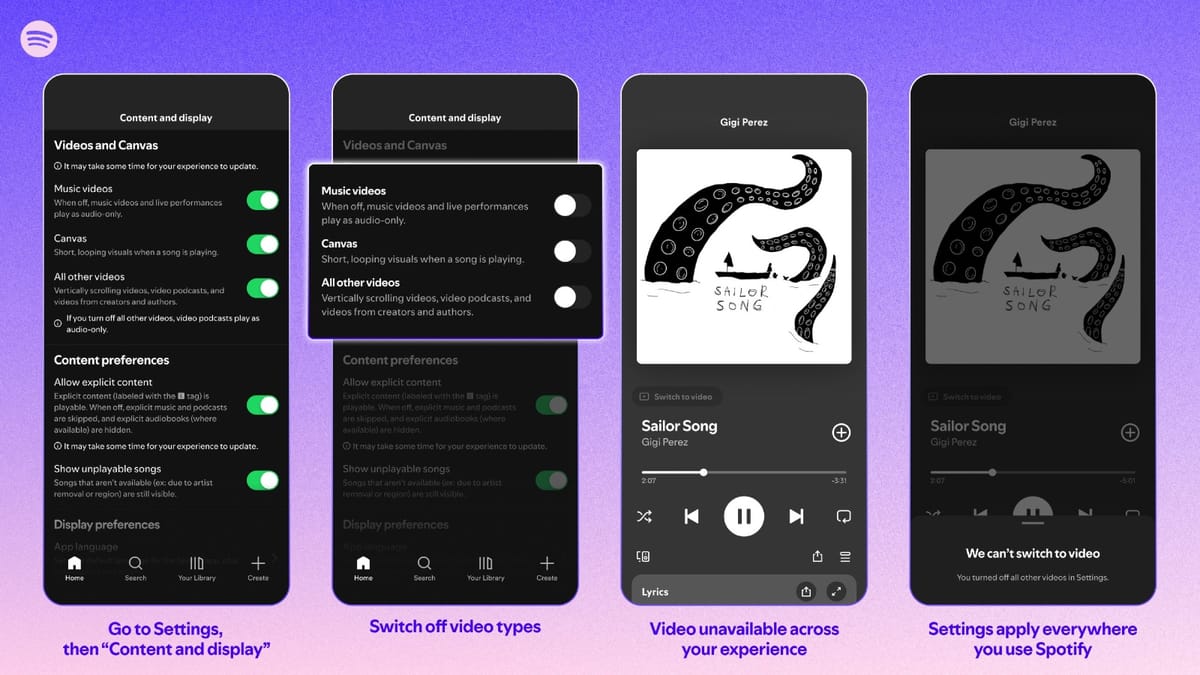
Spotify yesterday announced a new set of video controls that will give every user on the platform - from free-tier listeners to Family Plan members - the ability to switch off video content entirely, or keep it running. The announcement, dated April 9, 2026, marks the first time Spotify has extended granular video preference settings beyond parental controls for under-13 accounts to the full global user base.
The change arrives as Spotify continues building out its video infrastructure at significant scale. According to a Burson survey of 8,400 respondents across 19 markets, conducted between August 27 and October 3, 2025, 93% of Spotify users expressed excitement about features that give them more control over their experience. The same survey found that 92% of users say Spotify brings them closer to the things they love. Edison Research, cited in the announcement, found that 86% of Gen Z listeners use music or podcasts to help boost their mood.
The rollout has two distinct phases, each targeting different user segments.
The first phase began today. Family Plan managers can now switch video content on or off for any member accounts on their plan through subscription settings. Spotify had previously offered this type of control only for Family Plan managed accounts belonging to users under the age of 13, or the equivalent age threshold in a given country. The expansion removes that restriction, meaning a Family Plan account holder can now apply video controls to any member on the plan regardless of age.
The second phase covers a broader audience and begins rolling out this month. All Premium and Basic users - whether on Individual, Duo, Family, or Student plans - and all users on the free service will gain settings to control how video appears in their app. There is no geographic restriction mentioned in the announcement. The settings update will reach all users globally.
The controls live inside Settings, under the "Content and display" section. Two separate toggles are available. The first governs Canvas - the looping visual artwork that plays behind music tracks. The second governs videos for music and podcasts more broadly, which Spotify describes as covering all other video content on the platform.
Once preferences are set, they apply uniformly across every surface where Spotify runs: mobile, desktop, web, TV, and any other supported device. Users who disable video will still see video ads, as well as Canvas-like visuals on some audio ads. That distinction - separating user-controlled content from advertising - is significant. It means disabling video does not remove ad placements; it affects only the organic content layer.
The separation between controllable content video and ad video has direct consequences for the marketing community. Advertisers running video campaigns on Spotify - including Canvas-style placements - retain their reach even when users opt into audio-only mode for content. According to Spotify's announcement, "users will still see video ads, as well as Canvas-like visuals on some audio ads." This preserves advertiser exposure regardless of a listener's personal content preferences.
Spotify has been steadily expanding its advertising infrastructure. The platform launched its Spotify Ad Exchange (SAX) in April 2025, enabling programmatic buying through real-time auctions, and reported 8% ad revenue growth in Q1 2025 driven by automated buying tools. That growth came after a difficult period: ad-supported revenue declined 1% year-over-year to €453 million in Q2 2025, despite growing ad-supported monthly active users by 10% to 433 million.
In Q3 2025, monthly active users reached 713 million and Premium subscribers climbed 12% annually to 281 million, but ad-supported revenue continued declining, falling 6% year-over-year to €446 million. The trajectory puts pressure on Spotify to demonstrate that its growing video infrastructure translates into advertiser value.
Amazon DSP added Spotify's global audio and video inventory in October 2025, combining Amazon's shopping signals with Spotify's 696 million monthly users across nine markets. That partnership expanded programmatic access to Spotify video inventory, making the question of which video content users actually see - and whether they have opted into or out of visual experiences - more material to campaign planning.
Spotify's investment in video extends well beyond music. The platform expanded its music videos beta to 85 additional markets in October 2024, providing Premium subscribers with access to artist-shot video content alongside standard audio tracks. That expansion followed data indicating that users who discover a song and then watch its music video are 34% more likely on average to stream the song again in the following week, and that songs discovered with music videos are 24% more likely to be saved or shared within a week.
On the podcast side, Spotify's video podcast catalog had grown to nearly 500,000 shows as of November 2025, with more than 390 million users having streamed video podcasts - a 50% increase year-over-year. That volume makes the new off-switch meaningful for a substantial portion of the listener base that may prefer audio-only podcast consumption.
Spotify and Netflix announced a distribution partnership in October 2025 that brought video versions of Spotify Studios and The Ringer podcasts to Netflix, covering 17 distinct podcast properties across sports, culture, lifestyle, and true crime. The deal included shows such as The Bill Simmons Podcast and The Rewatchables. Video podcast formats are generating considerable attention from platform operators seeking to monetize time previously spent in audio-only consumption environments.
The Spotify Partner Program, launched January 2, 2025, introduced dual revenue streams combining Premium subscriber video engagement payouts with advertising revenue from free users. The program distributed more than $100 million to podcast publishers globally in its first quarter. Creator payouts grew over 300% in January 2025 compared to the prior year. Hundreds of creators now earn more than $10,000 monthly through the program. Video monetization, however, remains economically uneven: Audioboom's CEO Stuart Last noted in January 2026 that audio content generates around $71 RPM on average, while video generates less than half that figure.
Platforms across the industry have been expanding user control settings, reflecting pressure from regulators, user expectations, and competitive dynamics. Spotify's approach - giving individual users a binary choice about whether video plays at all - differs from platforms that rely on algorithmic selection to determine content format.
Spotify's Prompted Playlist feature, expanded to the US and Canada in January 2026, is part of the same broad pattern. That feature lets Premium subscribers describe desired listening experiences in natural language, generating playlists informed by their full listening history. The video control announcement cites the same underlying philosophy: that time on Spotify should be "intentional, personal, and rewarding."
Spotify's lossless audio launch in September 2025 offered another signal in the same direction. Introducing 24-bit/44.1 kHz FLAC quality across more than 50 markets, that feature came with granular settings for Wi-Fi, cellular, and download scenarios - a recognition that different users want different technical configurations for different environments. The video toggle follows the same logic applied to a different content dimension.
For advertisers, the net effect is a cleaner signal about audience intent. A user who has actively chosen audio-only mode represents a distinct engagement context from one who has left video enabled. Whether Spotify exposes that signal to advertisers through targeting tools has not been announced, but the data point exists.
The settings apply to two video categories: Canvas looping visuals (the animated artwork that plays while a music track runs) and videos for music and podcasts. When video is disabled across both categories, the platform reverts to static or audio-only presentation. The announcement confirms that ad video placements are excluded from user control - meaning the toggle governs only organic, non-advertising video content.
Device coverage is comprehensive. Settings set on one device carry across the full device ecosystem: mobile apps on iOS and Android, desktop clients, web players, and TV applications. This cross-device application matters because Spotify operates differently on different surfaces - mobile users may prefer audio-only during commutes, while the same listener might prefer video on a connected TV at home. The single toggle removes friction from managing that preference manually per device.
The rollout for Family Plan controls started April 9, 2026. The settings update for individual Premium, Basic, and free-tier users began rolling out globally this month.
Who: Spotify, the streaming platform with 751 million monthly active users as of Q4 2025, along with its users across Free, Basic, Premium Individual, Duo, Family, and Student plan tiers globally.
What: New video control settings that allow all users to toggle Canvas looping visuals and podcast or music videos on or off through Settings > Content and display. Family Plan managers additionally gain the ability to apply these controls to any member accounts on their plan. Video ads and Canvas-like visuals on audio ads remain unaffected by user settings.
When: Family Plan manager controls began rolling out globally on April 9, 2026. Settings for all other users - Premium, Basic, and free-tier - begin rolling out globally this month, April 2026.
Where: Controls are accessible through Settings > Content and display on all Spotify surfaces: mobile (iOS and Android), desktop, web player, TV, and other supported devices. Preferences set on one device apply across all devices.
Why: Spotify frames the change as part of its broader philosophy of giving listeners intentional control over their time on the platform. According to a Burson survey of 8,400 respondents across 19 markets conducted in late 2025, 93% of Spotify users expressed excitement about control features. The rollout also extends existing under-13 parental video controls to all Family Plan members, bringing consistency to a policy that previously applied only to minors.