The Trade Desk tests Claude for campaign creation
The Trade Desk's closed beta lets advertisers build campaigns through Claude, raising real questions about defaults, optimization logic, expertise, and transparency in programmatic buying.


The Trade Desk's closed beta lets advertisers build campaigns through Claude, raising real questions about defaults, optimization logic, expertise, and transparency in programmatic buying.
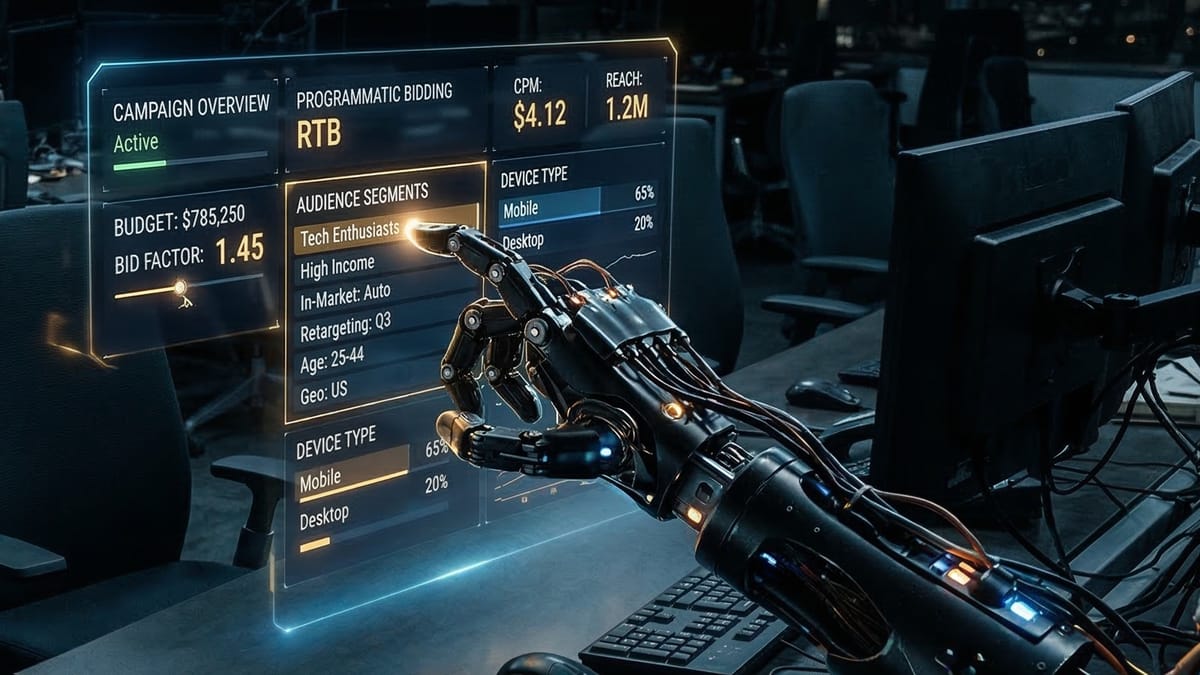
The Trade Desk yesterday confirmed it is running a closed beta that allows advertisers to create programmatic campaigns using Anthropic's Claude. The disclosure came from CEO Jeff Green at Marketecture Live in New York, speaking with moderator Ari Paparo in a session recorded on March 11-12, 2026, and published as episode 164 of the Marketecture podcast on March 13. Green's confirmation - apparently unplanned - is the clearest public signal yet that the company is actively testing how a general-purpose large language model can serve as the entry point for building campaigns on its Kokai platform.
The exchange was brief. Paparo asked whether someone could go into Claude and create a campaign in The Trade Desk. "In our closed beta? Yes," Green replied, according to a transcript of the conversation. He immediately acknowledged it was probably not something he was supposed to disclose. No details about the beta's participant count, scope, or timeline to general availability followed.
The architecture underlying the beta is not fully described in what Green disclosed at Marketecture Live, but its technical context matters. The Trade Desk launched OpenTTD on March 4, 2026, a unified portal giving data providers, publishers, and brands direct API access to its programmatic infrastructure. That portal - consolidating UID2, EUID, OpenPass, OpenAds, and OpenPath under a single access point - is almost certainly the technical layer through which Claude interacts with the platform. The APIs it exposes are what a language model calls to translate a conversational brief into executable campaign parameters.
What beta participants are presumably doing is issuing natural language instructions - a campaign objective, a target audience, a budget - and having Claude interpret those inputs and configure a campaign inside Kokai. The scale of what that translation involves is considerable. According to Green, The Trade Desk processes 20 million ad impression opportunities every single second, with bidding decisions required in 10 milliseconds or less. Within a single campaign, the variables a trader might adjust include site lists, bid factors, frequency caps, geographic targeting, creative formats, channel allocation, and data segment selection. Green characterised this at Marketecture Live as "10,000 different things" that could each affect campaign performance on a $500,000 media buy.
His argument for why programmatic advertising is well suited to AI agents rests on that complexity. A flight-booking AI simply replicates a booking interface in conversational form. Campaign optimisation is different: the trade-offs are genuinely dimensional, the permutations are vast, and representing them usefully to a human decision-maker has proven consistently hard in traditional UI design. "If the agents can frame these choices and help you see the trade-offs," Green said at Marketecture Live, "that's a perfect task for agentic." That framing is technically sound. It is also the premise that makes the question of defaults, expertise, and optimisation logic more important, not less.
Experienced programmatic traders develop campaign configurations over years of practice. They know which bid factors move efficiently in specific inventory environments, which frequency caps prevent fatigue without sacrificing reach, which data segments tend to over-index on cost relative to conversion lift. That expertise is not easily encoded in a natural language brief. When a trader manually builds a campaign in Kokai, their prior knowledge shapes hundreds of micro-decisions that are invisible in the final configuration but consequential for performance. When Claude builds the campaign from a brief, those micro-decisions become the platform's to resolve.
This is not a hypothetical problem. The Trade Desk's Kokai transition, which began forcing adoption in August 2025, generated sustained resistance from agency trading desks precisely because the platform's AI-driven architecture made implicit decisions that experienced traders previously made explicitly. One agency professional described the situation in a Reddit post from March 2025 as a question of scale and complexity: "This is mostly about functionality and our trader's time in platform." A campaign creation process mediated by a language model compresses that expertise gap further - the trader's craft is no longer embedded in the configuration process at all.
Kokai's distributed AI architecture, as documented since the platform's launch in June 2023, distributes predictive capabilities across bidding strategies, audience targeting, creative optimisation, and performance measurement. The platform's Koa engine performs predictive clearing for optimal bidding, impression scoring based on advertiser relevance, and budget optimisation continuously across active campaigns. A Claude-created campaign feeds into that same system. The question is whether a natural language brief captures enough strategic intent to guide those optimisations appropriately, or whether the absence of expert configuration at the setup stage creates downstream performance variability that is difficult to detect and harder to attribute.
The platform's own documented performance claims are instructive here. According to PPC Land's coverage of The Trade Desk's Q3 2025 earnings, Green described Kokai as delivering "26% better cost per acquisition, 58% better cost per unique reach, and a 94% better click-through rate compared to Solimar." Those gains were attributed to the platform's AI capabilities. But they were also measured on campaigns built by human traders using Kokai's interface - not by language models from natural language briefs. Whether an AI-created campaign preserves those performance characteristics, or whether the absence of expert setup degrades them, is a question the beta presumably exists to answer.
Every programmatic platform resolves ambiguous instructions toward some configuration. When a human trader leaves a parameter unspecified, they typically do so deliberately - either because they intend to rely on platform defaults or because they plan to refine it later. When a language model constructs a campaign, unspecified parameters are resolved by the model's training and by whatever defaults the platform applies. The distinction has real consequences.
Kokai's trading modes illustrate the stakes. Control Mode and Performance Mode, introduced with Audience Unlimited in September 2025, represent fundamentally different philosophies about who makes optimisation decisions. In Control Mode, Koa surfaces recommendations that traders evaluate and activate themselves - the AI is advisory, the human retains execution authority. In Performance Mode, Koa acts as a continuous co-pilot, dynamically optimising bids and allocation within guardrails the advertiser sets at the outset. Both modes incorporate agentic AI, but in very different roles relative to human expertise and subsequent campaign auditability.
A campaign brief fed into Claude does not automatically specify which mode applies. If the system defaults to Performance Mode, the advertiser is implicitly delegating optimisation authority to Koa from the moment the campaign is created - without necessarily having made that choice consciously. If it defaults to Control Mode, the AI recommendations surface but a human must still evaluate and act on them, preserving more of the trader's role. Neither outcome is inherently wrong. But the choice between them carries real consequences for how campaign performance develops, how changes are tracked, and how the final results can be explained.
The same logic applies to data segment selection. Audience Unlimited, launched in September 2025, introduced AI-powered scoring to evaluate data segments by relevance to specific campaigns, analysing thousands of curated segments from hundreds of third-party data providers. An AI-created campaign that activates Audience Unlimited does so because the system judges it relevant - not because a trader made an explicit data strategy decision. When performance is strong, that process is largely invisible. When it underperforms, the question of why specific segments were activated, and whether a human expert would have made the same choices, is considerably harder to answer.
Green's discussion of transparency at Marketecture Live is directly relevant here. He acknowledged that The Trade Desk has at times been "dogmatic" about transparency to the point of impracticality, historically providing clients with 30-page invoice breakdowns. His stated correction is "practical transparency" - creating understanding rather than maximising disclosure volume. What that means for an AI-created campaign remains unaddressed in what he disclosed.
The transparency challenge in agentic campaign creation operates on multiple levels. There is the transparency of the initial configuration - which settings were applied and on what basis. There is the transparency of ongoing optimisation - what changes Koa makes within a Performance Mode campaign over time, and why. And there is the transparency of the overall campaign logic relative to the advertiser's original intent, as expressed in a brief that may have been ambiguous or incomplete. Each layer is distinct, and each becomes harder to audit when a language model rather than a human made the originating decisions.
The Trade Desk's OpenAds and supply chain transparency initiatives reflect a genuine and sustained commitment to making auction mechanics visible. That commitment does not automatically extend to campaign creation logic. Supply chain transparency answers questions about where impressions come from and how auctions are structured. Campaign creation transparency answers questions about who made which configuration decisions and why. The former is technically addressed by OpenPath and OpenAds. The latter, for a Claude-created campaign, remains open.
Green's broader argument at Marketecture Live was that closed advertising ecosystems extract value by taking credit for performance they did not drive. He argued that platforms with closed systems have "taken credit for all the brand building that other companies have been doing." That argument presupposes that advertisers can independently verify what drove campaign outcomes. An agentic creation and optimisation system that obscures its own configuration logic creates the same attribution difficulty Green critiques in walled gardens - even within a platform that positions itself as the open internet's alternative. Whether the Claude beta resolves this problem, or defers it, depends on design choices that have not been disclosed.
The Trade Desk is not the first platform to move in this direction, and the comparison across competitors reveals meaningfully different approaches to the same underlying challenge.
Yahoo DSP announced on January 6, 2026, the integration of agentic AI capabilities directly into its platform, enabling advertisers to describe campaign issues in natural language, receive recommended next steps, and - with human approval - have agents execute changes within the Yahoo DSP interface. The Yahoo system uses a "Yours, Mine, and Ours" framework, allowing advertisers to deploy their own AI models, use Yahoo's native agents, or combine both through secure protocols. Agents identify opportunities and recommend changes, but advertisers retain final execution authority through explicit approval gates. Additional agentic capabilities covering optimisation, quality assurance, and advanced measurement were announced for rollout throughout 2026. No usage numbers from Yahoo's deployment have been publicly released.
The contrast with what Meta has done is instructive on the question of transparency and expert control. In February 2026, Meta integrated Manus AI directly into the Ads Manager navigation panel, placing a dedicated shortcut under the "Manage" section of the tools flyout - sitting alongside Instant Forms and Media Library in the interface hierarchy. Manus, acquired by Meta in December 2025, is positioned as a conversational agent for audience research, reporting, and campaign analysis - handling tasks that advertising teams typically perform manually or through custom API integrations. Some advertisers had already been seeing in-stream prompts to activate Manus inside Ads Manager before the shortcut appeared in February. Early practitioner reactions were mixed. One comment circulating on social platforms at the time captured a common concern: the agent was generating analysis that misread campaign data, attributing phone call conversions to an ad that contained no phone number.
That anecdote is significant beyond its specifics. Meta's Advantage+ ecosystem already automates targeting, creative variation, and placement decisions at a scale that has made expert oversight difficult - the system treats advertiser audience inputs as "suggestions" rather than constraints, expands beyond defined demographics when it predicts better performance, and generates up to 150 creative variations automatically. Adding a conversational AI layer to that system multiplies the distance between what an advertiser intends and what the campaign actually does. The Manus integration sits on top of an already heavily automated stack. The Trade Desk's Claude beta, by contrast, sits on top of a platform where Control Mode still exists as an option - but only if it is the default the beta applies.
Amazon has also been active. Its closed beta for a Model Context Protocol Server launched November 13, 2025, enabling natural language interactions with advertising APIs, before moving to open beta on February 2, 2026. Amazon's MCP Server allows advertisers to connect Claude, ChatGPT, Gemini, and other models as the conversational interface layer. According to PPC Land's coverage of the agentic AI acceleration across platforms in late 2025, the IAB Tech Lab's Agentic RTB Framework v1.0 entered public comment in November 2025, with Netflix, Paramount, The Trade Desk, Yahoo, and others providing support for the standard.
What distinguishes The Trade Desk's approach in the beta, at least structurally, is the use of a third-party model as the conversational interface. Yahoo built its agentic system natively. Meta embedded an acquired product into an existing stack. The Trade Desk, in this beta, is positioning itself as the execution infrastructure that Claude calls via the OpenTTD APIs. Whether that distinction reflects a durable strategic commitment to open AI integration, or simply the current architecture of an early-stage test, is not determinable from what Green disclosed.
For agency programmatic teams, the implications of AI-created campaigns depend heavily on what the beta reveals about configuration logic and the degree to which expert judgment is preserved at each stage. The Kokai transition itself is instructive. When forced adoption began in August 2025, the core complaint from experienced traders was not that Kokai's AI was wrong, but that the AI's implicit decision-making displaced expertise they had developed over years and could not easily verify or override at scale. A campaign created by a language model from a natural language brief takes that dynamic one step further: the trader's expertise is not displaced at the optimisation stage, but at the creation stage. The Manus situation at Meta suggests this displacement can move faster than advertisers anticipate.
Green's internal AI architecture - what he calls "distributed AI" - is designed to catch this problem before it reaches clients. "When you get bad data you can make bad decisions and never know it," he said at Marketecture Live. "How does the machine know when it's wrong?" The company tests AI within its own operations before exposing it externally. The closed beta is presumably that exposure phase. But whether the beta's design surfaces the expertise and transparency questions outlined above - and whether participants have been selected specifically to stress-test those dimensions - is not known from the outside.
The Trade Desk posted $2.896 billion in full-year 2025 revenue, with growth decelerating to 18% year over year. Q1 2026 guidance targets at least $678 million. According to Green on the February 25 earnings call, almost 100% of clients were running through Kokai by that point - the platform migration is complete. The next expansion - agentic campaign creation through external AI models - is what the Claude beta represents. Its design, its defaults, and what it preserves of human expertise will matter considerably to the agency trading desks and in-house programmatic teams who will eventually be asked to use it. Whether the beta's outcomes are made public, or remain internal, will determine how much of that design the industry can actually evaluate.
Who: The Trade Desk, a Ventura, California-based demand-side platform (NASDAQ: TTD), led by founder and CEO Jeff Green. The disclosure was made at Marketecture Live before approximately 1,000 attendees, in conversation with Ari Paparo, founder of Marketecture Media. The competitive context involves Yahoo DSP, Meta (through its Manus AI integration), and Amazon, all of which have deployed or are testing comparable agentic capabilities.
What: Green confirmed a closed beta in which advertisers can create campaigns on The Trade Desk's Kokai platform using Anthropic's Claude. The beta raises unresolved questions about which default settings and trading modes AI-generated campaigns apply, how much advertiser expertise is preserved when campaign configuration moves from human traders to a language model, and how optimisation decisions made autonomously within those campaigns will be explained and attributed. Meta's parallel deployment of Manus AI inside Ads Manager - which generated early reports of data misinterpretation - illustrates what can go wrong when AI campaign tools are deployed at scale without sufficient transparency mechanisms.
When: The disclosure was made at Marketecture Live, recorded March 11-12, 2026, and published as a podcast on March 13. Adweek reported on the beta on March 11. Yahoo DSP's comparable system launched January 6, 2026. Meta's Manus integration appeared in Ads Manager on February 21, 2026.
Where: Marketecture Live, New York City. The Trade Desk's API infrastructure for the beta is accessible through OpenTTD, launched March 4, 2026.
Why: The beta matters for the marketing community because it represents the first confirmed instance of a major independent demand-side platform using a third-party large language model as a campaign creation interface. For agency trading desks and in-house programmatic teams, the open questions - about what defaults apply, what expertise is preserved, how optimisation logic is made visible, and how performance can be independently verified - are the same questions raised by the Kokai transition, by Yahoo's agentic deployment, and by Meta's Manus rollout. Each platform is resolving them differently. The Trade Desk's answers, when they become visible beyond the closed beta, will matter to practitioners who currently rely on human expertise as the primary control mechanism in programmatic campaign management.