YouTube drops AI video feature that might actually work
YouTube launches Veo 3.1 Ingredients to Video on Shorts and Create app on January 13, 2026, enabling creators to generate vertical videos from three images.


YouTube launches Veo 3.1 Ingredients to Video on Shorts and Create app on January 13, 2026, enabling creators to generate vertical videos from three images.
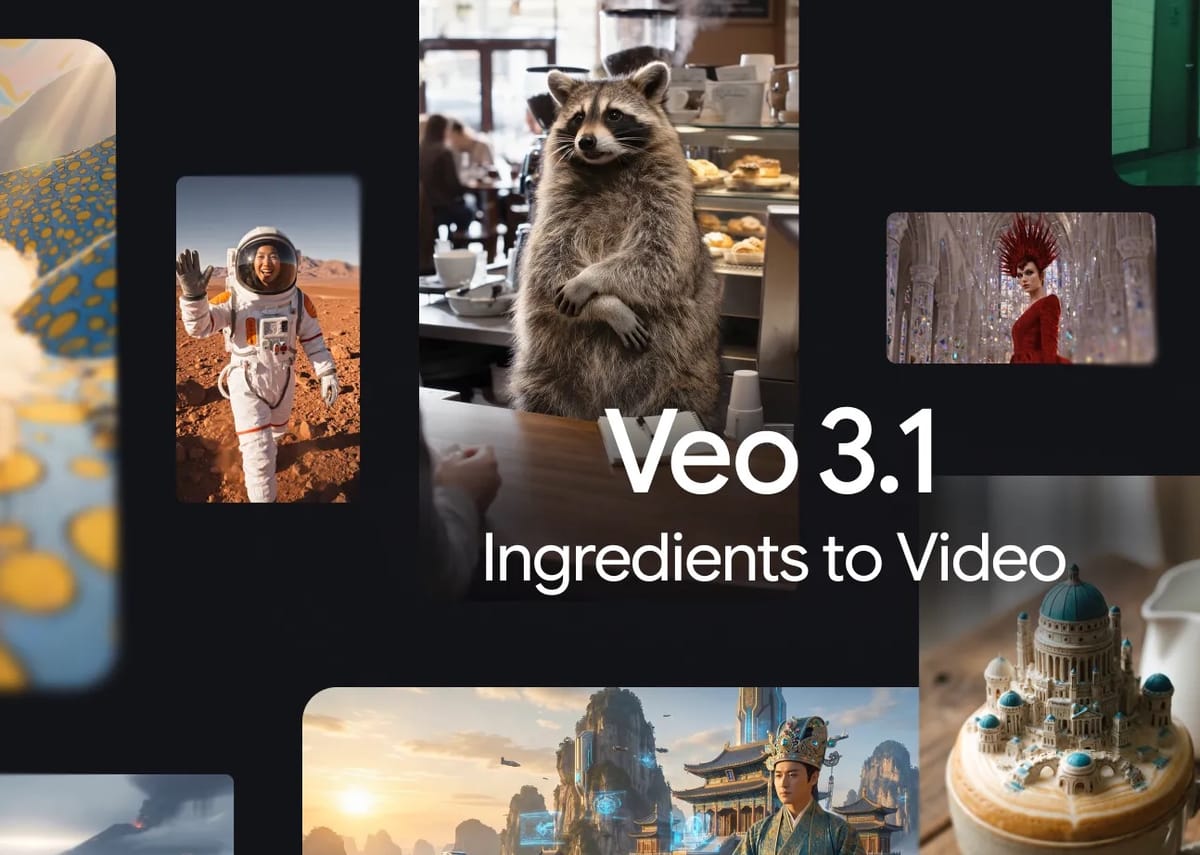
YouTube yesterday announced the availability of Veo 3.1 Ingredients to Video within YouTube Shorts and the YouTube Create app. The feature enables creators to generate vertical video clips from up to three uploaded images, transforming static photographs into dynamic content through artificial intelligence.
According to JJ from TeamYouTube, who posted the announcement in the YouTube Community, creators can "upload a photo of yourself, an object, and a background and see it come to life in one cohesive video." The capability represents YouTube's latest integration of Google DeepMind's Veo video generation technology, following previous implementations that brought photo-to-video and generative effects to the platform in July 2025.
The Ingredients to Video feature operates through a straightforward workflow within Shorts. Creators access the tool by clicking Create [+] and selecting the 'Create Video' button in their media gallery. The system accepts up to three images as inputs, processing them to generate high-quality vertical video clips designed for mobile viewing. YouTube specified that AI-generative tools in Shorts remain available in most countries for users who have their YouTube device language set to English.
The YouTube Create app implementation provides parallel access to the same functionality. Android users can download the application and tap 'Generate video' to begin creating content. The capability initially launches in India, the United States, Canada, New Zealand, and Australia through the mobile editing application, with YouTube stating it hopes to roll out more broadly, including to iPhones, in coming months.
Veo 3.1 introduces significant improvements over previous iterations of Google's video generation technology. According to Ricky Wong, Lead Product Manager at Google DeepMind, the update delivers "more consistency, creativity and control" compared to earlier versions. The system generates what Wong describes as "lively, dynamic clips that feel natural and engaging."
The model's identity consistency capabilities mark a substantial technical advancement. Veo 3.1 maintains character appearance across multiple generations even as settings change, addressing what had been a persistent limitation in AI video generation. This consistency extends beyond facial features to encompass clothing, poses, and environmental contexts within the same session.
Background and object consistency receive similar treatment in the updated system. Creators can maintain the integrity of settings and objects within scenes, enabling reuse of backgrounds or textures across multiple clips. The technology seamlessly blends disparate elements including characters, objects, textures, and stylized backgrounds into cohesive output.
YouTube's implementation specifically targets mobile-first, short-form video creation through native vertical outputs. The system generates content in a 9:16 aspect ratio without requiring cropping or quality loss during conversion. This native vertical format addresses the platform's strategic focus on YouTube Shorts as a growth driver amid competition with TikTok and Instagram Reels.
The Ingredients to Video launch arrives during a period of intensive AI feature deployment across YouTube's platform. The company launched more than 30 AI-powered programs in September 2025 designed to make video creation easier, including tools converting phrases into songs, translating and dubbing videos, finding optimal footage segments for automatic editing, and converting long videos into Shorts.
YouTube's AI strategy has drawn mixed responses from creators. While the platform introduced Edit with AI in November 2025 to transform raw footage into edited Shorts, earlier in the year YouTube faced backlash after acknowledging in August that it had been using AI to modify videos without creator consent. Music creator Rick Beato, with over five million subscribers, noticed unusual visual artifacts from the automatic enhancement system.
The Veo 3.1 integration distinguishes itself from controversial automatic modifications by placing control directly in creator hands. Creators choose when to generate content and maintain approval authority over outputs before publishing, contrasting with platform-level automation that sparked transparency concerns throughout 2025.
The Ingredients to Video capability builds upon Google's expanding Veo deployment across multiple properties. Google announced Veo 3 Fast on July 31, 2025, positioning it specifically for programmatic advertising applications requiring rapid video generation at reduced costs. At $0.40 per second, the model targets automated ad creative generation and rapid prototyping workflows.
Flow, Google's AI filmmaking platform, gained speech generation capabilities in July 2025, enabling users to create character dialogue through text prompts. The platform has generated tens of millions of videos since launching in May 2025, according to Kristin Yim, Product Manager at Google Labs. Flow expanded to 76 additional countries in the July update, bringing total coverage to more than 140 nations worldwide.
YouTube first integrated Veo 2 technology in July 2025 with Photo to Video, which transformed static images into dynamic 6-second clips. The feature launched in the United States, Canada, Australia, and New Zealand for creators seeking simplified content creation from existing camera roll photos. YouTube confirmed at that time it would integrate Veo 3 technology into Shorts tools in coming months, a promise fulfilled with the January 13 announcement.
Professional and enterprise workflows have received similar Veo 3.1 enhancements. The updated Ingredients to Video capabilities now roll out to Flow, the Gemini API, Vertex AI, and Google Vids, with 1080p and 4K resolution options available on Flow, the API, and Vertex AI. These implementations target filmmakers, businesses, and developers requiring programmatic video generation integrated into existing creative workflows.
Buy ads on PPC Land. PPC Land has standard and native ad formats via major DSPs and ad platforms like Google Ads. Via an auction CPM, you can reach industry professionals.
The marketing community faces significant implications as nearly 90% of advertisers plan to use AI for video advertisement creation by 2026, according to an Interactive Advertising Bureau report from July 2025. YouTube's integration of Veo 3.1 into consumer-facing creation tools potentially democratizes capabilities previously limited to enterprise customers with API access.
Research from Kapwing published November 28, 2024, revealed that 21% of videos in a new YouTube user's Shorts feed consisted of AI-generated content, raising questions about platform saturation with machine-generated material. Top AI content channels generate estimated annual revenues between $4 million and $4.25 million through advertising income alone, creating powerful financial incentives for automated content production.
YouTube CEO Neal Mohan has characterized generative AI as the biggest game-changer for the platform since ordinary people began watching each other's videos. Mohan told Wired that generative AI could do for video what the synthesizer did for music, though the platform simultaneously worries that advertisers will feel devalued by having their advertisements attached to low-quality generated content.
The Ingredients to Video feature addresses quality concerns through its emphasis on creator-controlled inputs and outputs. By requiring users to provide specific image inputs rather than generating content from text prompts alone, the system potentially maintains higher creative standards while enabling efficient production workflows.

The phased deployment reflects YouTube's established pattern for AI feature launches. YouTube Shorts Remix gained AI-powered Extend features in September 2025, rolling out gradually to all countries outside the European Union and United Kingdom. Edit with AI launched in 15 markets in November 2025, including Argentina, Australia, Brazil, Canada, Hong Kong, India, Indonesia, New Zealand, Singapore, South Korea, Taiwan, Thailand, Turkey, and the United States.
The YouTube Create app's initial availability in India, the United States, Canada, New Zealand, and Australia prioritizes markets where the Android application already maintains established user bases. The app launched on iOS devices globally on December 15, 2025, ending more than a year of Android exclusivity that began with beta releases in select markets during 2023.
India represents a particularly strategic market for mobile creation tools. YouTube Studio's mobile functionality has been specifically designed with Nigerian and Indian creators in mind, according to Ebi, Product Director for YouTube Studio. "My home country Nigeria, where it's going to be predominantly mobile for quite some time... the country really is mobile first," Ebi stated in April 2025 interviews. Similar considerations apply to India, where mobile device usage dominates content creation workflows.
The European Union and United Kingdom exclusions align with regulatory considerations affecting AI-powered content generation tools throughout 2025. Multiple YouTube features including Extend with AI explicitly excluded those markets during initial rollouts, suggesting ongoing policy and compliance evaluations that delay deployment timelines.
All content created using Veo 3.1 Ingredients to Video carries mandatory disclosure labels. YouTube's content labeling requirements for AI-altered content, implemented in March 2024, require creators to disclose the use of realistically altered or synthetic media generated via generative AI tools. Generated videos receive an AI label in their description, consistent with YouTube's labeling practices for other artificial intelligence tools within the Shorts ecosystem.
The platform's disclosure framework distinguishes between different types of AI usage. Creators must label content depicting scenarios, people, or places that have been significantly altered, including replacing faces, synthetically generating voices for realistic representations, altering footage of real places or events to present misleading scenarios, or depicting realistic fictional events. Creators need not label unrealistic alterations like animation, special effects, color filters, or minor beauty enhancements.
YouTube emphasized its commitment to continuous improvement, indicating it may add labels to undisclosed content if the platform believes viewers could be misled. Future enforcement measures may be considered for creators who repeatedly avoid disclosure requirements, though specific penalties have not been detailed in public documentation.
The labeling approach integrates with YouTube's broader transparency initiatives. Videos generated with Google's tools are embedded with SynthID digital watermark technology, providing imperceptible authentication markers. Google introduced video verification tools within the Gemini app on December 18, 2025, letting users upload videos and determine whether they were created or edited with Google AI.
Veo 3.1 operates through Google DeepMind's latest video generation architecture. The system processes up to three ingredient images alongside text prompts to guide motion, narrative, and visual composition. High-quality video generation creates fluid, cinematic-quality videos from single images or multiple inputs while maintaining stylistic consistency and detail.
Precise prompting capabilities combine image inputs with descriptive text to direct action, style, and content evolution. Creators can specify movement patterns, camera angles, lighting conditions, and narrative progression through natural language descriptions. The system interprets these instructions to generate cohesive video clips that maintain visual consistency across frames.
Enhanced upscaling capabilities support 1080p and 4K resolution outputs with what Google describes as state-of-the-art quality. The improved 1080p resolution offers sharper, cleaner video perfect for editing workflows, while 4K captures rich textures and stunning clarity ideal for high-end productions and large screen displays. These resolution options remain exclusive to Flow, the Gemini API, and Vertex AI implementations rather than consumer-facing YouTube Shorts and Create app integrations.
Native audio generation represents another technical advancement in Veo 3.1, though this capability has not been mentioned in YouTube's Shorts or Create app implementations. Flow users working with Veo 3 quality variants can generate speech, sound effects, and background noise directly within video clips through text prompt instructions, addressing growing demand for comprehensive video production tools within AI platforms.
The Ingredients to Video feature integrates into existing YouTube Shorts creation workflows without requiring specialized applications or technical expertise. Within Shorts, creators access the tool through the standard Create [+] button in their media gallery or by selecting from the top right corner and choosing Create video. This integration maintains consistency with other Shorts creation features while introducing AI-powered capabilities.
The YouTube Create app implementation provides more comprehensive editing capabilities alongside video generation. The application offers more than 40 transitions for blending content segments, speed adjustment controls for slow-motion or time-lapse effects, and automated caption generation in select languages. Background noise removal through audio cleanup tools and background removal through cutout effects provide chromakey-style functionality without requiring physical green screens.
Music integration draws from thousands of royalty-free tracks and sound effects available within the application. Beat matching features help creators synchronize video clips to soundtrack rhythms, while in-app voiceover recording allows narration without requiring separate recording applications. These tools complement the Ingredients to Video capability by enabling creators to enhance generated clips with professional audio production.
Export capabilities support multiple aspect ratios including portrait (9:16), landscape (16:9), and square (1:1) formats. Final videos export at either 720p standard resolution or 1080p high resolution with 30fps frame rate regardless of source material frame rates. Creators can upload finished videos directly to their YouTube channels through in-app publishing tools without requiring separate upload workflows.
YouTube's Veo 3.1 integration occurs within a rapidly consolidating AI video generation market. Google launched AI-powered video generation in Product Studio in October 2024, enabling merchants to transform static product images into dynamic video content. That implementation targets e-commerce businesses seeking professional-quality video marketing materials without significant equipment investment or expertise requirements.
Meta continues expanding AI creative tools across Facebook and Instagram advertising products. Microsoft Advertising launched Performance Max campaigns globally on March 4, 2024, creating cross-platform demand for automated creative generation. OpenAI's video generation capabilities through ChatGPT and specialized models compete across consumer and professional segments.
The programmatic advertising sector demonstrates substantial momentum toward AI-powered creative production. Industry data reveals that 86% of buyers use or plan to use generative AI for video ad creative, with projections indicating AI will account for 40% of all advertisements by 2026. This trend aligns with Google's strategic positioning of Veo across both consumer creation tools and programmatic advertising infrastructure.
Midjourney recently launched video capabilities, expanding beyond image generation into motion content. Runway ML, Pika, and other specialized video generation platforms compete for creator attention with varying feature sets, pricing models, and quality outputs. YouTube's integration advantage stems from embedded positioning within existing creator workflows rather than requiring separate platform access and manual export processes.
YouTube maintains distinct approaches to AI tool monetization compared to competitors. The platform denied plans for advertisements in the Gemini app in December 2025 despite Adweek reporting that Google told advertising clients about 2026 rollout plans during recent calls. Dan Taylor, Vice President of Global Ads at Google, stated "there are no ads in the Gemini app and there are no current plans to change that."
The Ingredients to Video capability remains free for creators using YouTube Shorts and the YouTube Create app. This contrasts with professional implementations through Flow, where subscription tiers offer distinct capabilities and usage limits. Google AI Pro provides 100 monthly generations for 21.99 euros monthly following a trial period, while Google AI Ultra delivers 12,500 monthly credits for 274.99 euros monthly.
Content creators working with brands must consider how AI-generated video affects sponsored content and brand safety protocols. All content created using Ingredients to Video carries AI disclosure labels, which may influence advertiser preferences for authentic versus AI-generated visual content in partnership campaigns. The mandatory labeling addresses transparency concerns while enabling creative experimentation within established disclosure frameworks.
YouTube Partner Program payments totaling $70 billion to creators, artists, and media companies over the last three years demonstrate the platform's economic significance for professional content producers. The introduction of accessible AI video generation tools potentially expands the creator economy by lowering barriers to high-quality content production, though questions remain about market saturation and content differentiation in an environment increasingly populated by machine-generated material.
The Veo 3.1 launch represents one component of YouTube's comprehensive AI strategy spanning content creation, moderation, discovery, and engagement tools. The platform introduced Nano Banana image editing into Posts features in December 2025 for creators in Canada, the United States, India, and New Zealand. This implementation enables text-based image transformation directly within community update workflows.
YouTube introduced AI upscaling and enhanced TV viewing features in October 2025, including Super Resolution that upscales videos below 1080p to HD with future 4K support planned. These enhancements target the platform's fastest-growing viewing environment as consumption patterns shift from mobile devices to television screens.
Content moderation represents another significant AI application area, though implementation has proven controversial. YouTube CEO defended expanding AI moderation in December 2025 while creators reported daily instances of wrongful channel terminations by automated systems. Prominent creators including MoistCr1TiKaL called the defense "delusional" after cases emerged where AI systems banned original content creators while leaving up channels that had stolen and reuploaded their videos.
Discovery and recommendation algorithms have undergone substantial AI-powered refinements throughout 2025. Creators reported significant view drops in September following undisclosed algorithm changes, with multiple channels documenting synchronized drops aligning with platform modifications around August 13. Data suggested desktop viewership experienced precipitous declines while mobile traffic increased correspondingly.
YouTube has indicated plans to expand Veo 3.1 Ingredients to Video availability beyond initial launch markets, though specific timelines remain undisclosed. The company stated it hopes to roll out more broadly to additional countries and to iPhone users through the YouTube Create app in coming months. This phased approach mirrors previous feature deployments that gradually expanded geographic coverage based on technical performance and user feedback.
Integration of Veo 3 technology into additional YouTube Shorts tools represents another confirmed development pathway. The company stated in July 2025 that it would integrate Veo 3 capabilities "in the coming months," a commitment partially fulfilled through the January 13 announcement. Additional Veo 3 implementations may introduce features currently available only in professional Flow implementations, including native audio generation and extended video duration options.
Resolution improvements for consumer-facing tools remain possibilities for future updates. Current Shorts and Create app implementations generate standard-definition vertical video, while enterprise customers accessing Veo 3.1 through Flow, Gemini API, or Vertex AI receive 1080p and 4K upscaling options. Democratizing these higher-resolution outputs would align with YouTube's stated commitment to providing creators with professional-quality tools through accessible interfaces.
Language expansion beyond English represents another likely development direction. Current AI-generative tools in Shorts operate exclusively for users with YouTube device language set to English, limiting global accessibility. Previous YouTube AI features including automated dubbing and translation have demonstrated the platform's commitment to multilingual support, suggesting Ingredients to Video may eventually support additional languages.
The marketing technology sector has responded to AI video generation proliferation with cautious optimism tempered by quality concerns. Research revealing that one-third of YouTube Shorts consist of brainrot content while 21% are AI-generated slop raises questions about platform integrity and advertiser brand safety in environments increasingly saturated with automated content.
YouTube CEO Mohan has argued that content quality depends on creative execution rather than production methods. "The genius is going to lie whether you did it in a way that was profoundly original or creative," Mohan stated to Wired. "Just because the content is 75 percent AI generated doesn't make it any better or worse than a video that's 5 percent AI generated. What's important is that it was done by a human being."
However, creator reception of AI tools has been mixed. While Edit with AI received positive responses for addressing workflow barriers, earlier controversies around automatic video enhancement without consent demonstrated that implementation details significantly impact creator trust and platform relationships.
The Ingredients to Video feature's emphasis on creator control addresses some transparency concerns while introducing new questions about content authenticity and market differentiation. As AI-generated content becomes increasingly sophisticated and accessible, creators face challenges distinguishing their work within algorithmic recommendation systems that may struggle to identify and reward genuine creativity versus automated production.
Subscribe PPC Land newsletter ✉️ for similar stories like this one
Subscribe PPC Land newsletter ✉️ for similar stories like this one
Who: YouTube announced the update through JJ from TeamYouTube, with technology developed by Google DeepMind's Veo team led by Lead Product Manager Ricky Wong. The feature affects content creators using YouTube Shorts and the YouTube Create app across five initial launch markets.
What: Veo 3.1 Ingredients to Video enables creators to generate high-quality vertical video clips by uploading up to three images that the AI system combines into cohesive motion content. The technology offers improved identity consistency, background preservation, and seamless blending of disparate visual elements compared to previous iterations.
When: The announcement occurred on January 13, 2026, with immediate availability in YouTube Shorts for users with English device language settings and in the YouTube Create app for Android users in India, the United States, Canada, New Zealand, and Australia. YouTube plans broader rollout including iPhone support in coming months.
Where: The feature launches within YouTube Shorts accessible through the main YouTube mobile app and the standalone YouTube Create app on Android devices. Geographic availability spans India, the United States, Canada, New Zealand, and Australia initially, with most other countries receiving Shorts access for English-language users. European Union and United Kingdom markets remain excluded.
Why: YouTube aims to simplify video creation by enabling creators to transform static images into dynamic content without requiring technical video production skills or equipment. The implementation addresses creator demand for accessible AI tools while maintaining control over outputs, following controversies around automatic video modifications earlier in 2025. The feature supports YouTube's strategic focus on Shorts as a growth driver competing with TikTok and Instagram Reels in the short-form vertical video market.