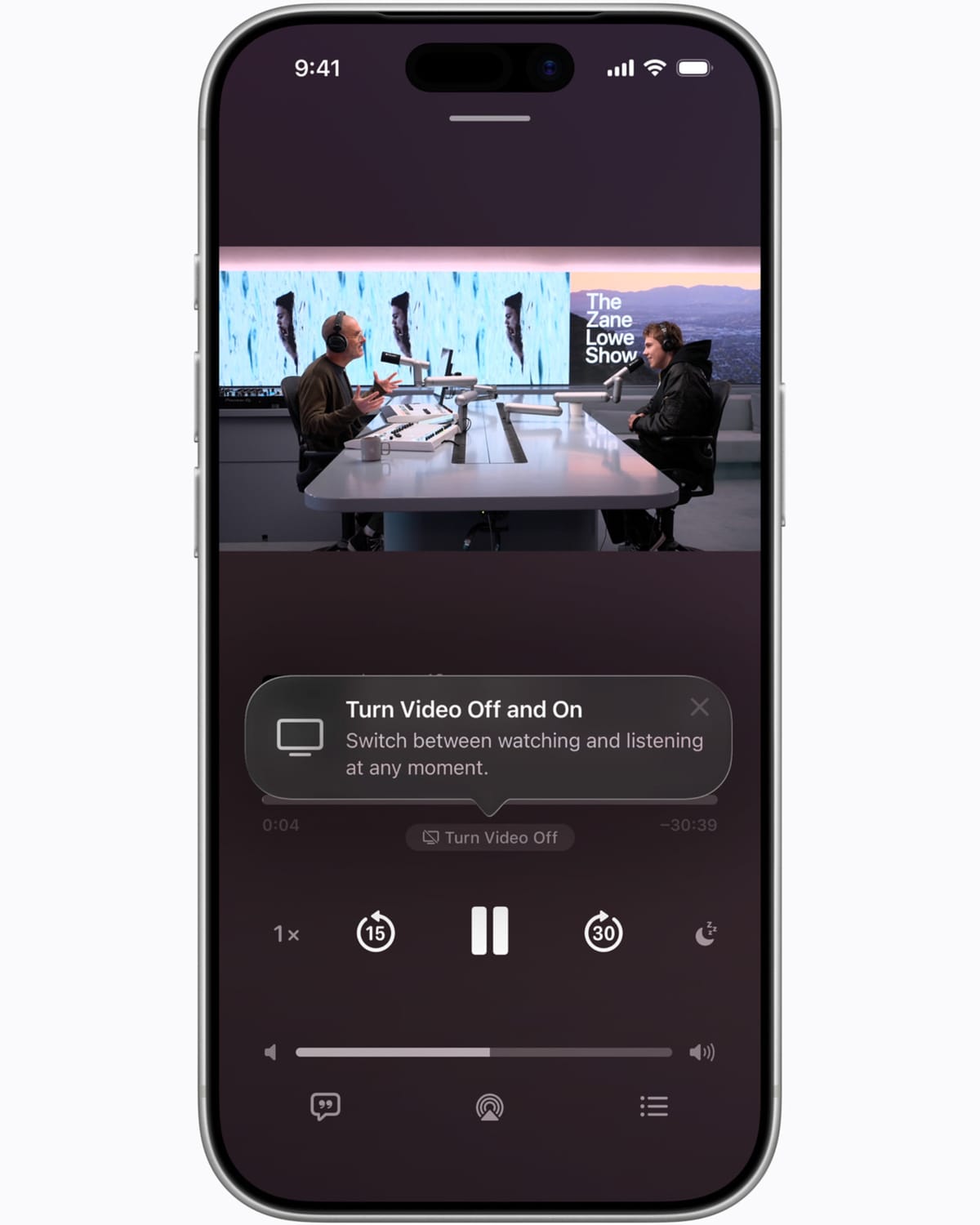
Apple today announced transformative video podcast capabilities coming to Apple Podcasts this spring, introducing HTTP Live Streaming technology that promises to reshape how creators monetize content and how advertisers access podcast audiences. The announcement positions Apple to compete directly with platforms like YouTube and Spotify in the rapidly expanding video podcast market, where advertising spending surged 32% year-over-year during the fourth quarter of 2025.
The company revealed the update in a February 16, 2026 press release, marking what Eddy Cue, Apple's senior vice president of Services, characterized as "a defining milestone" two decades after Apple added podcasts to iTunes. The shift arrives as video podcast consumption continues reshaping the industry, with video content commanding higher advertiser rates due to increased engagement opportunities and expanded creative possibilities.
HLS infrastructure enables dynamic advertising
The technical implementation centers on Apple's HTTP Live Streaming protocol, which supports adaptive bitrate streaming across varying network conditions. Users will be able to switch seamlessly between watching and listening to shows within the Apple Podcasts app, move to horizontal full display, and download videos for offline viewing. Automatic quality adjustment powered by HLS technology ensures smooth playback whether listeners are on Wi-Fi or cellular connections.
The HLS architecture differs fundamentally from traditional video hosting approaches. Instead of serving static video files, the system delivers content in small segments, allowing real-time quality adjustments based on available bandwidth. This technical design proves particularly important for mobile podcast consumption, where network conditions fluctuate frequently as users move between locations.
For creators, the most significant technical advancement involves dynamic video ad insertion capabilities. The system enables automated advertising placement within video episodes, including host-read spots, maintaining the authenticity that podcast audiences value while delivering programmatic efficiency. Research indicates 46% of U.S. podcast listeners never skip episodes of their favorite shows, creating favorable conditions for advertiser messaging.
Hosting provider ecosystem determines market penetration
Apple confirmed four hosting providers supporting HLS video at launch: Acast; ART19, an Amazon company; Triton's Omny Studio; and SiriusXM, inclusive of SiriusXM Media, AdsWizz, and Simplecast. Additional providers will join in the future, according to the announcement. The initial roster represents substantial market coverage, given these platforms power hundreds of major podcast networks.
Acast CEO Greg Glenday characterized the development as "a defining moment - expanding what's possible for creators, advertisers, and the medium as a whole." The company recently integrated episode-level targeting capabilities with Barometer to provide brand safety verification, positioning itself to capitalize on increased video inventory.
ART19 CEO Geoff Mattei emphasized creator empowerment: "Video deserves that same experience" as audio distribution, referring to ART19's focus on flexible monetization solutions. Amazon acquired ART19 in June 2021, subsequently integrating the Podcast Audience Network into Amazon DSP to provide advertisers with access to premium podcast inventory through unified campaign management.
SiriusXM's chief advertising revenue officer Scott Walker highlighted the technical innovation: "This innovation from Apple helps to keep the integrity of what makes the medium so special, while enhancing video and audio with new capabilities as the two formats continue to converge." The company reported podcast advertising revenue climbing nearly 50% year-over-year in the third quarter of 2025.
Sharon Taylor, Triton Digital's chief revenue officer, emphasized the importance of an open approach: "An open approach that enables publishers to retain control over their audiences, advertising, and measurement - while expanding access to content across formats - supports long-term growth and greater choice for listeners." Triton announced support for video podcast creation through Omny Studio in December 2025.
Revenue model preserves creator economics while taxing ad networks
Apple's business model maintains its long-standing policy of not charging hosting providers or creators to distribute podcasts, whether via traditional RSS/MP3 or HLS video. The company will instead charge participating ad networks an impression-based fee for delivering dynamic ads in HLS video on Apple Podcasts starting later this year. The announcement did not specify fee structures or rates.
This revenue approach differs substantially from Apple's approach to other services. The App Store charges developers 15-30% commissions on digital purchases. Apple Podcasts Subscriptions, launched in 2021, takes a 30% commission in the first year and 15% thereafter on subscriber revenue. The decision to charge ad networks rather than creators or hosting providers suggests strategic positioning to accelerate adoption while capturing revenue from the advertising value chain.
The impression-based fee model aligns with how programmatic podcast advertising has evolved across the industry. AdsWizz processes 16 billion monthly dynamically inserted audio ad impressions, while platforms increasingly adopt impression-based pricing to align with digital advertising standards established in display and video channels.
For the first time, creators can dynamically insert video ads - including host-read spots - unlocking access to the broader video advertising market while maintaining full creative control. Video integrates seamlessly into existing shows without disrupting followers or downloads. Creators can monetize through sponsorships and dynamic advertising, maintaining complete control of their content and monetization strategies through participating hosting providers and ad networks.
Video podcast economics demonstrate premium pricing potential
Industry data suggests substantial monetization opportunities for video podcast content. Audioboom reported revenue per mille figures of $40.74 for video content in June 2025, representing premium pricing compared to traditional audio-only podcast advertising. However, more recent data indicates video monetization rates have declined, with Audioboom CEO Stuart Last stating in January 2026 that the company's audio-only content generates around $71 revenue per thousand downloads on average while video generates less than half that figure.
The pricing volatility reflects incomplete infrastructure for video podcast advertising. Platforms have developed sophisticated dynamic ad insertion capabilities for audio content over years of technical refinement. Video podcast advertising requires parallel infrastructure development, including video-specific creative formats, quality verification systems, and measurement standards.
Podcast advertising spending increased 26% year-over-year in the third quarter of 2025, with 1,689 brands advertising on podcasts for the first time. New brands spent an average of $33,900 during the quarter, typically running 49-second advertisements. The influx demonstrates podcasting's evolution from experimental channel to strategic advertising platform.
Shows simulcast on YouTube demonstrated distinct characteristics compared to podcasts distributed solely via RSS feeds during Q4 2025. Simulcast shows showed 45% host-read advertisement share versus 34% for RSS-only podcasts. Ad load reached 8.34% for simulcasts compared to 7.77% for RSS podcasts. Direct response brand share hit 33% for simulcasts versus 24% for RSS podcasts, while renewal rates among direct response brands reached 43% for simulcasts compared to 34% for traditional podcasts.
The elevated host-read share for video-enabled formats suggests advertisers value visual integration and authentic endorsement. Host-read advertisements in video contexts allow viewers to observe host interactions with products or services, potentially enhancing credibility and persuasiveness compared to audio-only presentations.
Apple's entry into video podcasting arrives amid substantial platform competition. Edison Research began incorporating data from individuals whose sole podcast consumption occurred through video platforms in 2025, affecting shows with substantial video components. No Jumper climbed 11 spots in rankings, while The Pat McAfee Show rose 26 positions after the video integration.
YouTube's position as the dominant podcast platform represents a fundamental challenge that Apple must address. Research from Edison Research and SXM Media shows 70% of Gen Z listeners find podcasts through YouTube recommendations, while 75% discover new shows through brief podcast clips on social media. YouTube's recommendation algorithms consider viewing history, engagement metrics, and content similarity across the platform's entire ecosystem, creating audience development opportunities that traditional podcast platforms struggle to replicate.
Spotify has pursued aggressive video podcast expansion throughout 2025. The company launched its Partner Program on January 2, 2025, introducing dual revenue streams combining audience-driven payouts with advertising monetization. Spotify reduced Partner Program eligibility thresholds by 80% in January 2026, lowering the barrier from 2,000 listeners to 1,000 engaged audience members. The platform introduced a Distribution API enabling creators to publish and monetize video content from hosting platforms including Acast, Audioboom, Libsyn, Omny, and Podigee without switching services.
The competitive landscape reflects broader structural changes in audio consumption. Despite digital audio commanding 20% of consumer media time, audio investment represents only 2.9% of total digital advertising revenue, according to industry measurements. This 22% gap between consumer engagement and advertiser investment creates growth potential for platforms that can effectively monetize podcast audiences through both audio and video formats.
Measurement and attribution challenges persist
Video podcast advertising inherits measurement complexities that have challenged audio podcast monetization for years. Unlike digital display advertising where impression verification and conversion tracking follow established technical protocols, podcast consumption occurs across multiple platforms and devices. Users might discover content on one platform, download episodes on another, and listen through third-party applications, fragmenting the attribution chain.
Apple's approach maintains the open RSS ecosystem that has characterized podcasting since its inception. Creators distribute through participating hosting providers, maintaining portability across platforms. This open architecture differs from YouTube and Spotify's walled garden approaches, where content uploaded to those platforms remains under their technical control.
The HLS implementation provides Apple with technical capabilities for impression verification that traditional MP3 distribution lacks. Streaming delivery through Apple's infrastructure enables real-time tracking of video views, completion rates, and engagement metrics. These measurement capabilities become increasingly important as programmatic podcast advertising expands, with advertisers demanding accountability standards comparable to other digital channels.
However, the multi-platform distribution model creates attribution gaps. A listener might watch video episodes on Apple Podcasts while consuming audio versions through Spotify or other applications. Cross-platform behavior tracking proves technically challenging without unified user identifiers, limiting advertisers' ability to measure true reach and frequency across consumption patterns.
Industry responses to measurement challenges have included IAB Tech Lab certification programs providing standardized methodologies that enable comparison across different publishers and platforms. Triton Digital's Podcast Metrics provides IAB-certified measurement capabilities, addressing buyer concerns about data reliability. However, certification addresses methodology consistency rather than cross-platform attribution capabilities.
Technical requirements demand creator workflow adaptation
The shift to HLS video requires creators to adapt production and distribution workflows substantially. Traditional podcast production involves recording audio, editing episodes, and uploading MP3 files to hosting platforms. Video podcast production demands lighting, camera equipment, video editing software, and significantly larger file storage and bandwidth capacity.
Apple emphasized its commitment to supporting creators through this transition. The company directed podcast hosting providers and creators to podcasters.apple.com for information about enabling HLS video on Apple Podcasts and using Apple products and tools to capture, produce, and share video podcast episodes. The resources page presumably includes technical specifications, encoding guidelines, and production recommendations, though the announcement did not detail specific requirements.
The production burden varies substantially based on content type and creator resources. Established media companies with existing video production infrastructure can deploy video podcasts relatively efficiently. Independent creators operating with limited budgets face more substantial adaptation requirements, potentially creating competitive advantages for well-funded operations.
Some creators may adopt intermediate approaches, using static images or minimal video elements rather than fully produced video content. The technical flexibility of HLS delivery accommodates varying production quality levels, though whether audiences and advertisers will accept lower-quality video implementations remains uncertain.
Global distribution extends beyond U.S. market
Apple confirmed HLS video functionality will reach iPhone, iPad, and Apple Vision Pro users, as well as via Apple Podcasts on the web this spring. The announcement specified availability in beta versions of iOS 26.4, iPadOS 26.4, and visionOS 26.4 starting February 16, 2026. Apple's podcast catalog operates across iPhone, iPad, Mac, Apple Watch, CarPlay, Vision Pro, and the web at podcasts.apple.com.
The multi-device strategy reflects consumption pattern diversity. Edison Research data shows podcast listeners consume content across varying contexts - commuting via CarPlay, exercising with Apple Watch, relaxing with iPad or Vision Pro, and working on Mac. Video podcast consumption patterns differ from audio consumption, with video viewing typically occurring during leisure time with dedicated attention rather than background listening during other activities.
Apple Podcasts operates in more than 170 countries and regions, providing global distribution infrastructure that extends beyond U.S.-focused platforms. The announcement did not specify regional rollout schedules for HLS video capabilities, though the spring timeframe suggests broad availability across major markets.
International expansion becomes particularly important given global podcast advertising growth patterns. The United States captured 86.6% of global podcast advertising spend while representing 80.3% of listeners, demonstrating higher monetization efficiency than other markets. Video podcast capabilities may help international markets close this monetization gap by providing premium inventory formats that command higher rates.
Feature integration maintains existing user experience
Video episodes will integrate with existing features Apple Podcasts users already utilize, including personalized recommendations and editorial curation on the New tab and in Category pages. The seamless integration approach suggests Apple aims to avoid fragmenting the user experience between audio and video content.
Apple Podcasts already offers features including Enhance Dialogue mode, playback speeds from 0.5x to 3x, automatically created chapters, timed links, and transcripts across over 125 million episodes in 13 languages. Listeners can directly support creators through premium subscriptions with benefits like exclusive content and ad-free listening.
The preservation of existing feature parity between audio and video content addresses potential user experience friction. If video episodes lacked features users expect from audio podcasts - such as variable playback speeds or chapter navigation - adoption might suffer. The technical implementation apparently maintains feature consistency across content formats.
Premium subscription capabilities become particularly relevant for video content. Creators offering exclusive video content through Apple Podcasts Subscriptions can potentially command higher subscription prices than audio-only offerings, given video production costs and perceived value differences. The subscription model provides an alternative monetization path beyond advertising for creators building dedicated audience communities.
Advertising infrastructure determines adoption velocity
The success of Apple's video podcast initiative depends substantially on advertising infrastructure development by participating ad networks. Dynamic ad insertion for video requires technical capabilities including video creative management systems, quality verification processes, targeting infrastructure, and measurement reporting that many podcast ad networks have not yet deployed at scale.
SiriusXM Media, AdsWizz, and Simplecast bring substantial technical capabilities to the initiative. AdsWizz processes 16 billion monthly dynamically inserted audio ad impressions and facilitates four billion monthly audio impressions sold via third-party DSPs. The company transcribes 40 million podcast episodes for brand safety and contextual audience support, demonstrating sophisticated content analysis capabilities applicable to video content.
The technical infrastructure supporting video podcast advertising has advanced considerably across participating platforms. Triton Digital's Omny Studio announced support for video podcast creation, distribution, and monetization on December 4, 2025, alongside existing audio content capabilities. The expansion acknowledges that video has become essential infrastructure rather than an experimental format within the podcast ecosystem.
However, video advertising at scale requires creative asset management systems handling multiple video formats, aspect ratios, and quality levels. Advertisers must produce video creative assets specifically for podcast placements rather than repurposing television commercials or social media video ads. The creative production burden may slow advertiser adoption initially.
Market implications extend beyond podcasting
Apple's video podcast announcement carries implications extending beyond the podcasting industry into broader digital advertising markets. Video podcast inventory competes directly with YouTube for advertiser budgets, particularly for direct response marketers seeking performance-driven placements.
The emphasis on creator control and open distribution contrasts with platform-exclusive approaches pursued by competitors. Creators maintaining distribution across multiple platforms can potentially command higher advertising rates by demonstrating reach across diverse audiences rather than platform-specific concentrations.
For advertising technology providers, Apple's entry validates the video podcast category and may accelerate infrastructure investment. Demand-side platforms will need to integrate Apple Podcasts video inventory alongside existing YouTube, Spotify, and standalone podcast connections. Supply-side platforms must develop relationships with participating ad networks to access Apple's impression-based inventory.
The broader trend toward omnichannel audio advertising suggests platforms will increasingly compete by offering unified access to multiple formats. iHeartMedia and Magnite launched an omnichannel audio advertising marketplace in January 2024, bringing together broadcast radio, streaming radio, and podcast assets for inclusion in programmatic media buys. Video podcast inventory represents another format requiring integration into unified buying platforms.
Timeline
- June 21, 2020: SiriusXM acquires Simplecast podcast management platform
- August 18, 2023: AdsWizz integrates PodScribe's contextual-targeting solution for podcast advertising
- August 4, 2024: SiriusXM launches premium podcast subscription on Apple Podcasts
- March 31, 2025: Frequency launches Premium Publisher Network for podcast advertising monetization
- April 16, 2025: The Athletic signs exclusive global podcast deal with Acast
- July 17, 2025: Audioboom acquires UK podcast leader Adelicious
- August 2, 2025: Edison Research podcast rankings reveal video integration challenges
- August 9, 2025: Audioboom video strategy delivers positive results
- August 20, 2025: Triton Digital launches advanced podcast audience targeting with Q2 data
- October 16, 2025: Audioboom reports record Q3 revenue with 18% growth from video expansion
- November 1, 2025: SiriusXM reports third quarter revenue of $2.16 billion with podcast growth
- November 4, 2025: Podcast advertising spending surges 26% as Gaming industry leads growth
- November 14, 2025: Washington Post partners with Triton Digital for podcast monetization strategy
- December 4, 2025: Triton Digital's Omny Studio announces support for video podcast creation, distribution, and monetization
- December 7, 2025: Programmatic audio shifts to curation, identity, and video in 2026
- December 20, 2025: Global study reveals podcast advertisers missing affluent 55+ audiences
- January 7, 2026: Spotify cuts Partner Program barriers as Audioboom stakes video claim
- January 15, 2026: Audioboom hits $5.1M profit as Spotify partnership targets video monetization gap
- January 21, 2026: Acast and Barometer debut episode-level podcast targeting before bids
- January 26, 2026: Amazon DSP unlocks podcast ads with ART19's audience intelligence
- February 10, 2026: Podcast ad spending hits 32% growth as 1,482 new advertisers test channel
- February 16, 2026: Apple announces HLS video podcast capabilities coming to Apple Podcasts this spring
Summary
Who: Apple announced the update, with participation from hosting providers Acast (CEO Greg Glenday), ART19 (CEO Geoff Mattei), Triton's Omny Studio (CRO Sharon Taylor), and SiriusXM (chief advertising revenue officer Scott Walker). Eddy Cue, Apple's senior vice president of Services, provided the strategic context.
What: Apple introduced HTTP Live Streaming video podcast capabilities enabling creators to distribute video content through participating hosting providers while maintaining complete control over monetization. The system supports dynamic video ad insertion including host-read advertisements, seamless switching between video and audio consumption, offline viewing, and automatic quality adjustment. Apple will charge participating ad networks an impression-based fee for delivering dynamic ads in HLS video starting later this year, while not charging hosting providers or creators for distribution.
When: The announcement occurred on February 16, 2026, with functionality available for testing in beta versions of iOS 26.4, iPadOS 26.4, and visionOS 26.4 starting the same day. General availability will arrive this spring for iPhone, iPad, Apple Vision Pro, and web users.
Where: The functionality will launch globally across more than 170 countries and regions where Apple Podcasts operates, accessible through iPhone, iPad, Mac, Apple Watch, CarPlay, Vision Pro, and web at podcasts.apple.com.
Why: The initiative addresses creator demand for video podcast monetization capabilities while maintaining content control and distribution flexibility. It positions Apple to compete with YouTube and Spotify in the rapidly expanding video podcast market where advertising spending surged 32% year-over-year during Q4 2025. The move enables creators to access the broader video advertising market through dynamic ad insertion while preserving the open RSS ecosystem that has characterized podcasting. For Apple, the implementation provides new advertising revenue opportunities through impression-based fees charged to ad networks, without undermining creator economics or hosting provider relationships.
Share this article
The link has been copied!