
Industry leaders spar over brand building's toughest challenge yet
Marketing strategists debate whether modern media environments have made advertising fundamentally harder—or if claims of secular stagnation miss the point entirely.

Marketing strategists debate whether modern media environments have made advertising fundamentally harder—or if claims of secular stagnation miss the point entirely.
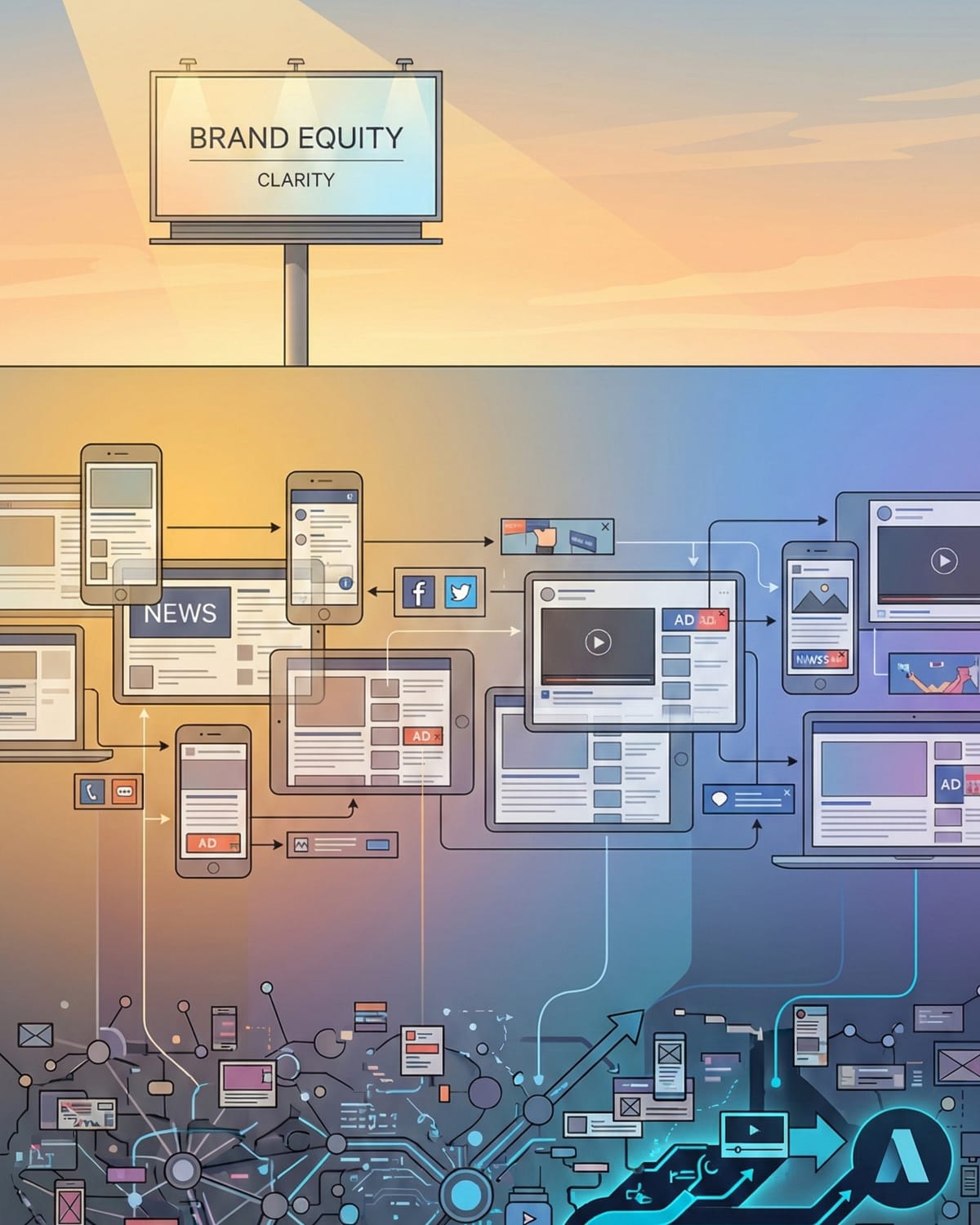
A contentious debate about advertising effectiveness has erupted across professional networks following the January 8 publication of research suggesting the modern media landscape poses unprecedented challenges to brand building. The Institute of Practitioners in Advertising released analysis from Omnicom Media Group UK's Chief Strategy Officer Charlie Ebdy arguing that distraction, clutter, and algorithmic biases have created structural barriers to campaign performance that marketers cannot control through execution alone.
The research, published on the IPA website under the title Only the paranoid survive: rethinking effectiveness in 2026, introduces the concept of advertising "secular stagnation"—borrowing terminology from depression-era economics to describe environmental factors that cap potential returns regardless of strategic quality. Ebdy's central thesis contends that media consumption patterns since the mid-2010s have fundamentally altered the conditions under which advertising operates, creating what he characterizes as a landscape "increasingly and inherently hostile to advertising effectiveness."
Marketing professionals responding to the analysis split sharply on whether structural challenges justify rethinking fundamental approaches or whether the framing obscures more pressing issues. The debate unfolded primarily through LinkedIn discussions following Ebdy's January 8 post and parallel conversations on X, where industry figures Tom Goodwin and Brian O'Kelley offered competing perspectives on performance marketing, brand investment, and the role of automation in advertising strategy.
Ebdy's analysis identifies three interconnected environmental shifts that he argues have degraded advertising effectiveness at a population level. First, smartphone adoption since the mid-2010s has layered incremental media consumption onto existing habits rather than substituting for other activities, according to Ofcom data cited in the research. The pattern creates concurrent advertising exposure across multiple platforms while increasing overall ad load because digital platforms serve more advertising per minute of consumption than traditional media.
Second, the proliferation of media touchpoints and advertising opportunities has cluttered consumption experiences both within platforms and across the broader media environment. The combination of simultaneous platform usage and higher per-minute advertising volume means individual advertising exposures occupy progressively smaller fractions of any person's total media time, potentially diluting share-of-voice effects and making mental availability more expensive to secure.
Third, algorithmic recommendation systems that prioritize historic consumption patterns or behavior of similar users create what Ebdy characterizes as a "Matthew Effect" favoring established brands. Research from Paul Dyson's 2013 Top 10 Drivers of Profitability analysis showed increased advertising returns concentrated among the largest advertisers, while cultural platforms like Spotify demonstrate similar dynamics where algorithms reinforce existing popularity rather than surface unknown alternatives.
These observations build on decades of marketing science research documenting relationships between advertising context and outcomes. Studies cited in the IPA paper include Armstrong & Chung (2000), Bolls & Muehling (2007), and Kischner & Karpinski (2021), alongside 2014 research from AOL and Nielsen, all showing that advertising consumed by distracted audiences, in cluttered environments, or amid higher ad loads generates weaker recall and sales effects. Ebdy emphasizes these factors "act as a drag on performance" rather than making effectiveness impossible, but argues the cumulative impact creates measurably worse baseline conditions than existed previously.
Brand marketing shown to drive up to 6x greater long-term sales impact, according to research from TransUnion and MMA Global released in October 2025, demonstrates that traditional measurement tools may undervalue brand contributions by as much as 83%—suggesting difficulty distinguishing between genuine effectiveness declines and measurement gaps.
The structural analysis diverges from typical effectiveness debates that frame performance as products of execution quality. Ebdy notes: "Mostly, performance is framed as a product of insular excellence, or at least intent: your understanding of audience, your application of effectiveness principles, the quality of your advertising assets, the wisdom of your media choices." The secular stagnation hypothesis instead positions environmental factors as primary constraints on achievable outcomes, analogous to economic conditions that cap growth regardless of policy interventions.
Dr. Grace Kite, who focuses on marketing effectiveness measurement, offered qualified agreement with Ebdy's environmental analysis while proposing alternative explanations in a January 8 LinkedIn comment. She suggested economic conditions—specifically inflation outstripping salary increases—may explain effectiveness challenges more directly than media environment shifts. The observation introduces macroeconomic demand constraints as potential confounding variables in any effectiveness decline attribution.
Mike Follett, CEO of Lumen Research, characterized the analysis as "very smart thinking" that aligns with data presented by Peter Field and Heather Dansie in Manchester showing declines in high-attention media consumption. The validation from attention measurement specialists lends empirical support to claims about degraded advertising consumption quality, though Scott Luther, EVP of Head of Media at Mythic, noted that "objective conditions are primary drivers of outcomes in nearly any other complex market"—implicitly questioning why advertising should be exempt from environmental constraints.
James Hankins, whose marketing strategy work has been documented in analyses of brand versus performance balance, suggested the proliferation of low-attention media represents only part of the picture. In his January 14 comment, Hankins indicated he had been developing related analysis examining "broader business and cultural contexts" beyond pure media environment changes, suggesting the secular stagnation frame may oversimplify multicausal effectiveness challenges.
Erez Levin referenced research from Dr. Grace Kite and Tom Roach on "lots of littles" approaches to brand building, though Ebdy responded with skepticism about that particular methodology. The exchange illustrated fractures even among those broadly accepting environmental challenge premises, with disagreement about which specific responses most effectively address identified problems.
Ebdy's recommendations center on budget reassessment "from first principles," systematic testing and experimentation rather than wholesale strategic overhauls, and preservation of distinctive brand assets. On budget allocation, the analysis warns against simple spending increases without evaluating where money flows: "Some brands will find themselves drastically underspending what is necessary to grow in this new environment, others will have been lulled into spending the right amount very badly." The guidance acknowledges highly digitized categories may see algorithmic feedback loops protecting large brand positions, potentially indicating overspending among market leaders.
The paper emphasizes evidence-based change management over "jumping headlong in the unknown like the mavericks of yesteryear," advocating for what it describes as "crossing the river while feeling the stones"—systematic prototyping that builds effectiveness knowledge before scaling interventions. This measured approach contrasts with radical transformation narratives that periodically surface in marketing discourse, positioning paranoia about environmental challenges as competitive advantage rather than justification for panic.
Tom Goodwin, keynote speaker and consultant who co-founded All We Have Is Now, articulated a more fundamental critique of performance marketing economics in a January 17 post on X. Goodwin argued that "a whole generation and tranche of people don't get that the best way to advertise isn't to drive immediate sales but to be able to charge a lot more money." The observation positions pricing power derived from brand strength as the primary advertising objective, with volume-focused performance marketing representing a "doom loop" that traps companies in unsustainable margin profiles.
According to Goodwin, companies addicted to performance advertising that drives clicks and sales "without enough margin to make the company sustainable" face structural disadvantages regardless of tactical optimization. He noted that "there are almost no examples ever of companies trading volume for margin by moving up market once a user base is established," suggesting performance marketing's foundational promise—acquire customers cheaply, then optimize for profitability—rarely materializes in practice.
The critique extends to technological solutions frequently positioned as performance marketing enhancements. Goodwin characterized "real time optimization and using AI to make ads" as mechanisms that "merely cement your position as a company that can't break out of average and widespread competition." The assessment positions automation and algorithmic optimization as tools that increase efficiency within existing competitive positions rather than enabling differentiation necessary for premium pricing.
Goodwin's perspective received mixed responses. One commenter dismissed the analysis as "made up slop" noting "countless numbers of companies that trade on value rather than cost," while others endorsed the framing. Raoul Plickat suggested that effective value positioning "required deep thinking" increasingly "outsourced to AI," with most marketing professionals now engaging in superficial competitive mimicry. Robin M. emphasized that "remarkable brands outlast C Suite and activist investors," positioning long-term brand stewardship as incompatible with performance marketing's short-term optimization culture.
Research on brand awareness boosting performance marketing ROI by 286% from TikTok and Tracksuit, released in October 2024, demonstrated that brands known by 40% of consumers achieved 43% better performance marketing efficiency than those known by 30%. The finding supports Goodwin's contention that brand investment creates conditions for superior performance outcomes, though it positions the relationship as synergistic rather than zero-sum.
Kamran Hassan's April 5, 2025 thread on X offered simplified principles derived from eight years of marketing experience, emphasizing customer-centric messaging over product features. Hassan's guidance—"People don't care about your product. They care about what your product can do for them" and "Marketing is not about which product you sell. Marketing is about which story you tell"—echoed themes from Goodwin's critique while avoiding explicit performance-versus-brand framing.
Brian O'Kelley, co-founder and CEO of Scope3, contributed satirical commentary through his January 17 LinkedIn post titled "Dante's Ads Inferno," which enumerated nine levels of advertising quality degradation. The ninth level described "ads as a vector to target and kill people," while progressively less severe infractions included retargeting that follows users despite zero purchase intent, excessive commercial breaks during crucial sports moments, and sponsored listings for knockoff products.
O'Kelley's first level—"Your wife texting you 'ChatGPT is getting ads???' and somehow thinking it's your fault"—resonated with advertising professionals navigating platform expansion into new surfaces. Luis Manrique suggested a tenth level involving "satan chewing on CTV fraud, last touch attribution and cookie banners," highlighting measurement methodology concerns that compound environmental effectiveness challenges.
The commentary reflects broader industry anxiety about Meta's AI advertising automation and platform control over campaign execution. Meta's Advantage+ system and subsequent Andromeda machine learning improvements have generated performance claims alongside advertiser concerns about reduced targeting, creative, and placement control. The tension between algorithmic efficiency and strategic oversight appears across platform debates, with marketers questioning whether automation genuinely improves outcomes or simply obscures attribution in ways that benefit platform revenue.
Alexander S. noted that someone asked whether Claude would add advertising, prompting explanation that the AI assistant's existing pricing model obviated ad-supported economics "for now." The exchange illustrated awareness that advertising expansion follows economic logic rather than user benefit calculations, with platforms introducing monetization when revenue needs exceed subscription or transaction-based models.
Andrea Tortella, CEO of Thrad focusing on paid advertising in large language models, countered that "ads in chatgpt is paradise not hell," suggesting professional perspectives on advertising quality diverge sharply from consumer and adjacent industry views. The comment highlighted fractures between those building advertising infrastructure, those buying placements, and end users experiencing implementation.
The debate's intensity partly reflects limited empirical evidence about whether advertising effectiveness has genuinely declined at population level. Ebdy acknowledges that "advertising effectiveness is notoriously difficult to define—let alone measure—at an industry level," with available data suggesting campaigns have "become more efficient and less effective" without definitive causal attribution. Some analysts interpret patterns as execution failures—insufficient investment or poor application of established principles. Others suggest statistical artifacts from conflating large and small brand performance in aggregated datasets.
Research showing marketing measurement confidence stalling despite data growth, released by TransUnion in October 2025, found that 61.7% of marketers maintain confidence in performance metrics but confidence levels have stopped increasing despite improved tools and abundant data. The stagnation occurred alongside 49.5% of respondents citing fragmented data as the primary reason they question measurement accuracy, suggesting technical capabilities have not translated into strategic clarity.
Google's March 2025 research revealing marketing returns in months 5-24 equaling first four months demonstrated that businesses routinely undervalue carryover effects in measurement approaches. Steven Rampersad, Principal Analytical Consultant at Google, emphasized that "the 'carryover effect' is real, but often overlooked," with analysis showing 1% brand awareness increases typically drive 0.6% long-term sales lifts while boosting short-term sales by 0.4%.
The measurement complexity means distinguishing between genuine effectiveness declines and artifact-driven misperceptions remains challenging. Marketers drowning in data yet struggling to measure campaign impact, according to December 2025 Funnel research, found that 86% of in-house marketers and 79% of agency marketers cannot determine the impact of each marketing channel despite unprecedented analytics access. Only 8% of in-house teams and 21% of agency marketers possess advanced analytics skills using methods like market mix modeling, incrementality testing, and attribution modeling.
Organizations with sophisticated measurement capabilities demonstrate superior results across multiple dimensions compared to peers relying on basic reporting tools. Among teams using advanced analytics, 76% feel empowered to experiment with new marketing approaches, suggesting measurement maturity functions as both cultural and performance differentiator. The finding implies that effectiveness challenges may disproportionately impact organizations lacking analytical sophistication to navigate complex environments.
The secular stagnation hypothesis carries implications for budget allocation between brand building and performance marketing. Research cited in Ebdy's analysis and broader industry studies consistently shows optimal splits varying by business model, with e-commerce brands achieving peak media effectiveness when allocating 40-60% of investment to brand building. Analysis of European brands' e-commerce ROI between 2020-2023 showed highest returns occurring when brand-performance splits approached this balance, challenging recent trends toward performance-heavy allocations.
LinkedIn's research on owned prominence versus rented advertising in B2B marketing, released in December 2025, argued that branded searches deliver $12.99 return on advertising spend versus $0.68 for generic terms. The platform's analysis characterized AI-driven discovery as reshaping marketing strategies by privileging brands with strong organic presence across multiple information sources, potentially disadvantaging those relying primarily on paid placements.
The tension between long-term brand investment and short-term performance pressure appears across organizational contexts. BCG brand impact analysis of nearly 150 US brands showed that regaining lost market share requires $1.85 investment for every $1 initially saved through cuts, according to 2022 research. The multiplier effect suggests cutting brand budgets during economic pressure creates compounding challenges that exceed initial savings, though organizations facing immediate revenue needs may have limited alternatives regardless of long-term economics.
Tom Goodwin's emphasis on pricing power derived from brand strength connects to research showing strong brands consistently command prices up to twice those of weaker brands in the same category. During economic uncertainty, pricing advantages become especially valuable as strong brands experience less volume decline when raising prices. TransUnion and MMA Global research from October 2025 demonstrated that brand campaigns lift favorability by 24% and drive conversion rates up to 4.7 times higher among favorable consumers, providing mechanisms through which brand investment generates financial returns.
The effectiveness debate unfolds alongside platform infrastructure changes that alter advertising delivery mechanisms. Amazon's December 2025 shift of Brand Store quality ratings from engagement-based scoring to sales performance attribution exemplifies broader industry movement toward outcome-focused measurement. High-quality stores generate up to 97% more sales than low-quality counterparts according to Amazon's July-September 2025 data, with the methodology change enabling clearer algorithmic optimization toward business objectives.
Meta's introduction of AI agents and continued Advantage+ automation expansion represents parallel developments where platforms increasingly mediate campaign execution through algorithmic systems. The Model Context Protocol Server launched in closed beta in November 2025 creates standardized access layers connecting AI models with advertising infrastructure, potentially enabling more sophisticated automated optimization while further abstracting advertiser control.
Retail media networks' expansion of audience targeting capabilities, documented in IAB Australia's December 2025 blueprint, identifies 16 segmentation methods retailers must deploy to compete as the channel approaches projected $300 billion market size by 2030. The standardization efforts and infrastructure investments suggest retail media's maturation may create new high-performing inventory sources even as other channels face effectiveness challenges.
Pentaleap's H2 2025 benchmarks showing sponsored products coverage climbing 7% as retailers adopt dynamic placement strategies indicates ongoing inventory expansion. Electronics and office supplies command high impression volumes suggesting mature auction dynamics, while furniture's 182% impression volume growth indicates emerging opportunity in higher-consideration categories. The category-level variations demonstrate that advertising effectiveness challenges manifest unevenly across product verticals and platform maturities.
The secular stagnation debate matters for marketing professionals because it frames effectiveness challenges as either surmountable through improved execution or requiring fundamental strategic recalibration. Ebdy's analysis positions recognizing environmental constraints as competitive advantage: "Those who recognise this potential inflection point will have a headstart on stealing the market share of those who don't." The framing suggests paranoia about structural challenges enables superior strategic responses compared to competitors attributing performance gaps purely to tactical shortcomings.
However, critics could argue the environmental determinism risks becoming self-fulfilling prophecy if it discourages investment or experimentation. Dr. Grace Kite's emphasis on economic demand constraints and James Hankins' attention to broader business contexts suggest multiple causal factors contribute to effectiveness variation beyond media environment alone. Organizations cutting budgets based on secular stagnation premises without addressing measurement gaps, allocation inefficiencies, or creative quality may worsen outcomes while attributing results to uncontrollable external forces.
The IPA's October 2024 framework for combining marketing mix modeling, experimentation, and attribution emphasized that "the solution lies more in establishing a decisive, effectiveness culture than in chasing the perfect evaluation technique." Laurence Green, Director of Effectiveness at IPA, positioned organizational culture as primary determinant of measurement success, with technical methodology choices secondary to systematic learning agendas and cross-functional alignment.
X's announcement of a $1 million prize for top article content during the next payout period, referenced in an January 18 post using Lorem Ipsum placeholder text, illustrates platform incentive structures that may influence content creation patterns. The prize structure's emphasis on long-form writing over short-form engagement signals platform strategy shifts, though connection to advertising effectiveness debates remains indirect.
Professional networks' role in facilitating these debates demonstrates how industry discourse increasingly occurs through semi-public forums rather than conferences or trade publications alone. LinkedIn and X enable rapid exchange of perspectives while creating permanent records that document evolution of professional thinking. The transparency allows broader participation but may also accelerate consensus formation around potentially incomplete frameworks before empirical evidence fully develops.
As platforms continue expanding AI-driven automation, measurement methodologies struggle to keep pace with attribution complexity, and privacy regulations constrain tracking capabilities, the advertising industry confronts genuine uncertainty about optimal strategies. Whether current conditions represent temporary transition challenges or permanent environmental shifts that require new effectiveness benchmarks remains unresolved. Organizations investing in sophisticated measurement, systematic testing, and long-term brand building while maintaining tactical performance marketing capabilities appear best positioned to navigate uncertainty regardless of which interpretation proves correct.
Who: Charlie Ebdy, Chief Strategy Officer at Omnicom Media Group UK and Convenor of Judges for the 2026 IPA Effectiveness Awards, authored research introducing advertising secular stagnation concept. Industry respondents include Dr. Grace Kite (marketing effectiveness specialist), Mike Follett (CEO of Lumen Research), Tom Goodwin (keynote speaker and consultant), Brian O'Kelley (co-founder and CEO of Scope3), and James Hankins (marketing strategy vice president).
What: Analysis arguing modern media landscape poses unprecedented structural challenges to advertising effectiveness through distraction (concurrent platform usage), clutter (proliferated touchpoints), and algorithmic bias (systems favoring established brands). Debate centers on whether environmental factors genuinely constrain achievable outcomes or whether claims obscure execution shortcomings, with parallel discussions questioning performance marketing's fundamental economics and AI automation's role in campaign strategy.
When: The IPA published Ebdy's analysis on January 8, 2026, with subsequent discussion unfolding through LinkedIn comments dated January 8-14, 2026 and parallel X posts from January 17-18, 2026. Research draws on media consumption trends since mid-2010s smartphone adoption and marketing science studies spanning 2000-2021.
Where: Published on IPA website (ipa.co.uk) with professional discourse occurring primarily through LinkedIn and X, representing semi-public forums where marketing practitioners, agency leaders, technology executives, and effectiveness researchers exchange perspectives on advertising strategy.
Why: Three interconnected environmental shifts potentially degraded advertising effectiveness: smartphone usage adding incremental media consumption and concurrent advertising exposure, proliferated touchpoints creating cluttered environments where individual exposures occupy smaller time fractions, and algorithmic recommendation systems creating feedback loops that benefit established brands over unknown alternatives. Marketing science research consistently shows distraction, clutter, and high ad-load environments reduce recall and sales effects, though distinguishing genuine effectiveness declines from measurement artifacts or execution failures remains challenging without population-level empirical data.