Microsoft adds customer goals and automation across Performance Max
Microsoft expands Performance Max campaigns with customer acquisition targeting while introducing automated assets to responsive search ads across most global markets.


Microsoft expands Performance Max campaigns with customer acquisition targeting while introducing automated assets to responsive search ads across most global markets.

Microsoft this week rolled out new customer acquisition features for Performance Max campaigns alongside expanded automation for responsive search ads, marking the platform's latest push toward AI-driven campaign optimization across its advertising network. The updates, announced January 15, aim to provide search-first marketers with additional controls while simultaneously automating asset creation processes that could deliver five percent click-through rate improvements.
Performance Max campaigns gained new customer acquisition capabilities through an open beta feature targeting advertisers using purchase goals. The functionality enables specific targeting of new customers with options to either increase bids for new prospects or focus exclusively on customer acquisition campaigns, bringing net-new customer revenue alongside existing Performance Max campaign objectives.
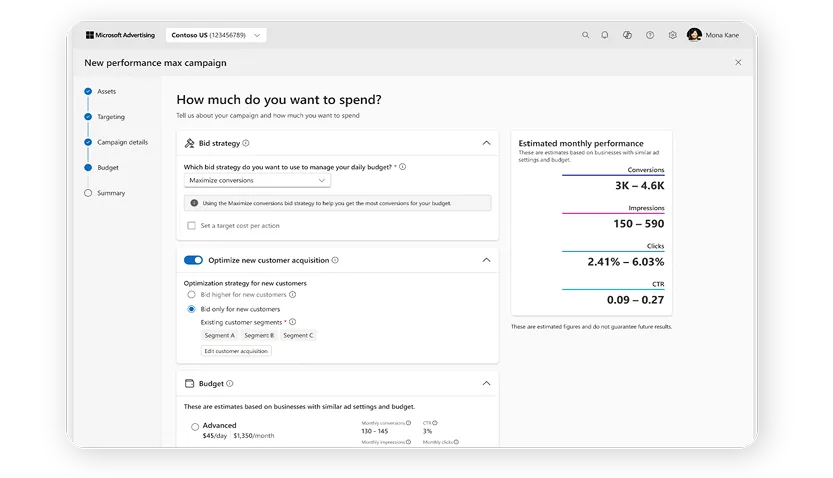
According to Microsoft Advertising, the feature entered open beta for advertisers using purchase goals and allows businesses to distinguish between first-time buyers and repeat customers within their automated campaigns. This represents a significant expansion of Performance Max targeting granularity since the campaign type's global launch in March 2024.
Advertisers setting up Performance Max campaigns for new customer acquisition should establish conversion values for new customers ideally representing at least 30 percent of average revenue from typical sales. Microsoft recommends this premium valuation approach to properly signal the relative importance of customer acquisition compared to repeat purchases.
The platform emphasizes uploading and refreshing audience lists daily or weekly to maintain campaign effectiveness. Frequent list updates enable the artificial intelligence systems powering Performance Max to accurately distinguish between new and existing customers, preventing budget waste on audiences who have already converted.
Customer Match lists function as the primary mechanism for identifying existing customers within the new acquisition feature. Advertisers upload customer information including email addresses, phone numbers, or mailing addresses that Microsoft hashes and matches against user profiles across its network. The system then either prioritizes new users not found in these lists or exclusively targets them depending on the selected acquisition mode.
The customer acquisition feature offers two distinct operational modes. The first increases bids for users identified as new customers while continuing to serve advertisements to existing customers at standard bid levels. This balanced approach maintains existing customer engagement while prioritizing budget allocation toward acquisition objectives.
The second mode focuses exclusively on acquiring new customers by preventing advertisements from serving to users found in Customer Match lists. This aggressive acquisition strategy sacrifices potential repeat purchases to maximize new customer volume, suitable for businesses with high customer lifetime values or those seeking to expand market share rapidly.
Similar customer acquisition functionality exists in Google Ads Performance Max campaigns, where advertisers using the feature achieved results including a 545 percent increase in new customer conversions in documented case studies. Google's implementation leverages Customer Match lists and Google Tag data to identify and prioritize bidding toward new prospects.
The Microsoft implementation arrives as Performance Max campaigns demonstrate strong performance metrics across the platform's AI-powered Copilot integration. Internal data revealed advertisers implementing Performance Max campaigns achieved 2.6 times more site visits and 4.2 times more conversions compared to campaigns without Performance Max integration, according to October 2024 measurements.
Microsoft introduced share of voice metrics for Performance Max campaigns providing historical data extending back to November 10. The metrics encompass impression share, click share, impression share lost to budget, and impression share lost to rank, addressing advertiser demands for increased visibility into automated campaign performance.
Share of voice metrics aggregate impression data from search and shopping placements while excluding audience placements from reporting calculations. This separation reflects the different competitive dynamics and auction mechanics operating across Microsoft's advertising inventory types.
Impression share measures the percentage of total available impressions a campaign captured compared to the total it was eligible to receive. This metric enables advertisers to understand whether their Performance Max campaigns are reaching their full potential audience or losing visibility to competitors or budget constraints.
Click share calculates the percentage of total available clicks a campaign received relative to the maximum clicks it could have generated. High impression share combined with low click share suggests creative or relevance issues preventing user engagement despite adequate impression delivery.
Impression share lost to budget quantifies the percentage of potential impressions that did not serve because daily budget limitations prevented auction participation. This metric directly identifies when budget increases would expand campaign reach, providing clear guidance for investment decisions.
Impression share lost to rank measures the percentage of potential impressions lost because competing advertisers achieved higher Ad Rank scores. This metric indicates when improving quality scores, bid amounts, or advertisement relevance could increase impression delivery without budget increases.
The November 10 historical data availability enables advertisers to analyze Performance Max campaigns launched after that date with complete share of voice visibility. Earlier campaigns can access these metrics starting from November 10 forward, though historical performance before that date remains unmeasured through these specific reporting dimensions.
Share of voice reporting joins other transparency features Microsoft introduced throughout 2024 including search term insights reports, which provide visibility into actual search queries triggering Performance Max advertisements. Combined, these reporting enhancements address persistent advertiser concerns about automated campaign opacity.
Asset group-level URL options and tracking templates became available within Performance Max campaigns, enabling advertisers to submit tracking parameters and custom parameters for data segmentation at the asset group level. This extends existing URL options and tracking parameters from campaign and ad group levels to Performance Max implementations.
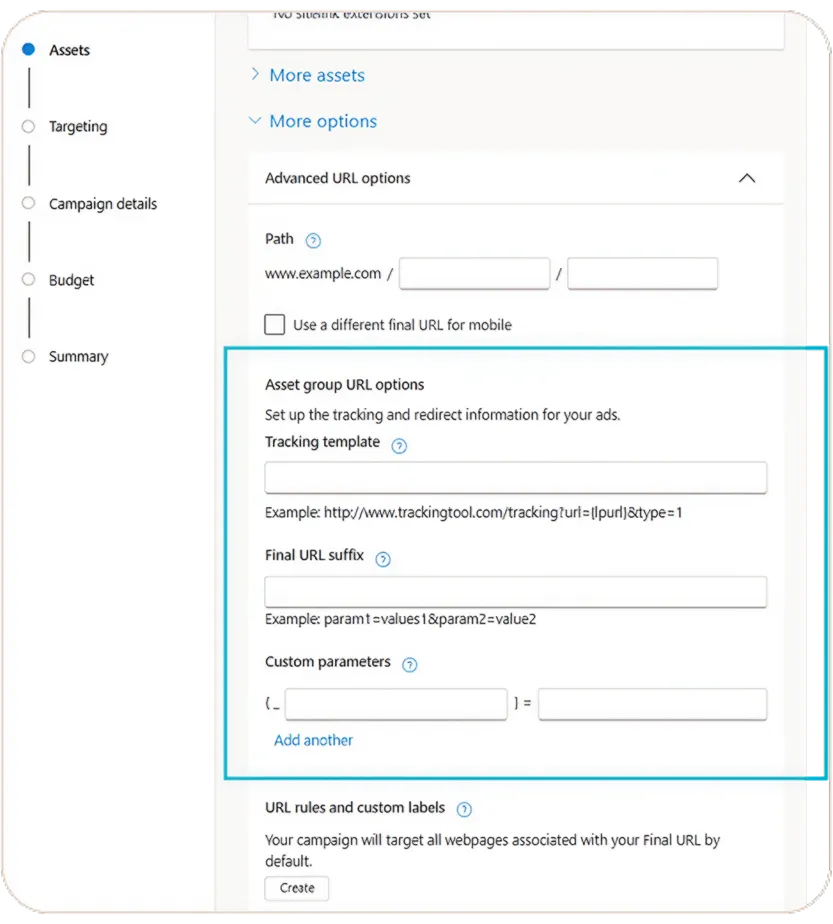
Asset groups represent collections of creative assets including text headlines, descriptions, images, and logos that Performance Max combines algorithmically to create advertisements. Each Performance Max campaign can contain multiple asset groups targeting different product categories, audience segments, or messaging strategies.
Previous tracking parameter implementations operated only at the campaign level, preventing advertisers from distinguishing performance across asset groups when analyzing external analytics platforms or attribution systems. The asset group-level capability enables granular tracking of which creative themes, product categories, or messaging approaches drive optimal results.
URL tracking templates enable advertisers to append parameters to final URLs without modifying the destination page addresses displayed to users. Common implementations include UTM parameters for Google Analytics integration, click identifiers for conversion tracking systems, and custom values for segmentation within marketing automation platforms.
Custom parameters provide additional flexibility by allowing advertisers to define arbitrary key-value pairs appended to tracking templates. These parameters enable sophisticated attribution schemes where different asset groups pass distinct identifiers to landing pages or analytics systems for detailed performance analysis.
The asset group-level tracking enhancement particularly benefits advertisers managing Performance Max campaigns with diverse product catalogs or multiple brand portfolios within single campaigns. Retailers selling across numerous categories can now accurately attribute conversions and revenue to specific product groupings rather than analyzing campaign performance in aggregate.
The platform doubled its search theme limit to 50 themes per campaign, up from the previous 25-theme restriction announced just last week. Search themes function as words or phrases that help Microsoft Advertising's artificial intelligence systems optimize performance during initial campaign learning periods.
According to Navah Hopkins, Microsoft Ads Liaison, search themes function as "valuable guidance to help your PMax campaign understand the ways of searching you find useful for your business." The expanded capacity allows advertisers to provide more comprehensive signals to Microsoft's artificial intelligence systems that power Performance Max automation.
Search themes operate as words or phrases representing queries people might use when searching on Bing. Unlike keywords in traditional Search campaigns, themes don't restrict campaign reach but instead guide the learning algorithms toward relevant traffic patterns. This fundamental distinction enables Performance Max campaigns to discover converting queries beyond advertiser-specified terms while maintaining strategic direction.
The 50-theme limit applies at the campaign level rather than asset group level, meaning a single Performance Max campaign can incorporate up to 50 distinct search theme signals regardless of how many asset groups it contains. This campaign-level implementation reflects Microsoft's approach of treating search themes as high-level strategic guidance rather than granular targeting parameters.
Hopkins specified that advertisers can "partner Search themes with LinkedIn profile targeting and other audiences signals (including Impression Based Remarketing) to ensure your PMax campaign orients itself around your ideal customer." This combination approach enables sophisticated campaign orientation that blends search intent signals with professional demographic targeting and behavioral remarketing data.
The expansion ensures all search themes transfer during campaign imports when migrating from Google Ads, helping campaigns benefit from richer and more comprehensive signals without manual reconstruction. Previous 25-theme limits sometimes truncated Google Ads imports where advertisers had configured more extensive theme lists, creating performance discrepancies between platforms.
Performance Max campaigns utilize search themes during initial learning phases to accelerate optimization. According to Microsoft's documentation, campaigns serving Product ads should begin generating impressions within three days of activation, while campaigns without Product ads typically start within four days. Search themes help reduce this learning period by providing explicit signals about relevant customer search patterns.
Microsoft enhanced asset group import functionality to reduce campaign disruption during Google Import processes. Asset groups containing images that fail to meet size requirements, exceed the previous 25-image limit, or include auto-generated logos will still import all eligible assets, minimizing interruption to campaign imports.
The previous import behavior rejected entire asset groups when any component failed validation checks, forcing advertisers to manually identify and remove problematic assets before reimporting. This workflow created significant friction for advertisers managing numerous Performance Max campaigns across both Google Ads and Microsoft Advertising platforms.
The enhanced import logic separates asset validation from asset group acceptance, enabling partial imports where valid components proceed while invalid elements receive clear error messages for remediation. Advertisers can then address specific asset issues without disrupting entire campaign structures or delaying launches.
Image size requirements vary across platforms due to different rendering contexts and placement inventory characteristics. Google Ads may accept images Microsoft Advertising rejects because Microsoft's native placements across MSN, Outlook, and Microsoft Edge have distinct aspect ratio and resolution requirements compared to Google Display Network placements.
The 25-image limit expansion enables asset groups to contain more creative variations for algorithmic testing. More images provide Performance Max's artificial intelligence systems with greater creative flexibility, potentially improving advertisement relevance across diverse user contexts and placements throughout Microsoft's advertising network.
Auto-generated logos represent another common import friction point where Google Ads creates logo variations from uploaded images that don't meet Microsoft Advertising's specific logo requirements. The enhanced import process now isolates these auto-generated logos rather than rejecting entire asset groups, preserving advertiser-uploaded creative assets.
Audience ads received content targeting as a generally available feature, introducing new methods for reaching customers within contextually relevant environments across Microsoft properties and select partner sites. The feature provides two distinct targeting approaches for advertisers seeking to align advertisements with specific content contexts.
Placement targeting enables advertisers to serve ads exclusively on premium Microsoft properties including MSN, Outlook, Microsoft Casual Games, and Microsoft Edge browser placements. This option restricts ad delivery to Microsoft-owned inventory, providing controlled brand-safe environments for advertisement placements without exposure to external partner sites.
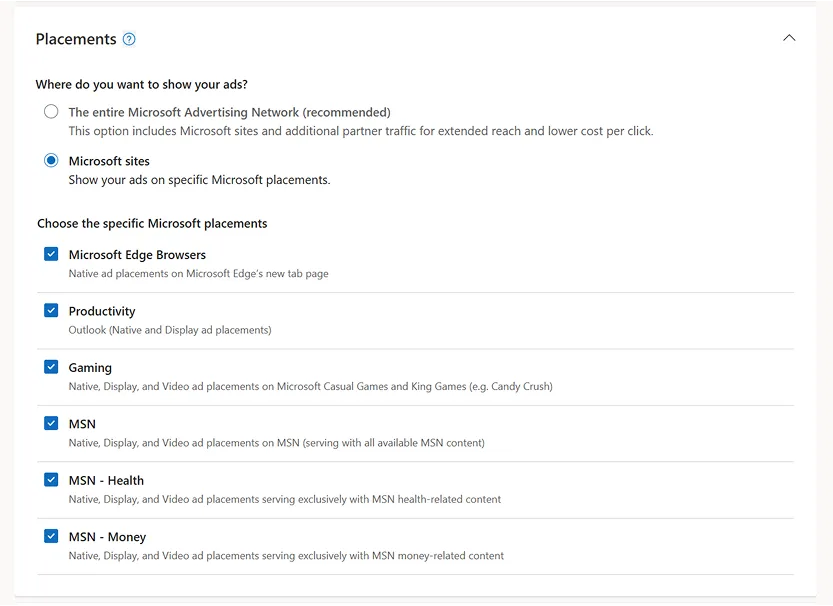
MSN reaches hundreds of millions of monthly users through its news aggregation, lifestyle content, and personalized feeds across desktop, mobile, and tablet devices. Outlook's native advertising placements appear within the email interface used by millions of business and consumer users globally, offering high-attention advertising contexts.
Microsoft Casual Games portfolio includes popular titles like Solitaire, Mahjong, and other casual gaming properties that attract daily engaged audiences. Microsoft Edge browser native advertising appears within new tab pages and other browsing contexts, reaching users during active internet usage sessions.
Topic targeting allows advertisers to align ads with specific content categories such as Finance, Travel, Health, and other editorial verticals, ensuring messages appear alongside relevant high-quality content. This categorical approach enables advertisers to reach audiences consuming content related to their products or services without restricting delivery to specific properties.
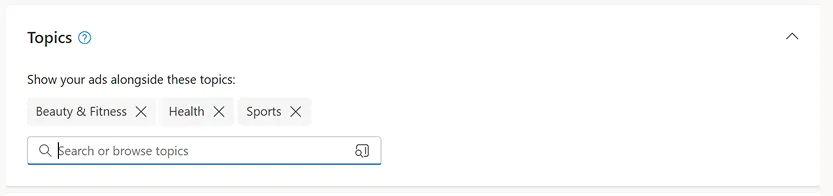
Finance topic targeting serves advertisements alongside content about banking, investing, personal finance, and economic news. Travel topic targeting appears with content about destinations, booking information, travel tips, and tourism coverage. Health topic targeting aligns with wellness content, medical information, fitness articles, and healthcare coverage.
By matching advertisements to actively consumed content, content targeting aims to increase engagement rates and strengthen brand alignment within appropriate editorial contexts. Contextual relevance theory suggests users demonstrate higher receptivity to advertisements appearing alongside related content compared to untargeted placements.
Microsoft released a content targeting report alongside the general availability announcement. The reporting functionality enables advertisers to understand where ads serve across content categories and Microsoft properties, providing insights for optimizing future campaign strategies based on content performance patterns.
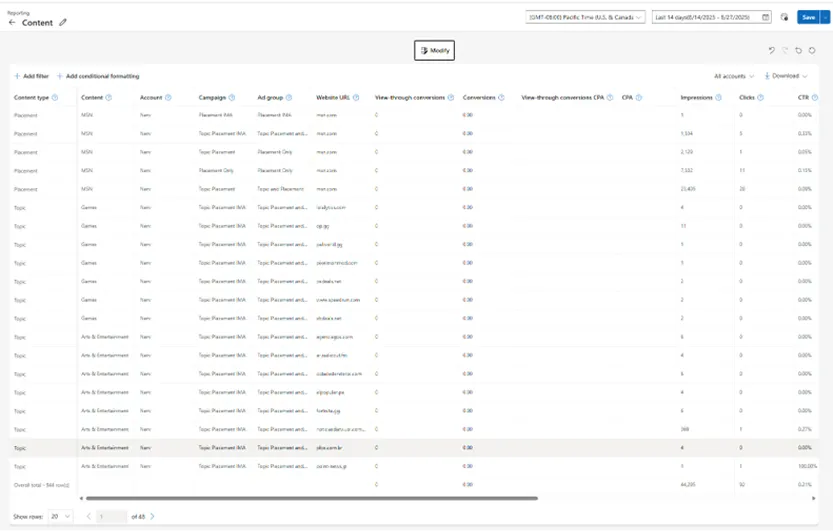
The content targeting report displays impression volumes, click-through rates, conversion rates, and cost metrics segmented by content category and placement property. Advertisers can identify which contextual environments deliver optimal performance and adjust targeting strategies accordingly.
Content targeting represents an alternative to behavioral audience targeting that relies less on user-level data collection. As privacy regulations restrict behavioral tracking capabilities and third-party cookie deprecation limits audience targeting precision, contextual approaches like content targeting provide viable alternatives for reaching relevant users.
Location targeting improvements expanded coverage and enhanced import reliability from Google Ads campaigns. Microsoft increased geographic location availability while improving campaign activation rates by reducing the frequency of imports remaining paused or inactive, addressing previous friction points where location targeting discrepancies between platforms caused campaign activation failures.
Geographic targeting enables advertisers to restrict or prioritize advertisement delivery based on user locations determined through IP addresses, GPS coordinates, and other geolocation signals. Accurate location coverage ensures advertisers can target specific markets without inadvertently excluding valid users or including irrelevant audiences.
The expansion added new geographic entities across Microsoft Advertising's supported markets, potentially including additional cities, postal codes, designated market areas, or administrative regions depending on market-specific data availability. More granular location options enable sophisticated local marketing strategies for businesses with regional presence or location-specific offerings.
Import reliability improvements address situations where Google Ads campaigns targeted locations that Microsoft Advertising either didn't support or mapped differently in its location taxonomy. Previous import failures required manual location remapping before campaigns could activate, creating operational friction for advertisers managing cross-platform campaigns.
The enhanced import process includes automatic location mapping where Microsoft Advertising identifies equivalent or parent locations when exact matches don't exist. Campaigns targeting specific neighborhoods might automatically map to encompassing cities, ensuring import success while maintaining reasonable targeting precision.
Campaign activation rate improvements reduce instances where imported campaigns remain paused awaiting advertiser intervention. Higher activation rates accelerate time-to-market for cross-platform campaign launches and reduce the manual overhead associated with multi-platform advertising management.
Microsoft described the update as "a small, but meaningful enhancement for anyone managing geotargeted campaigns," acknowledging that location targeting improvements deliver incremental rather than transformative value. However, for advertisers heavily dependent on geographic precision such as local service businesses, retailers, or regional brands, these enhancements directly impact campaign effectiveness.
Autogenerated assets for responsive search ads began rolling out today as an automatically enabled feature for new ad creation globally, excluding China and South Korea. The functionality generates additional text assets for responsive search ads when advertisers have not provided all available text fields, which include 15 headline slots and four description positions.
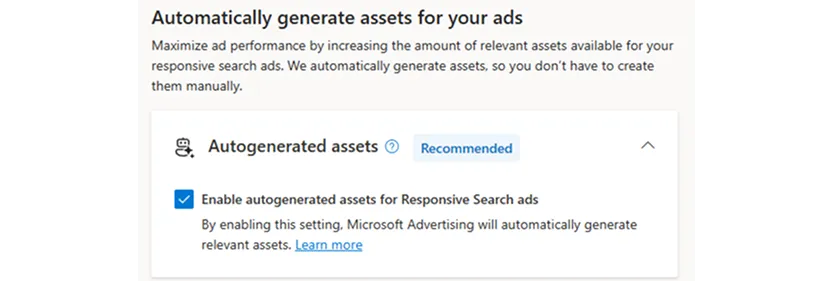
According to Microsoft Advertising, the auto-generated asset feature creates more relevant ads by leveraging website content to customize assets for customers. The system increases ad variation counts available to complement advertiser-created headlines and descriptions, potentially improving click-through rate performance through enhanced relevance and testing capabilities.
The autogenerated asset system analyzes landing page content, existing ad copy patterns, and historical performance data to create additional headlines and descriptions that align with advertiser messaging while introducing variation. Machine learning algorithms identify key themes, value propositions, and product attributes from landing pages to generate contextually relevant ad text.
Microsoft reported that advertisers enabling autogenerated assets in responsive search ads experienced five percent increases in click-through rates. The system maximizes responsive search ad performance by continually generating, testing, and optimizing text assets over time, creating a feedback loop where successful variations inform future generation patterns.
The five percent click-through rate improvement represents the average across advertisers testing the feature during beta periods. Individual results vary based on existing ad quality, landing page content richness, and competitive intensity within specific markets and categories.
The functionality operates only when advertisers have not provided maximum text assets. Responsive search ads accept up to 15 headlines and four descriptions, enabling substantial variation through combinatorial testing. When advertisers supply fewer than these maximums, autogenerated assets fill remaining slots to maximize testing potential.
However, when advertisers have already provided maximum text assets, autogenerated assets will not create additional content. This design choice respects advertiser creative preferences while offering automation assistance for campaigns with limited manual asset development.
Advertisers in sensitive verticals including Adult, Autos, Credit Cards, Credit Reporting, Gambling, Government, Health Information, Health Services, Insurance, Legal Services, Loans and Lending, Pharmaceuticals, and Travel must opt into the autogenerated asset feature rather than receiving automatic enablement.
Microsoft maintains opt-in requirements for these categories because regulatory restrictions, content sensitivity, or compliance requirements often necessitate manual review of all advertising copy before publication. Automated asset generation could produce text that violates industry-specific regulations or fails to meet mandatory disclosure requirements.
Existing responsive search ads will not retroactively enable auto-generated assets. The feature only applies to newly created ads following the feature rollout, preserving current campaign configurations without modification. This approach prevents unexpected creative changes that might disrupt established campaign performance or introduce unapproved messaging.
Imported responsive search ads from other platforms honor the autogenerated asset settings selected on originating platforms, maintaining consistency across advertising ecosystems. An ad imported from Google Ads with autogenerated assets enabled will maintain that setting within Microsoft Advertising unless the advertiser manually changes the configuration.
Advertisers creating responsive search ads through Microsoft Advertising's API remain opted out by default, requiring explicit activation for API-based ad creation workflows. This default reflects the programmatic nature of API usage where advertisers typically implement structured creative management processes incompatible with unexpected automated asset generation.
Image extensions remain unaffected by the autogenerated asset functionality, which applies exclusively to text asset generation. Image extensions require specific visual assets that cannot be algorithmically generated from landing page content without sophisticated image creation capabilities beyond current responsive search ad automation.
Advertisers can disable autogenerated assets when creating new responsive search ads by unchecking the "Enable auto-generated assets" option during the creation process. The checkbox appears prominently within the responsive search ad creation interface, ensuring advertisers consciously choose whether to adopt the automation feature.
For existing campaigns, advertisers navigate to the Campaign tab, select campaigns for editing, click the Edit dropdown menu, and choose "Edit auto-generated assets settings" to modify the feature status. This bulk editing capability enables efficient management across numerous campaigns without individual ad-level configuration.
Viewing and deleting auto-generated assets requires accessing the Campaign tab's Assets sub-tab where the Source column identifies which assets originated from the autogenerated system. This transparency enables advertisers to distinguish between manually created and algorithmically generated content for performance analysis or editorial review.
Advertisers can select specific auto-generated assets for removal through checkmark selection followed by deletion commands. Deleted autogenerated assets may regenerate if the underlying landing page content and campaign signals continue suggesting similar messaging, though the system attempts to avoid immediately recreating recently deleted variations.
The autogenerated asset implementation reflects broader industry trends toward AI-assisted advertisement creation. Google Ads has similarly expanded automated asset generation capabilities within responsive search ads, using machine learning to create headline and description variations based on landing page content and historical performance patterns.
Google's implementation includes Automatically Created Assets as a campaign-level setting that generates tailored headline and description assets based on each responsive search ad's unique context. The system provides inline asset recommendations during ad creation, allowing advertisers to choose from various creatives and edit them as needed.
The parallel development across both major search advertising platforms indicates industry-wide movement toward reducing manual creative development workload while maintaining or improving advertisement relevance and performance. Automation proponents argue these systems enable smaller advertisers to compete more effectively against well-resourced competitors with dedicated creative teams.
Microsoft's January updates emphasize the dual approach of expanding automation capabilities while maintaining advertiser control through optional features, manual override options, and enhanced reporting visibility. The strategy addresses ongoing tension between efficiency gains from AI-powered automation and advertiser demands for transparency and granular campaign management capabilities.
Performance Max customer acquisition targeting provides automation while enabling explicit strategic objectives around new customer revenue. Share of voice metrics deliver transparency into automated campaign performance previously obscured from advertiser view. Asset group-level tracking enables detailed analysis despite algorithmic creative optimization.
The search theme expansion demonstrates Microsoft's willingness to provide more strategic guidance mechanisms even within automated campaign types. Fifty themes enable comprehensive campaign orientation without requiring manual keyword management or restricting algorithmic reach discovery.
Content targeting for audience ads represents a middle path between fully automated behavioral targeting and manual placement selection. Advertisers specify strategic preferences through topic or placement selection while algorithms handle specific ad serving decisions within those parameters.
Autogenerated assets for responsive search ads follow an opt-out implementation for most advertisers while maintaining opt-in requirements for sensitive verticals. This balanced approach maximizes adoption among general advertisers while respecting regulatory and compliance considerations for restricted industries.
The platform's emphasis on search-first marketers positions Performance Max and automated responsive search ad features as complementary tools within comprehensive search advertising strategies. Microsoft maintains that combining Performance Max with traditional search campaigns can deliver 32 percent decreases in cost-per-acquisition and threefold increases in return on ad spend on average.
Microsoft's advertising business surpassed $20 billion in annual revenue in April 2025, driven partially by AI-powered advertising format adoption and Performance Max campaign growth across its network. The financial success validates Microsoft's automation strategy while providing resources for continued platform investment.
The January product updates arrive as Microsoft continues investing heavily in AI-powered advertising tools across its platform. Recent Copilot enhancements introduced image animation capabilities for video creation, expanded API access for generative AI features, and performance comparison tools for campaign analysis throughout November 2025.
Timeline
Five Ws Summary
Who: Microsoft Advertising platform affecting search-first marketers using Performance Max campaigns and responsive search ads across global markets excluding China and South Korea for certain features.
What: Microsoft introduced new customer acquisition targeting for Performance Max campaigns, share of voice metrics extending back to November 10, asset group-level URL tracking templates, doubled search theme limits to 50 per campaign, enhanced asset group import functionality, made audience ads content targeting generally available with placement and topic options, improved location targeting coverage and import reliability, and rolled out autogenerated assets for responsive search ads with five percent average click-through rate improvements.
When: Announced January 15, 2026, with autogenerated assets for responsive search ads beginning rollout today, new customer acquisition goals entering open beta for Performance Max campaigns using purchase goals, and share of voice metrics available with historical data back to November 10.
Where: Available globally across Microsoft Advertising network including Bing search, Microsoft Audience Network properties like MSN and Outlook, Microsoft Edge browser, and Microsoft Casual Games, with autogenerated assets excluding China and South Korea and requiring opt-in for sensitive industry verticals including Adult, Autos, Credit Cards, Gambling, Health Services, Insurance, Legal Services, Pharmaceuticals, and Travel.
Why: The updates address advertiser demands for increased campaign controls and transparency while accelerating AI-powered automation across Microsoft's advertising platform, balancing efficiency gains from machine learning optimization with granular management capabilities for search-first marketing strategies as the company's advertising revenue surpasses $20 billion annually.