Pinterest's no-experience ad boost tool is here - but is it enough?
Pinterest launches Promote a Pin on March 24, 2026, letting creators and small businesses boost content without advertising experience using AI targeting across 619 million users.


Pinterest launches Promote a Pin on March 24, 2026, letting creators and small businesses boost content without advertising experience using AI targeting across 619 million users.
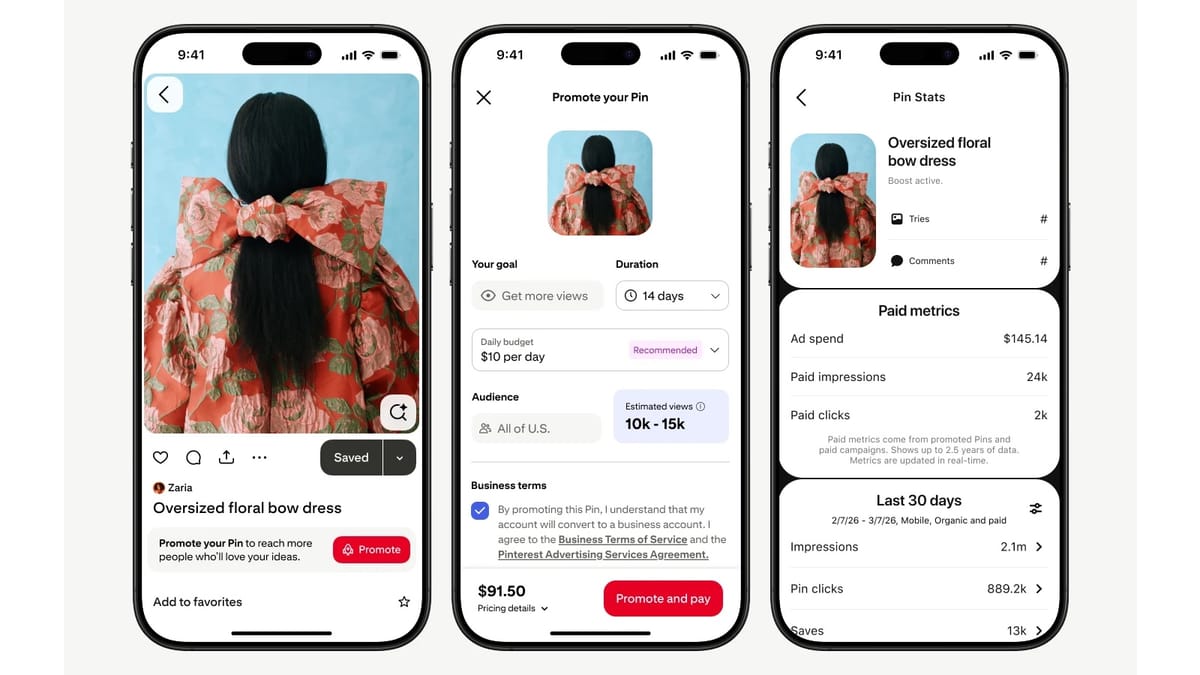
Pinterest today introduced Promote a Pin, a self-serve promotional feature that allows creators, small businesses, and general users to amplify content on the platform without prior advertising knowledge. The announcement, dated March 24, 2026, marks Pinterest's most direct effort yet to bring advertising tools to audiences that have historically been excluded from digital media buying.
The feature is built on a simplified flow requiring only a few taps within the Pinterest mobile app. According to the announcement, users can boost existing Pins to expand reach, connect with audiences, and drive results - with flexible budget controls designed for those unfamiliar with campaign management. There is no minimum expertise requirement. That is a deliberate departure from how promotional tools have traditionally worked across social and search platforms, where meaningful participation has often required either significant budgets or technical fluency.
Pinterest's stated rationale for the launch rests heavily on its current user metrics. According to the company, the platform connects with 619 million active users and handles more than 80 billion searches each month. Half of those searches, Pinterest notes, are commercial in nature - meaning users arrive with purchasing intent rather than passive browsing behavior. That intent signal is the core argument for why a boosted Pin, even a simply promoted one, can reach an audience predisposed to act.
The platform also cites internal survey data suggesting that 80% of businesses on Pinterest describe their customers as more interested and engaged there than on other platforms. That figure is worth contextualising: it comes from Pinterest's own business audience, making it a self-selected sample. Still, the commercial search volume numbers, independently reported as part of the company's financial disclosures, provide some external grounding.
Pinterest reached 600 million monthly active users in Q3 2025, its ninth consecutive quarter of record growth, with revenue expanding 17% year-over-year to $1.049 billion. That trajectory provides important context for why the company is now expanding its advertising surface to less sophisticated buyers. Growth at that scale requires broadening the advertiser base, not only deepening spend among established players.
The mechanism underpinning Promote a Pin is Pinterest's Taste Graph, which the company describes as a proprietary, state-of-the-art multimodal AI system. According to the announcement, the Taste Graph is trained on billions of images, videos, and text to power recommendation systems across the platform. When a user promotes a Pin, this AI infrastructure determines which of Pinterest's 619 million users is most likely to engage with or convert from that content - without requiring the advertiser to configure targeting parameters manually.
That is a meaningful technical distinction. Traditional self-serve advertising tools on platforms like Meta or Google still require advertisers to specify audiences, objectives, bid strategies, and creative guidance. Promote a Pin, by contrast, offloads those decisions entirely to the algorithmic layer. The advertiser provides a Pin and a budget. The system handles the rest.
The real-time tracking functionality allows advertisers to monitor performance after launch and adjust as needed. According to Pinterest, the feature supports flexible budgets, though specific minimum spend thresholds were not disclosed in the announcement. The rollout covers users in the United States over the coming weeks, with global expansion and additional features expected in future phases.
One logistical detail worth noting: when using the Pinterest app on iOS and paying through Apple's in-app purchase system, Apple may charge an additional service fee. Pinterest directs users to its Help Center for specifics on that cost structure.
Promote a Pin is not launching in isolation. According to Pinterest, the company is simultaneously experimenting with a pre-built Performance+ Catalog Sales campaign setup, designed with Pinterest best practices for merchants who want to go live quickly and with confidence. That configuration is available directly through the Pinterest Shopify app or through Ads Manager.
This parallel launch is significant for the marketing community. It suggests Pinterest is pursuing two distinct advertiser cohorts simultaneously: the non-technical creator or small business owner who simply wants to boost a single Pin, and the more structured merchant who uses Shopify as a commerce backbone and wants a guided, automated entry point into catalog-based advertising.
Pinterest launched its Shopify app in January 2023, giving merchants a quick way to upload catalogs and turn products into shoppable Product Pins. The new Performance+ Catalog Sales integration builds on that infrastructure. Performance+, which Pinterest launched in October 2024, reduces campaign creation inputs by 50% while leveraging machine learning for targeting and budget allocation. Retail advertisers using Performance+ experienced a 24% higher conversion lift on average compared to those using only traditional campaigns, according to Pinterest's Q3 2025 earnings data.
The combination of Promote a Pin and the Performance+ Catalog Sales path essentially creates a two-tier entry system for new advertisers. Light-touch promotion sits at one end; structured catalog commerce sits at the other. Both share the same AI targeting infrastructure.
According to the announcement, Lee Brown, Pinterest's Chief Business Officer, framed Promote a Pin as part of an ongoing effort to reduce barriers across the advertiser base. "From entrepreneurs to global brands we're making it easier for businesses of every size to reach the right audiences, connect with new customers and grow on Pinterest," Brown said. He described the feature as "a significant step in our work to remove barriers and deliver simple, powerful tools that unlock greater opportunity and long-term growth."
The language is consistent with a broader strategic narrative Pinterest has maintained since at least 2024. The company has invested substantially in simplifying its advertising product suite. The Pinterest Media Planner, launched January 23, 2026, eliminated manual spreadsheet work for upper-funnel planning by integrating audience discovery, budget estimation, and scenario modeling into Ads Manager. That tool targeted professional media buyers. Promote a Pin targets the other end of the market entirely - those who have never used an advertising platform before.
For practitioners, the launch raises several practical considerations. The absence of manual targeting means advertisers cede control over audience selection entirely. That may suit a small business owner unfamiliar with demographic or interest targeting, but it creates limited transparency for anyone trying to understand why their content is or isn't performing. The real-time tracking dashboard will be essential for determining whether the Taste Graph's automated decisions align with business goals.
Top of Search ads, which Pinterest introduced on September 25, 2025, demonstrated what AI-powered targeting can achieve at scale: a 29% higher click-through rate than standard campaigns in testing, with Wayfair reporting a 237% CTR increase over a two-week test period. Those results came from sophisticated advertisers with established catalog feeds. Whether the Taste Graph delivers comparable efficiency for a creator promoting a single lifestyle Pin remains an open question.
The commercial search behavior data is relevant context here. According to Pinterest, 96% of searches on the platform are unbranded - meaning users searching for "capsule wardrobe ideas" rather than a specific clothing brand. For a small business or creator, that unbranded search environment is both an opportunity and a challenge: the audience is discoverable, but so is every competitor offering similar content.
The Epsilon Clean Room integration announced November 5, 2025 and Anonym's privacy-preserving measurement partnership both addressed sophisticated advertisers with proprietary first-party data. Promote a Pin targets businesses that have none of that infrastructure. The measurement experience for those users will depend entirely on Pinterest's in-app analytics, which means the platform controls both the delivery mechanism and the performance report.
That structural dynamic - where Pinterest acts as both the advertiser's buying platform and its primary source of truth for results - is a tension worth watching as the feature scales. The Pinterest Performance Essentials certification, launched April 17, 2025, was designed to educate marketers on conversion tracking, catalog integration, and measurement methodology. Promote a Pin's audience, by definition, will largely bypass that educational infrastructure.
The U.S. rollout is phased, occurring "over the coming weeks" from the March 24, 2026 announcement date. No specific international launch timeline was given, other than a general reference to global expansion in the future. Given that Pinterest's Rest of World revenue grew 66% year-over-year in Q3 2025 - outpacing both the U.S./Canada region at 4% growth and Europe at 41% - the sequencing of the U.S.-first rollout suggests product and infrastructure considerations are driving the timeline rather than commercial priorities.
Who: Pinterest, represented by Chief Business Officer Lee Brown, announced the launch. The feature targets creators, small businesses, and general users - including those with no prior advertising experience. The platform operates with 619 million active users.
What: Pinterest introduced Promote a Pin, a simplified Pin-boosting feature that requires no advertising expertise. The tool uses the Taste Graph multimodal AI system to handle targeting automatically, based on billions of images, videos, and text signals. Flexible budgets and a streamlined in-app flow are the primary design parameters. Simultaneously, Pinterest is experimenting with a pre-built Performance+ Catalog Sales campaign setup accessible through the Pinterest Shopify app and Ads Manager.
When: The announcement was made on March 24, 2026. The U.S. rollout is phased, occurring over the coming weeks. Global expansion and additional features are planned for the future.
Where: The feature is being rolled out to users in the United States through the Pinterest iOS and Android apps. Payment through Apple's in-app purchase system may include an additional Apple service fee. No international launch date has been specified.
Why: Pinterest is seeking to broaden its advertiser base beyond technically sophisticated buyers and established brands. With 619 million active users generating more than 80 billion monthly searches - half of them commercial in intent - the platform is positioning its AI targeting infrastructure as a route for smaller operators to reach high-intent audiences without requiring media buying expertise. The move also supports Pinterest's revenue growth trajectory, which has shown nine consecutive quarters of record user expansion.