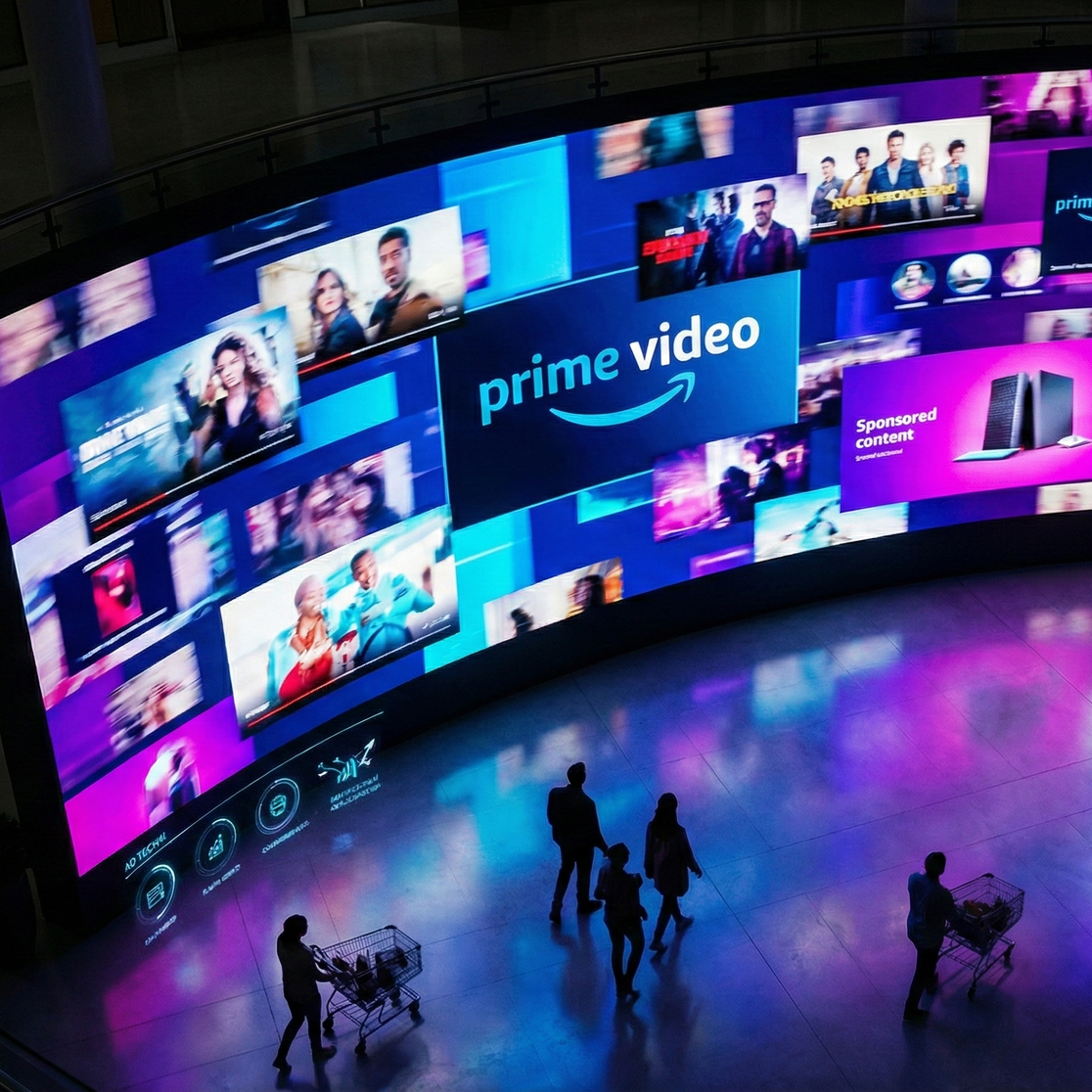
Amazon this week reported advertising services revenue of $21.3 billion for the fourth quarter of 2025, representing 23% growth compared to the same period in 2024, according to financial results announced February 6, 2026. This acceleration marks the advertising segment's strongest quarterly performance of the year and positions the business as a critical profitability driver across Amazon's North America and international operations.
Amazon's advertising business achieved $68.6 billion in full-year 2025 revenue, demonstrating sustained momentum that began with Q1's 19% growth. The company maintained consistent expansion throughout the year, with Q2 reaching 22% growth and Q3 matching that pace before accelerating to 23% in the final quarter. The advertising segment now operates at a $69 billion annual run rate, more than double the $29 billion generated just four years ago.
CEO Andy Jassy emphasized Prime Video's expanding role during the February 5 earnings call. The streaming platform maintained an average ad-supported audience of 315 million viewers globally, up from 200 million disclosed in April 2024. Prime Video advertising became available in 16 countries during 2025, including the United States, United Kingdom, Germany, France, Japan, and nine other markets. The streaming service launched ads on all programming in January 2024, offering subscribers the option to skip advertisements through a premium tier upgrade.
CFO Brian Olsavsky highlighted that advertising contributed more than $12 billion of incremental revenue for Amazon during 2025. Operating income for the fourth quarter reached $25 billion, though this figure included $2.4 billion in special charges related to tax dispute resolutions in Italy and lawsuit settlements. The advertising segment contributed to North America's operating income of $11.5 billion for the quarter, representing a 24% increase compared to Q4 2024.
Amazon's fourth-quarter advertising performance benefited from Thursday Night Football's record viewership. The weekly NFL broadcast averaged more than 15 million viewers on Prime Video, marking 16% growth year-over-year and the third consecutive year of double-digit audience expansion. The platform hosted the most-streamed NFL game in history when the Packers-Bears wild card playoff game drew more than 31.6 million viewers on January 10, 2026.
The company's demand-side platform capabilities expanded significantly throughout 2025. Amazon DSP added in-market audiences across 32 countries in November, including Belgium, Egypt, South Africa, and Poland. The platform integrated Netflix's ad-supported tier in Q4 2025, providing advertisers with direct access to premium streaming content across 11 countries. Spotify's global audio and video inventory became available through Amazon DSP in October, delivering programmatic access to 696 million monthly ad-supported listeners across nine markets.
Amazon consolidated its advertising platforms in November through the introduction of unified Campaign Manager. The integration merged the Amazon DSP and Ads Console into a single buying tool, eliminating the fragmented workflow that previously required advertisers to manage sponsored ads and programmatic campaigns through separate interfaces. Kelly MacLean, vice president of Amazon Ads, stated that advertisers can now manage campaigns across the funnel through one global entry point.
The platform launched AI-powered automation features during Q4. Ads Agent processes natural language instructions to execute complex advertising workflows, allowing advertisers to upload media plans and enable automatic campaign structure creation. The system reviews thousands of audience segments to recommend targeting options for Amazon DSP campaigns while building SQL queries for analytics without requiring coding expertise.
Prime Video expanded its measurement capabilities in November when Amazon Marketing Cloud integrated viewership signals from the streaming platform. The dataset provides three primary data types - content title information, content type classification, and show-level engagement metrics. Advertisers can examine content preferences among their customer base while analyzing overlap between customer segments and Prime Video viewers within AMC's privacy-safe clean room environment.
The advertising business demonstrated scale advantages across Amazon's retail infrastructure. More than 300 million customers used Rufus, Amazon's AI-powered shopping assistant, during 2025. Jassy noted that customers using Rufus complete purchases at 60% higher rates compared to those not using the feature. Visual search through the Lens tool experienced 45% usage growth year-over-year, enabling customers to find products through image-based queries.
Amazon's advertising technology infrastructure benefited from sustained investment throughout 2025. The company's technology and infrastructure costs reached $92.4 billion for the full year, reflecting ongoing development in artificial intelligence and machine learning capabilities. These investments enabled features like Creative Agent, which generates professional-quality video assets through conversational interfaces and expanded to support Streaming TV and Sponsored TV advertising formats in November.
Location-based interactive ads launched for Prime Video in October 2025. The feature enables advertisers to transform national television commercials into thousands of location-specific variants without creating multiple creative assets. Advertisers can customize messaging with local pricing, dealership information, or agent details while adjusting clickthrough URLs based on viewer location at both zip code and state levels through the Amazon DSP Video template.
The advertising segment's growth trajectory positioned Amazon as the third-largest digital advertising platform globally, trailing Meta and Alphabet. Amazon's 22% growth rate in Q3 2025 compared favorably with Meta's advertising revenue expansion during the same period. The company's position at the intersection of e-commerce and advertising provides distinct advantages in attribution and return on ad spend measurement, enabling direct connections between ad impressions and purchases within its ecosystem.
Sponsored Products remained the largest contributor to advertising revenue during Q4, representing the core of Amazon's retail media business. The format launched interactive video capabilities in November, enabling advertisers to upload one to five product feature videos per product. Shoppers viewing search results can access up to three video thumbnails showing relevant features without leaving the results page.
Prime Video Channel Insights completed its open beta phase in November, becoming available to all eligible Amazon Marketing Cloud advertisers who operate as Prime Video Channel partners. The dataset provides enrollment and streaming analytics that enable audience analysis, campaign measurement, and media activation across Amazon's advertising platforms. Channel partners can build custom audience segments based on viewing behavior, then activate those audiences across Amazon DSP for display and video campaigns.
Third-party validation of Amazon's measurement capabilities expanded during Q4. Integral Ad Science earned Media Rating Council accreditation for server-to-server integration of Amazon DSP impression, viewability, and invalid traffic data. The certification validates independent third-party verification for advertisers running programmatic campaigns through Amazon's demand-side platform across both display and video advertisements.
Amazon's subscription services segment, which includes Prime memberships and digital content subscriptions, generated $13.1 billion in Q4 2025, representing 14% growth. The Prime membership provides the foundation for advertising expansion by delivering a loyal subscriber base that accesses streaming content, online shopping, and fast delivery services within a single ecosystem. The integration enables Amazon to leverage commerce data for advertising targeting while measuring downstream purchase behavior.
The advertising business operates within Amazon's broader technology infrastructure. AWS segment revenue reached $35.6 billion for Q4, growing 24% year-over-year and representing the fastest growth in 13 quarters. The cloud computing division provides the technical foundation for advertising data processing, campaign optimization algorithms, and measurement capabilities that differentiate Amazon's offerings from competitors lacking equivalent computing infrastructure.
Amazon introduced reserve share of voice for branded search in October 2025. The feature allows advertisers to secure top-of-search placements for branded keywords at fixed, upfront prices through fully self-service platforms accessible via the Advertising Console and API. The reservation system enables brands to ensure their advertisements appear in the top-of-search position for branded queries, providing protection against competitor conquesting and predictable budget planning.
The company's international advertising expansion accelerated during Q4. The International segment generated $50.7 billion in net sales, growing 17% year-over-year and 11% when excluding foreign exchange impacts. Operating income for the International segment reached $1.0 billion for the quarter, though this represented a 21% decline compared to the prior year period due to investments in quick commerce initiatives and pricing strategies.
Amazon's advertising measurement infrastructure expanded through multiple partnerships during 2025. Microsoft Monetize joined Amazon's Certified Supply Exchange program in October as a preferred supply-side platform. The partnership provides Amazon DSP advertisers with access to Microsoft's open internet inventory while Microsoft Monetize publishers gain additional demand access through Amazon DSP advertisers. The technical integration enables deal packages that include Amazon Shopper Insights integration.
Content investment supported advertising inventory expansion throughout 2025. Amazon's total content spending reached $22.4 billion for the year, representing 10% growth compared to 2024. The investment spans licensing and production costs associated with Prime Video and Amazon Music programming. The capitalized costs of video and music content totaled $36.5 billion as of December 31, 2025, with a weighted average remaining life of 3.2 years for capitalized video content.
Prime Video introduced AI-powered video recaps in November, generating personalized summaries synchronized with individual viewing history. The technology demonstrates Amazon's video analysis and editing capabilities that inform both content creation and advertising creative development workflows. The system operates exclusively on Prime Video programming, processing video content to extract meaningful narrative elements and synthesize new video products automatically.
The advertising platform's technical capabilities include goal-based bidding, Performance+ optimization using machine learning, and modeled attribution for off-Amazon conversions. These features operate across display, video, and connected television formats. Amazon DSP holds Media Rating Council accreditation for display begin-to-render impressions and click-through reporting, applying to third-party exchange transactions across desktop, mobile web, and mobile in-app environments, plus Fire TV within connected television environments.
Amazon's advertising growth occurred amid significant organizational changes. The company announced 16,000 employee layoffs in January 2026, citing the need for reducing layers, increasing ownership, and removing bureaucracy. These reductions followed 14,000 employee cuts in October 2025, representing approximately 10% of Amazon's previous corporate headcount. The restructuring efforts aimed to streamline operations while maintaining investment in growth areas including advertising, AI infrastructure, and low Earth orbit satellites.
The company's forward guidance for Q1 2026 projects net sales between $173.5 billion and $178.5 billion, representing growth between 11% and 15% compared to first quarter 2025. Operating income guidance ranges from $16.5 billion to $21.5 billion. The projections include approximately $1 billion in higher year-over-year costs related to Amazon Leo satellite operations, reflecting increased spending on satellite launches during the quarter.
Amazon announced capital expenditure plans of $200 billion for 2026, representing roughly 50% growth compared to $131.8 billion spent in 2025. The investment will predominantly support AWS infrastructure to meet surging demand for artificial intelligence services, while also funding advertising technology development, robotics initiatives, and low Earth orbit satellite deployment. The substantial increase in capital spending reflects Amazon's strategic positioning across multiple high-growth technology sectors.
The advertising business's profitability contribution extended beyond direct revenue generation. The segment enhanced overall marketplace economics by providing sellers and vendors with tools to increase product visibility, driving incremental sales that generate additional fees from third-party seller services and fulfillment operations. The integrated model creates compound value across Amazon's business units, distinguishing its advertising offering from platforms lacking equivalent e-commerce infrastructure.
Third-party seller services generated $52.8 billion in Q4, growing 11% year-over-year. This segment includes commissions and related fulfillment fees from marketplace transactions, many of which originate from sponsored product advertisements. The connection between advertising and seller services demonstrates how Amazon's advertising business operates as part of a broader ecosystem rather than as an isolated revenue stream.
Online stores net sales reached $83.0 billion for the quarter, growing 10% compared to Q4 2024. The retail channel includes product sales and digital media content where Amazon records revenue gross, spanning consumable and durable goods including media products available in physical and digital formats. Sponsored product advertisements drive substantial traffic to product detail pages within the online stores channel, creating direct attribution between advertising spend and purchase behavior.
Amazon's operating cash flow for full-year 2025 totaled $139.5 billion, up 20% compared to 2024. The strong cash generation enables continued investment in advertising infrastructure while funding AWS expansion and content acquisitions that support Prime Video inventory. Free cash flow, calculated as cash flow from operations reduced by capital expenditures, reached $11.2 billion on a trailing twelve-month basis.
The advertising platform's competitive positioning benefited from Amazon's unique data assets. The company accesses shopping behavior across hundreds of millions of customers, streaming viewership patterns from Prime Video subscribers, and search query data from marketplace interactions. These first-party signals enable targeting capabilities unavailable to platforms lacking integrated e-commerce operations, creating differentiation that supports premium pricing and sustained growth.
Amazon Web Services contributed technical infrastructure supporting advertising operations. The cloud computing division provides data processing capabilities for audience segmentation, campaign optimization algorithms running on machine learning models, and measurement attribution systems analyzing billions of customer interactions. These technical capabilities operate at scale unavailable to smaller advertising platforms, creating barriers to entry that protect Amazon's market position.
The advertising segment's international expansion accelerated during 2025 as Prime Video launched advertising in multiple new markets. The global footprint now spans North America, Europe, Asia Pacific, and Latin America regions. International advertising revenue remains smaller than North America but demonstrated stronger growth rates during Q4, reflecting earlier stage market development and lower competitive intensity in certain geographies.
Amazon's advertising measurement evolved throughout 2025 to address marketer demands for accountability. The company introduced conversion path reporting showing 30-day customer journeys across sponsored ads and DSP formats, enabling advertisers to understand how multiple touchpoints contribute to purchase decisions. These attribution capabilities operate within Amazon Marketing Cloud's clean room environment, maintaining privacy protections while delivering granular performance insights.
Retail media networks operated by competing retailers integrated Amazon's advertising technology during 2025. Macy's Media Network adopted Amazon Retail Ad Service in early November, representing the first major department store to implement Amazon's platform since its January 2025 launch at CES. The technology service enables retailers to implement sponsored product advertisements on their websites while maintaining control over ad placements, creative formats, and frequency.
The advertising platform's technical development continued through Q4 with enhanced content exclusion categoriesannounced in December. The feature enables advertisers to manage brand suitability settings across Twitch and third-party web and mobile inventory through unified controls. Content exclusion categories function as binary switches that prevent advertisements from appearing alongside specific content topics conflicting with brand values.
Amazon's position in connected television advertising strengthened during Q4 as industry spending shifted toward streaming platforms. Connected TV's share of media budgets doubled from 14% in 2023 to 28% in 2025, according to industry projections cited in previous earnings disclosures. Prime Video added a free news hub in December, aggregating content from ABC News Live, CBS News 24/7, LiveNOW from Fox, CNN Headlines, and NBC News NOW among hundreds of channels. The news destination creates additional premium inventory across diverse content categories.
The advertising business operates within regulatory frameworks governing digital platforms. Amazon faces scrutiny from competition authorities regarding marketplace practices and advertising disclosures, though no significant regulatory actions materialized during Q4 2025. The Federal Trade Commission maintains ongoing investigations into various aspects of Amazon's business operations, including advertising practices and marketplace competition dynamics.
Amazon's advertising growth trajectory positions the segment as a cornerstone of the company's long-term strategy. The business benefits from network effects where increased advertiser participation improves targeting effectiveness, which attracts additional advertisers while enhancing value for existing customers. These dynamics create self-reinforcing growth that supports continued market share gains against established competitors.
Timeline
- February 6, 2025: Amazon reports Q4 2024 advertising revenue of $17.3 billion with 18% year-over-year growth
- May 1, 2025: Amazon's Q1 2025 advertising business generates $13.9 billion, achieving 19% growth
- July 31, 2025: Amazon advertising revenue reaches $15.7 billion in Q2 2025, marking 22% year-over-year increase
- September 10, 2025: Netflix becomes available in Amazon DSP starting Q4 across 11 international markets
- October 1, 2025: Amazon DSP adds Spotify's global audio and video inventory across nine markets
- October 7, 2025: Amazon DSP integrates Microsoft Monetize SSP as preferred partner
- October 28, 2025: Amazon introduces reserve share of voice for branded search advertising
- October 31, 2025: Amazon enables zip code-level ad targeting for Prime Video
- October 31, 2025: Amazon Q3 2025 advertising revenue hits $17.7 billion with 22% growth
- November 4, 2025: Amazon DSP expands in-market audiences to 32 countries with unified targeting
- November 11, 2025: Amazon launches AI agent for automated campaign management
- November 11, 2025: Amazon Marketing Cloud launches Prime Video viewership signals
- November 11, 2025: Amazon launches interactive video format for Sponsored Products
- November 11, 2025: Amazon consolidates advertising platforms into unified Campaign Manager
- November 13, 2025: IAS earns MRC accreditation for third-party Amazon DSP measurement
- November 18, 2025: Amazon expands Prime Video Channel analytics to all eligible partners
- November 19, 2025: Prime Video introduces AI-powered video recaps for season catch-ups
- December 7, 2025: Amazon Prime Video adds free news hub for US streaming customers
- December 18, 2025: Amazon DSP adds content exclusion categories for brand suitability
- January 1, 2026: Amazon DSP unlocks podcast ads with Art19's audience intelligence
- February 6, 2026: Amazon reports Q4 2025 advertising revenue of $21.3 billion with 23% year-over-year growth
Summary
Who: Amazon announced fourth quarter 2025 financial results, with CEO Andy Jassy and CFO Brian Olsavsky presenting earnings to investors and analysts. The announcement affects advertisers using Amazon's platforms, agencies managing campaigns, marketplace sellers relying on sponsored products, and streaming advertisers accessing Prime Video inventory.
What: Advertising services revenue reached $21.3 billion in Q4 2025, growing 23% year-over-year and marking acceleration from previous quarters. Full-year 2025 advertising revenue totaled $68.6 billion. Prime Video maintained an average ad-supported audience of 315 million viewers globally across 16 countries, up from 200 million in April 2024. Amazon consolidated its advertising platforms through unified Campaign Manager, launched AI-powered automation features, and expanded demand-side platform capabilities across streaming inventory including Netflix and Spotify integrations.
When: Amazon released fourth quarter 2025 financial results on February 6, 2026, covering the period ending December 31, 2025. The results encompass the critical holiday shopping quarter and reflect advertising platform developments throughout the full year 2025.
Where: The advertising revenue spans Amazon's global operations, with primary concentration in North America markets. Prime Video advertising operates in 16 countries including the United States, United Kingdom, Germany, France, Japan, Canada, Australia, Brazil, India, Italy, Mexico, Netherlands, Spain, Sweden, Austria, and New Zealand. Amazon DSP provides programmatic access across 32 countries following November 2025 expansion.
Why: The results demonstrate Amazon's sustained momentum in digital advertising as the company leverages integrated e-commerce infrastructure, expanding streaming viewership, and technical capabilities across demand-side platform operations. Advertising contributes significantly to North America and International segment profitability while benefiting from Amazon's unique position connecting shopping behavior data with premium video inventory. The 23% growth rate in Q4 positions advertising as a critical driver of Amazon's financial performance amid substantial capital investments in AI infrastructure and satellite technology.
Share this article
The link has been copied!